OpenAI's Yang-Mills proof shows AI's power, and its black-box problem (opens the source in a new tab)
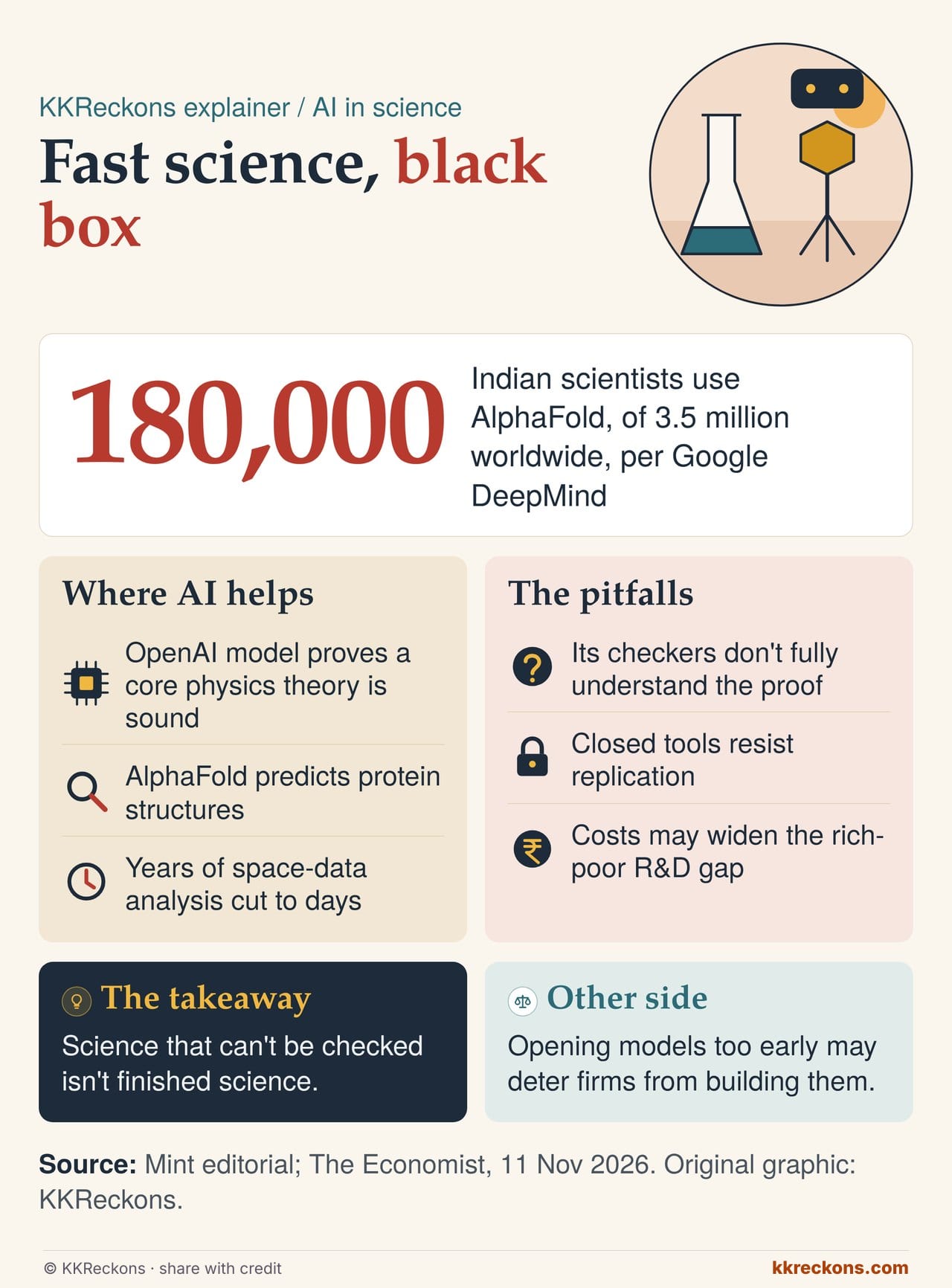
- The Economist reports that outside physicists confirmed on November 10th that an unreleased OpenAI model proved the first part of the Yang-Mills problem: that a core theory of particle physics stands on firm mathematical footing. Its 1,147-page prose proof is unpublished, and the checkers admit they don't fully understand it.
- A Mint editorial welcomes such gains, citing AlphaFold, used by 180,000 Indian scientists, but warns that black-box tools resist reproducibility and could widen the R&D gap with poorer nations.
- Mint wants AI firms to open their models to scrutiny after a reasonable period.
- 180,000
- Indian scientists use AlphaFold
Why it matters Both pieces point to one tension: AI now produces results scientists can confirm but can't fully explain. If the best tools stay closed and costly, Indian labs risk becoming users of discovery rather than makers of it.
Other side The proof was checked through Lean code, so a black box can still be verified, and The Economist says the key ideas appear to come from human physicists. Forcing firms to open models could also blunt the incentive to build them.