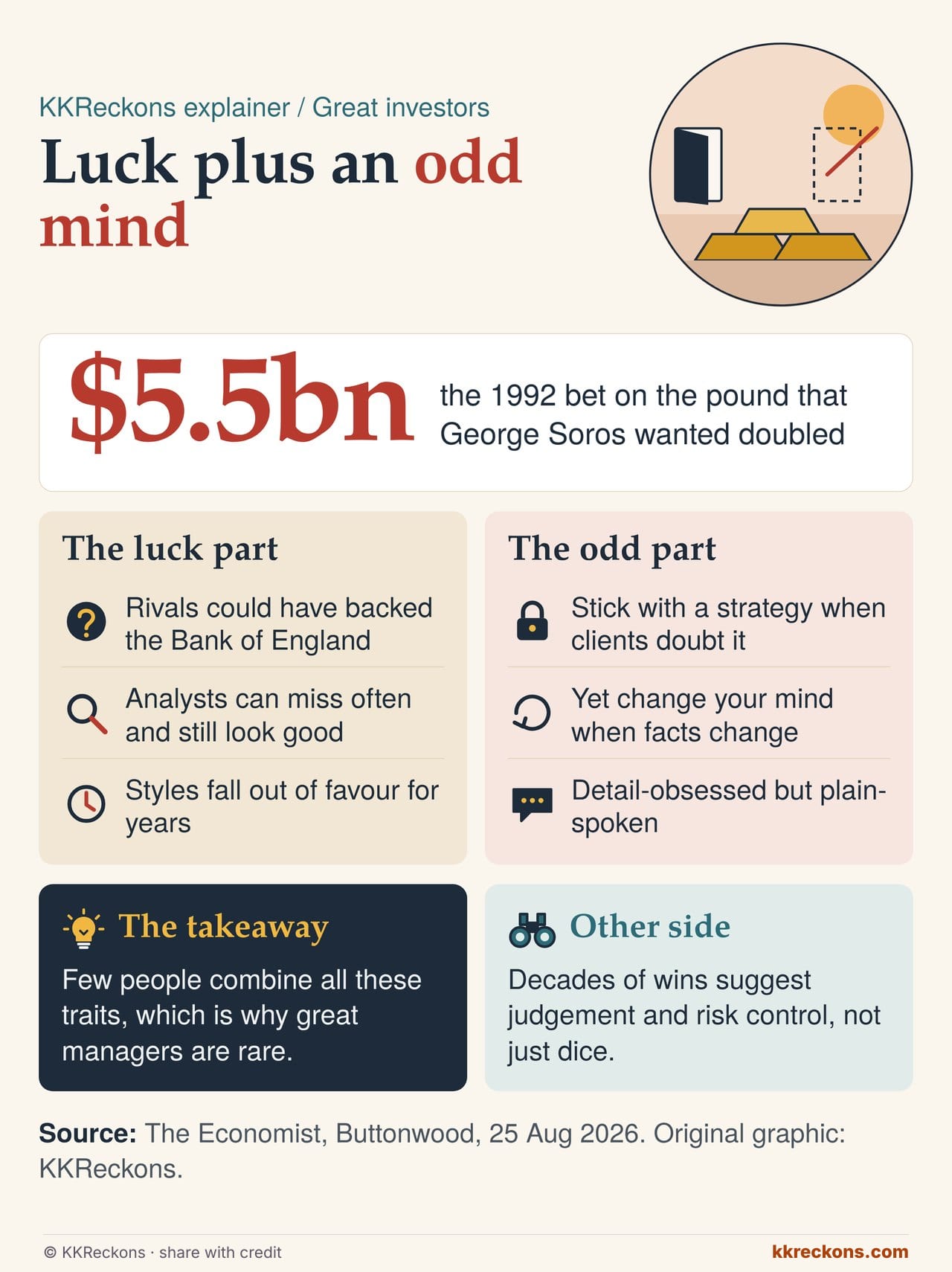
The Economist's Buttonwood column revisits the 1992 bet against the pound, when George Soros told Stanley Druckenmiller to double a $5.5bn position, and argues luck mattered as much as nerve: other traders could have sided with the Bank of England.
It notes analysts can be wrong often and still look excellent, and styles such as value investing fall out of favour for years; Cliff Asness stuck with his quant strategies until they worked again.
Its verdict: greatness needs stubbornness plus the oddity to change your mind, a rare mix, so most savers may do better with an index fund.
$5.5bn
pound bet Soros wanted doubled, 1992
Why it matters Track records reward the survivors we hear about; telling skill from luck is the key question before paying any manager a premium fee.
Other side Calling winners lucky can be too easy: decades of success, like Soros's, point to judgement and risk control, not just dice.
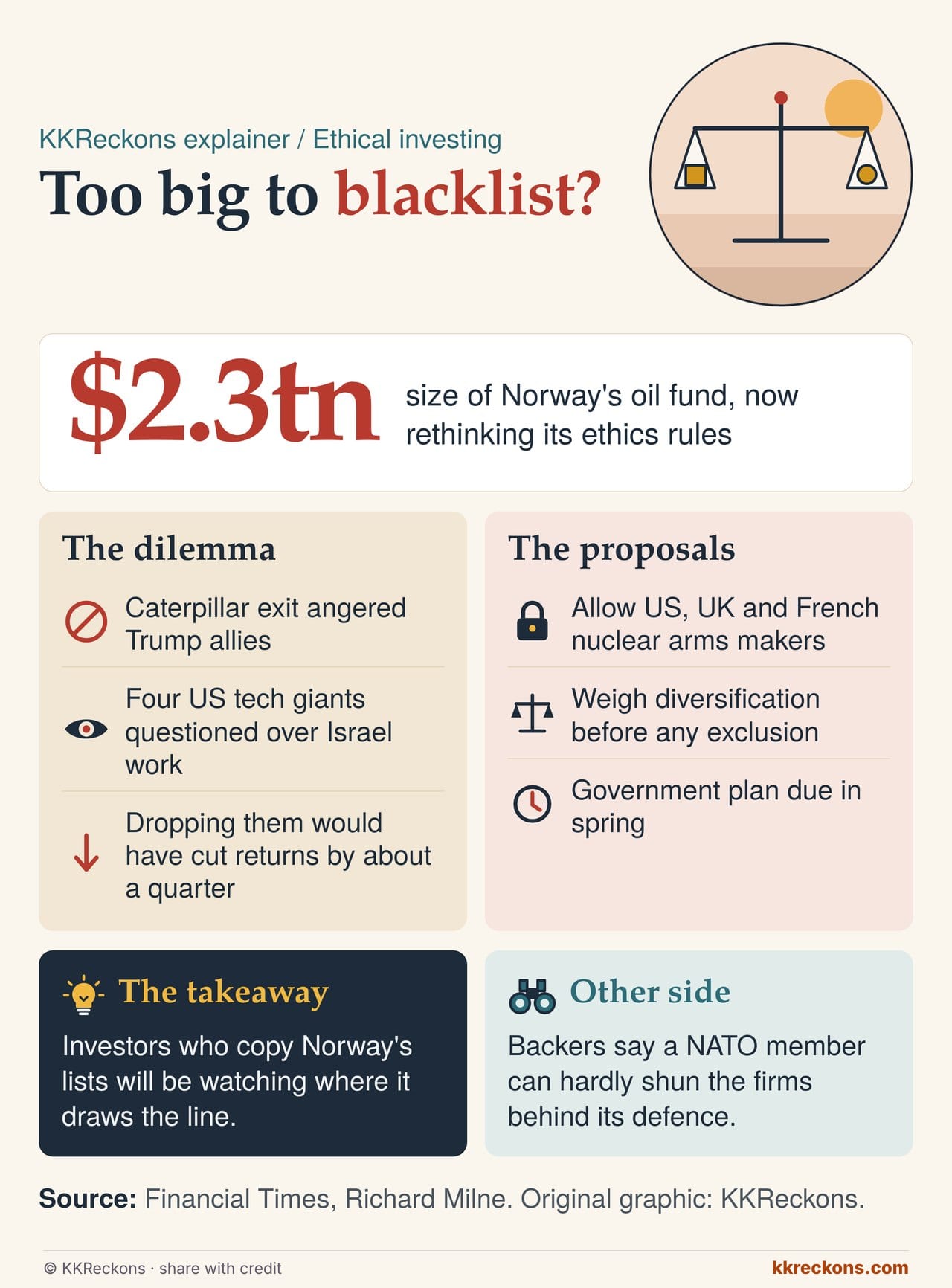
An FT column says Norway is drafting proposals on how its oil fund should handle ethics, after its exit from Caterpillar over links to Israel's alleged violations angered US politicians close to President Trump.
An expert group suggested allowing investment in nuclear-weapons makers in the US, UK and France, and weighing diversification before any exclusion. Central bank research found dropping Alphabet, Amazon, Meta and Microsoft would have cut returns by about a quarter from 2012 to 2025.
Critics say that gives the biggest firms a lower ethical bar. A government proposal is due in spring, with a parliamentary debate next summer.
$2.3tn
fund assets
Why it matters Many investors copy the fund's exclusion lists, so if Norway decides some firms are too big to drop, ethical investing elsewhere may quietly shift too.
Other side Supporters argue it is consistent: Norway relies on NATO's nuclear umbrella, and a fund held for future generations cannot ignore what exclusions cost it.
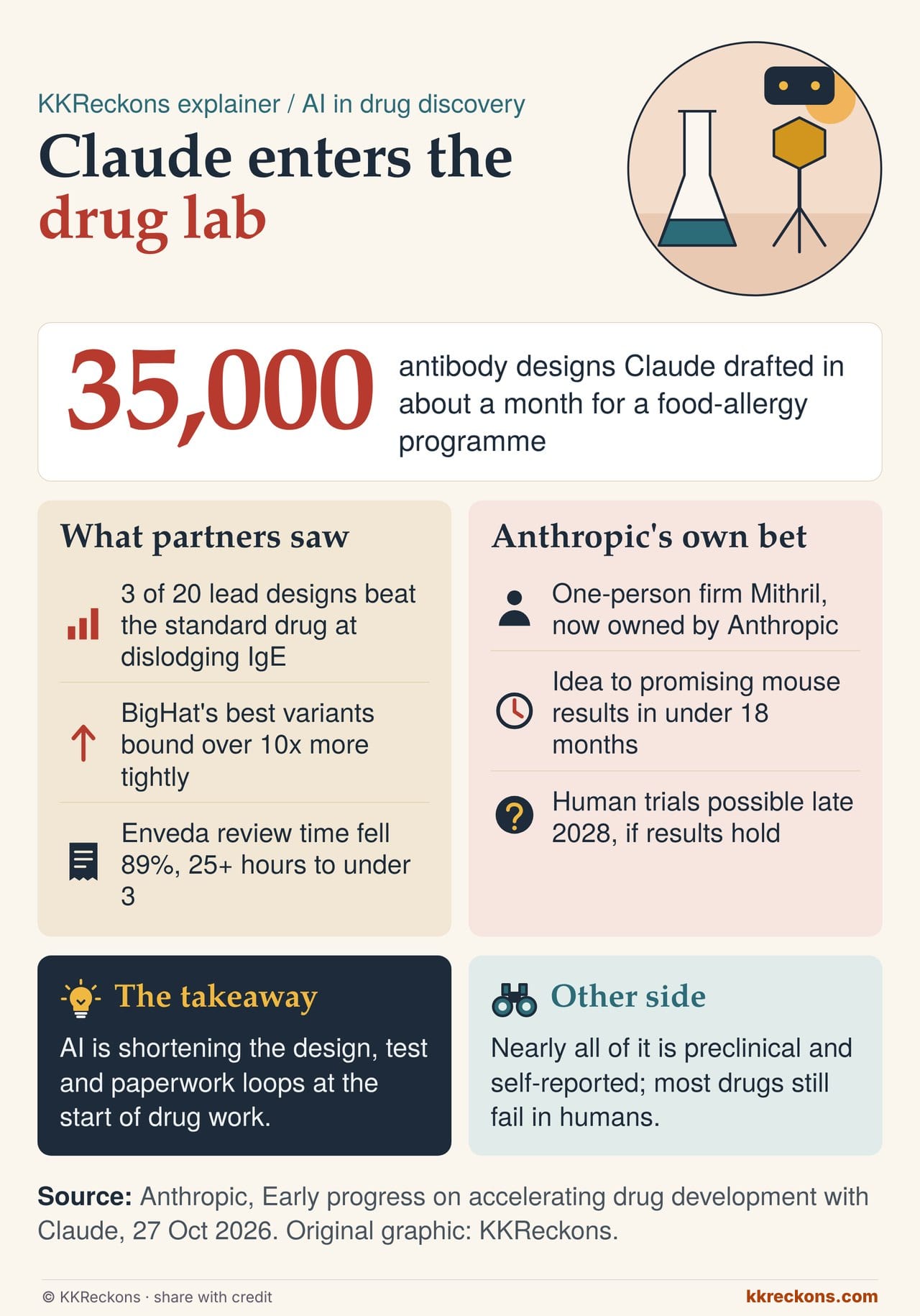
Anthropic says it spent months working with six drug developers, including Bristol Myers Squibb and Generate Biomedicines. For Divergence Labs, Claude produced about 35,000 antibody designs for a food-allergy drug in roughly a month; in early tests, three of the 20 that dislodged IgE did better than the standard medicine.
At Enveda, Claude checked 1,061 pages of manufacturing paperwork, caught all 11 issues human reviewers found plus seven more, and cut review time by 89%. BigHat's best antibody variants bound more than 10 times more tightly.
In Anthropic's own muscular dystrophy programme, a candidate went from idea to promising mouse results in under 18 months; human trials could start in late 2028 if results hold.
35,000
antibody designs in about a month
89%
less human review time at Enveda
<18 mo
from idea to promising mouse data
Why it matters Drug discovery is slow because each loop of design, testing and paperwork takes months; if AI shortens every loop, the cost of trying a new medicine, and who can afford to try, could change.
Other side Almost all of this is preclinical and reported by the vendor and its partners. Most drug candidates fail in human trials, so speed at the start says little yet about cures.
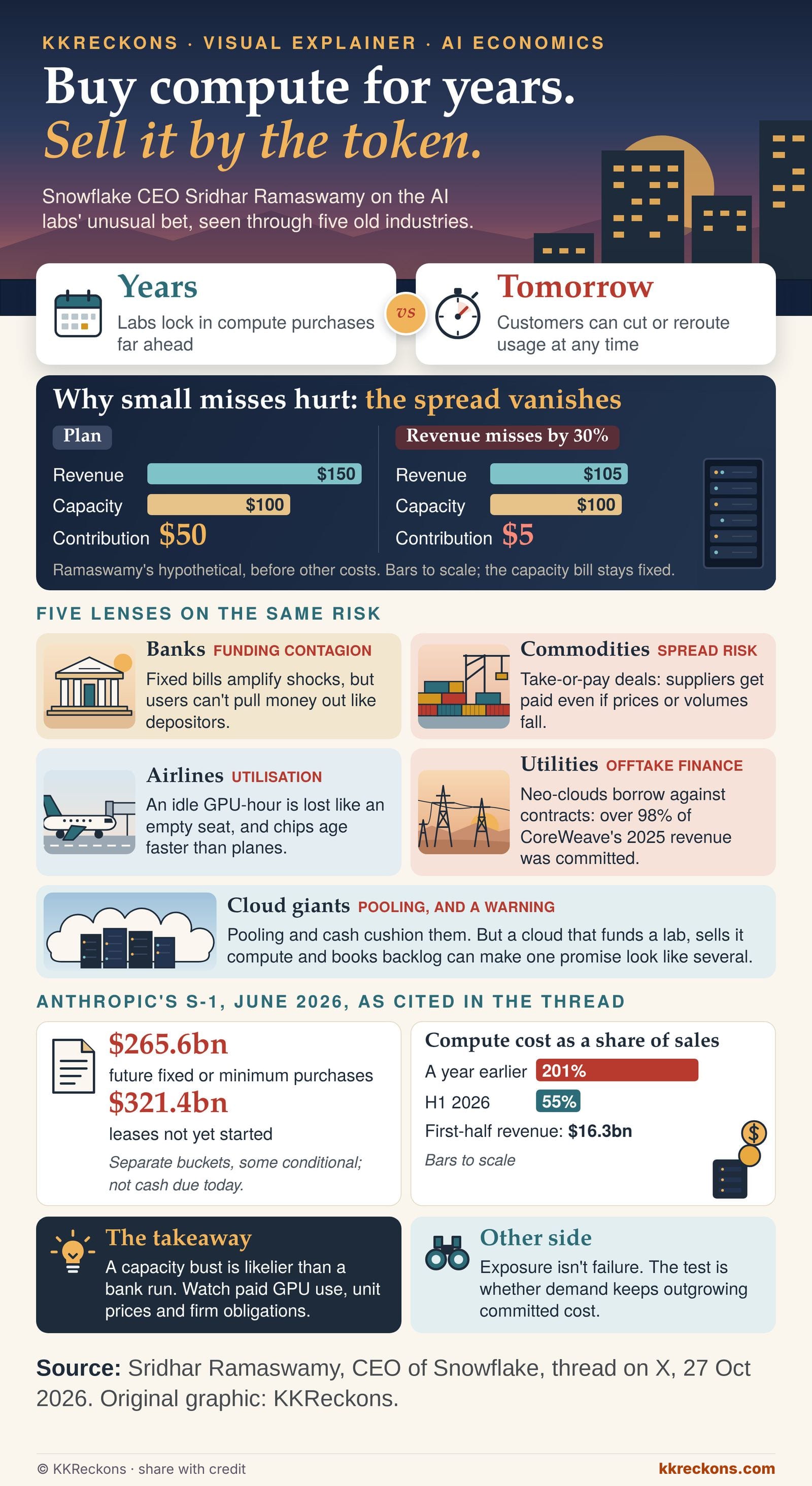
Snowflake CEO Sridhar Ramaswamy argues in a thread on X that AI labs commit to compute for years while selling usage customers can cut tomorrow. In his hypothetical, $100 of capacity against $150 of expected revenue leaves $50; a 30% revenue miss cuts that to $5.
He draws lessons from banks, commodity traders, airlines, utilities and cloud giants, and warns that clouds which invest in labs and also sell them compute can make one promise look like several revenue streams.
Citing Anthropic's S-1, he says compute cost fell to 55% of first-half sales of $16.3bn, from 201% a year earlier.
$50 to $5
spread after a 30% revenue miss
55%
Anthropic compute cost to sales, H1, as cited
$265.6bn
future purchase commitments, as cited
Why it matters As AI firms head for public markets, investors must judge whether long compute contracts are a moat or a trap; his three gauges, paid GPU Graphics processing unit: the chip, mostly from Nvidia, that trains and runs AI models. use, unit prices and firm obligations, make a practical checklist.
Other side He is not a neutral observer: Snowflake sells data and AI services. And contract-backed cash flows that lenders treat as safe are only as strong as the labs signing them.
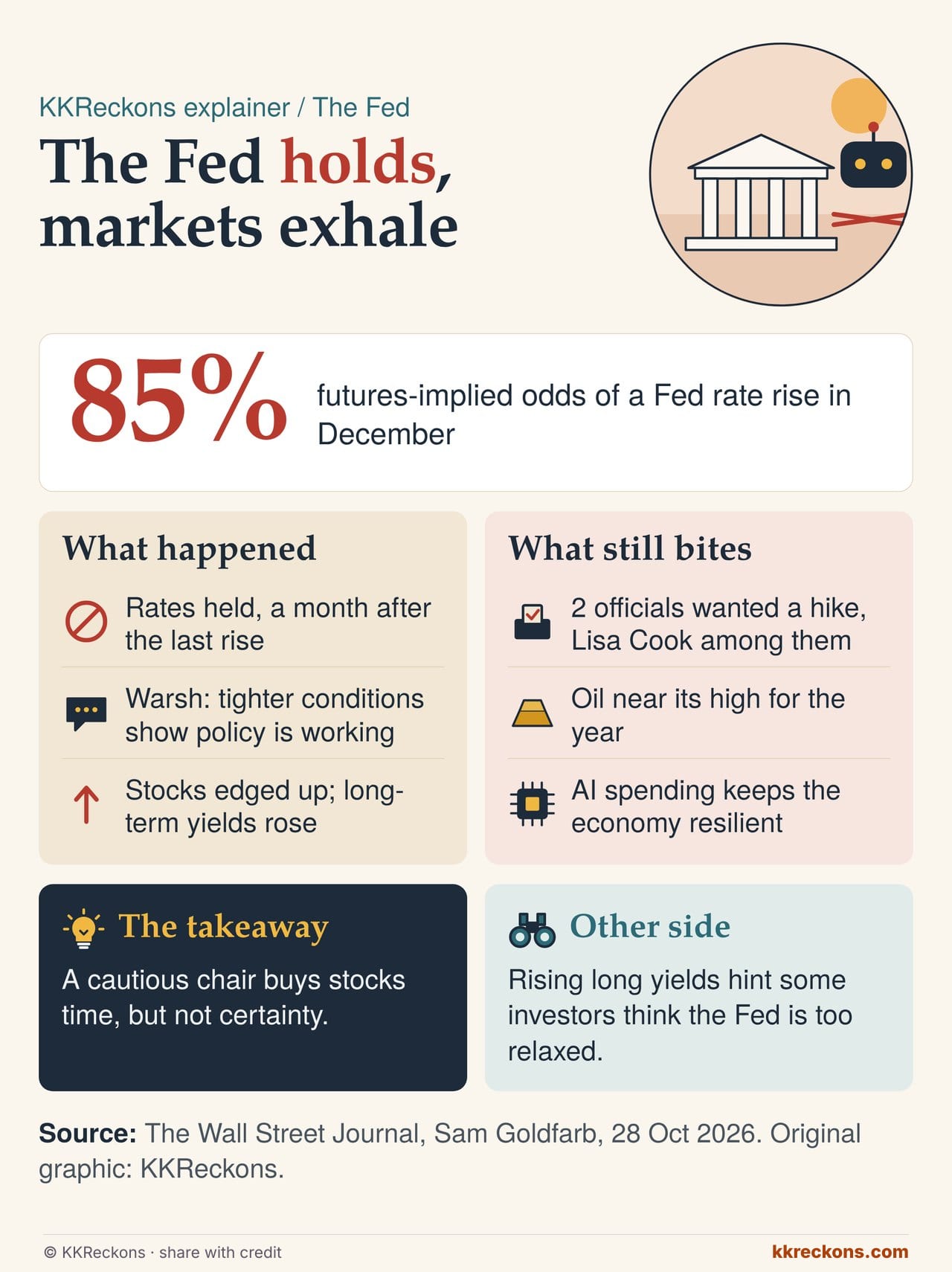
The Wall Street Journal reports the Federal Reserve held rates on Wednesday, a month after raising them. Chairman Kevin Warsh said tighter financial conditions showed policy was already working, which investors took as a sign that a fast run of hikes is unlikely; stocks edged up and longer-term yields rose.
Two officials dissented in favour of a hike, among them Governor Lisa Cook, who had never voted against a Fed decision. Futures still put the chance of a December rise at about 85%.
The paper notes Anthropic's IPO Initial public offering: when a company first sells its shares on a stock exchange. filing helped tech shares bounce this week, while high oil prices keep inflation worries alive.
85%
futures odds of a December hike
2
officials voted for a hike
Why it matters Markets now hinge on whether the Fed treats AI-driven spending as a reason to keep tightening; a cautious chair buys stocks time but leaves inflation risk with bond investors.
Other side Long-term yields rising while short-term ones fell suggests some investors think the Fed is too relaxed. If inflation stays hot, the calm could turn quickly.
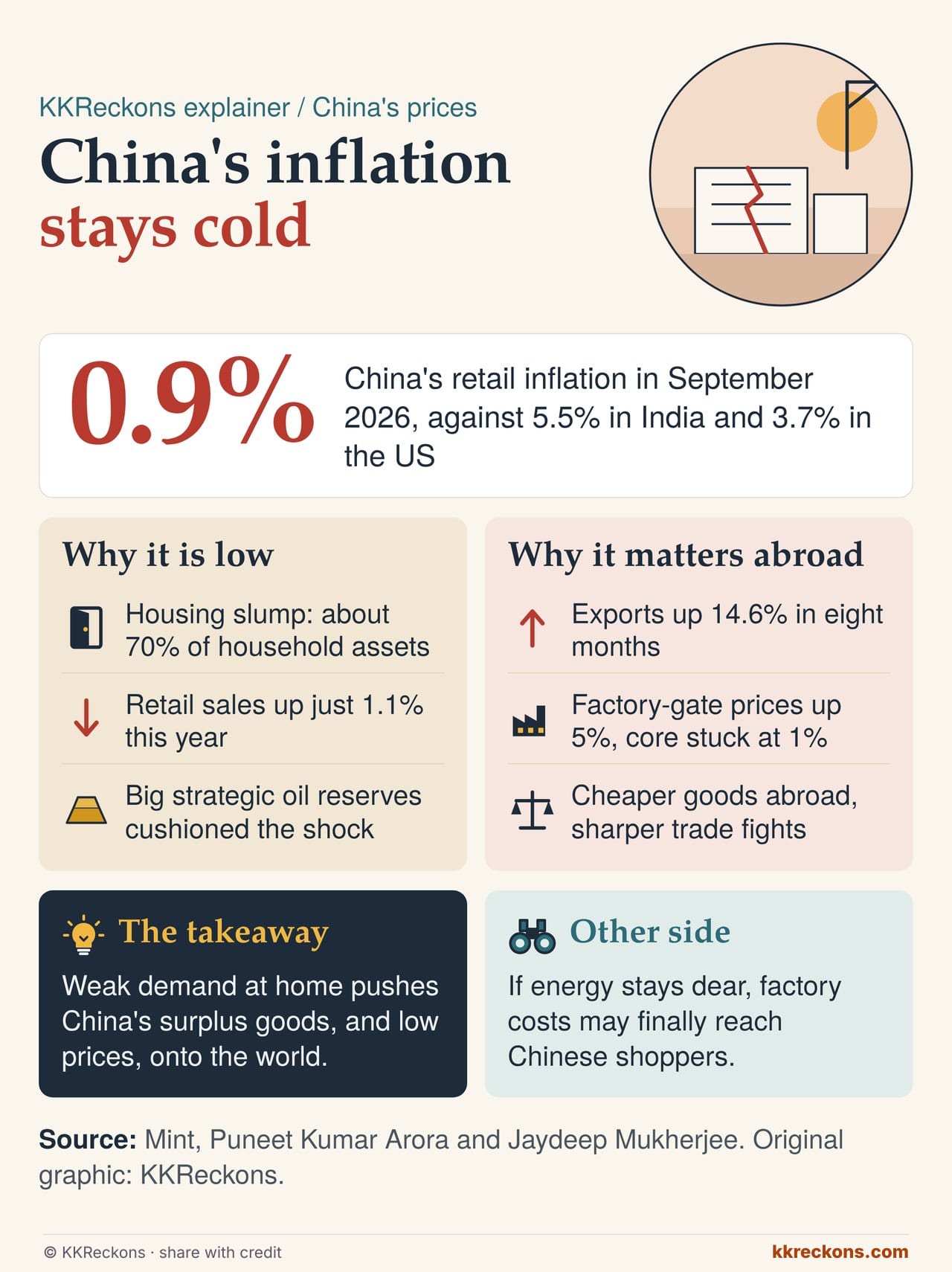
In a Mint column, economists Puneet Kumar Arora and Jaydeep Mukherjee note China's retail inflation was just 0.9% in September 2026, against 3.7% in the US, 3.8% in the eurozone and 5.5% in India, despite the West Asia energy shock.
Oil reserves and the shift to electric cars helped, but they argue weak demand matters more: housing is about 70% of household assets, and while factory-gate prices rose 5%, core consumer inflation stayed at 1%.
With retail sales up 1.1% and exports up 14.6% this year, they warn China may export its disinflation, easing prices abroad but stoking trade fights.
0.9%
China retail inflation, Sept 2026
5%
factory-gate inflation, Sept
70%
of household assets in housing
Why it matters Cheap Chinese goods can soften inflation for India and the US, but they also squeeze local manufacturers and invite tariffs.
Other side Factory-gate prices are already climbing fast; if energy stays dear, those costs could reach Chinese shoppers and turn exported disinflation into exported inflation.