5 stories · 7 min read

China pops, credit wheezes, zombies nap, waists shrink, kids unplug. Capex keeps eating.

China's AI bubble popped; America's is hissing out through bond prices, while the Fed weighs one more hike and diet drugs quietly shrink the snack aisle.

Special report todayPopped or leaking? A KKReckons research brief on the AI bubbleOur deeper dive behind today's lead: China's crash, neocloud credit, Gartner's revenue gap, history, hedges and the India angle, with every figure sourced.Read the report

AI Stress Index

25/100Elevated

27 Oct close · Story 01

Gauges →

Markets at the last close before this edition · 27 Oct

  • Nifty 5022,753On the day, up 0.68%. 1 wk: −0.59%Close of 26 Oct
  • S&P 5007,723On the day, up 0.60%. 1 wk: +0.13%
  • US 10-yr yield4.99%On the day, up 1 bp. 1 wk: −12 bp
  • Brent crude$109.44On the day, down 5.50%. 1 wk: +0.60%
  • Gold$4,075On the day, up 0.91%. 1 wk: −1.63%
  • USD/INR₹95.11On the day, up 0.18%. 1 wk: +0.41%

Yahoo Finance daily closes. Not investment advice.

40%China's STAR50 AI and chip index fall in under four months, about $480bn erased14.2%of listed Indian firms stressed or zombie in 2025, the lowest in a D&B study

Pick of the day

One story worth slowing down for

China's AI stocks crash 40% as US neocloud debt stress spreads (opens the source in a new tab)
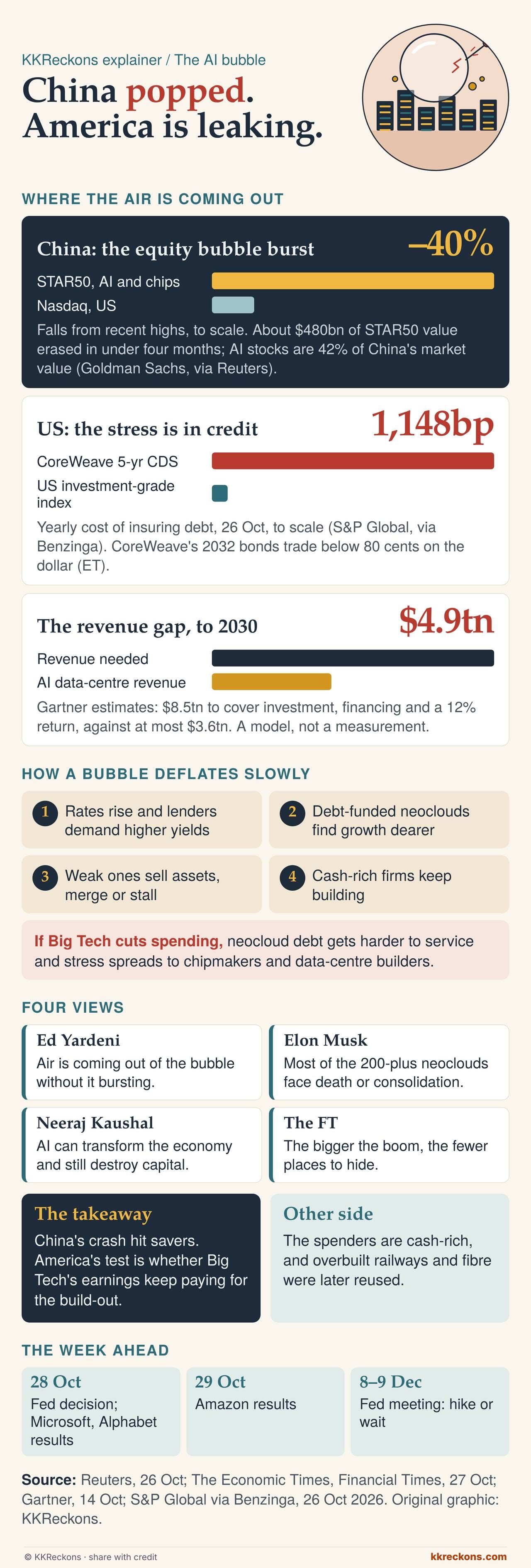
Explainer on the AI bubble: China's STAR50 down 40% against 6% for the Nasdaq, CoreWeave's CDS at 1,148bp against 63bp for investment grade, and Gartner's $8.5tn revenue need against $3.6tn.
Original graphic: KKReckons
  • Reuters reports China's STAR50 index of AI and chip leaders has fallen 40% in under four months, erasing about $480bn; AI stocks are 42% of China's market value, per Goldman Sachs. The Nasdaq has slipped only 6%.
  • In the US the strain shows in credit. ET says CoreWeave's 2032 bonds trade below 80 cents, Musk predicts a die-off among 200-plus Neocloud A newer cloud company, such as CoreWeave or Nscale, that rents out AI chips, often funded with debt., and Gartner sees $8.5tn of revenue needed by 2030 against at most $3.6tn.
  • Ed Yardeni says air is leaking without a burst. An FT editorial warns hedges are getting dearer; Columbia's Neeraj Kaushal argues AI can transform the economy and still destroy capital.
40%
STAR50 fall in under four months
$8.5tn
revenue needed by 2030 vs $3.6tn (Gartner)

Why it matters Two kinds of deflation are under way at once: a retail-driven equity crash in China and a slow squeeze on America's most indebted builders. Whether the US stays on the slow path depends on Big Tech's own earnings paying for the build-out.

Other side The biggest spenders are among the most cash-rich firms ever, and overbuilt railways and fibre were later put to use. Gartner's gap is a model, not a measurement, so losses may stay with leveraged lenders rather than the wider economy.

Also read: The limits of hedging the AI boom (FT editorial) · The AI boom may transform the economy and still destroy capital (ET, Neeraj Kaushal) · CoreWeave, Nvidia and Meta credit default swaps (Benzinga)
India edition

What moved in India

India's zombie firms drop to 14.2% of listed companies, D&B finds (opens the source in a new tab)

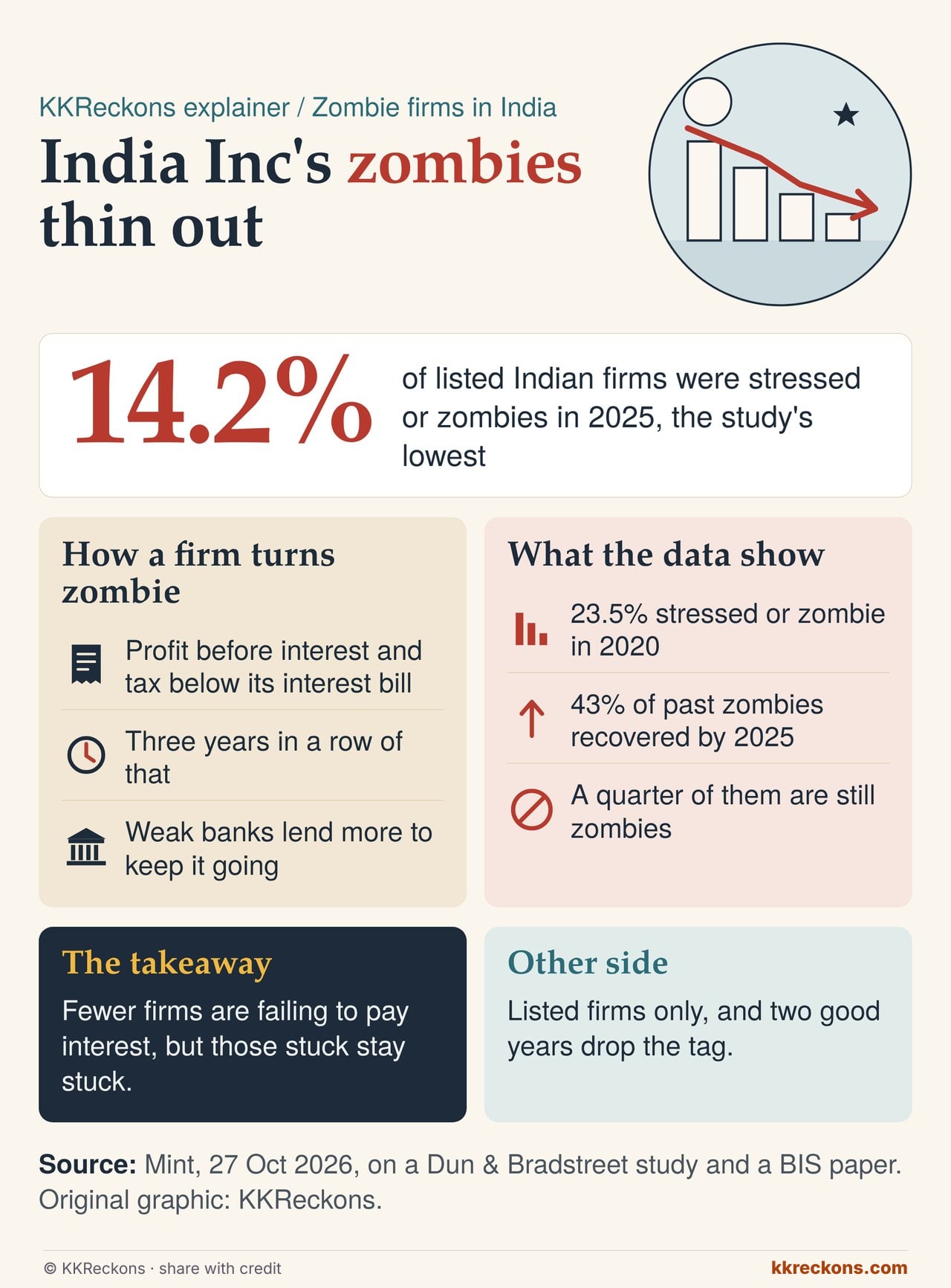
Explainer on India's zombie firms: 14.2% of listed firms stressed or zombie in 2025, down from 23.5% in 2020; 43% of past zombies recovered, a quarter still stuck.
Original graphic: KKReckonsView full size ↗
  • A Dun & Bradstreet study of about 6,000 listed firms, reported by Mint, calls a company stressed when its operating profit falls short of its interest bill, and a zombie after three such years. The share stressed or zombie fell to 14.2% in 2025 from 23.5% in 2020.
  • Of 971 firms that were zombies at some point since 2015, about 43% had fully or partly recovered by 2025, but a quarter were still zombies.
  • A BIS paper ranks India second of 10 Asian economies for zombie firms and blames weak banks that keep rolling over bad loans.
14.2%
stressed or zombie firms in 2025
971
firms classed as zombies since 2015

Why it matters Zombies hold on to credit and staff that healthier firms could use; the BIS estimates the drag at about 0.2 percentage points a year on growth and inflation. For investors, an interest-cover ratio below 1 is an early warning worth checking.

Other side The study covers only listed firms and drops the tag after two good years, so it may flatter recovery; the BIS's stricter test finds more. Some firms, like Bharti Airtel, were sound businesses that recovered, so the label alone is no verdict.

World edition

What moved everywhere else

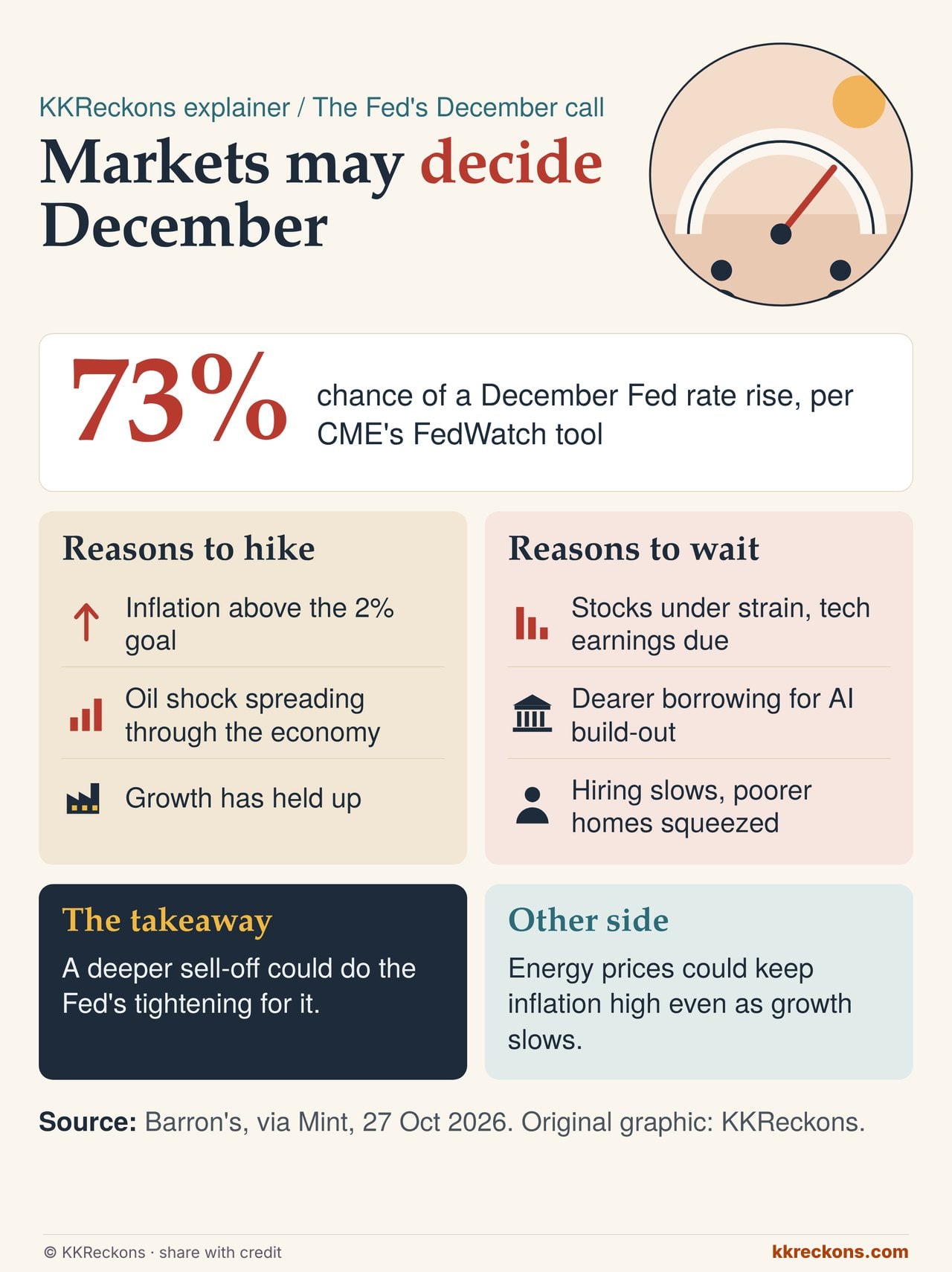
Fed expected to hold as markets see 73% odds of a December rate hike (opens the source in a new tab)

Explainer on the Fed's December decision: a 73% chance of a hike per CME FedWatch, with inflation and oil arguing for it and strained stocks and slowing hiring arguing to wait.
Original graphic: KKReckonsView full size ↗
  • The Fed is expected to hold rates this week, so attention shifts to its 8–9 December meeting, where CME's FedWatch tool puts the odds of a rise at 73%, Barron's reports. Inflation is above target and an oil shock is spreading.
  • This week's Microsoft, Alphabet and Amazon results matter because AI spending has propped up growth and depends on borrowing that gets dearer as rates rise.
  • Citigroup economists warn a deeper stock slide could end the hiking cycle. Chair Kevin Warsh wants to drop forward guidance, leaving markets to read the signals.
73%
odds of a December hike (CME FedWatch)

Why it matters Markets are already doing some of the Fed's work: falling stocks and wider Credit spread The extra interest a risky borrower pays over a safe government bond; wider spreads signal more worry. tighten conditions without a vote. That turns AI earnings into a quiet input to US interest rates, and so to borrowing costs well beyond America.

Watch next Warsh's press conference on Wednesday and the 8–9 December decision. Dearer energy could keep inflation high even as growth slows, which would push the Fed to hike despite a sell-off.

Weight-loss drugs reshape spending as 1 in 10 Americans take GLP-1s (opens the source in a new tab)

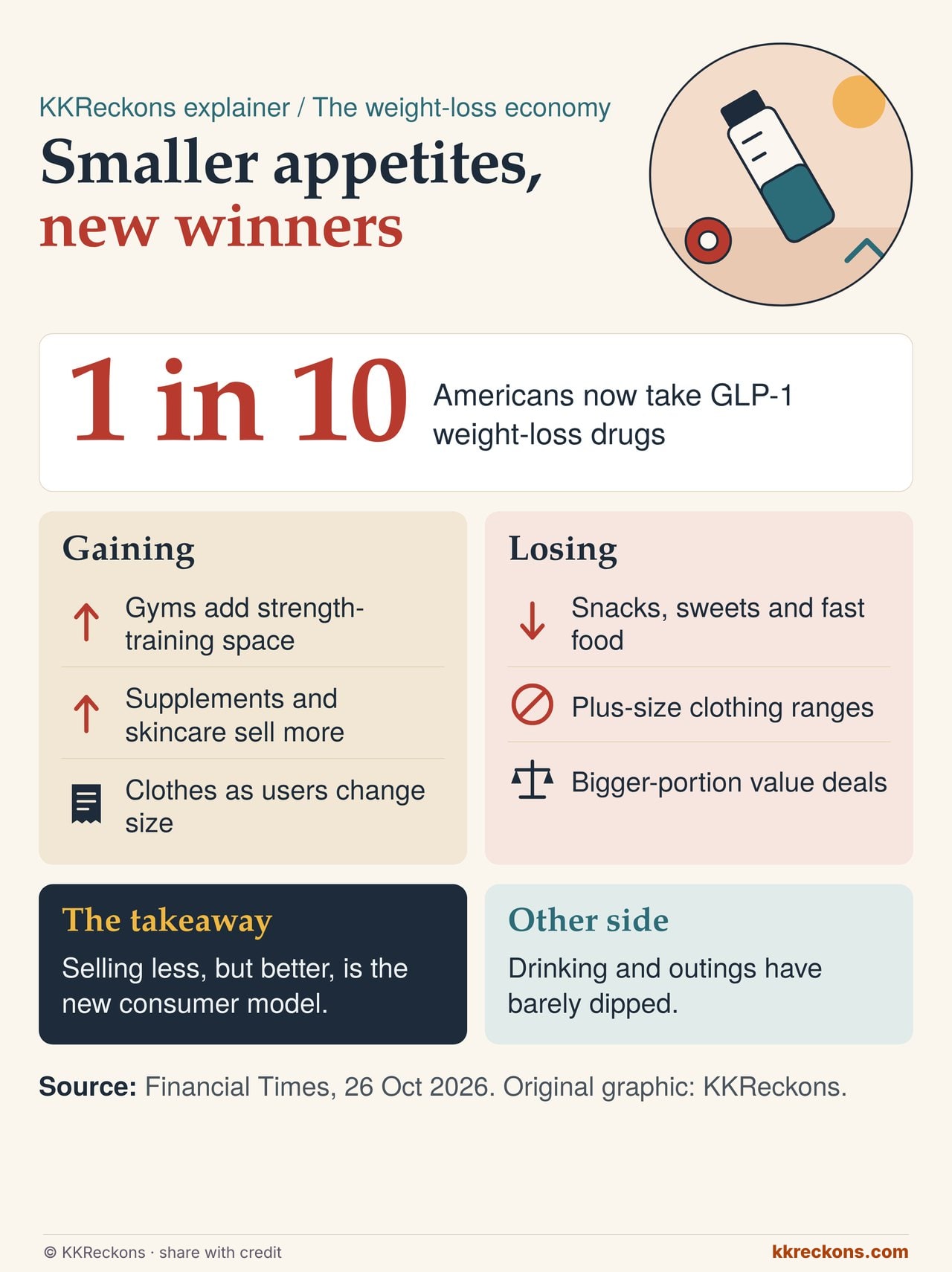
Explainer on the weight-loss economy: about one in 10 Americans on GLP-1 drugs; gyms, supplements and clothing gain while snacks, fast food and plus-size ranges lose.
Original graphic: KKReckonsView full size ↗
  • An FT Big Read finds people on GLP-1 drugs, now about one in 10 Americans, are changing what they eat, buy and do. Gyms are giving more floor space to strength training, and supplement and skincare makers are gaining customers.
  • Snacks, fast food and plus-size clothing are losing out: Macy's calls its plus-size business very soft, and brands are pushing smaller, pricier, protein-rich portions.
  • More than 200 listed companies outside healthcare discussed the drugs on earnings calls last quarter. Pills and cheaper generics after patents lapse in the early 2030s could widen use.
1 in 10
Americans taking GLP-1s
200+
non-health firms citing them on earnings calls

Why it matters The drugs undercut the volume model behind packaged food and fast food: sell more for less. Consumer investors may need to sort brands by whether they can win on quality and price rather than quantity.

Other side Drinking and nights out have barely dipped, so the hit is narrower than feared. Some users regain weight or stop, and so far the clearest effects come from early, wealthier adopters, which may not hold as use widens.

Silicon Valley parents push schools to cut back on classroom tech (opens the source in a new tab)

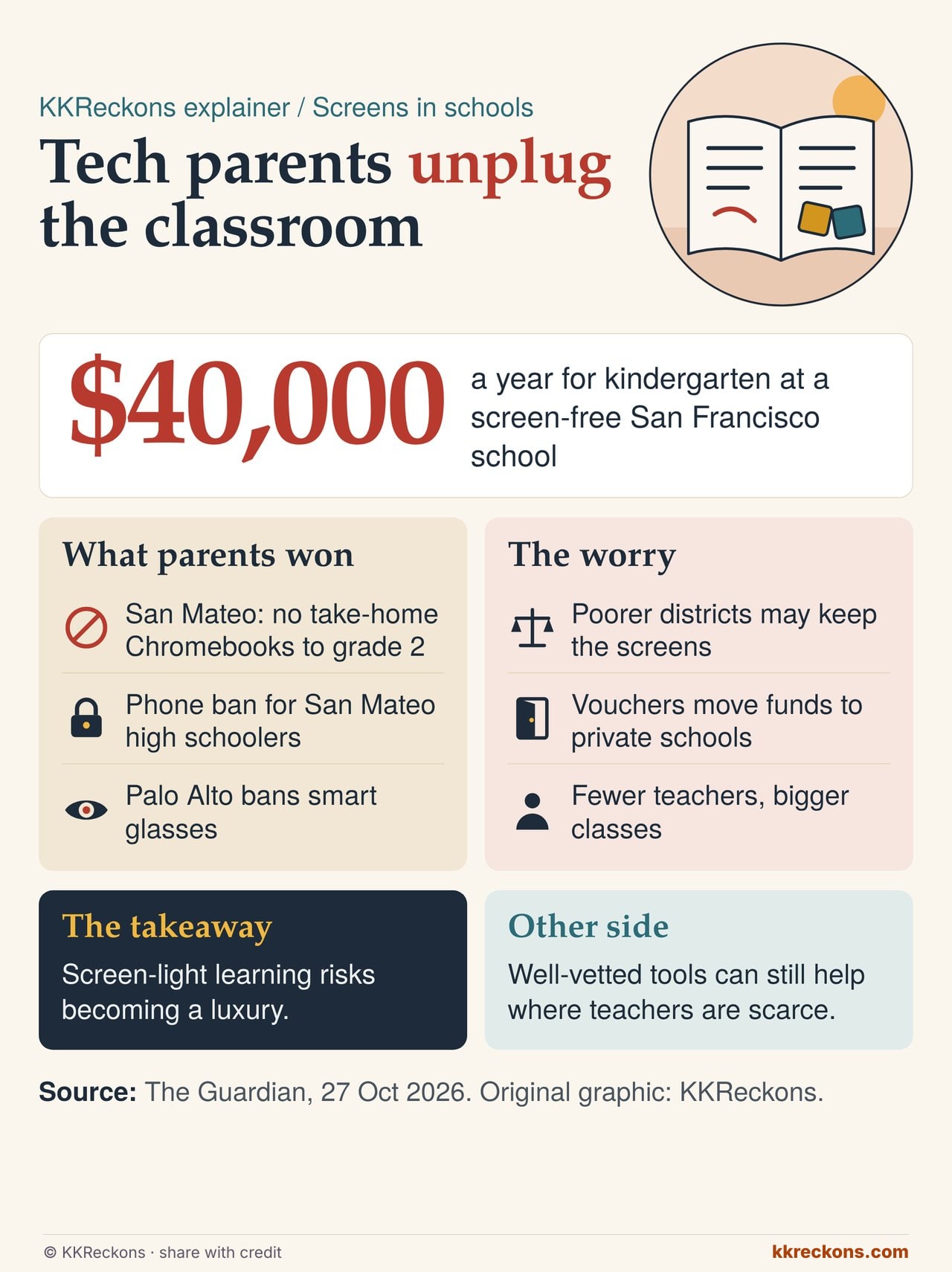
Explainer on screens in schools: $40,000 a year for a screen-free San Francisco kindergarten; San Mateo, Mountain View and Palo Alto curb classroom tech; poorer districts may be left with screens.
Original graphic: KKReckonsView full size ↗
  • Bay Area tech workers are paying for screen-light schooling, the Guardian reports: San Francisco Waldorf, two miles from Anthropic's headquarters, charges $40,000 a year for kindergarten, and many new families work in tech.
  • Parents are pushing public districts too. San Mateo has stopped sending Chromebooks home with pupils up to second grade and bans high schoolers' phones; Mountain View is moving away from the i-Ready program and Palo Alto bans smart glasses.
  • Experts warn poorer districts may keep the screens richer ones drop, while school-choice vouchers move public money to private schools.
$40,000
yearly kindergarten fee, SF Waldorf
81%
teachers say pupils get screens by kindergarten (NYT survey, 2025)

Why it matters The people who build the platforms are opting out for their own children, a strong signal about what the tech does well and badly. The risk is two tiers: human-led teaching for families who can pay or push, screens standing in for staff everywhere else.

Other side Good tools can personalise practice and fill gaps where teachers are scarce, and the parents' main ask is evidence and vetting, not a blanket ban. A few wealthy districts may not speak for families who rely on school devices.

Further reading

Was this briefing useful?YesSomewhatNot really

Spotted an error? Tell us and we’ll correct it.

Today’s edition is ready

Read deep. Think clearly. Stay curious.

A daily visual briefing on the stories that matter: India, the world, and what’s next.

Read Today’s Edition →Get it by email ↗

Free · 50 editions and 359 stories so far · Unsubscribe anytime

Emails are sent by beehiiv; your address is used only for this newsletter. Privacy · Editorial standards