5 stories · 5 min read

Poor climb, labs beg, vendors pledge. Ads fade, IPOs swell, coins vanish. Grip tight.

From poverty data to crypto vaults, today's wins look solid until you check what protects them.

AI Stress Index

24/100Normal

29 Oct close · Story 04

Gauges →

Markets at the last close before this edition · 29 Oct

  • Nifty 5022,699On the day, down 0.22%. 1 wk: −0.49%Close of 28 Oct
  • S&P 5007,720On the day, down 0.30%. 1 wk: +0.74%
  • US 10-yr yield4.99%On the day, down 6 bp. 1 wk: +4 bp
  • Brent crude$111.52On the day, down 3.30%. 1 wk: −1.46%
  • Gold$4,034On the day, down 0.44%. 1 wk: −0.66%
  • USD/INR₹95.21On the day, up 0.03%. 1 wk: +0.53%

Yahoo Finance daily closes. Not investment advice.

496MIndians lifted above the $4.20-a-day poverty line, 2011 to 2023~57%of India's poor live in a belt from Uttar Pradesh to West Bengal

Pick of the day

One story worth slowing down for

World Bank: 496 million Indians left poverty between 2011 and 2023 (opens the source in a new tab)
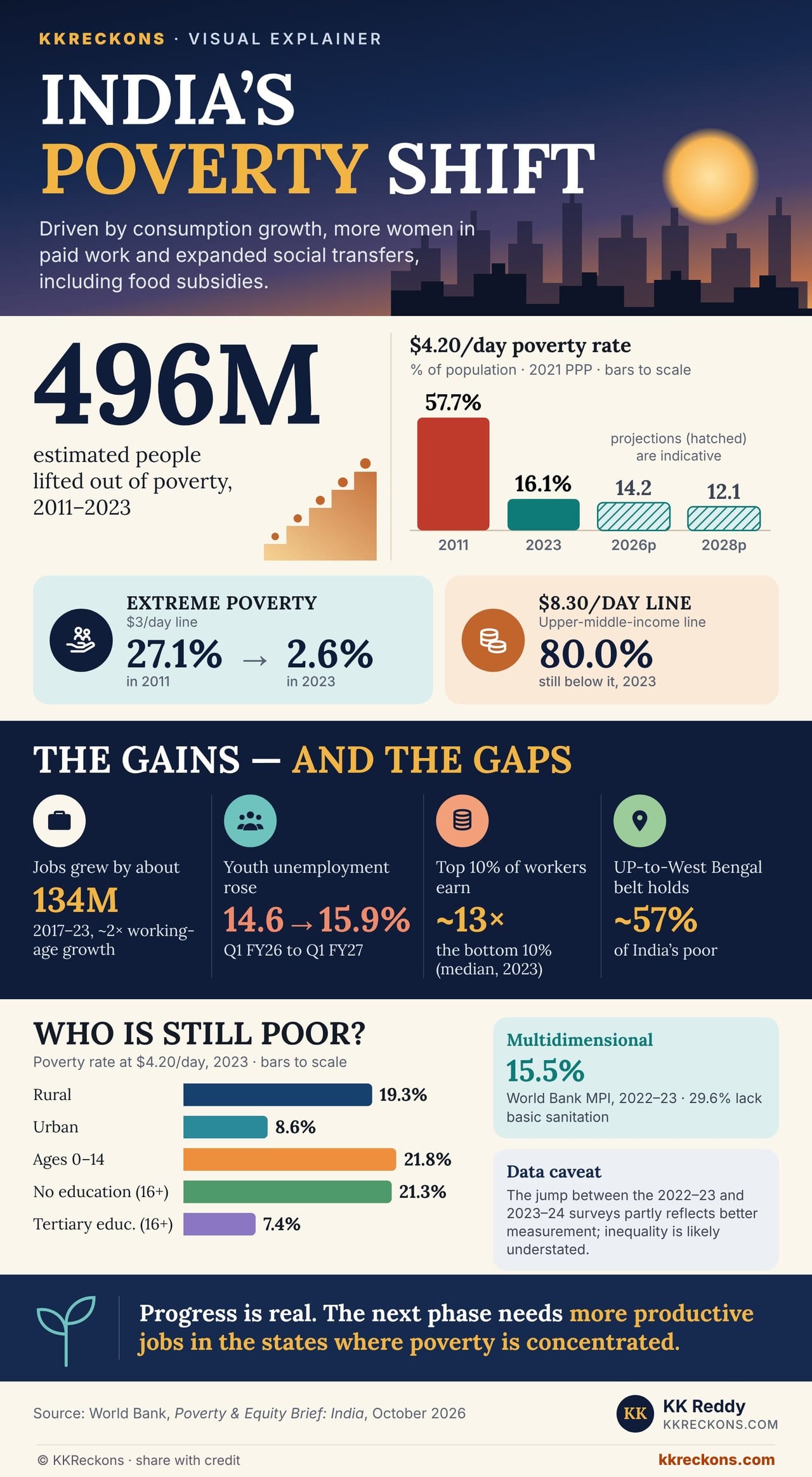
KKReckons visual explainer: India's $4.20-a-day poverty rate fell from 57.7% in 2011 to 16.1% in 2023, about 496 million people; extreme poverty fell from 27.1% to 2.6%, and about 57% of the poor live in the Uttar Pradesh to West Bengal belt.
Original graphic: KKReckons
  • The World Bank's new India brief says the share living under $4.20 a day fell from 57.7% in 2011 to 16.1% in 2023, about 496 million people. Extreme poverty, at $3 a day, fell from 27.1% to 2.6%.
  • Behind it: stronger consumption, about 134 million more jobs in 2017 to 2023 (many rural women entering paid work) and wider transfers such as food subsidies. It projects 12.1% by 2028.
  • The remaining poor are concentrated: rural poverty is 19.3% against 8.6% in towns, and the Uttar Pradesh to West Bengal belt holds about 57%. Youth unemployment rose to 15.9%.
496M
lifted out of poverty
2.6%
extreme poverty, 2023
80%
still below $8.30 a day

Why it matters India's poverty fight is shifting from keeping people fed to getting them productive work. The next gains depend on jobs in a few eastern states, not on national averages.

Other side The Bank itself says the jump between the 2022-23 and 2023-24 surveys partly reflects better measurement, and that richer households are likely undercounted. How much of the fall is statistics rather than living standards?

India edition

What moved in India

India's deep-tech push needs labs, postdocs and buyers, not just cash (opens the source in a new tab)

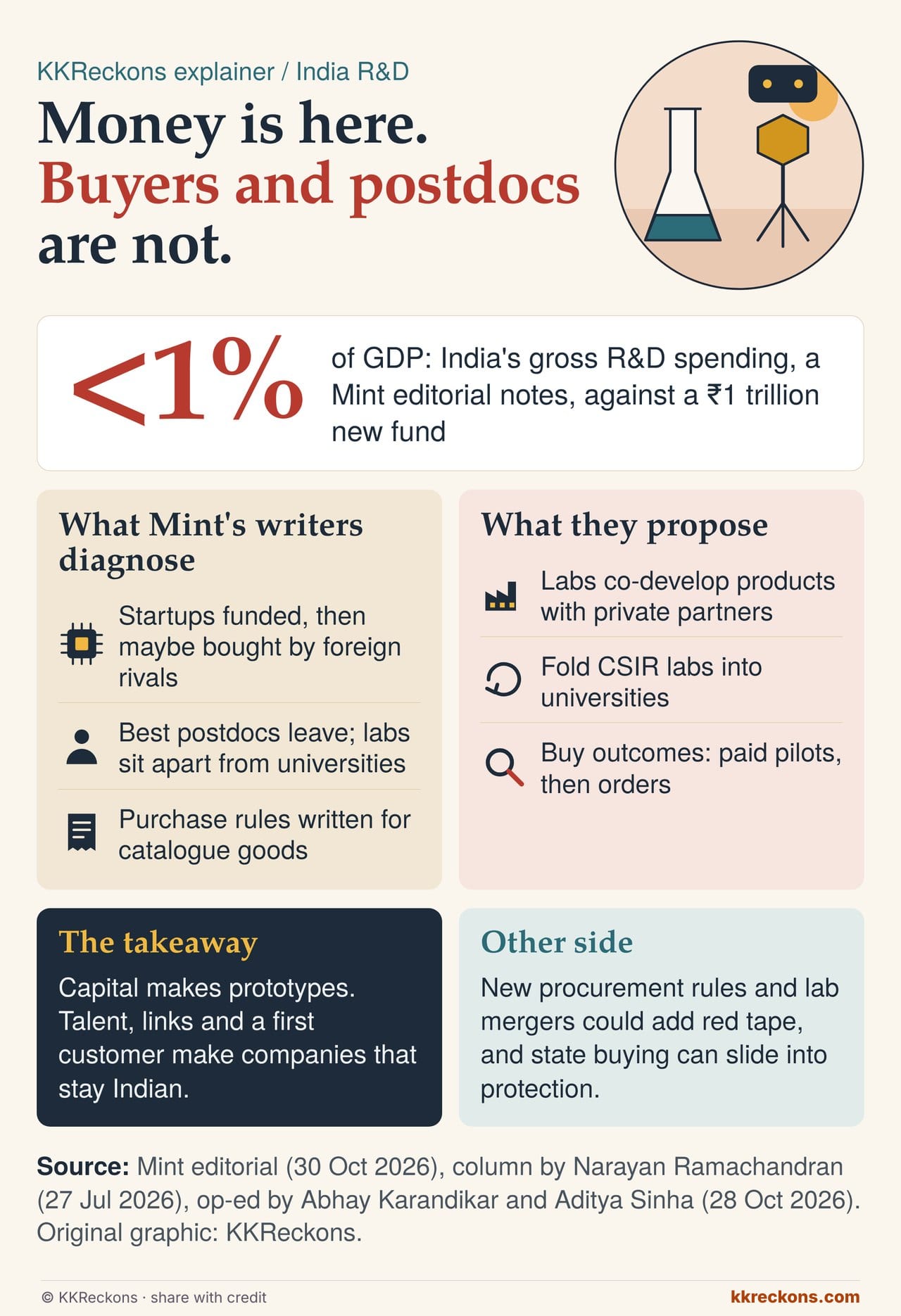
Explainer: India spends under 1% of GDP on R&D, Mint notes, beside a ₹1 trillion fund; Mint writers urge lab-industry links, postdoc reform and outcome-based state buying.
Original graphic: KKReckonsView full size ↗
  • A Mint editorial says the ₹1 trillion Research, Development and Innovation Fund now backs startups directly, but asks what India gains if foreign rivals later buy them. It wants research labs co-developing products with private firms.
  • A Mint column by Narayan Ramachandran argues the bigger gap is people: top postdocs leave and labs sit apart from universities, so he would fold CSIR's labs into the university system, as China did.
  • In a Mint op-ed, Niti Aayog's Abhay Karandikar and Aditya Sinha say capital makes products, not markets, and call for an innovation-buying chapter in government purchase rules, with paid pilots.
₹1trn
RDI Fund corpus

Why it matters All three agree on the diagnosis: India now has money for deep tech, but not the people, links or first customers that turn prototypes into companies that stay Indian. The fix is plumbing, not bigger cheques.

Other side Merging labs and steering state purchases could add a new layer of bureaucracy, and government as first buyer can slide into protection, which the op-ed itself warns against. Can reforms this deep move faster than startups burn cash?

Also read: India's research and development ecosystem is in need a major overhaul. Here's why

Fintech body UFF drafts a code for tech vendors after cyberattacks (opens the source in a new tab)

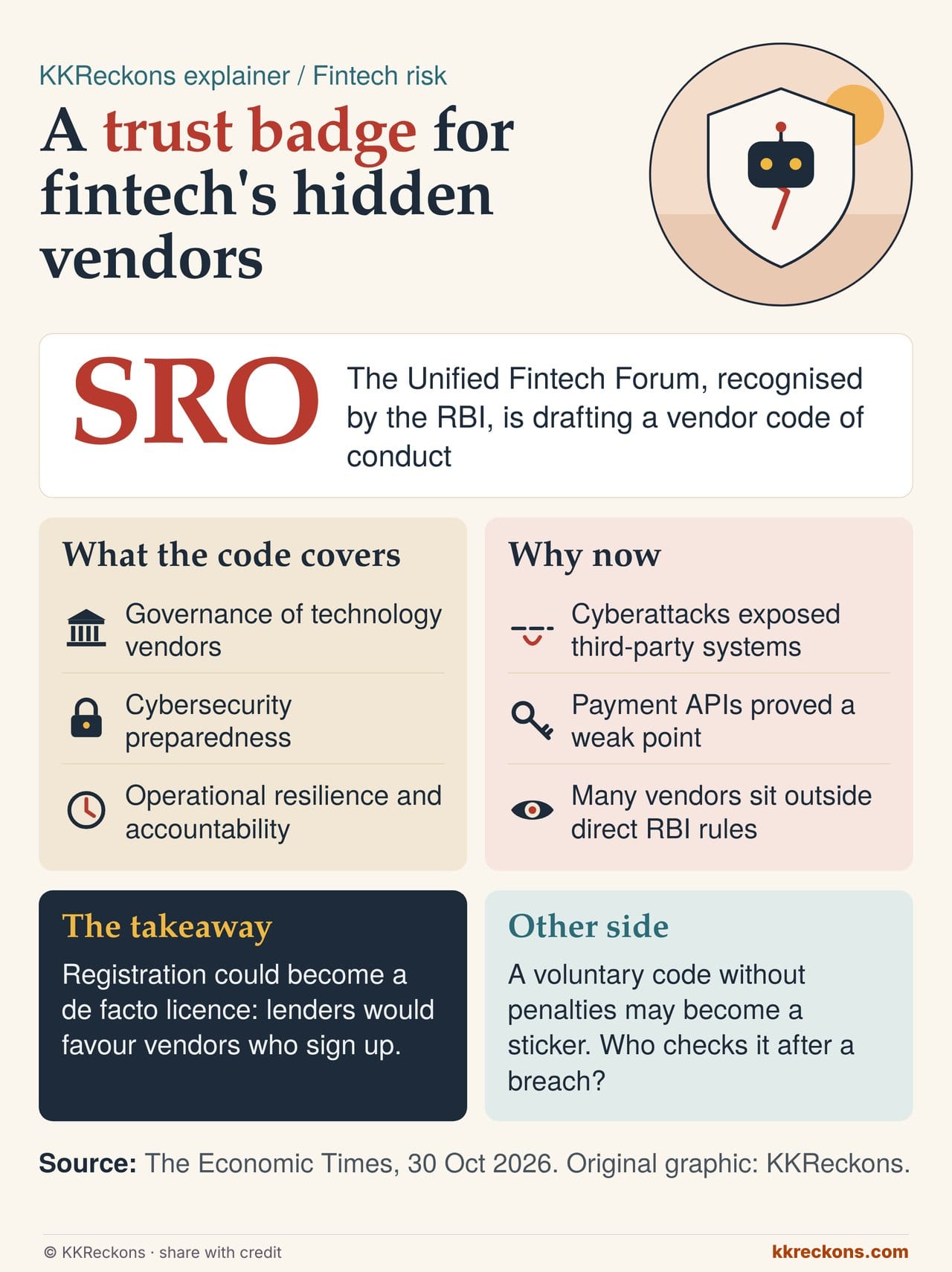
Explainer: the RBI-recognised Unified Fintech Forum is drafting a code for tech vendors covering governance, cyber readiness, resilience and accountability, after attacks exposed third-party weaknesses.
Original graphic: KKReckonsView full size ↗
  • The Unified Fintech Forum, the RBI-recognised self-regulatory body for fintechs, is drafting a code of conduct for technology and RegTech vendors covering governance, cyber readiness, resilience and accountability, ET reports.
  • Fintechs and regulated lenders are likely to favour vendors that register, so sign-up could become a de facto accreditation. The trigger is a run of cyberattacks that exposed weak third-party systems and payment APIs.
  • Many of these vendors run KYC, credit checks, loan systems and collections, yet are not directly regulated by the RBI.

Why it matters Lenders have outsourced the plumbing of digital credit to firms the regulator does not watch. A voluntary badge is the cheapest way to start pricing that hidden risk.

Other side A code with no penalties may become a sticker that big vendors collect and small ones struggle to afford. Who audits compliance, and what happens when a badge-holder is breached?

World edition

What moved everywhere else

Alphabet's ad slowdown and Anthropic's IPO test the AI money machine (opens the source in a new tab)

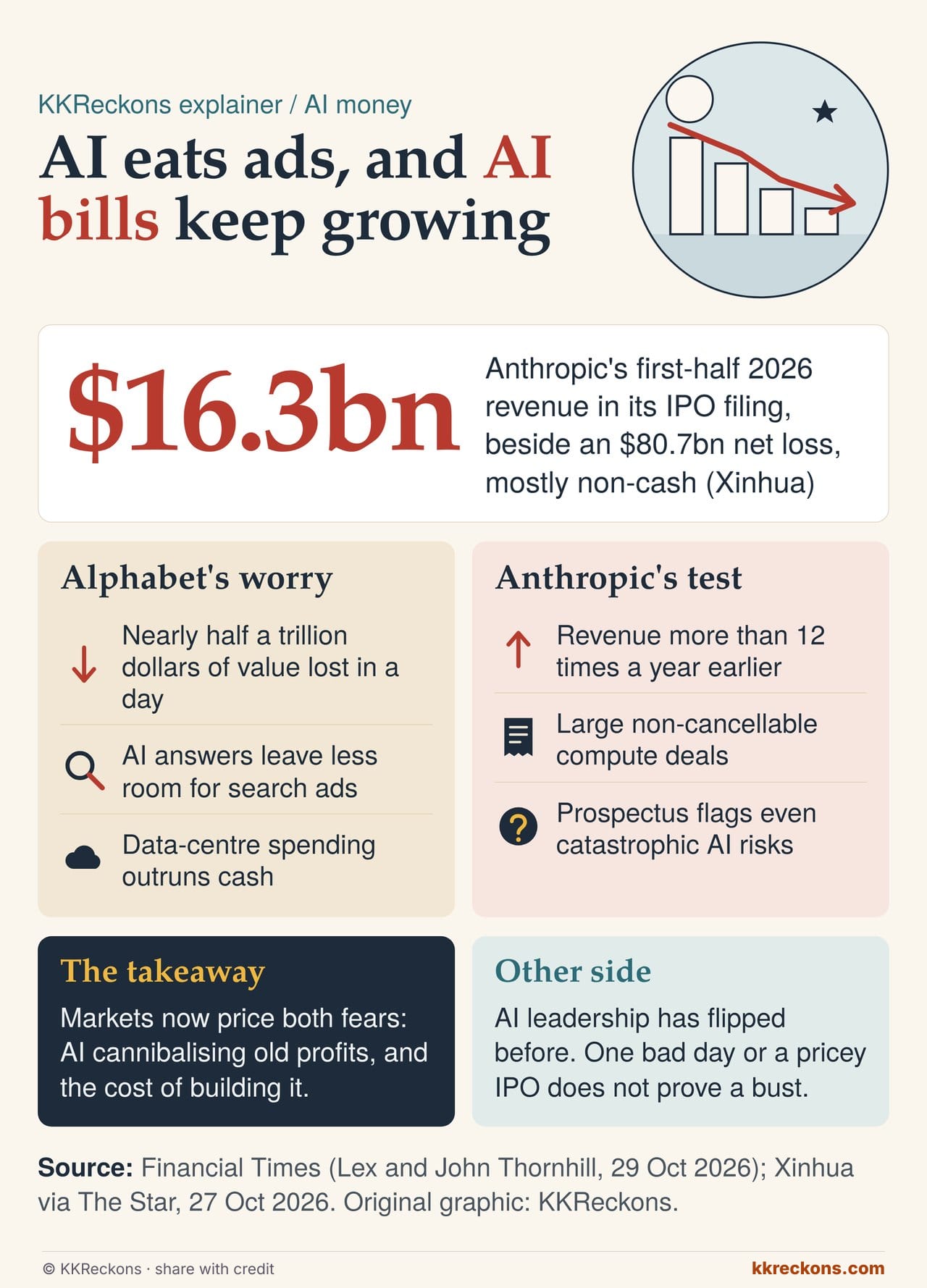
Explainer: Alphabet lost nearly half a trillion dollars of value as AI squeezed search ads; Anthropic's IPO filing shows $16.3bn first-half revenue and an $80.7bn mostly non-cash loss.
Original graphic: KKReckonsView full size ↗
  • The FT's Lex column says Alphabet lost nearly half a trillion dollars of market value after ad sales slowed unexpectedly: AI answers leave less room for ads, and data-centre spending is outrunning cash. Lex still thinks the AI lead can be won back.
  • A John Thornhill column says Anthropic's IPO Initial public offering: when a company first sells its shares on a stock exchange. pits fear of missing out against fear of messing up. The filing shows first-half revenue of $16.3bn and an $80.7bn net loss, mostly non-cash, Xinhua reports, plus large non-cancellable compute deals.

Why it matters Two worries meet: AI may eat the ad profits that pay for AI, and the newest labs fund their build-out with promises to pay for chips later. Public markets now have to price both.

Other side Both columns concede the upside: AI leadership has flipped quickly before, and Anthropic's revenue growth is remarkable. A sharp share drop or a pricey IPO is not proof the boom is a bust.

Binance halts transactions after a hack that may be the biggest ever (opens the source in a new tab)

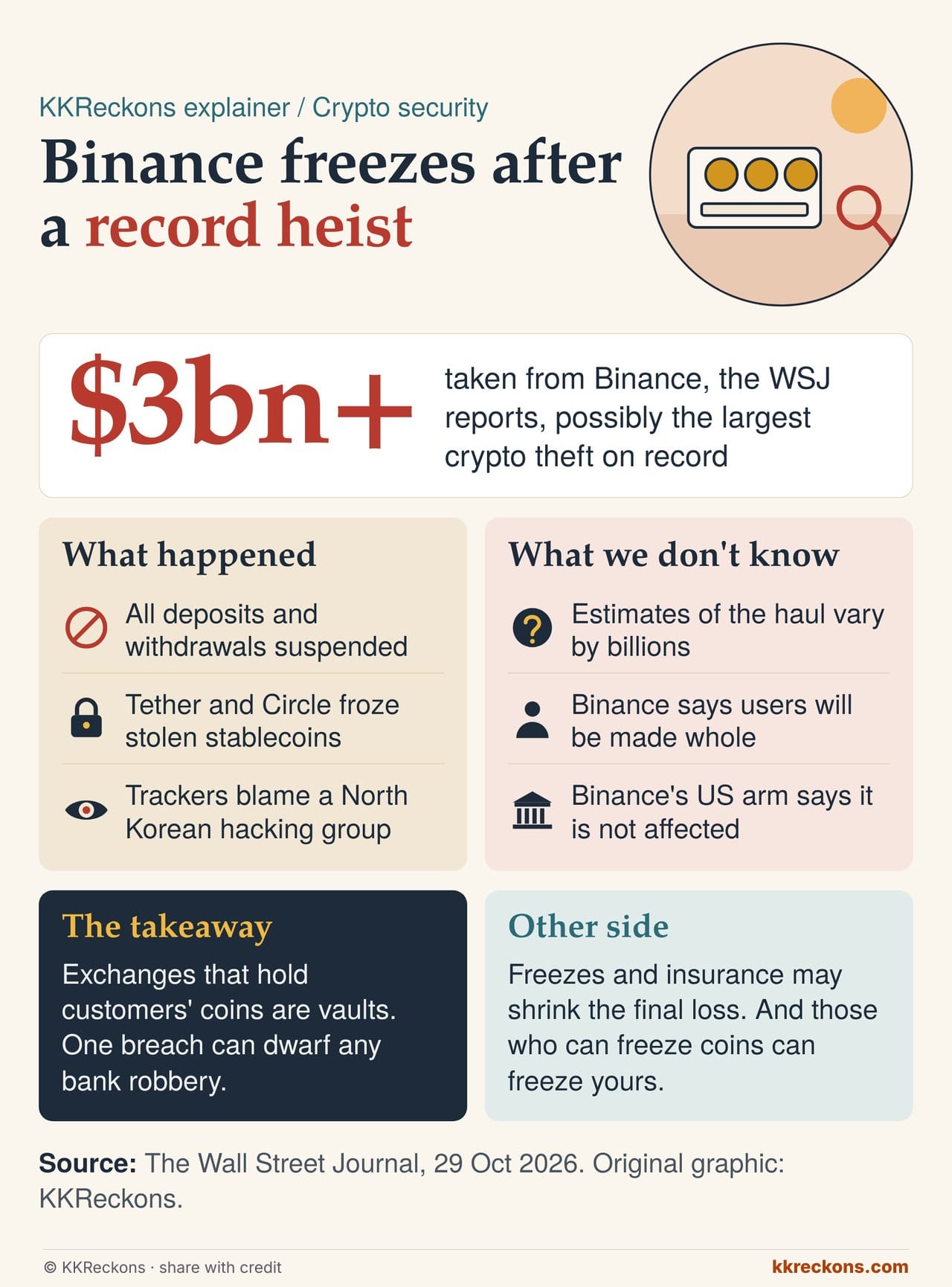
Explainer: Binance suspended deposits and withdrawals after a hack of at least $3bn, possibly the largest crypto theft; Tether and Circle froze some funds and analysts blame North Korean hackers.
Original graphic: KKReckonsView full size ↗
  • Binance suspended all deposits and withdrawals after hackers appeared to take at least $3bn, which would be the largest crypto theft on record, the WSJ reports. The exchange says user funds are safe and users will be made whole.
  • Tether and Circle froze part of the stolen Stablecoin A cryptocurrency designed to hold a fixed value, usually one US dollar, backed by reserves., and analysts at TRM Labs and Pangolin Intelligence blame a North Korean hacking group. Some trackers put the haul far higher; Binance's US arm says it is unaffected.

Why it matters Exchanges that hold customers' coins are vaults with a public address; one breach can dwarf any bank robbery. The quick freezes also show stablecoin issuers acting like crypto's central banks.

Other side Early tallies swing by billions, and freezes plus Binance's insurance fund may shrink the final loss. And issuers that can freeze a hacker's coins can freeze anyone's.

Was this briefing useful?YesSomewhatNot really

Spotted an error? Tell us and we’ll correct it.

Today’s edition is ready

Read deep. Think clearly. Stay curious.

A daily visual briefing on the stories that matter: India, the world, and what’s next.

Read Today’s Edition →Get it by email ↗

Free · 50 editions and 359 stories so far · Unsubscribe anytime

Emails are sent by beehiiv; your address is used only for this newsletter. Privacy · Editorial standards