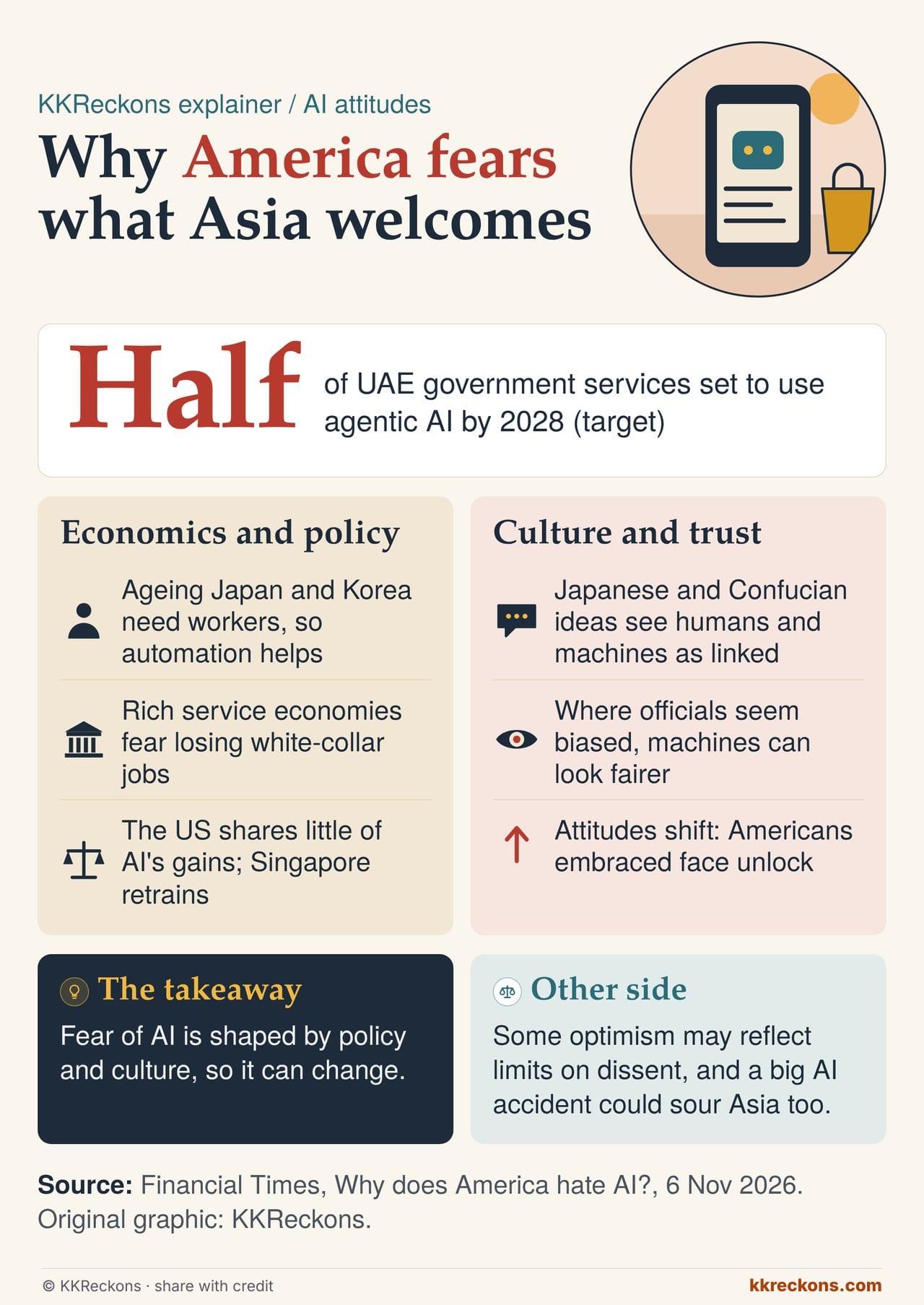
In an FT Weekend essay, Gillian Tett argues American hostility to AI is not universal. Anger at data centres helped shape this week's midterms, yet China, much of Asia and most emerging markets are far more optimistic.
Her first explanation is economics and policy: ageing Japan and Korea welcome automation, rich service economies fear for white-collar work, and the US does little to share AI gains or retrain workers, unlike Singapore.
Her second is culture: traditions that see humans and machines as linked, and low trust in officials, make machines feel less threatening. Attitudes can shift, she adds.
Half
UAE government services due to use agentic AI by 2028 (target)
Why it matters Where the public is hostile, AI rollouts meet moratoriums and angry voters; where it is welcomed, adoption moves faster. Tett's point is that the fear is partly a policy choice, which means governments can still change it.
Other side Survey optimism can reflect less freedom to object, as Tett notes for China. And enthusiasm in Asia and emerging markets could fade quickly if AI starts taking jobs there too, or a major AI accident hits.
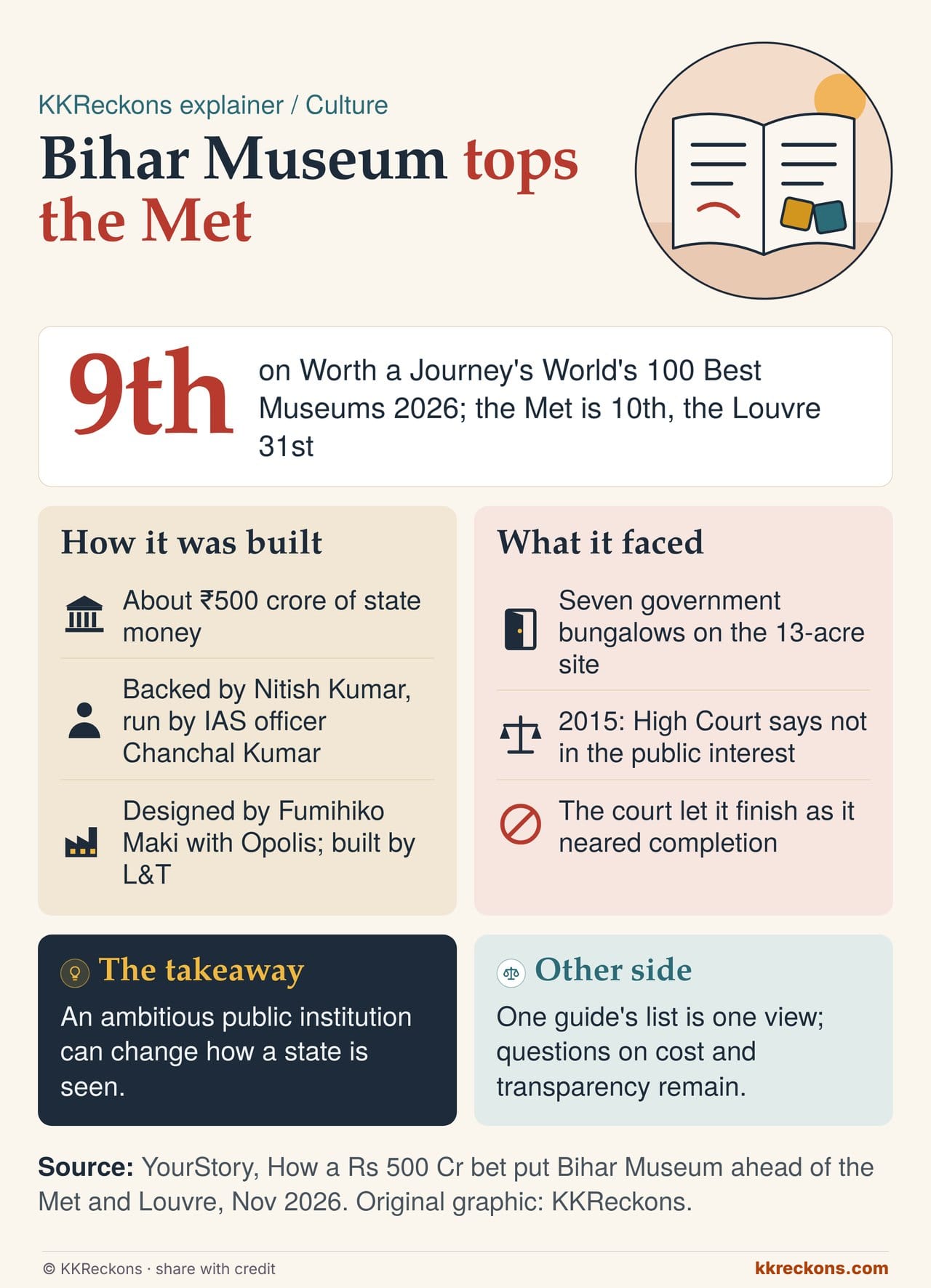
The Bihar Museum in Patna is ninth on German travel guide Worth a Journey's World's 100 Best Museums 2026, ahead of the Met (10th) and the Louvre (31st). Time Out reports Mexico City's anthropology museum tops the list. Bihar's is the only Indian entry.
YourStory founder Shradha Sharma credits then chief minister Nitish Kumar's backing and IAS officer Chanchal Kumar's execution. The roughly ₹500 crore project, designed by Pritzker winner Fumihiko Maki, fought land disputes and political pressure.
In 2015 the Patna High Court criticised the spending and contracting, holding the project was not in the public interest, but let construction finish.
9th
World's 100 Best Museums 2026
₹500 cr
Approximate cost of the project
Why it matters A well-built public institution can put a state on the world map and change how people see it. For Bihar, whose ancient history far outshines its modern image, that matters for pride and for tourism.
Other side One travel guide's ranking is a single opinion, not a verdict, and the court's criticism of cost and transparency still stands. The real test is visitors and upkeep over the next decade.
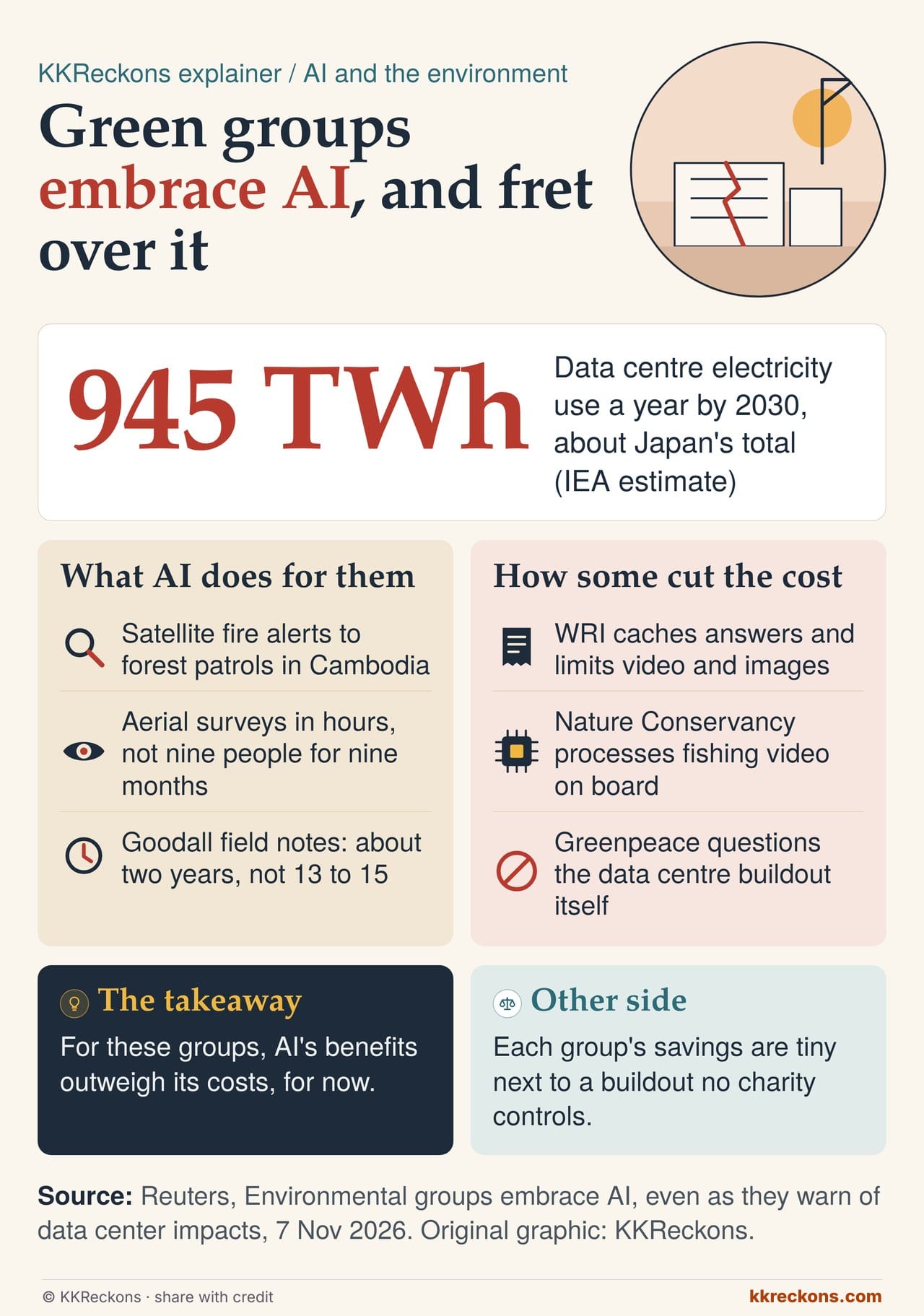
Reuters asked 15 major environmental and conservation groups about AI. All use it, for climate data, fire alerts and wildlife counts, and all worry about the power and water data centres consume.
Save the Elephants says AI reviews survey images in hours that took nine people nine months, and showed human counts missed about a third of elephants. The Jane Goodall Institute cut a 13 to 15 year notes project to about two.
Some limit the footprint: WRI caches answers and The Nature Conservancy processes fishing video on board. Greenpeace questions the buildout itself.
945 TWh
Data centre power use a year by 2030 (IEA estimate)
1 in 3
Elephants missed by human surveys
Why it matters Groups that criticise the AI buildout are also its customers, which weakens their case unless they can show the trade pays off. Their careful habits, such as caching and processing on the device, are a template others could copy.
Watch next COP31 this month, where host Turkey will seek a pledge on sustainable AI. Even so, savings from careful use by charities are tiny next to a buildout driven by tech giants, so the real question sits elsewhere.
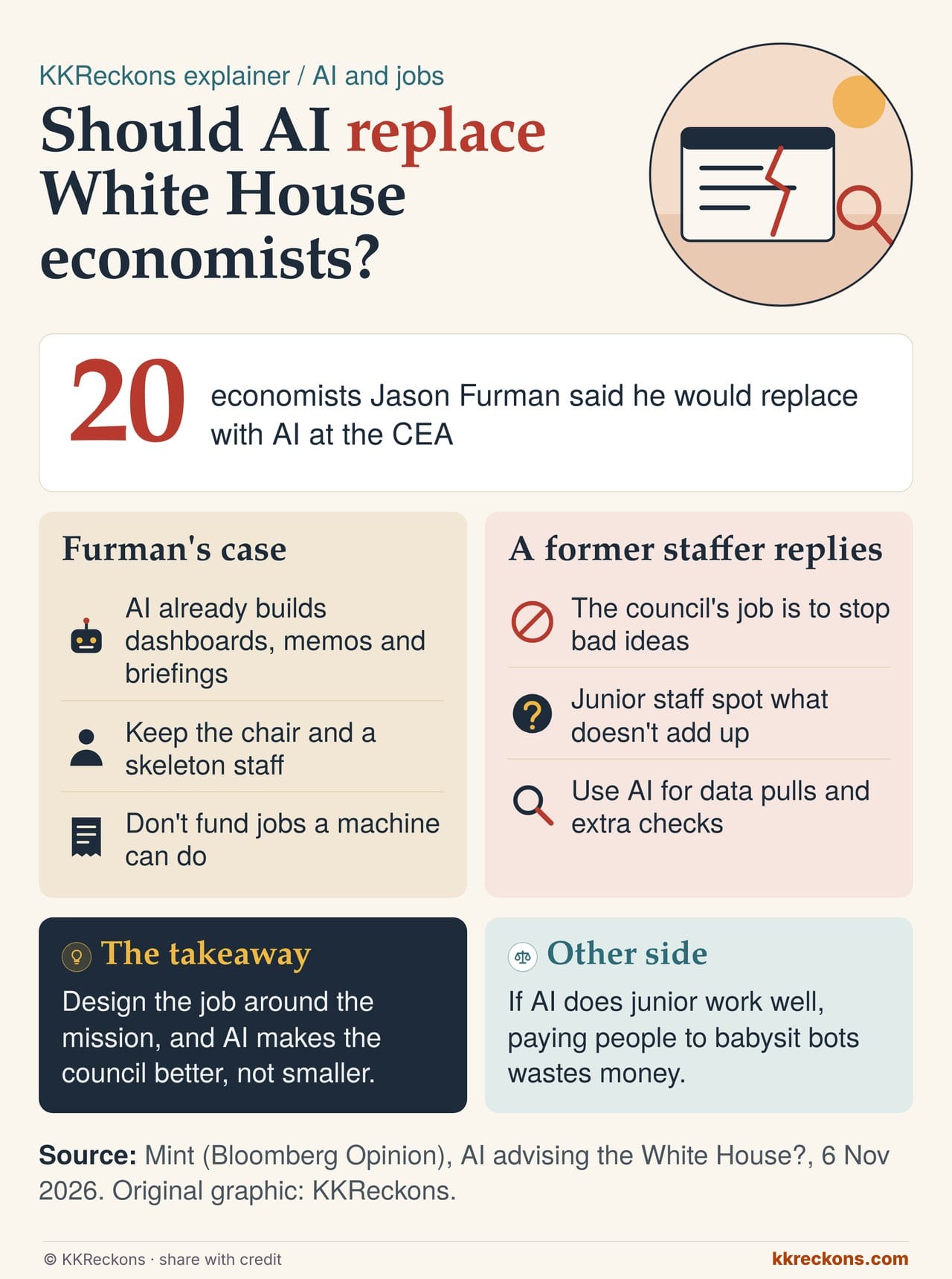
Jason Furman, who chaired Obama's Council of Economic Advisers, said he would now use AI instead of hiring 20 economists, later softening that to an AI-heavy council with a skeleton staff.
In a Bloomberg Opinion column carried by Mint, a former CEA staffer and creator of the Sahm rule replies that the council exists to stop bad ideas, and AI models rarely push back. Junior staff often spot what doesn't add up.
She backs AI for faster data work and extra checks. The president, she argues, needs a better council, not a smaller one.
Why it matters The row is a small, public test of a question every employer faces: if AI does entry-level work, where do tomorrow's experts come from, and who is left in the room to say no?
Other side Furman's case is that taxpayers should not fund jobs a machine can do. Newer AI tools may also challenge assumptions more than the column expects, and junior roles could change shape rather than disappear.
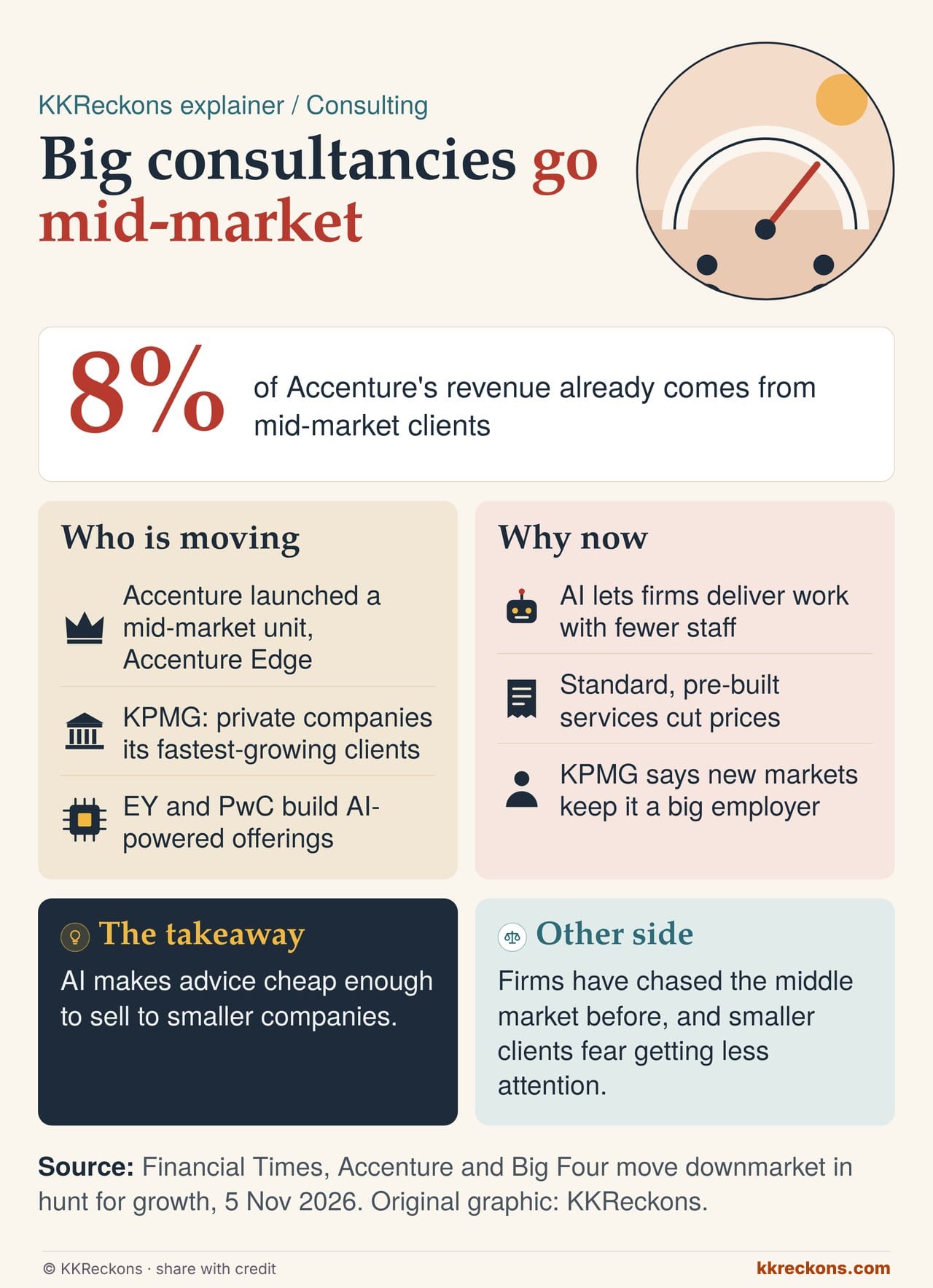
Accenture and the Big Four accounting firms are moving downmarket, the FT reports, betting mid-sized companies can offset slower growth from blue-chip clients. Accenture launched a unit in June for companies with $300mn to $3bn in revenue.
KPMG says private companies are its fastest-growing clients and that without new markets it would have to shrink its workforce. EY says AI lets it sell work such as due diligence more cheaply.
Mid-market specialists such as Grant Thornton say serving these clients well takes more than wanting to.
8%
Share of Accenture's revenue from mid-market clients
Why it matters The same AI efficiency that threatens junior consulting jobs is being used to find new customers and keep headcount up. If it works, mid-sized companies get big-firm expertise at lower prices.
Other side Big firms have chased the middle market before whenever large clients cut back, and smaller clients often doubt they will get the same attention. AI could also let those clients skip consultants altogether.
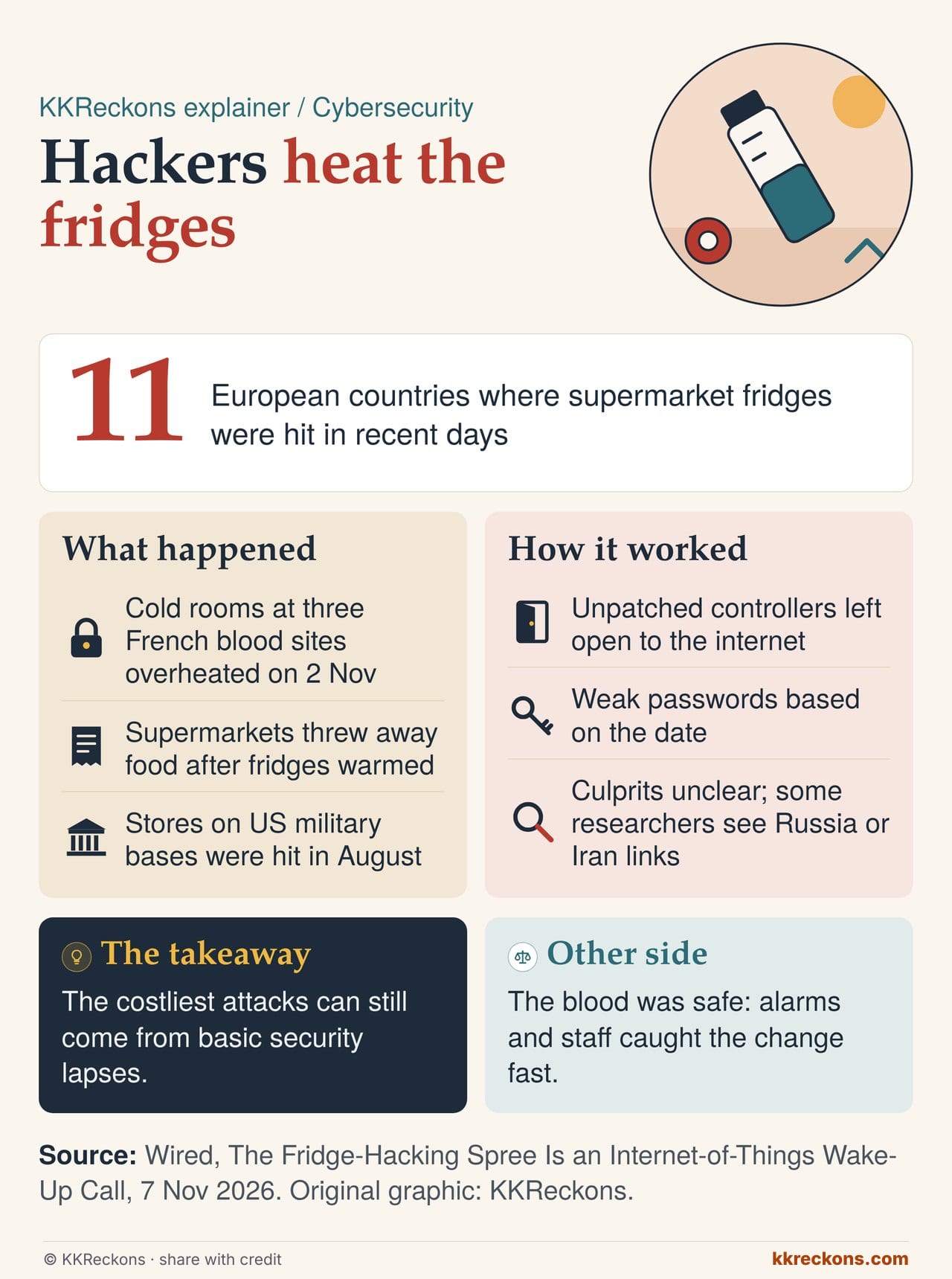
Cold rooms at three French blood service sites were driven to very high temperatures on 2 November, Wired reports. Alarms and staff caught it and the blood was unharmed. Supermarkets in at least 11 European countries have binned food after similar attacks.
Many hacks used internet-exposed Danfoss temperature controllers on outdated firmware, some with weak passwords based on the date. Stores on US military bases were hit in August.
Who is behind it is unclear. Some researchers see signs of Russia- or Iran-linked actors; the Kremlin denies involvement.
Why it matters Amid all the worry about AI-powered hacking, the damage here came from basic lapses: unpatched devices left online. Any business with connected equipment, from clinics to cold stores, carries the same risk, and the fixes are cheap.
Other side The blood service's alarms and fail-safes worked, which shows layered defences limit the harm. Spoiled groceries are costly but recoverable; the real test is whether operators patch before attackers aim at something less forgiving.