5 stories · 6 min read

India booms at 6.5%. Nvidia swoons on one man. Junk pays 18%. Bots build firms; labs draw the line.

India looks sturdier than its headlines, Nvidia shows the cost of a one-man company, weak US borrowers lose cheap credit, and agents stand in for staff.

AI Stress Index

32/100Elevated

11 Nov close · Story 03

Gauges →

Markets at the last close before this edition · 11 Nov

  • Nifty 5025,255On the day, up 0.84%. 1 wk: +5.40%
  • S&P 5007,619On the day, up 1.31%. 1 wk: −0.90%
  • US 10-yr yield5.00%On the day, up 2 bp. 1 wk: +10 bp
  • Brent crude$92.76On the day, up 1.39%. 1 wk: −1.97%
  • Gold$4,001On the day, down 0.74%. 1 wk: −1.78%
  • USD/INR₹93.93On the day, down 0.02%. 1 wk: −0.87%

Yahoo Finance daily closes. Not investment advice.

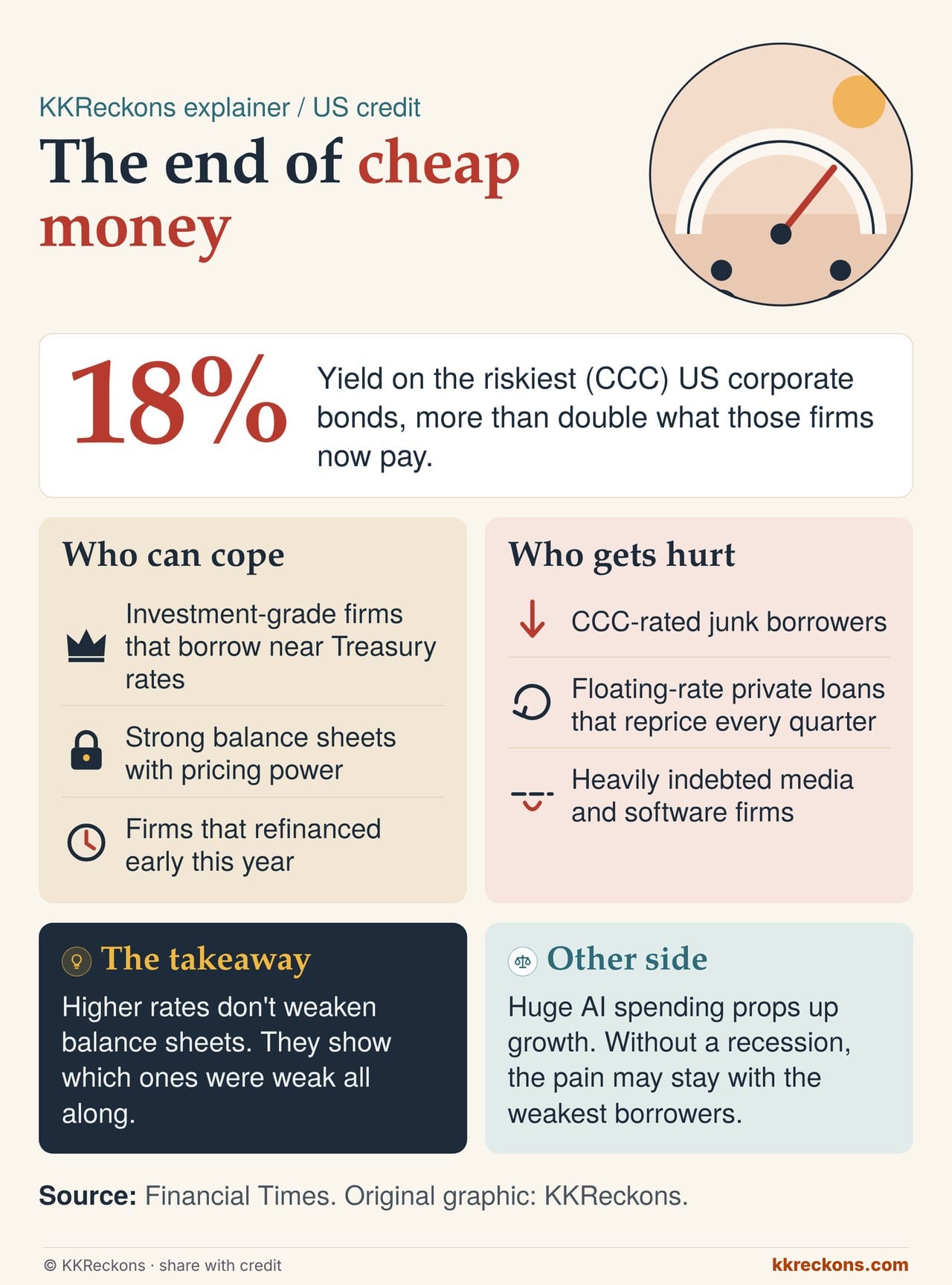
$6bnForeign funds put nearly $6bn into Indian shares in November, the most since Sept 2024.18%The riskiest US corporate bonds now yield almost 18%, more than double what they pay.

Pick of the day

One story worth slowing down for

India grows 6.5% a year as hotels fill and foreign money returns (opens the source in a new tab)
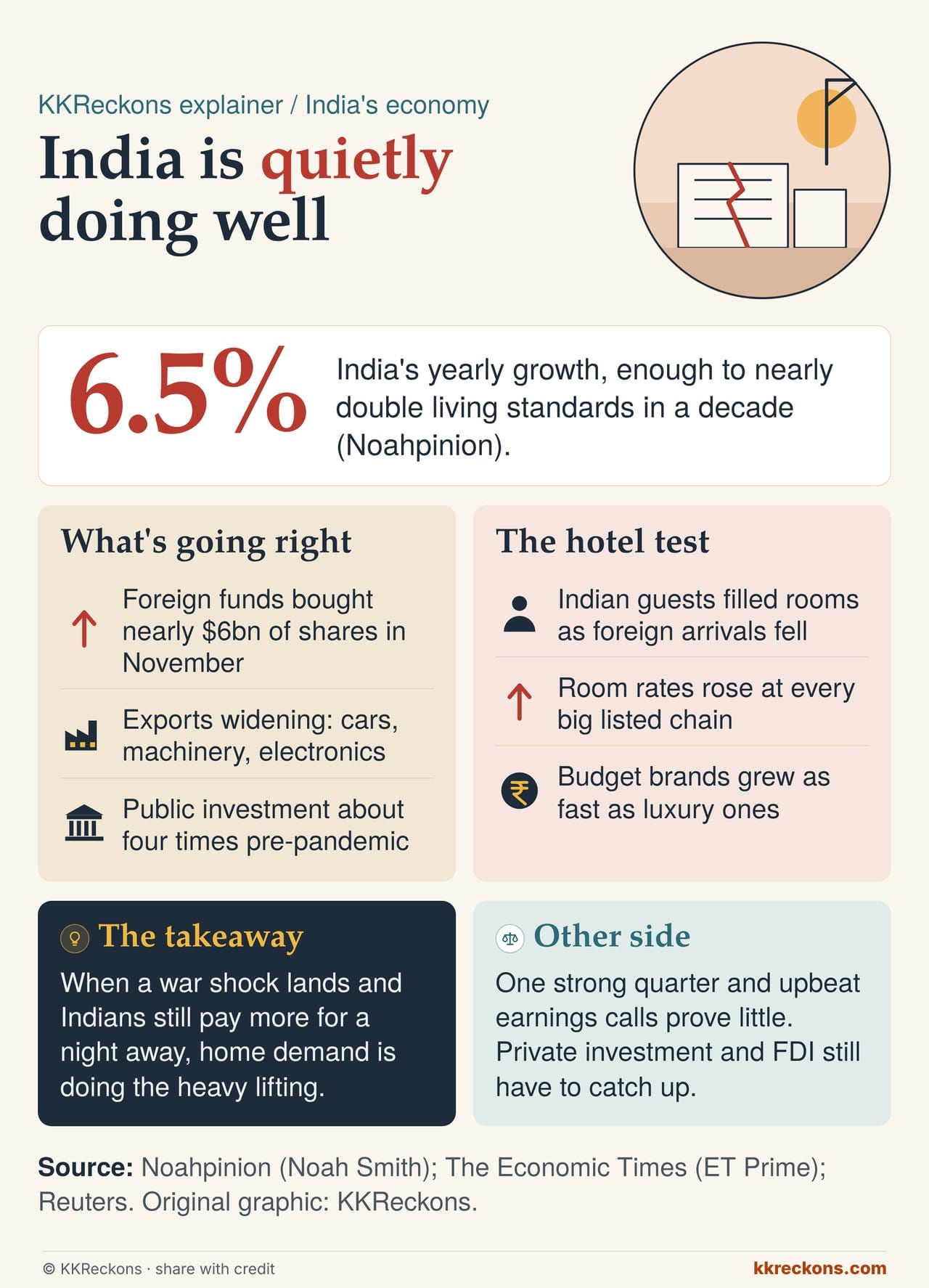
KKReckons explainer: India's economy, about 6.5% yearly growth, what is going right and the hotel test
Original graphic: KKReckonsView full size ↗
  • Noah Smith (Noahpinion) argues India is quietly doing great: growth near 6.5% a year, faster than China since the pandemic, extreme poverty largely gone, public investment about four times pre-pandemic levels and exports widening.
  • An ET Prime analysis finds the same strength in hotels. After the US-Iran war raised fuel prices and cut flights, Indian guests kept filling rooms and paid higher rates, from budget brands to palace suites.
  • Investors are noticing. Foreign funds have bought nearly $6bn of Indian shares in November, the most since September 2024 after two years of selling, Reuters reports, as some look for an alternative to AI-heavy markets.
6.5%
India's yearly growth (Noahpinion)
$6bn
Foreign buying of Indian shares in November (Reuters)
80%
Indian Hotels occupancy in Q2, up from 75% (ET)

Why it matters A hotel night is a choice, not a need. When Indians pay more for one during a war shock, it points to a wider base of households with spare cash, the kind of home demand growth needs once the public spending push fades.

Other side One quarter, a BRICS summit in Delhi and upbeat earnings calls are thin proof, and foreign money that arrives in a month can leave as fast. Smith himself warns that private investment and FDI still lag, and state-led spending lifts growth only for a while.

Also read: Indian shares rise on foreign flow optimism; financials, autos lead
World edition

What moved everywhere else

Nvidia's CEO probe shows how much markets lean on one man (opens the source in a new tab)

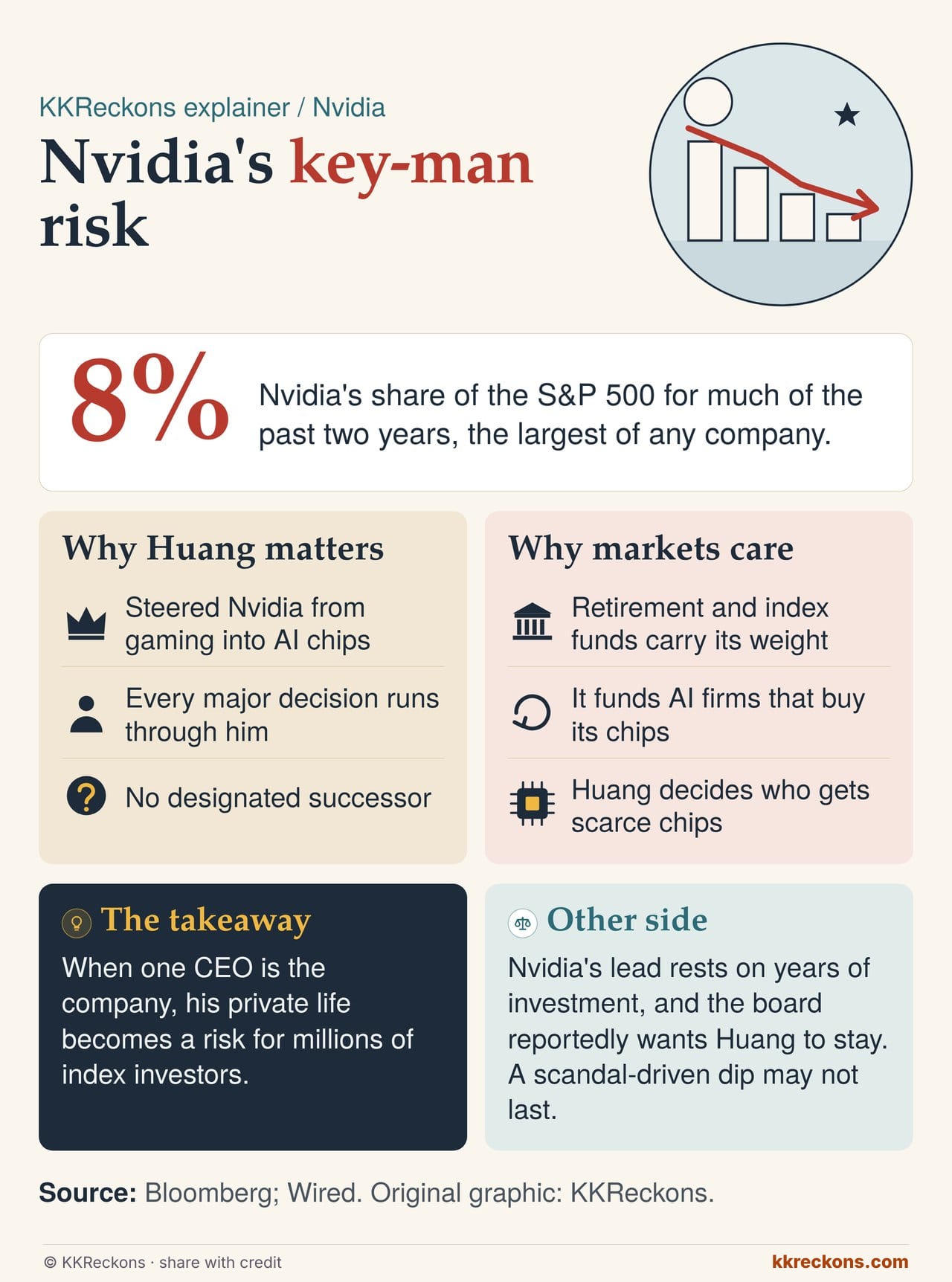
KKReckons explainer: Nvidia's key-man risk, about 8% of the S&P 500, why Huang matters and why markets care
Original graphic: KKReckonsView full size ↗
  • Nvidia shares slid after reports that a woman suspected of being a Chinese intelligence asset had grown close to CEO Jensen Huang, who has acknowledged an affair. An independent board committee is investigating; China calls the spy claim unsubstantiated.
  • Bloomberg explains the market stakes: every big decision runs through Huang, no successor is designated, and Nvidia's weight in the S&P 500, about 8% for much of two years, has slipped below Apple's.
  • Wired says the AI industry is reeling too. Nvidia controls about 90% of chips for training frontier models, so Huang decides who gets them, and it has invested in customers such as OpenAI and Anthropic.

Why it matters Index funds tie millions of savers to Nvidia, and AI labs depend on Huang for scarce chips and funding. When one founder's private life can move both, the AI boom's single point of failure is a person, not a chip.

Other side The board reportedly wants to keep Huang, and Nvidia's lead rests on years of investment and yearly chip launches, not one man's diary. A dip driven by scandal rather than sales may not last; rivals, China and doubts over AI spending are the bigger tests.

The end of cheap money is squeezing America's weakest borrowers (opens the source in a new tab)

KKReckons explainer: the end of cheap money, CCC bonds yielding about 18%, who can cope and who gets hurt
Original graphic: KKReckonsView full size ↗
  • An FT Big Read says the era of ultra-low borrowing costs is over for US companies: the Fed raised rates in September, markets price in more hikes, and the 10-year Bond yield The annual return a bond pays at today's price; rising yields mean borrowing is getting dearer. topped 5%, its highest since 2007.
  • Strong investment-grade firms can absorb it. The pain falls on junk-rated borrowers, above all CCC names, whose bonds now yield almost 18%, and on companies with floating-rate private-credit loans that reprice every quarter.
  • Many firms refinanced early to push out due dates, but past quick-fix debt deals often ended in a second default within three years.

Why it matters A decade of buybacks and buyouts ran on cheap debt. If losses in the weakest credits force funds to sell what they can, the selling can spread to safer bonds, which is how a niche problem becomes a market one.

Other side Huge AI capital spending is holding up the US economy, and many investors think a full default wave needs a recession. Until one arrives, the damage may stay with borrowers that were fragile anyway.

AI agents let start-ups run with no staff and prototype in days (opens the source in a new tab)

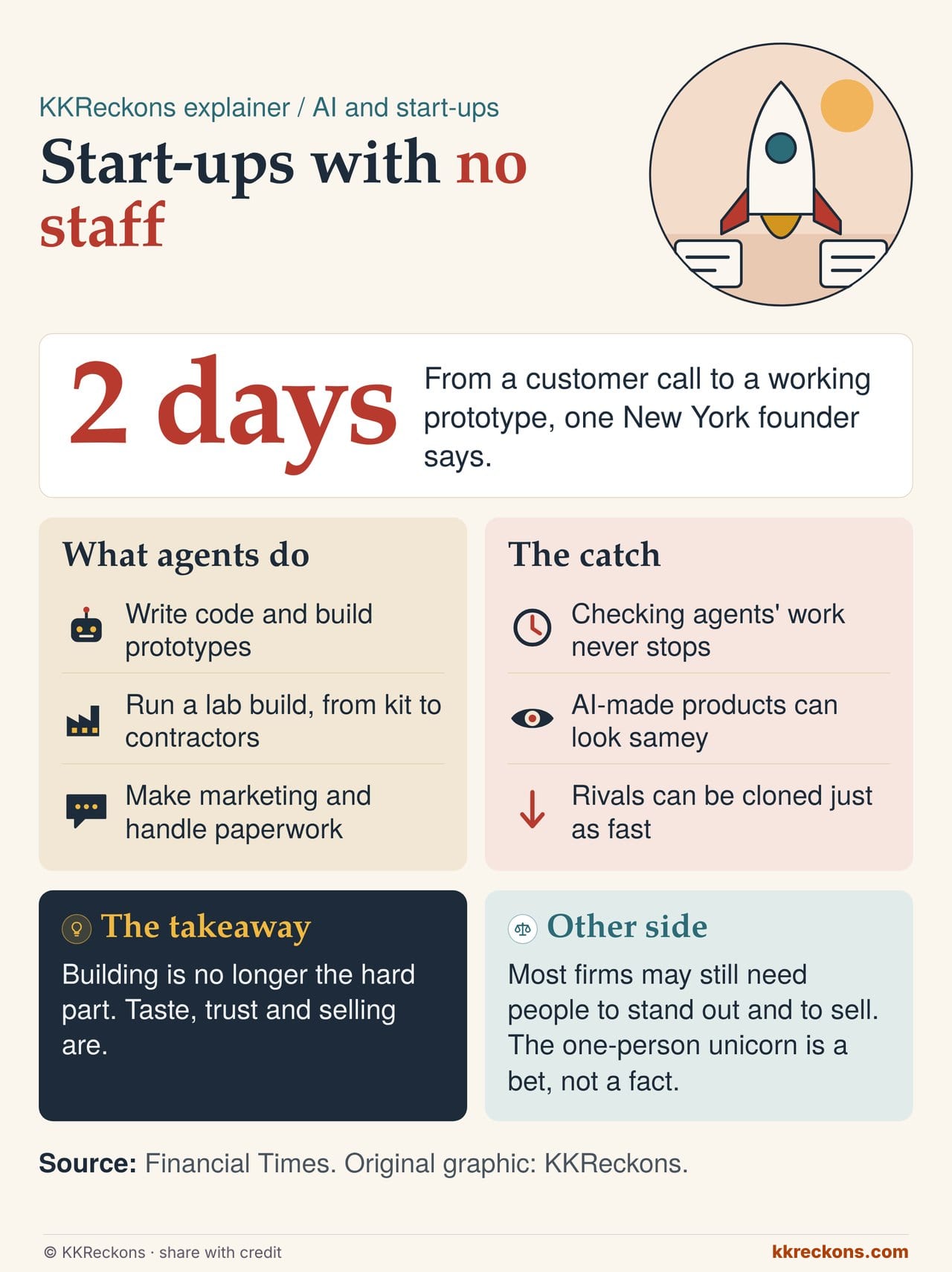
KKReckons explainer: start-ups with no staff, prototype in 2 days, what agents do and the catch
Original graphic: KKReckonsView full size ↗
  • Founders now use AI agent AI software that takes actions on its own, like booking, buying or moving money, not just answering questions. for almost every job, from code and company filings to marketing videos. A Helsinki pair has an agent running the build of their next automated biotech lab, from buying kit to directing contractors.
  • Founders date the shift to late-2025 coding tools such as Anthropic's Claude Opus 4.5 and Claude Code. One New York founder says a recorded customer call can become a working prototype two days later. Weekly US business applications have mostly stayed above 100,000 since ChatGPT launched, Apollo data show.
  • The catch: supervising agents around the clock is draining, and rivals can copy a product just as fast.

Why it matters When building costs almost nothing, the edge moves to taste, trust and selling. That helps small teams far from Silicon Valley and hurts anyone whose advantage was a big engineering department.

Other side The one-person billion-dollar company is still a bet. Malt's co-founder argues most firms will hire once AI-made products start to look alike, and more start-ups also means more clones and faster failures.

5AI toolsOpinion

AI firms tighten guardrails on DIY reverse engineering of gadgets (opens the source in a new tab)

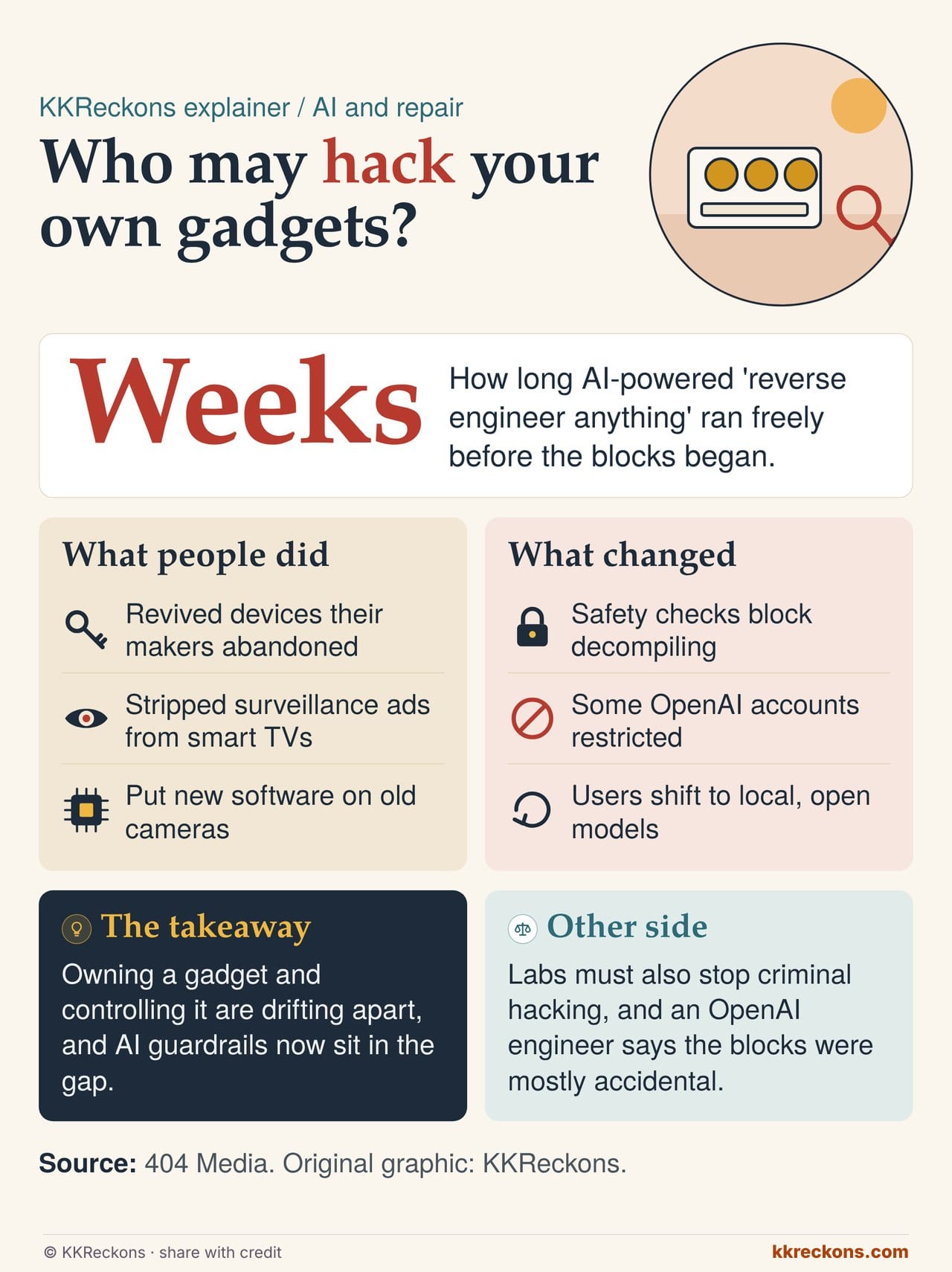
KKReckons explainer: who may hack your own gadgets, what people did with AI and what changed
Original graphic: KKReckonsView full size ↗
  • 404 Media reports that people using Claude Code and OpenAI's Codex to reverse engineer their own gadgets, from reviving abandoned smart devices to stripping ads off smart TVs, are hitting safety checks, warnings and some account bans.
  • An OpenAI engineer said the blocks were mostly accidental and are being fixed. Hobbyists and security researchers say they are shifting to local, open-weight models, many from China, that won't lock them out.
  • The author argues AI firms are shielding device makers; law professors warn cheap AI reverse engineering will test copyright, trade-secret and anti-hacking law.

Why it matters Controlling a device you bought used to take rare skills. If AI makes it trivial, the guardrails a few labs choose will decide whether right-to-repair goes mainstream or drifts to open models that nobody oversees.

Other side The skills that free a smart TV can also probe someone else's network, and labs under pressure to stop criminal hacking will err on the strict side. The real test is whether they can tell a tinkerer from an attacker.

Was this briefing useful?YesSomewhatNot really

Spotted an error? Tell us and we’ll correct it.

Today’s edition is ready

Read deep. Think clearly. Stay curious.

A daily visual briefing on the stories that matter: India, the world, and what’s next.

Read Today’s Edition →Get it by email ↗

Free · 50 editions and 359 stories so far · Unsubscribe anytime

Emails are sent by beehiiv; your address is used only for this newsletter. Privacy · Editorial standards