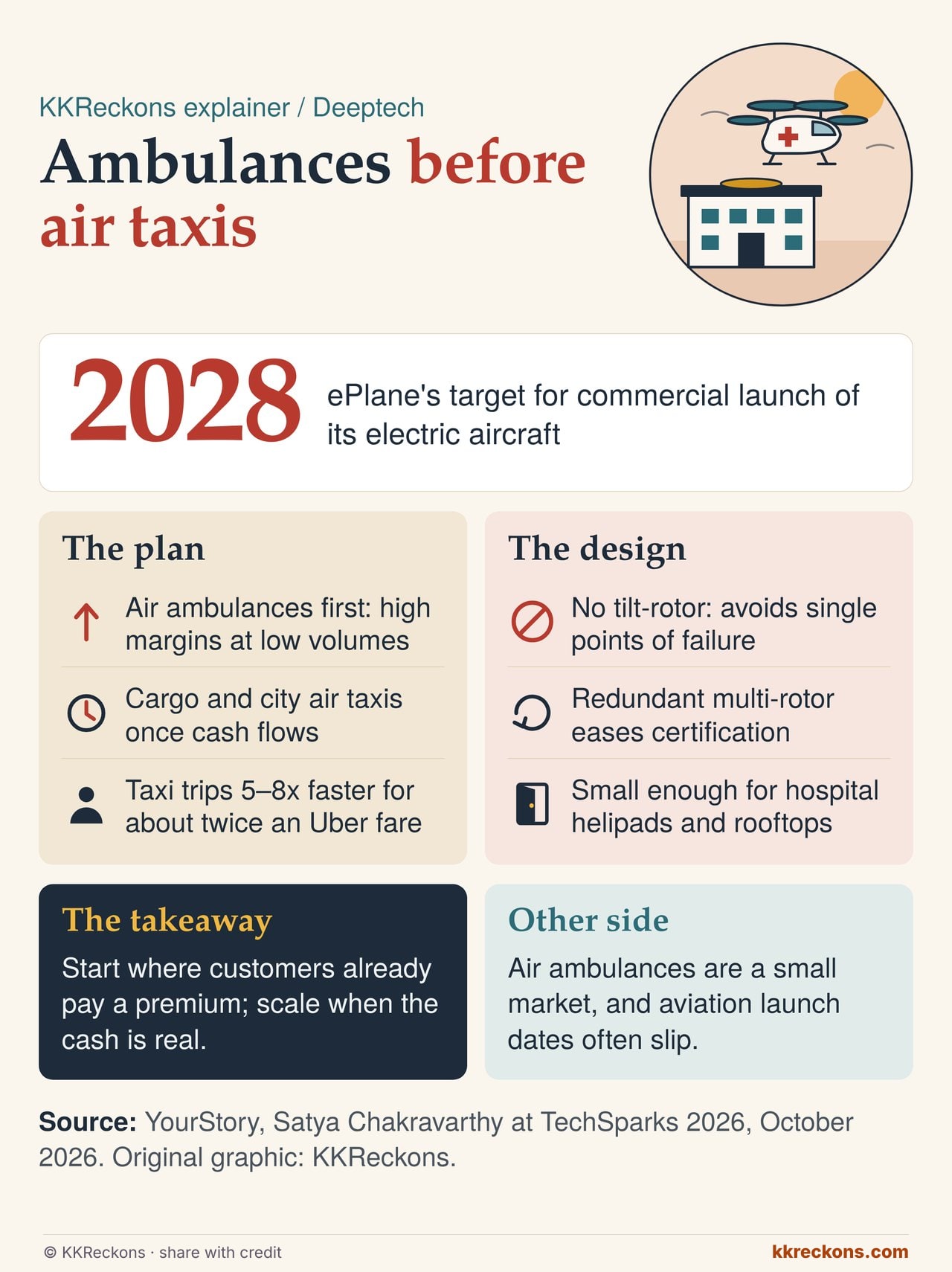
IIT Madras professor Satya Chakravarthy told YourStory's TechSparks 2026 that his ePlane Company will sell electric air ambulances before flying air taxis. Ambulances earn high margins at low volumes, bringing in cash while production scales.
Cargo and city taxis come later. He pitches a five-to-eightfold cut in travel time for roughly twice an Uber fare.
The design skips tilt-rotors, which add single points of failure, for a redundant multi-rotor that is easier to certify and small enough for hospital helipads and rooftops. Commercial launch is targeted for 2028.
2028
Commercial launch target
5–8x
Faster than road, he says
Why it matters Most flying-taxi dreams die chasing a mass market before the cash shows up. Starting where buyers already pay a premium, emergency care, is the rare deeptech plan that puts revenue ahead of the demo.
Other side Air ambulances are a small, regulated market; a few hospital contracts may not cover a certification bill this large, and aviation launch dates tend to slip. He himself calls patient capital an oxymoron.
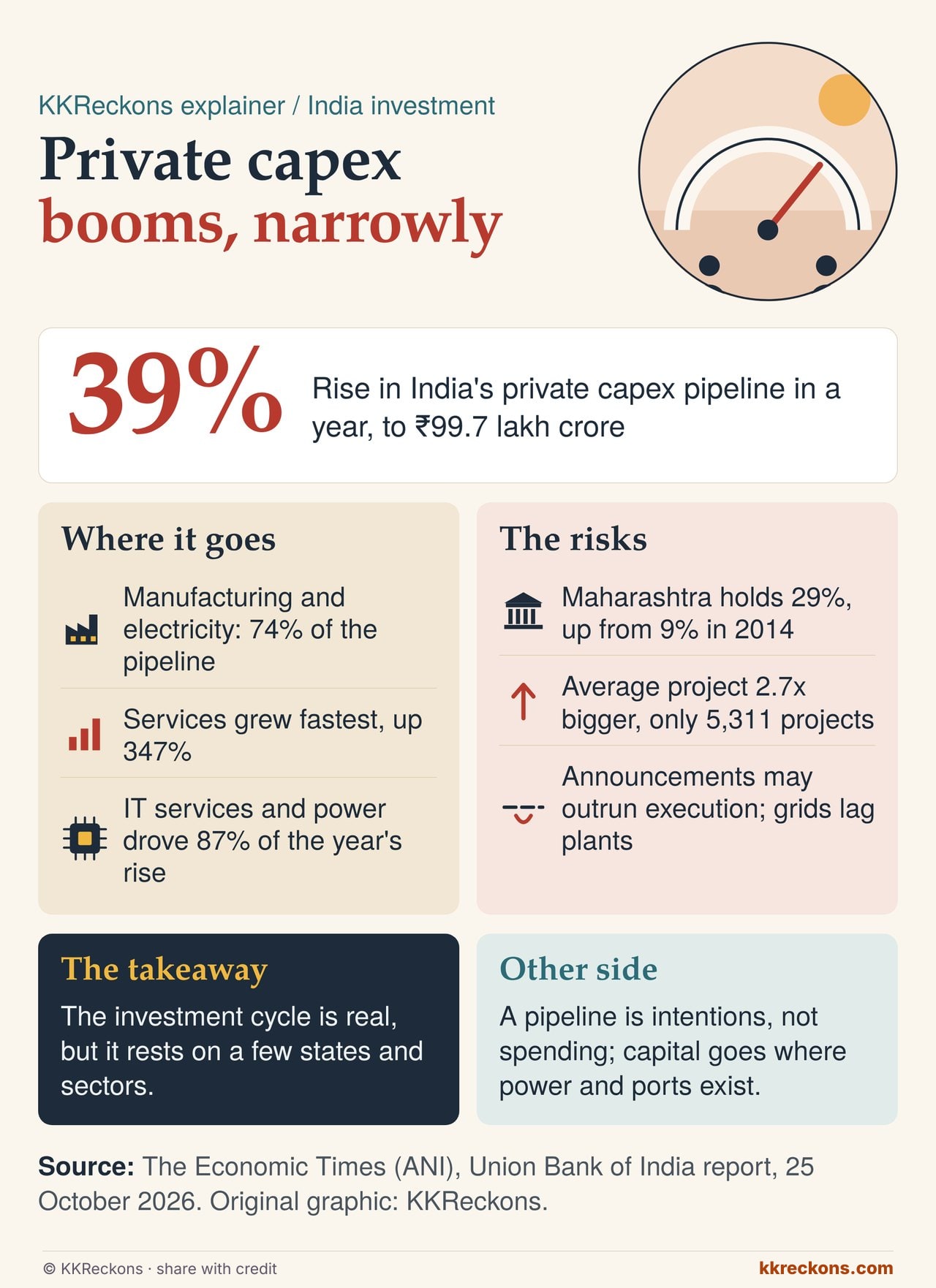
A Union Bank of India report puts India's outstanding private Capex Capital expenditure: money a company spends on long-lived things like buildings, chips and data centres. pipeline at ₹99.7 lakh crore in September 2026, up 39% in a year and 4.1 times its March 2014 level.
Projects are getting bigger rather than more numerous: the count rose only 50%, to 5,311, while the average project grew 2.7 times. Manufacturing and electricity hold 74%; services grew fastest.
Maharashtra alone holds 29%, up from 9% in 2014, and the top five states 68%. The bank warns announcements may outrun execution, and transmission lags generation.
₹99.7L cr
Private capex pipeline
29%
Share in Maharashtra
Why it matters India's investment revival is finally showing up in private order books, but on a narrow base. Lenders should watch where the money goes: fewer, larger bets, one state, two sectors.
Other side A pipeline is a list of intentions, not spending. Big tickets in power and IT services may simply follow demand, and states that already have land, power and ports will naturally draw more.
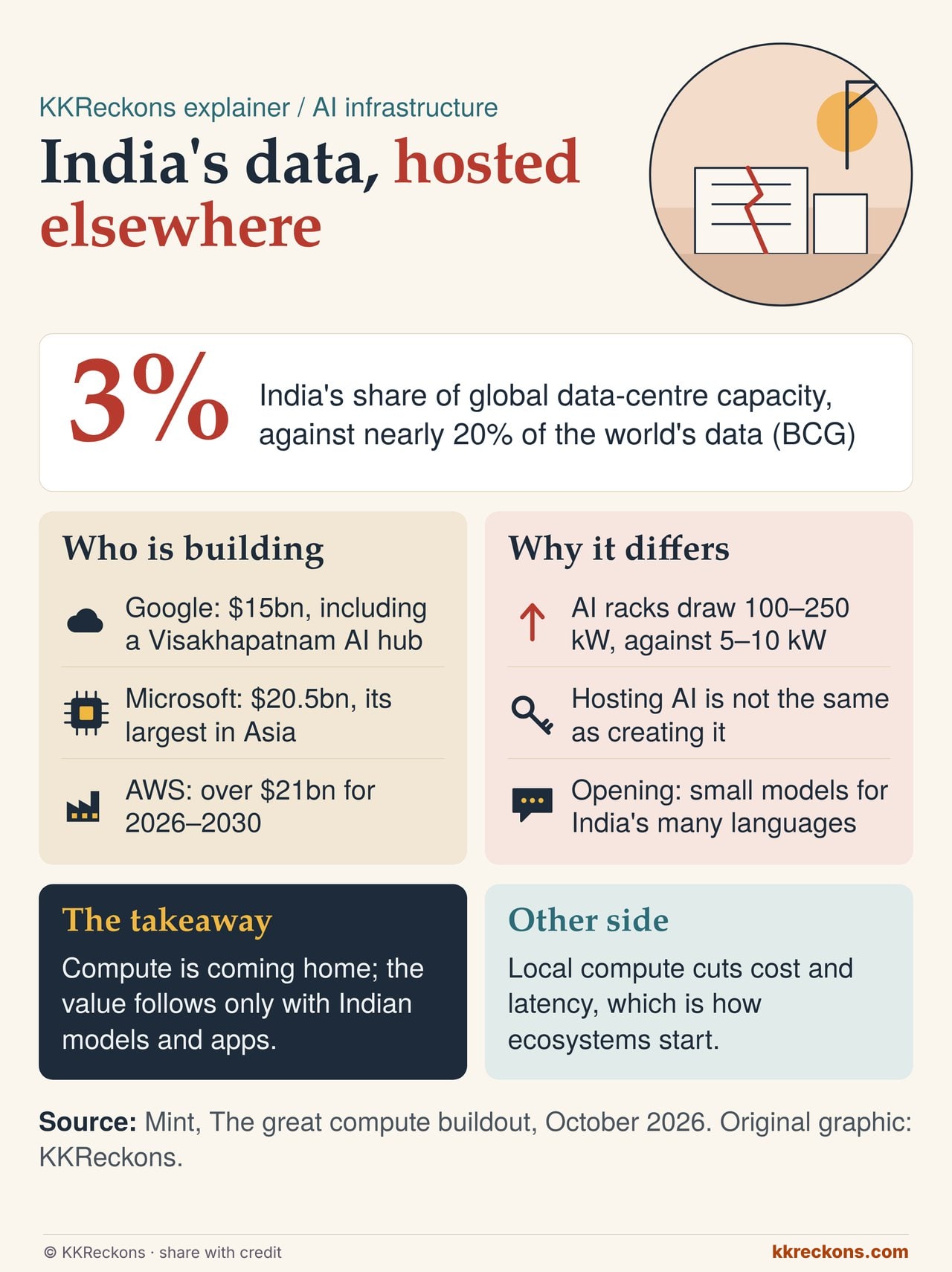
India generates nearly 20% of the world's data but holds about 3% of global data-centre capacity, Mint reports, citing BCG. Google ($15bn, including a Visakhapatnam hub), Microsoft ($20.5bn) and AWS (over $21bn for 2026–2030) are moving to close the gap.
AI racks draw 100–250 kW, against 5–10 kW for older servers, so new sites are built differently. Indian operators such as CtrlS and CapitaLand India Trust are adding capacity too.
Mint argues hosting AI is not creating it: India's edge may lie in small local-language models for farming, health and finance.
20%
Share of world data
3%
Share of data-centre capacity
Why it matters Data centres decide where AI runs and who collects the rent. Owning the buildings without the models or chips could make India a landlord rather than an owner of its own AI economy.
Other side Local compute cuts latency and cost for Indian startups, which is how ecosystems begin. And India may not need frontier-scale models to use AI well, as Mint itself argues.
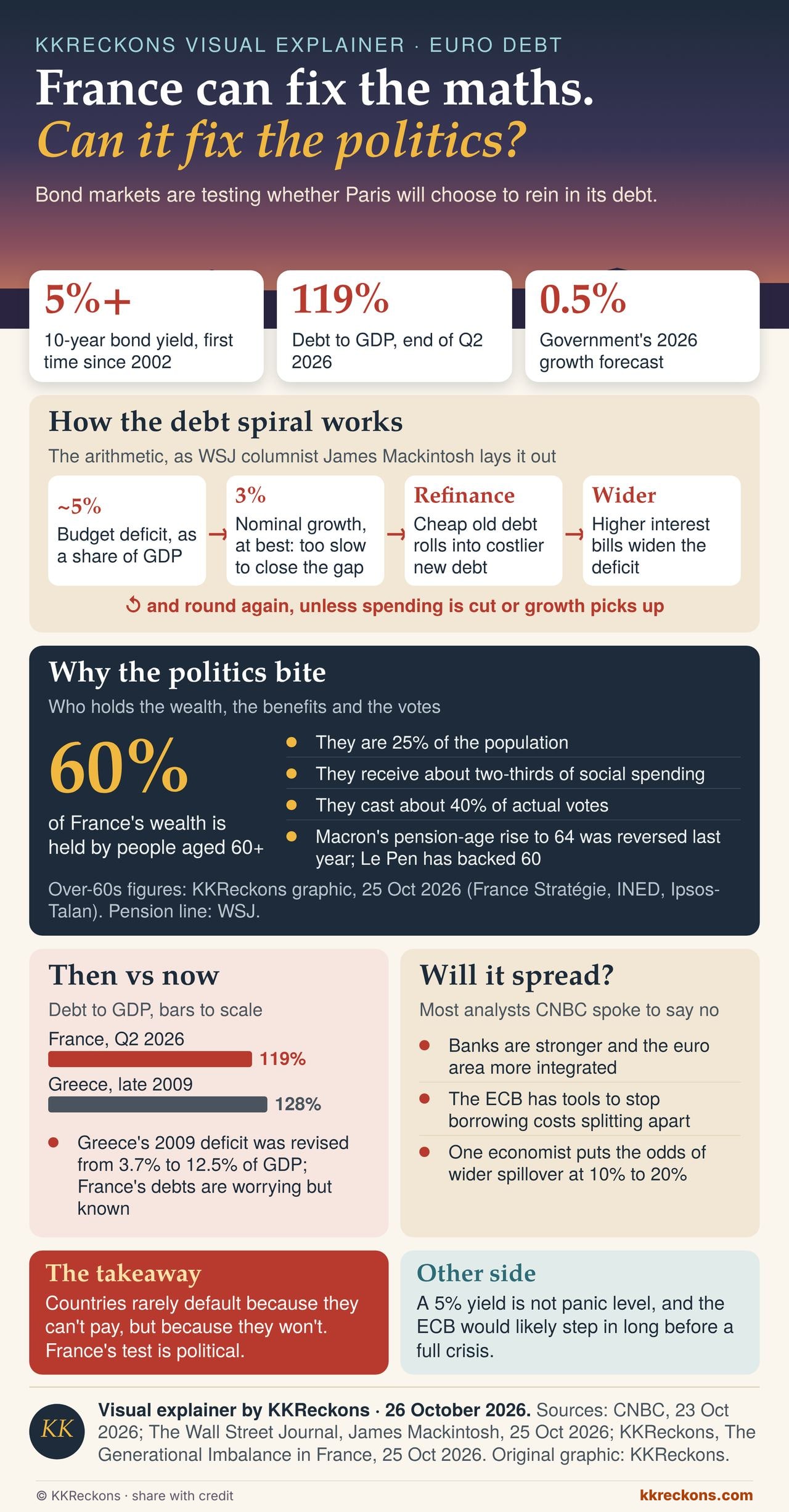
France's Bond yield The annual return a bond pays at today's price; rising yields mean borrowing is getting dearer. rose above 5% for the first time since 2002, CNBC reports, and its premium over Germany is the widest since the euro crisis. The euro is down almost 5% against the dollar this year, and 2026 growth is forecast at 0.5%.
A WSJ column by James Mackintosh calls France the weakest link in a world of higher rates: a deficit near 5% of GDP against nominal growth of 3% at best, taxes already near their limit, and voters refusing cuts.
Most analysts CNBC spoke to see contagion as limited: stronger banks, ECB tools and trusted statistics, unlike Greece in 2009.
5%+
10-year yield, first since 2002
119%
Debt to GDP, Q2 2026
0.5%
2026 growth forecast
Why it matters This is a political crisis in a bond-market costume. The maths is fixable; the politics is not, because the older voters who hold most of the wealth and turn out most also defend the pensions that make the sums hard.
Other side A 5% yield is not panic territory, and the ECB would likely step in long before Italy-style spreads. If a credible spending plan emerges after the next election, today's sell-off could look like a buying opportunity.
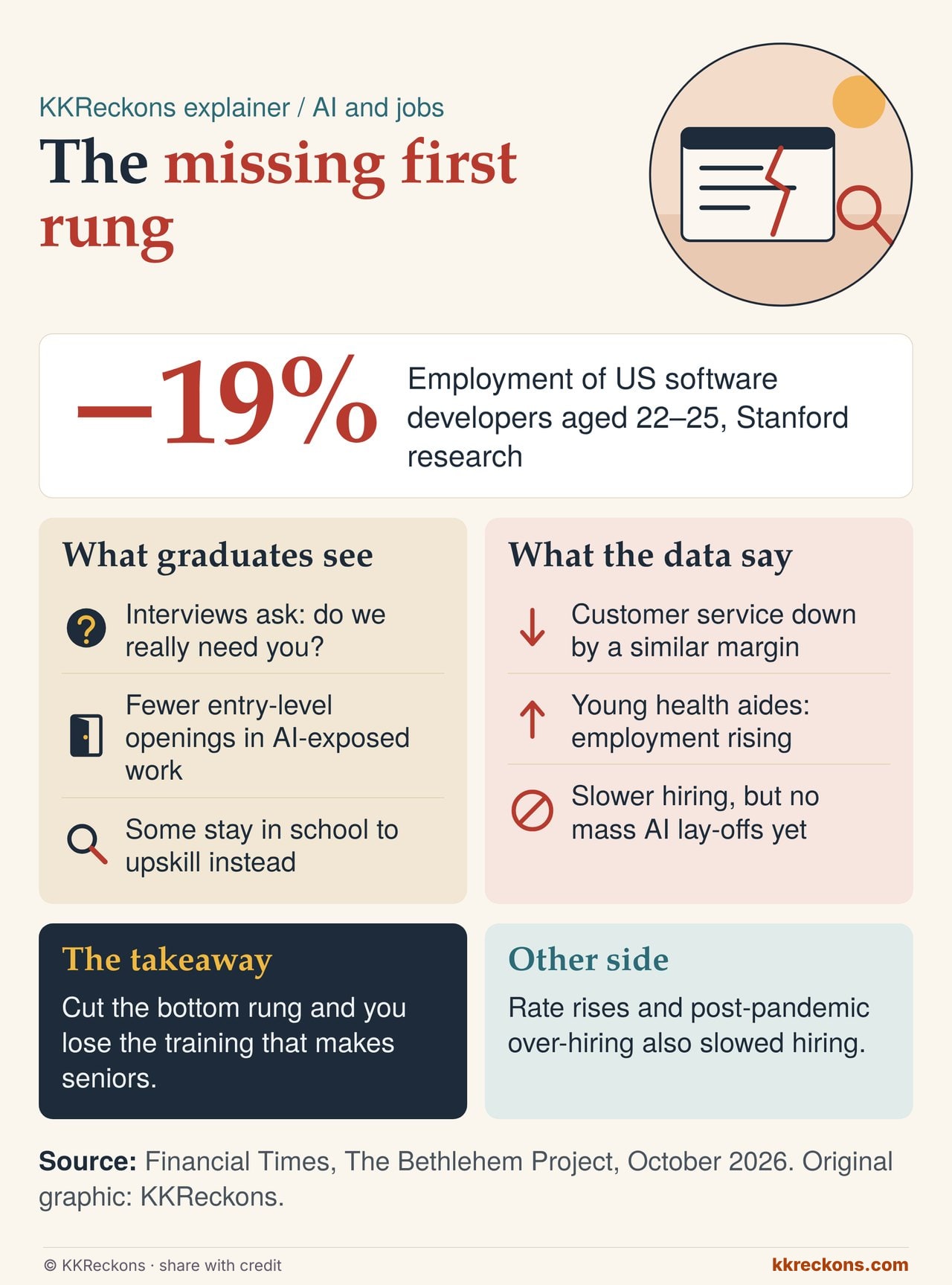
In Pennsylvania's Lehigh Valley, the FT meets young graduates who say AI is closing the door to first jobs. A 2022 computer-science graduate says almost every interview now asks whether he is needed at all.
Stanford research finds employment of software developers aged 22 to 25 down 19%, with customer service hit similarly, while jobs AI cannot do, such as health aides, are growing.
There are no mass AI lay-offs yet; the squeeze is in hiring. One Lehigh student chose a master's degree over a job hunt to stay ahead of the machines.
−19%
Software developers aged 22–25
Why it matters The first AI casualty is not the job you have but the one you never get. Cut the bottom rung and a generation loses the training that turns graduates into seniors.
Other side Hiring freezes also follow rate rises and post-pandemic over-hiring, and the data show slower hiring, not firing. Earlier technology shifts also killed entry roles before creating new ones.
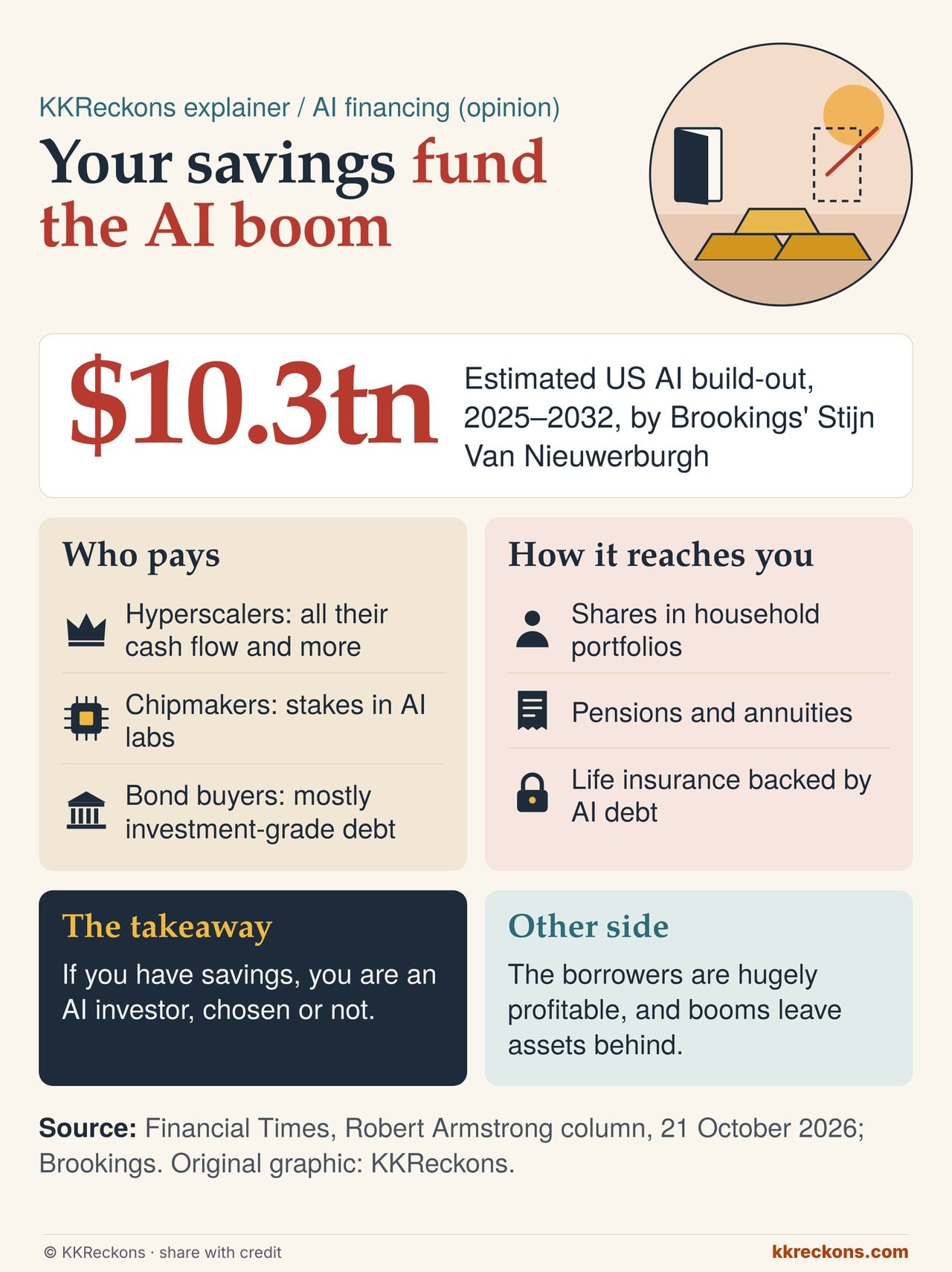
FT columnist Robert Armstrong argues that almost every big pool of capital in the rich world is now funding AI data centres, so anyone with savings is exposed.
He cites a Brookings estimate that the US build-out will cost $10.3tn through 2032, more each year than the railroad and interstate booms combined. Hyperscaler The giant cloud companies (Amazon, Microsoft, Google, Meta, Oracle) that build the biggest data centres. are spending all their cash flow, chipmakers are buying stakes in AI labs, and debt is piling up.
Most of that debt is rated investment grade, thanks to hyperscaler guarantees or chips as collateral, which lets it into pensions, annuities and life insurance.
$10.3tn
US AI build-out to 2032 (Brookings)
Why it matters AI risk no longer sits only with tech shareholders. When the guarantors and the spenders are the same companies, a demand miss would travel through retirement accounts, not just stock tickers.
Other side Investment-grade ratings reflect borrowers that are among the most profitable firms on earth, and booms that looked reckless, like the railroads, still left valuable assets behind. The risk is timing, not ruin.
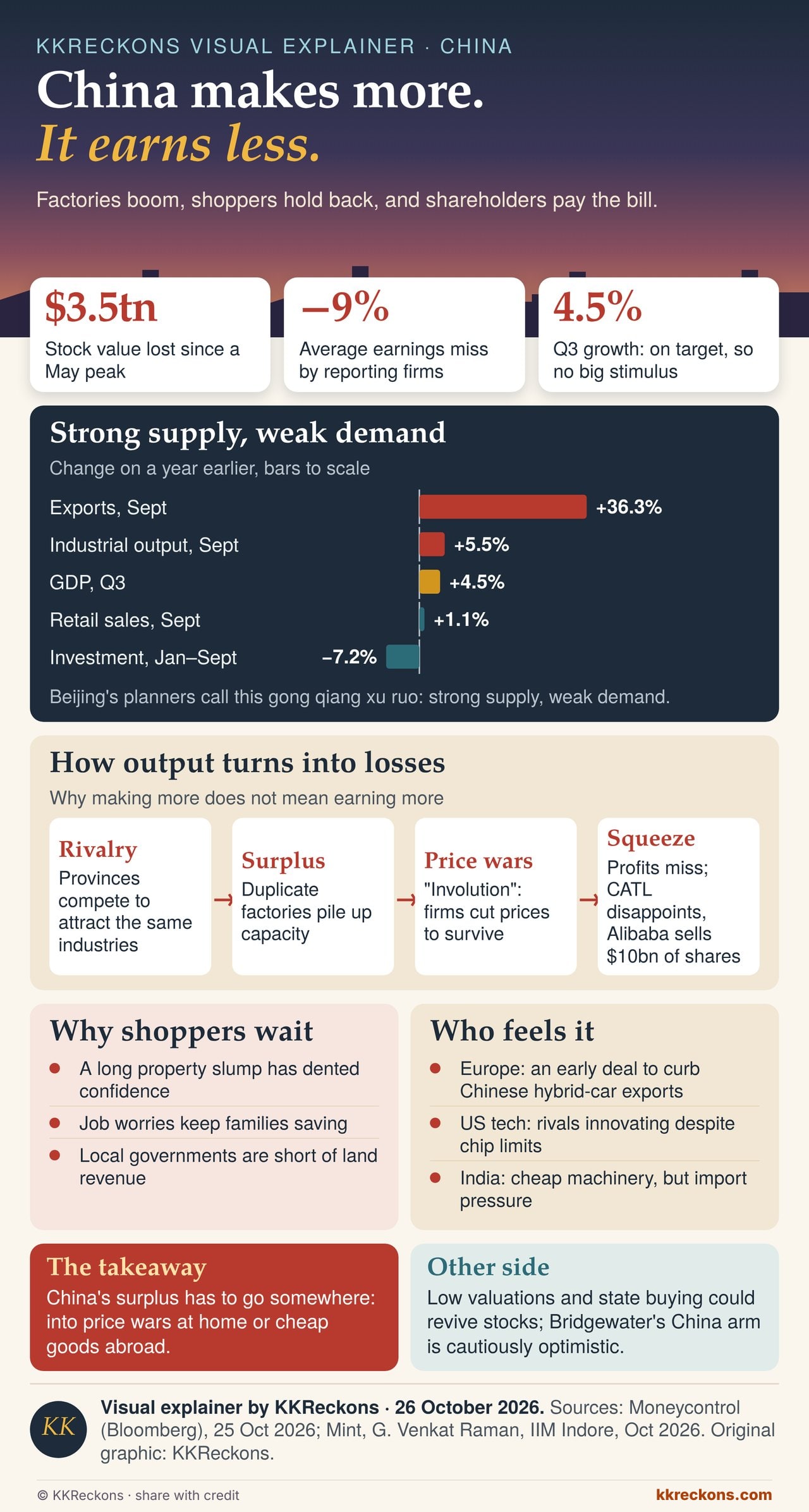
Chinese stocks have shed $3.5tn since a May peak, Bloomberg data in Moneycontrol show, pushing the CSI 300 into a bear market. Reporting MSCI China firms have missed forecasts by 9% on average, led by CATL, while cash-hungry tech giants sell shares.
A Mint column by IIM Indore's G. Venkat Raman explains why: in September exports jumped 36.3% and industrial output 5.5%, but retail sales rose just 1.1%. Beijing calls it strong supply, weak demand.
Property gloom and job worries keep households saving, and local rivalry breeds price wars. With growth on target at 4.5%, big stimulus looks unlikely.
$3.5tn
Stock value lost since May
+36.3%
September exports
+1.1%
September retail sales
Why it matters China shows that winning on production does not mean winning on profits. The surplus it cannot sell at home lands abroad as cheap goods, so Europe, America and India all inherit China's demand problem.
Other side Low valuations, state buying and low Bond yield The annual return a bond pays at today's price; rising yields mean borrowing is getting dearer. can pull money back fast, and Bridgewater's China arm is cautiously optimistic. A credible push on household incomes from the Fifth Plenum would change the story.
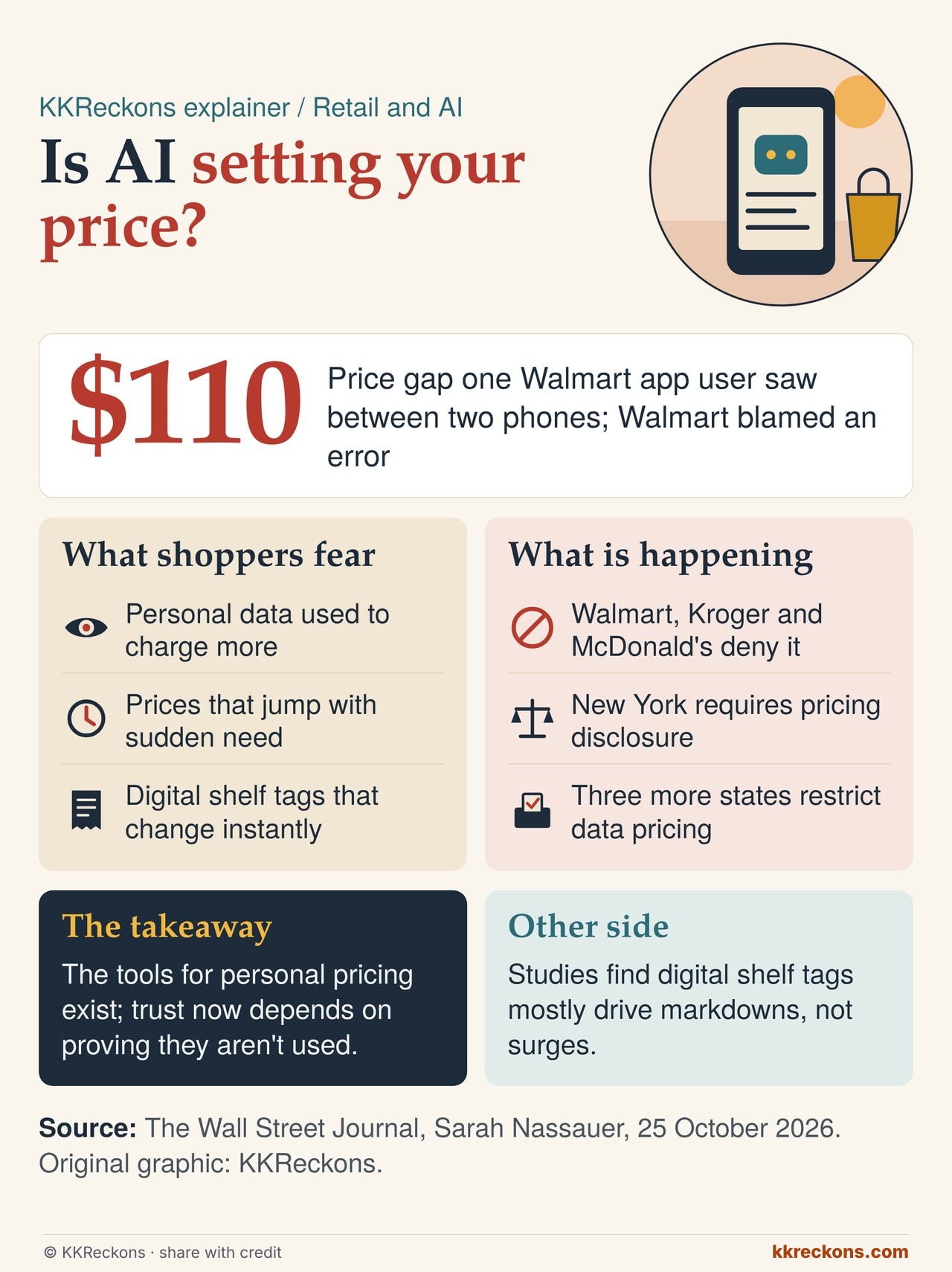
American shoppers increasingly believe stores, restaurants and ride-hailing apps use AI and personal data to charge them more, the WSJ reports. One Walmart app user saw a hard drive listed $110 cheaper on his wife's phone; Walmart blamed a since-fixed error.
Walmart, Kroger and McDonald's deny pricing by who is buying. Walmart's chief executive wrote: "We price the product, not the person."
Lawmakers are moving anyway. New York requires disclosure of algorithmic pricing, Maryland, Connecticut and New Jersey restrict data-driven pricing, and the FTC has proposed penalising deceptive personalised prices.
$110
Price gap between two phones
Why it matters Pricing runs on trust. Even if no retailer is doing it, the patents, data and digital shelf tags make it possible, and shoppers squeezed by inflation are ready to assume the worst.
Other side Studies of digital shelf labels in the US and Europe find they mostly enable markdowns on food near expiry, not surge pricing. Colorado's governor vetoed a ban because it would also have outlawed targeted discounts.