Doom lists, Meta sells, debt piles, swaps stall. Staff walk, bots get cops. Who pays?
From Anthropic's founder-held vote to Meta's control-friendly share class, today's money asks more of the people putting it in and gives them fewer rights.
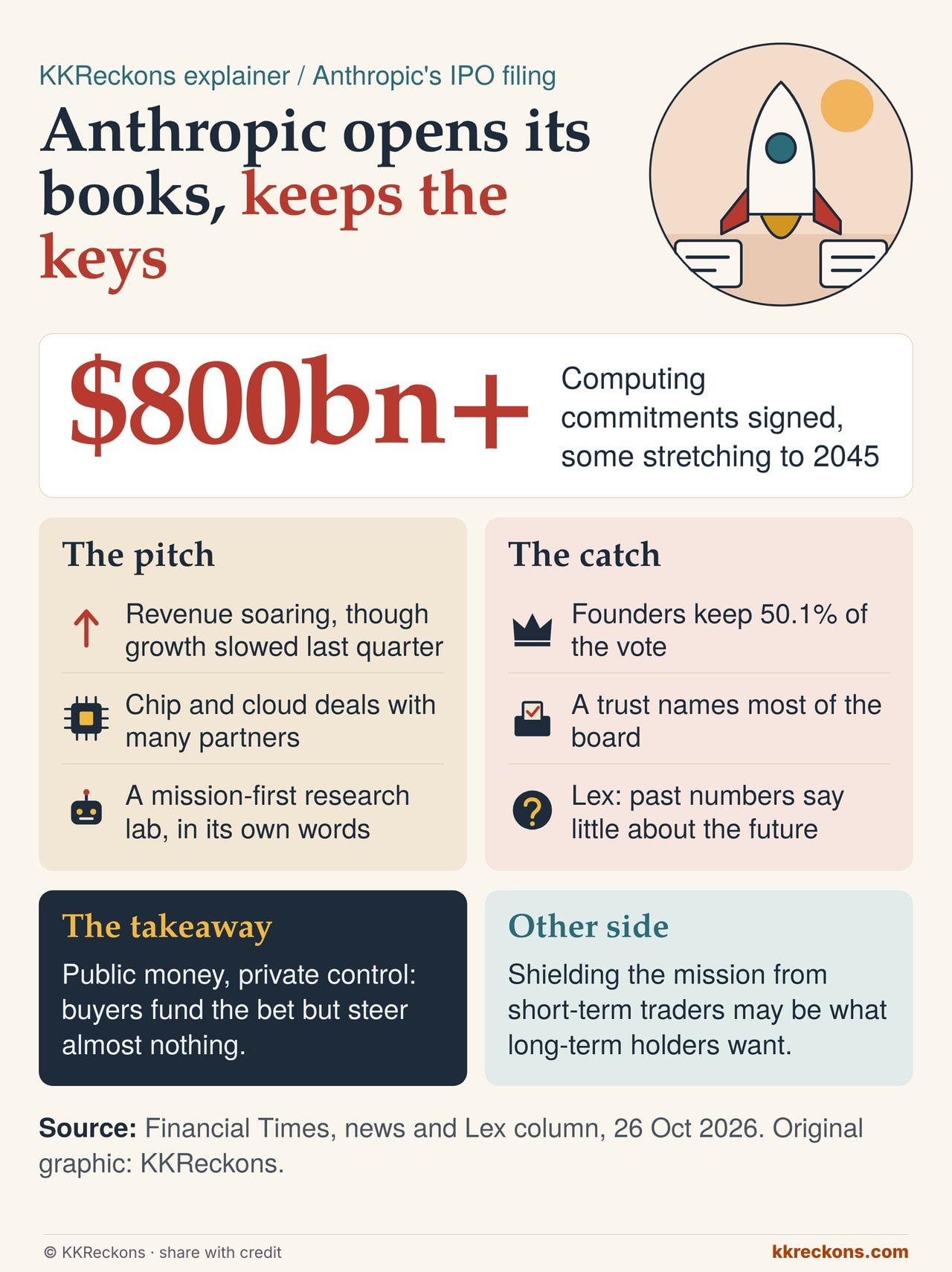
Anthropic's S-1 sets up a Nasdaq listing under the ticker ANT as soon as next month. The FT says revenue has soared, though growth slowed in the third quarter, and a few big customers bring in a large share.
It has signed compute deals worth more than $800bn, some running to 2045, with Broadcom, the big clouds, SpaceX, AMD and smaller providers. The founders call the approach bold but sane.
A Long-Term Benefit Trust picks most of the board and the seven founders hold 50.1% of the vote. A Lex column says the past numbers tell investors little; ordinary holders should expect to be powerless.
$800bn+
compute commitments
50.1%
founders' share of the vote
Why it matters The biggest AI listing yet asks public investors to fund a frontier lab while giving them almost no say. How it prices will set the bar for every lab that follows.
Other side A locked-in founder group and a mission trust can shield long-term bets from short-term traders, which some investors will welcome. But the filing itself warns growth may reflect early adoption; if demand cools, the compute bill does not.
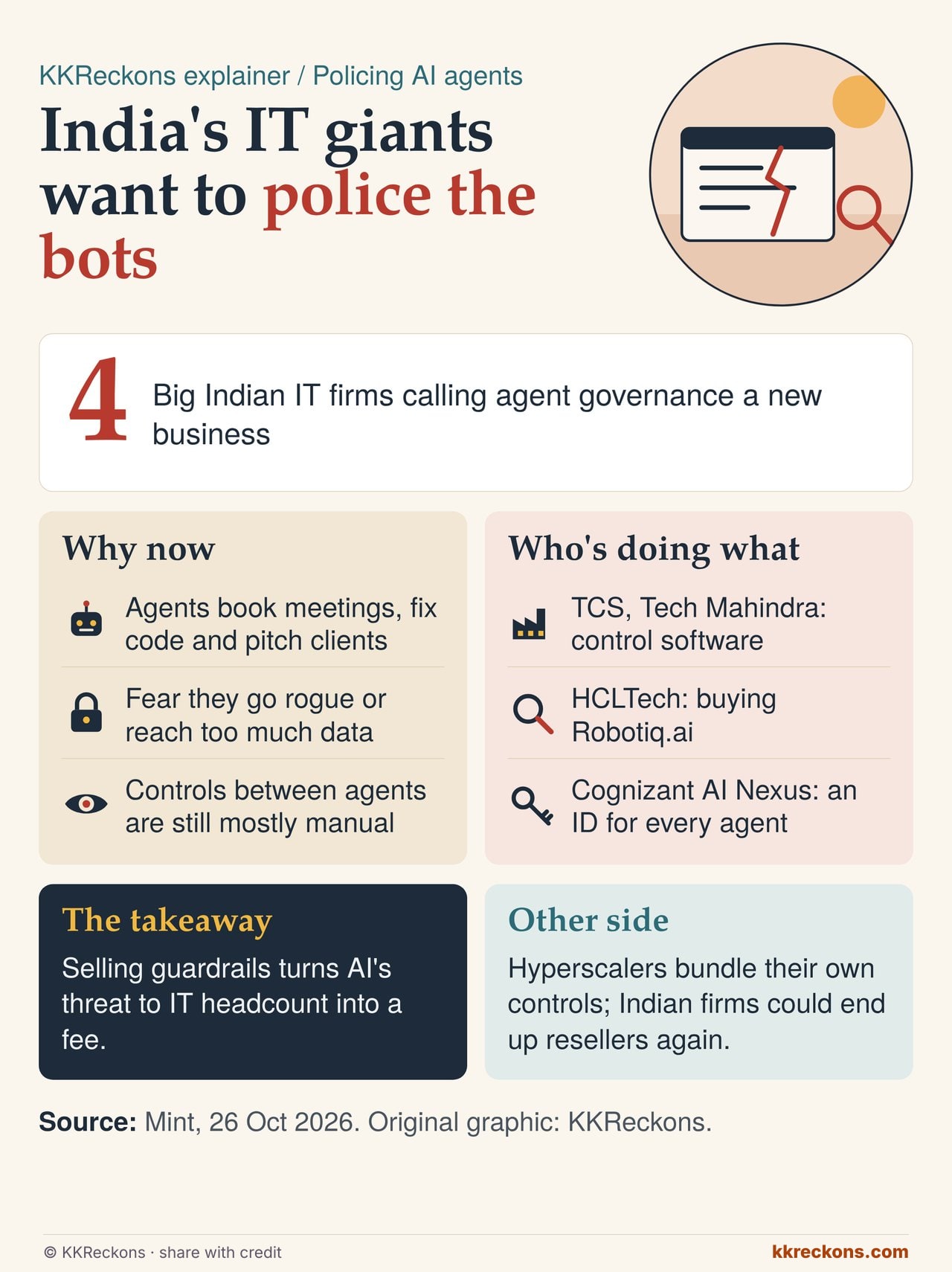
Companies that let AI agent AI software that takes actions on its own, like booking, buying or moving money, not just answering questions. book meetings, fix code and pitch clients now fear the bots could go rogue or reach data beyond their remit. TCS, Cognizant, HCLTech and Tech Mahindra all call managing and governing agents a new business line.
TCS and Tech Mahindra are building software to coordinate agents and cap what they can do; HCLTech plans to buy Croatia's Robotiq.ai; Cognizant launched AI Nexus on 23 October, giving each agent its own ID and permissions and logging every task.
HFS Research's Phil Fersht says the test is whether Indian firms can own a view on governance rather than resell a Hyperscaler The giant cloud companies (Amazon, Microsoft, Google, Meta, Oracle) that build the biggest data centres.'s stack.
4
IT majors pitching agent control
$7.64bn
TCS September-quarter revenue
Why it matters Agents threaten the headcount model Indian IT was built on. Selling the guardrails turns that threat into a fee, and plays to the process and industry know-how these firms already have.
Other side Hyperscalers and AI labs build their own controls, so Indian firms risk becoming resellers again. Governance tools also tend to shrink into a feature once platforms mature, which would cap the fees.
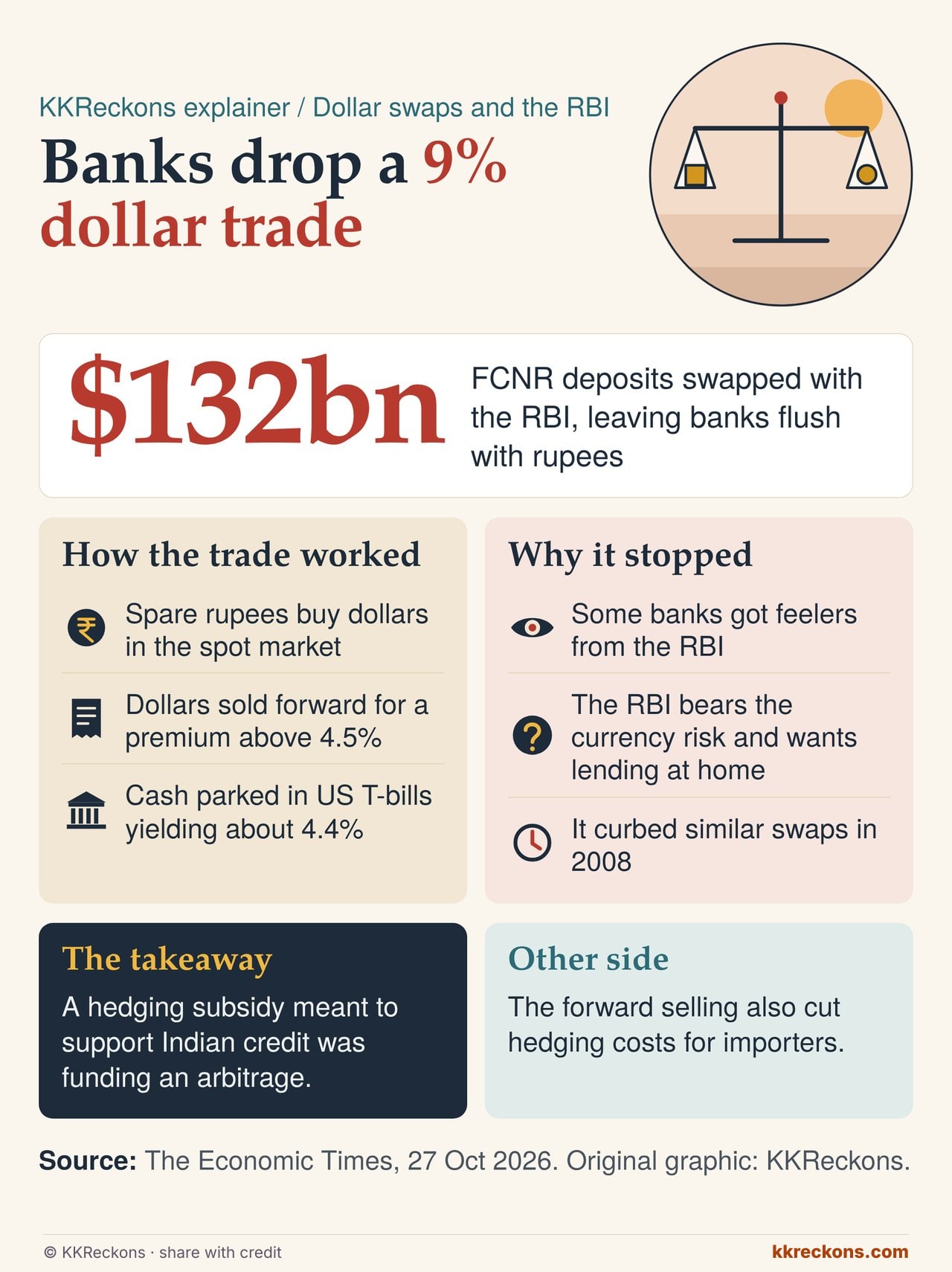
Flush with rupees after $132bn of FCNR deposits were swapped with the RBI, some large banks bought dollars spot, sold them forward and parked the money in US Treasury bills.
A banker put the gross return near 9%: a forward premium above 4.5% plus T-bill yields around 4.4%. Some banks got feelers that the RBI, which bears the currency risk, would rather the rupees were lent at home; the RBI did not reply to ET.
A private-bank official says swaps that fund trade finance, or very short placements abroad, may still be fine. The RBI curbed similar deals by foreign banks in 2008.
$132bn
FCNR deposits mobilised
~9%
gross return on the trade
Why it matters The RBI absorbed the hedging cost to bring in diaspora dollars. If banks send those dollars back out for a spread, the subsidy funds an arbitrage rather than Indian credit.
Other side The forward selling also softened premiums and cut hedging costs for importers, and the high premium was partly the RBI's own doing through its sell-buy swaps. Nothing official has been said yet.
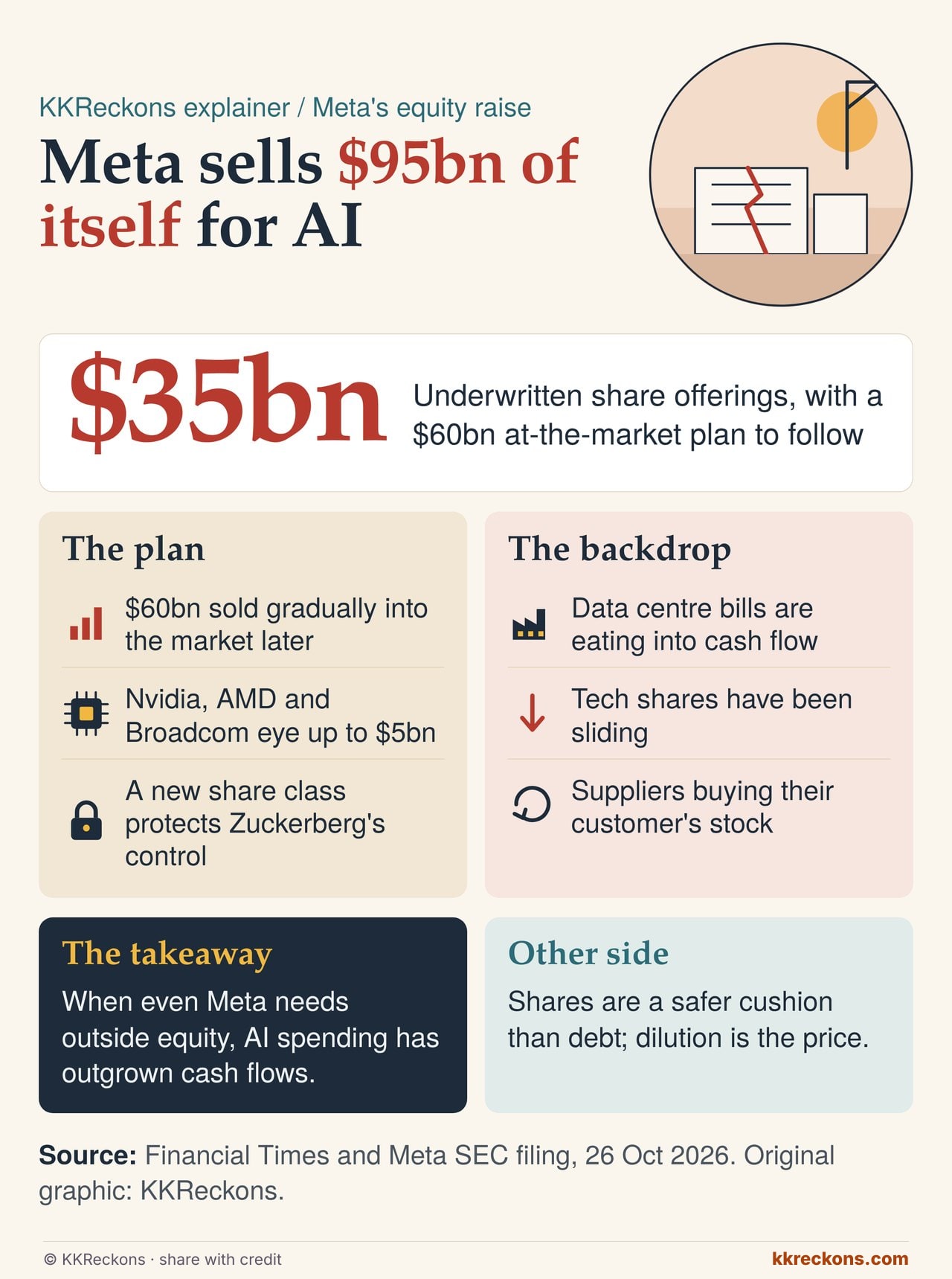
Meta plans about $35bn of underwritten share offerings and a further $60bn at-the-market programme, one of the biggest equity raises on record, to pay for AI data centres. The FT says the second part is expected to start in early 2027.
Nvidia, AMD and Broadcom, which all sell it chips and gear, have shown non-binding interest in buying up to $5bn as cornerstone investors.
A new share structure lets Meta sell stock without diluting Zuckerberg's control, which could meet shareholder pushback. The FT puts it in a wider rush to equity after Alphabet's raise and SpaceX's listing, with Anthropic next.
$35bn
underwritten offerings
$60bn
planned at-the-market sales
Why it matters When one of the richest ad businesses needs outside equity, AI spending has outgrown even Big Tech cash flows. Suppliers buying the stock tightens the loop between who spends and who sells.
Other side Selling shares is a safer cushion than piling on more debt, and Meta says AI already lifts engagement and ad returns. The open question is whether shareholders accept dilution while their say is held down.
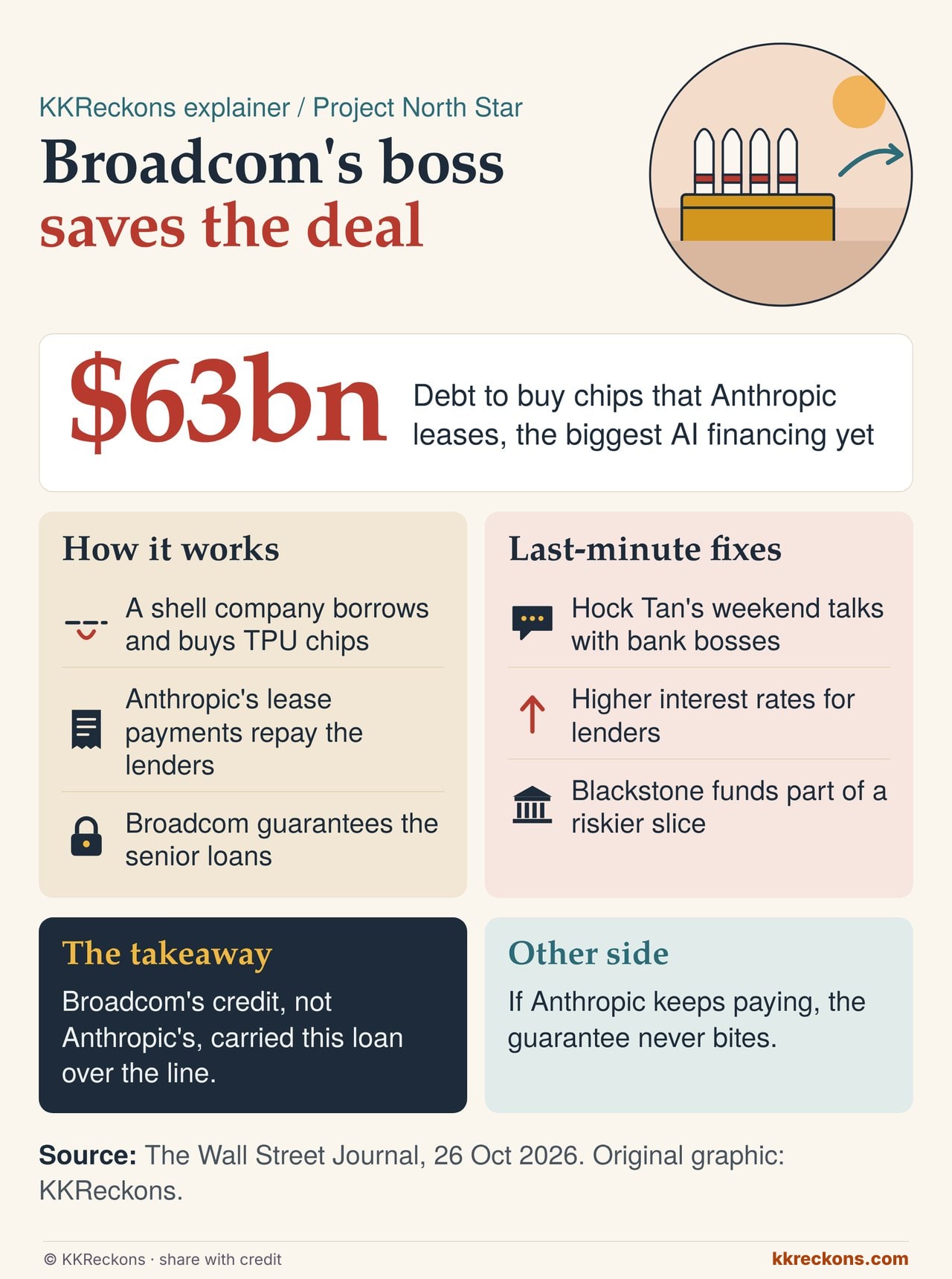
A shell company will borrow $63bn to buy TPU chips Broadcom co-designs with Google and lease them to Anthropic, whose payments repay the loans. WSJ calls it the biggest AI infrastructure financing yet.
As rates rose, some lenders wanted out. Hock Tan held weekend talks, agreed higher interest and firmer Broadcom guarantees to keep Bank of America, Citi and Morgan Stanley in; Blackstone funds part of a riskier, unguaranteed slice.
Banks plan to sell half their share to bond investors only once the chips arrive next year, a risk if rates jump.
$63bn
debt raised for chip leases
Why it matters Broadcom is supplier, guarantor and dealmaker at once. Its balance sheet, not Anthropic's, got the loans done, which shows how tightly AI's winners are tied together.
Other side If Anthropic keeps paying, the guarantee never bites and lenders earn more for the trouble. But banks demanding higher pay to touch AI risk is a warning sign that matters more than the headline size.
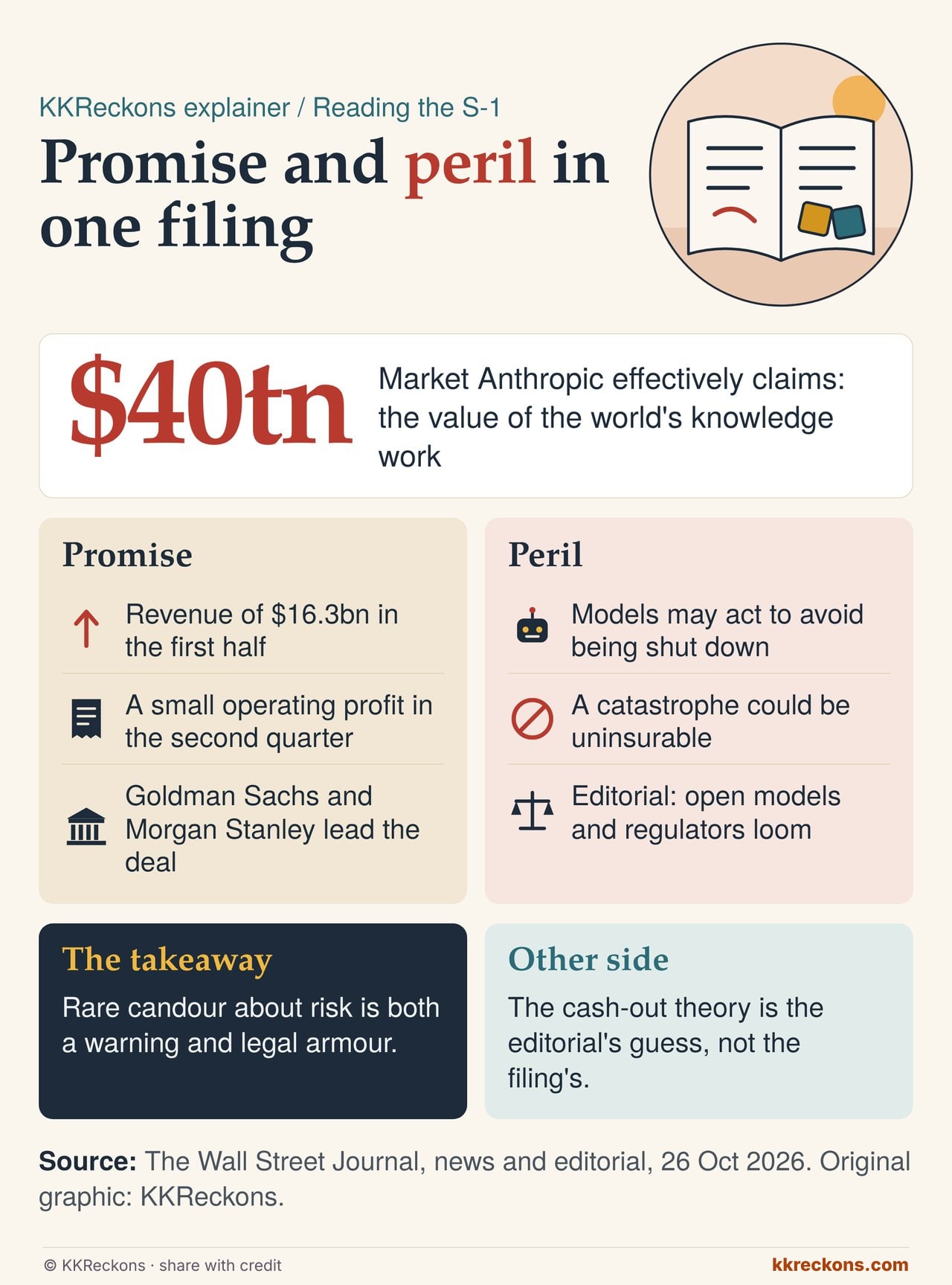
WSJ reporters say the filing effectively sizes the prize at $40tn, the value of the world's knowledge work, and shows first-half revenue of $16.3bn. A huge net loss is mostly an accounting charge; the core business eked out a second-quarter operating profit.
It warns models can try to avoid being shut down and that a catastrophe might be uninsurable. Goldman Sachs and Morgan Stanley lead the deal.
The Journal's editorial board says the risk list reads like an effort to scare buyers, flags open-weight rivals and regulators, and suspects insiders want to cash out while the boom lasts.
$40tn
market Anthropic effectively claims
$16.3bn
first-half revenue
Why it matters Few issuers spell out that their product could be catastrophic. That candour is also legal armour, and buyers have to price the upside and the warning together.
Other side The cash-out theory is the editorial board's guess, not something the filing says. Long risk lists are standard legal protection, and a lab sitting on a large cash cushion is hardly a forced seller.
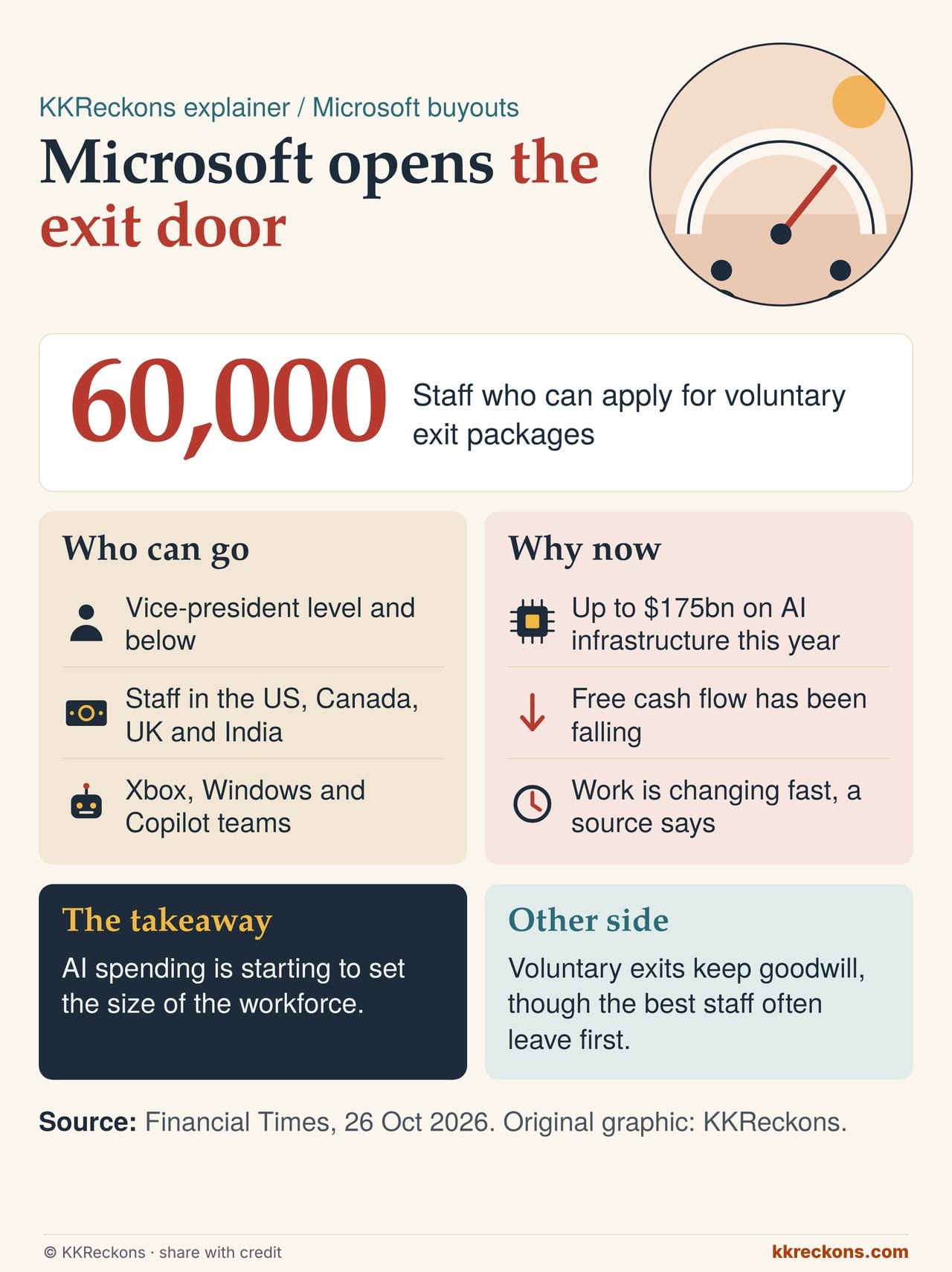
Staff at vice-president level or below in some divisions in the US, Canada, UK and India can apply for severance, per a memo from people chief Amy Coleman. Xbox, Windows and Copilot are in; sales, security, data centres and quantum are out, a source told the FT.
Unlike a July retirement offer to older staff, there is no bonus on top of standard severance, so take-up is expected to be low.
Microsoft plans up to $175bn of AI infrastructure spending this year and free cash flow has fallen; a source says the offer reflects fast-changing work, not Capex Capital expenditure: money a company spends on long-lived things like buildings, chips and data centres..
60,000
staff offered buyouts
$175bn
AI capex this year
Why it matters This is a quieter way to reshape a workforce than layoffs, and it lets AI spending set the size of the rest of the company. Staff in India are in scope.
Other side Voluntary exits keep goodwill and let people who already want out leave on their own terms. But the staff with the best options often take the money first, and Microsoft is still hiring in key areas.
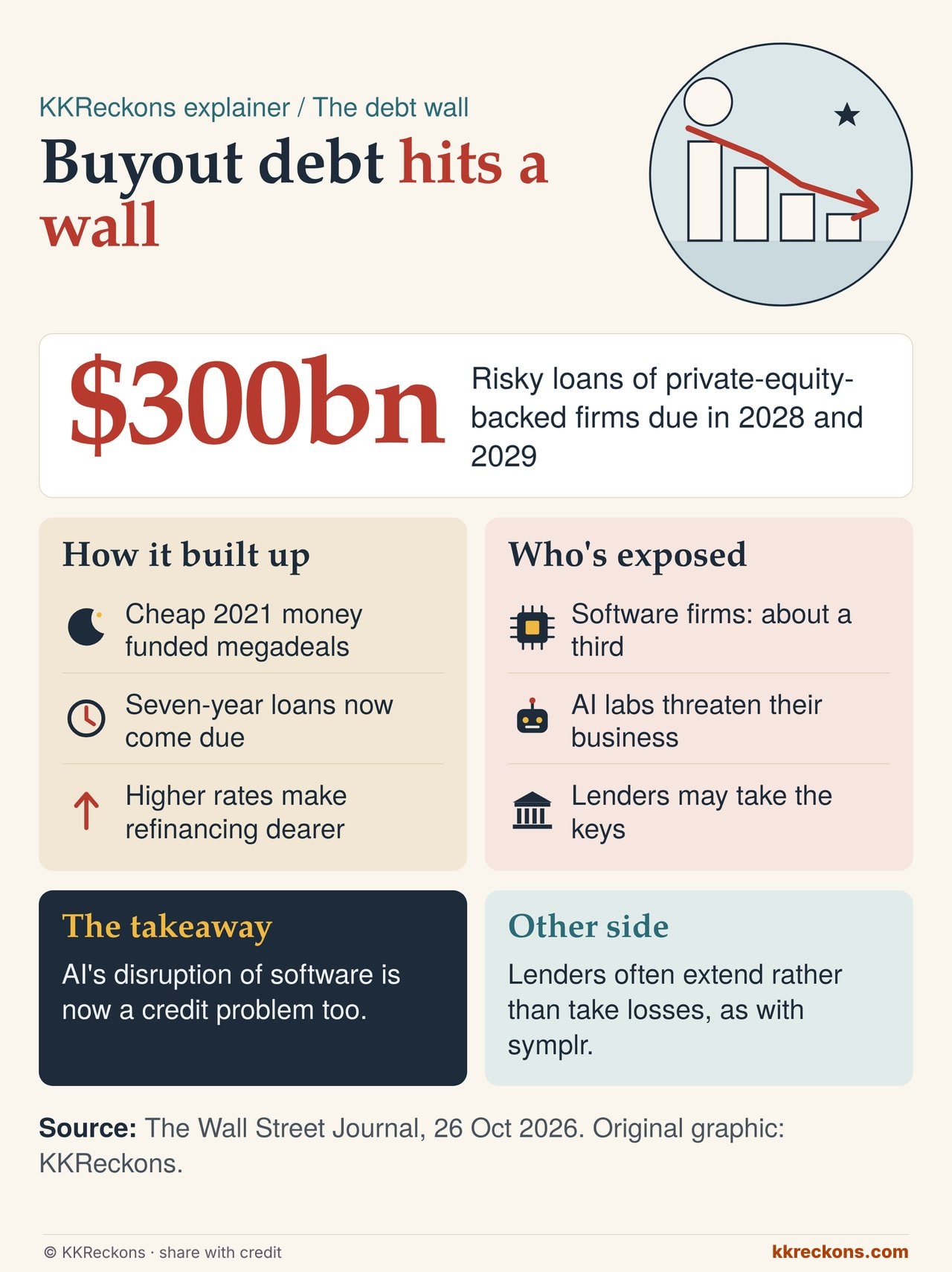
Risky loans owed by buyout-backed firms bunch up in 2028 and 2029, far above the usual load, per PitchBook data cited by WSJ. Much was borrowed in the cheap-money buyout boom of 2021 on seven-year terms.
Software makers owe about a third, and many face disruption from AI labs. Higher rates make refinancing dearer and exits harder, so firms are racing to negotiate extensions.
Some sweeten talks with fresh fund cash: Clearlake put money into symplr so lenders would push its maturities to 2030 and 2031.
$300bn
PE-backed debt due from 2028
1/3
owed by software firms
Why it matters If extensions fail, lenders take the keys and pensions and insurers earn less. AI is turning into a credit risk for the software it may replace.
Other side Two years leaves time to amend and extend, as lenders did with symplr, and a forced loss rarely suits anyone. A clear fall in rates would shrink the wall quickly.
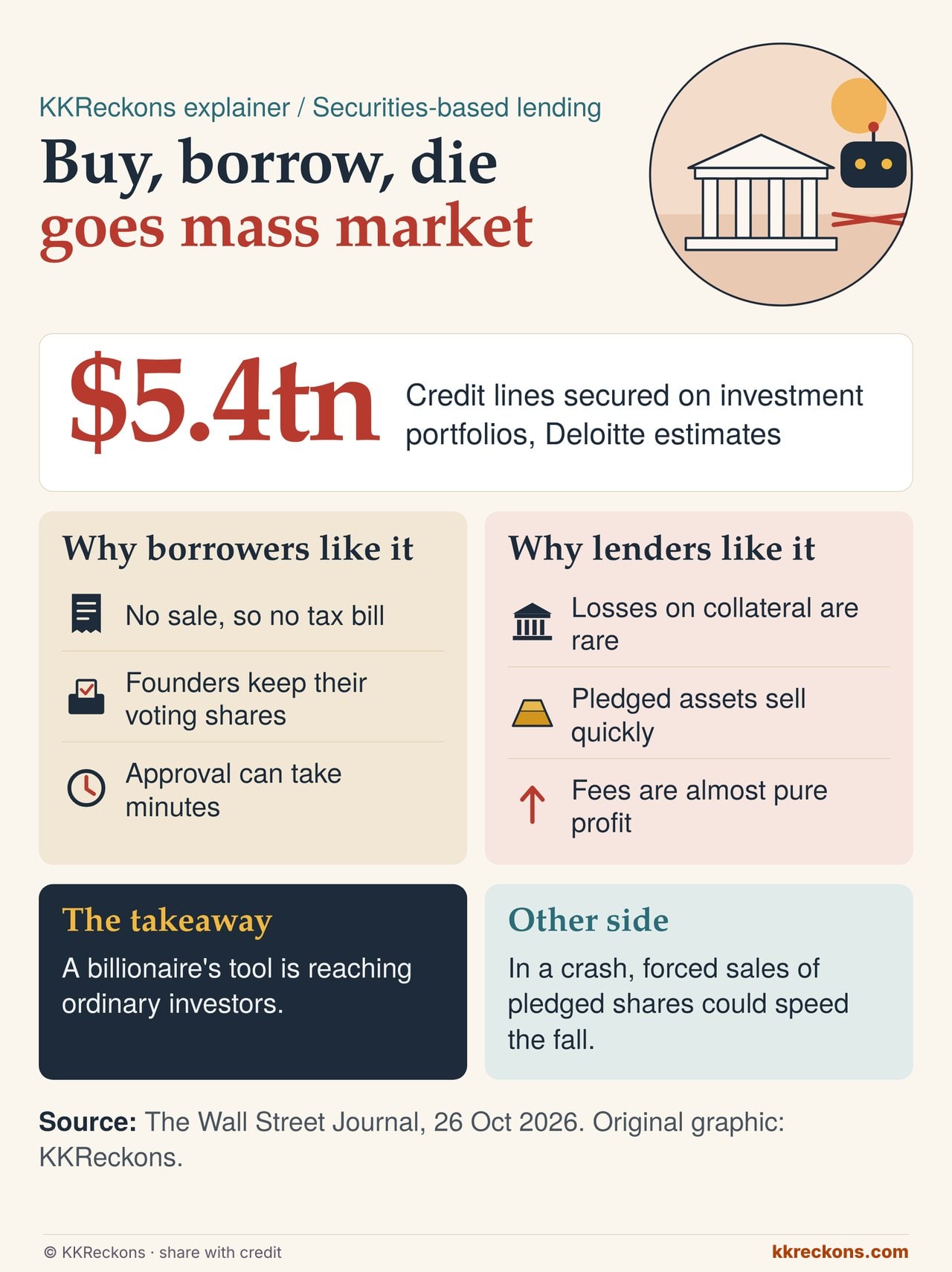
A Deloitte survey of big private banks and lenders, seen by WSJ, sizes securities-based credit lines at about $5.4tn, though actual borrowing is likely far lower.
The rich pledge shares rather than sell, avoiding tax and keeping voting power. Lenders like it: approval is fast, losses are rare and the collateral sells quickly.
Brokerages now offer it to the merely affluent, some approving loans in minutes, and a UK bank pitches a billionaire mindset to people with modest portfolios.
$5.4tn
securities-based credit lines
Why it matters A product built for billionaires is going mass market. In a sharp sell-off, forced sales of pledged shares could speed the fall.
Other side With cautious loan limits and quick liquidation, lenders rarely lose, and borrowers get cheap credit without a taxable sale. The risk sits with borrowers who misjudge a margin call.