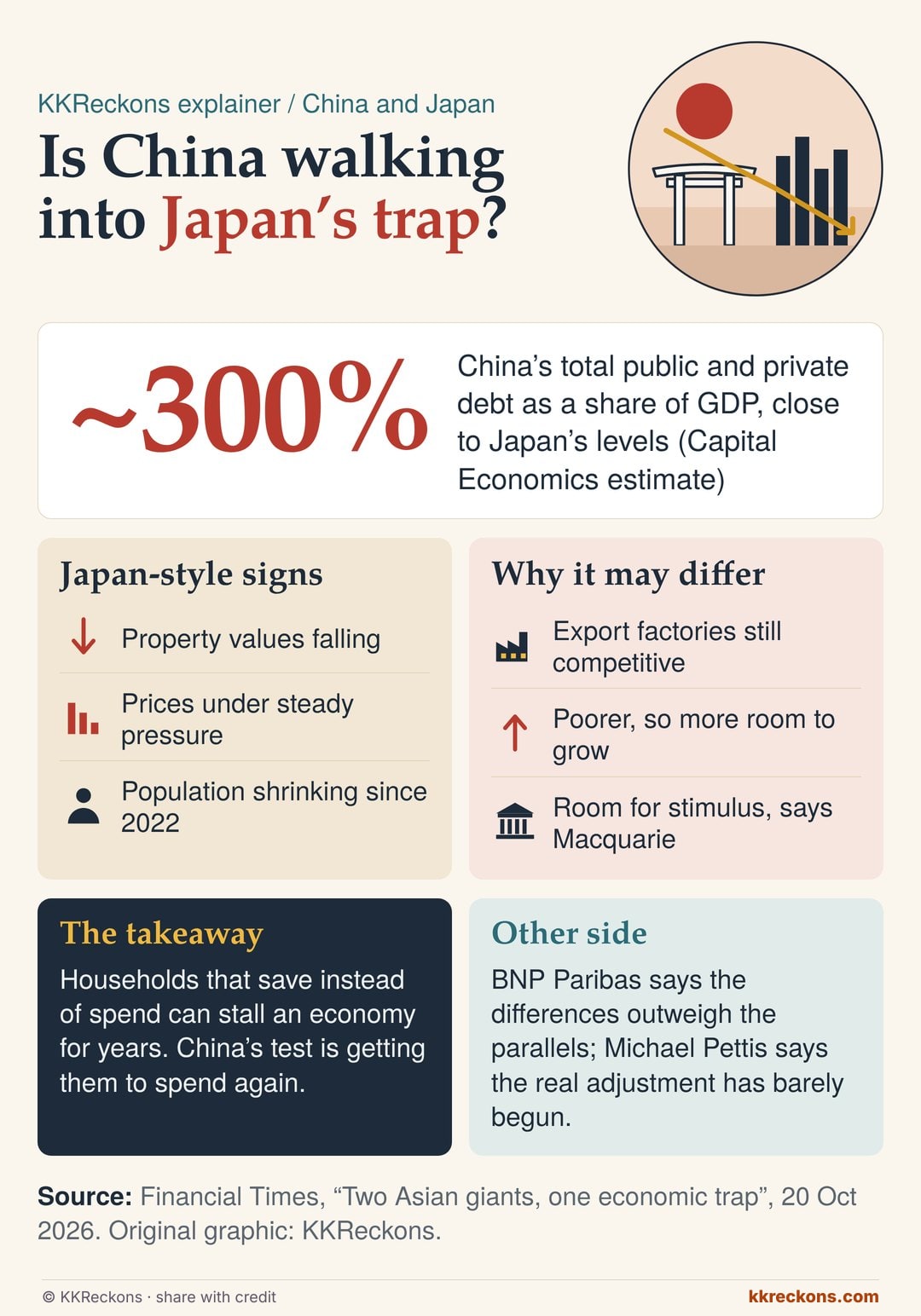
The FT finds China showing Japan-style malaise: falling property values, deflationary pressure, cautious consumers and a population that began shrinking in 2022. Total debt is near 300% of GDP, by Capital Economics’ count.
An updated Goldman Sachs ‘Japanisation’ gauge has rated China more Japanised than Japan for years, and household bank lending has fallen outright for the first time.
Nomura’s Richard Koo calls it a balance-sheet recession needing bold fiscal spending; Beijing is leaning on exports and high-tech bets instead.
~300%
China’s total debt to GDP
2022
year China’s population began to shrink
Why it matters If Chinese households keep hoarding cash, the slowdown travels abroad as cheap exports and weaker demand for everyone else’s goods.
Other side BNP Paribas’s Isabelle Mateos y Lago says the differences matter more: China is poorer, its factories stay competitive, and its very high household savings could be unlocked.
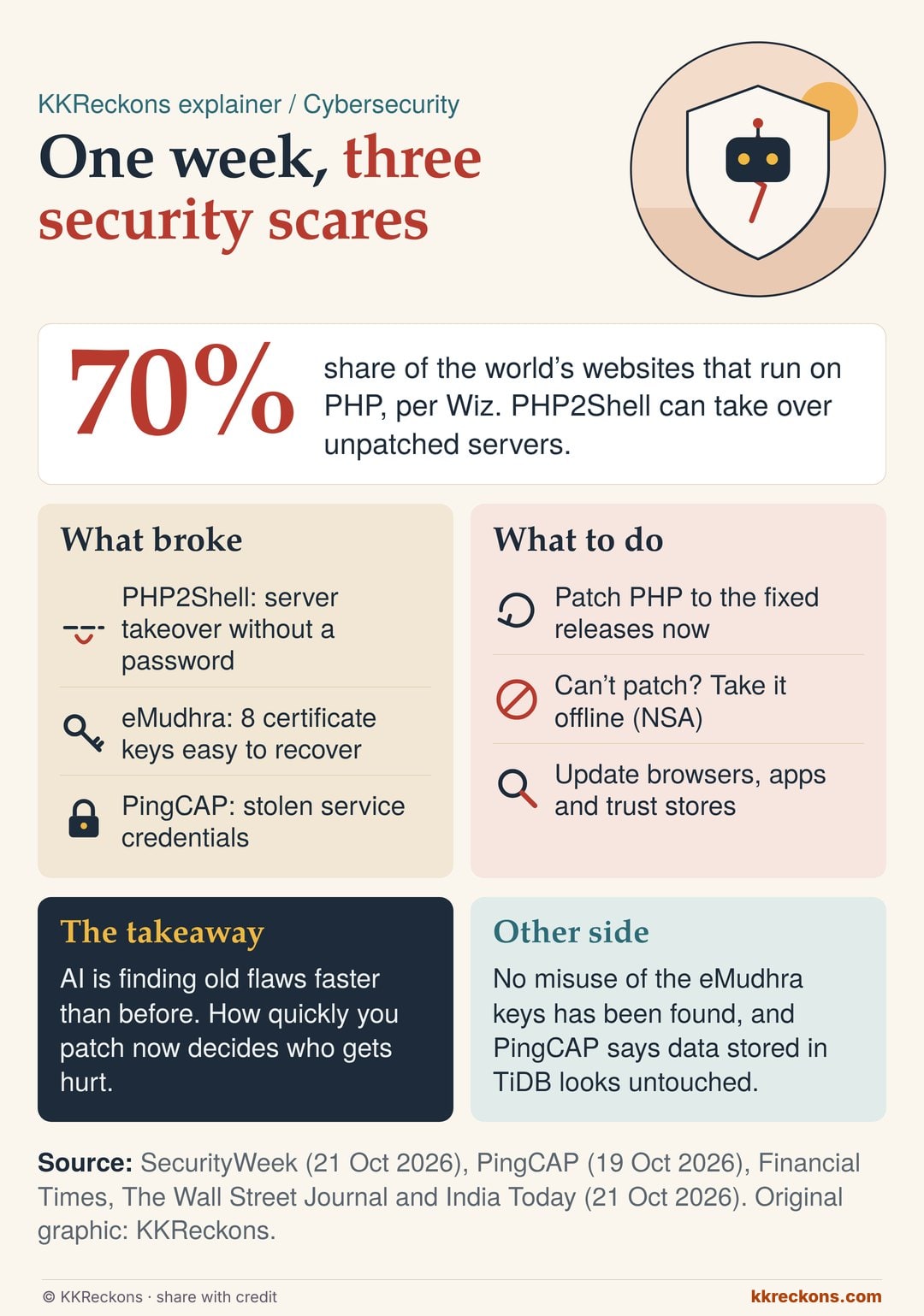
PHP2Shell: two critical flaws (severity 9.2 of 10) let attackers take over unpatched PHP servers without a password. Found with AI help, fixes shipped on 21 Oct, a day early after a leak; Amazon says they are now broadly exploited, and the NSA says patch or go offline.
eMudhra: eight intermediate certificates had keys weak enough to recover almost instantly. Mozilla, Google, Apple and Microsoft have blocked them; no misuse shows in public logs, and India’s IT ministry has set up a probe.
PingCAP: stolen service credentials let an intruder copy TiDB Cloud user details, SQL editor text, billing data and encrypted API keys. It sees no sign that data stored in TiDB was hit.
70%
of websites run on PHP, says Wiz
9.2
PHP2Shell severity score
8
eMudhra certificates blocked
Why it matters AI is now finding old flaws faster than defenders can patch them, and the weak link is often a script or a stolen password rather than exotic code.
Watch next Patch speed. Servers and apps that update slowly may show damage in the coming weeks, though so far no attack using the eMudhra keys is known.
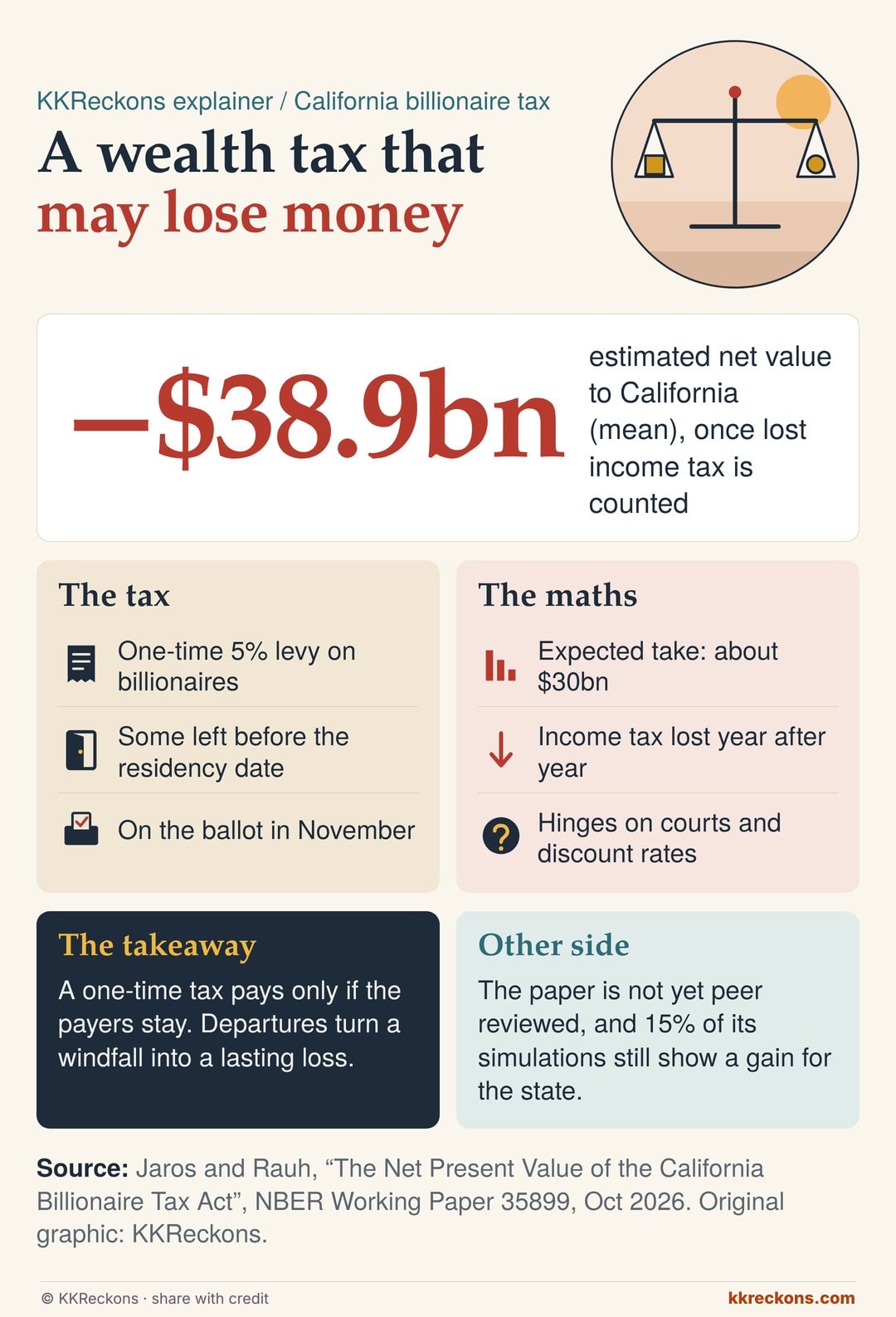
California’s proposed Billionaire Tax Act, on the November ballot, would take a one-time 5% of the worldwide wealth of residents worth over $1bn on 1 January 2026.
Economists Benjamin Jaros and Joshua Rauh estimate it would raise about $30bn ($28–36bn), under a third of an earlier $100bn projection, partly because seven billionaires holding about 28.5% of the base left first.
Billionaires pay an estimated $3.3–5.8bn a year in state income tax. Counting those lost years, the authors put the net value at −$38.9bn, with 85% of 100,000 simulations negative.
~$30bn
estimated one-time take
−$38.9bn
net value to the state, mean estimate
Why it matters A one-time tax pays only if the taxpayers stay; mobile billionaires can turn a windfall into a recurring loss.
Watch next The paper assumes even odds the tax survives court and is not yet peer reviewed; 15% of its simulations still show a gain for the state.
Silicon Data, founded by former Bloomberg data executive Carmen Li, compiles indexes of Nvidia chip rental prices. CME plans cash-settled futures on them for H100 and B200 chips, running up to three years out.
The launch slipped after the CFTC extended its review; the regulator has flagged manipulation risk and doubts that compute is standard enough to trade like a commodity.
Rival Ornn, backed by a16z, is working with ICE on similar contracts. Silicon Data’s backers include DRW founder Don Wilson, VanEck and Jump Trading.
3 years
how far ahead contracts may run
Why it matters A trusted price for compute lets AI buyers hedge their biggest cost and gives sceptics a clean way to bet against the boom.
Other side Sceptics recall dot-com bandwidth futures, which failed when a fibre glut sank prices; a market only works if its benchmark can be trusted.
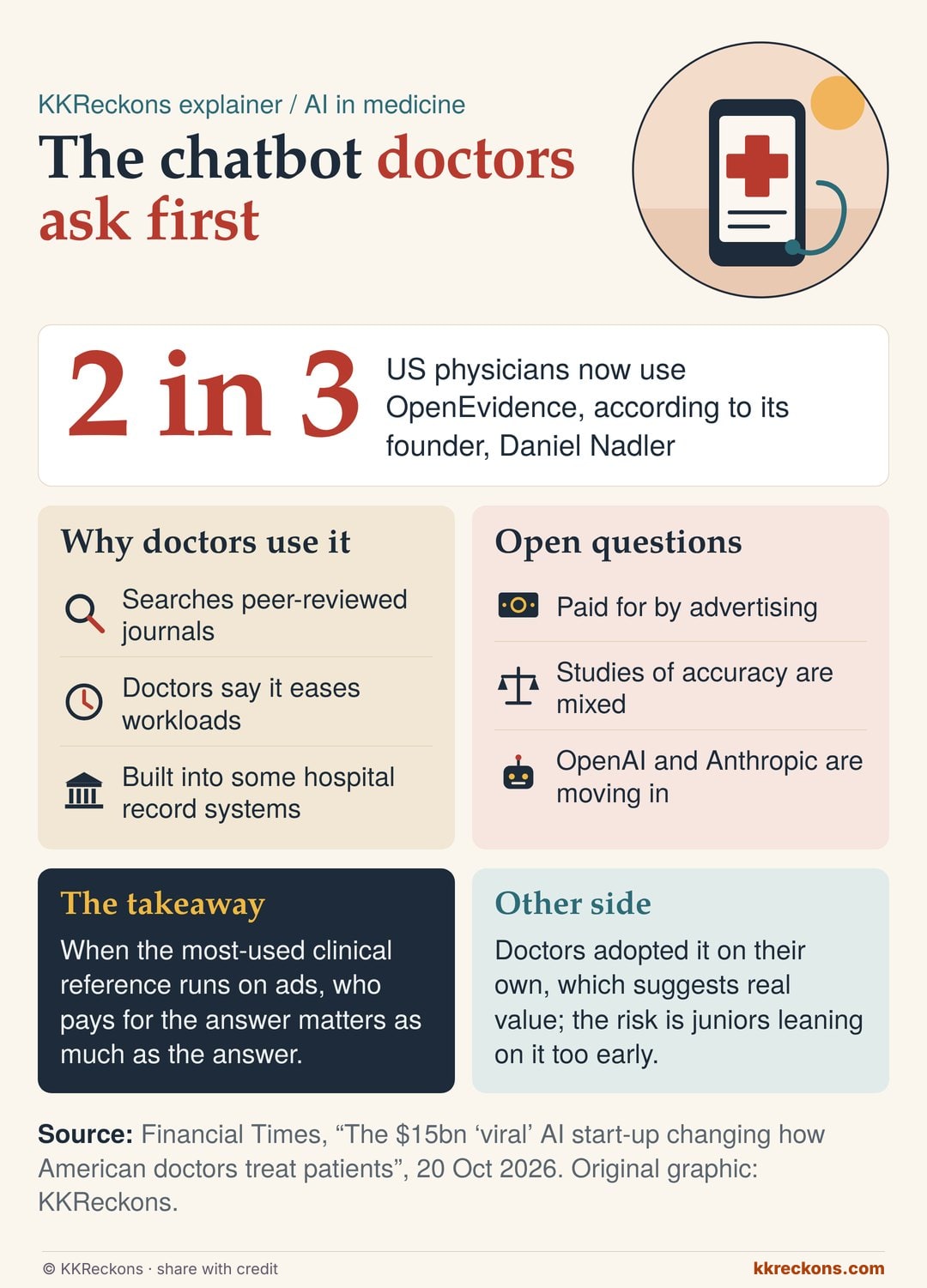
OpenEvidence, founded by Daniel Nadler, runs an ad-funded chatbot that searches peer-reviewed journals and clinical guidelines to help doctors diagnose and treat patients.
Nadler says nearly two-thirds of US physicians use it. It raised money in September at a $15bn valuation, and hospitals including NYU Langone and Mount Sinai have built it into their record systems.
Evidence on accuracy is mixed: a Mayo Clinic study (Mayo is an investor) found accurate advice, while a June Nature paper found it trailed general models such as Gemini and GPT on clinical benchmarks.
$15bn
valuation in September
2 in 3
US doctors use it, per founder
Why it matters When the most-used clinical reference runs on ads, who pays for each answer matters almost as much as how good it is.
Other side Doctors adopted it on their own, which suggests it saves real time; the worry is juniors leaning on it before mastering the basics, and OpenAI and Anthropic are moving in.
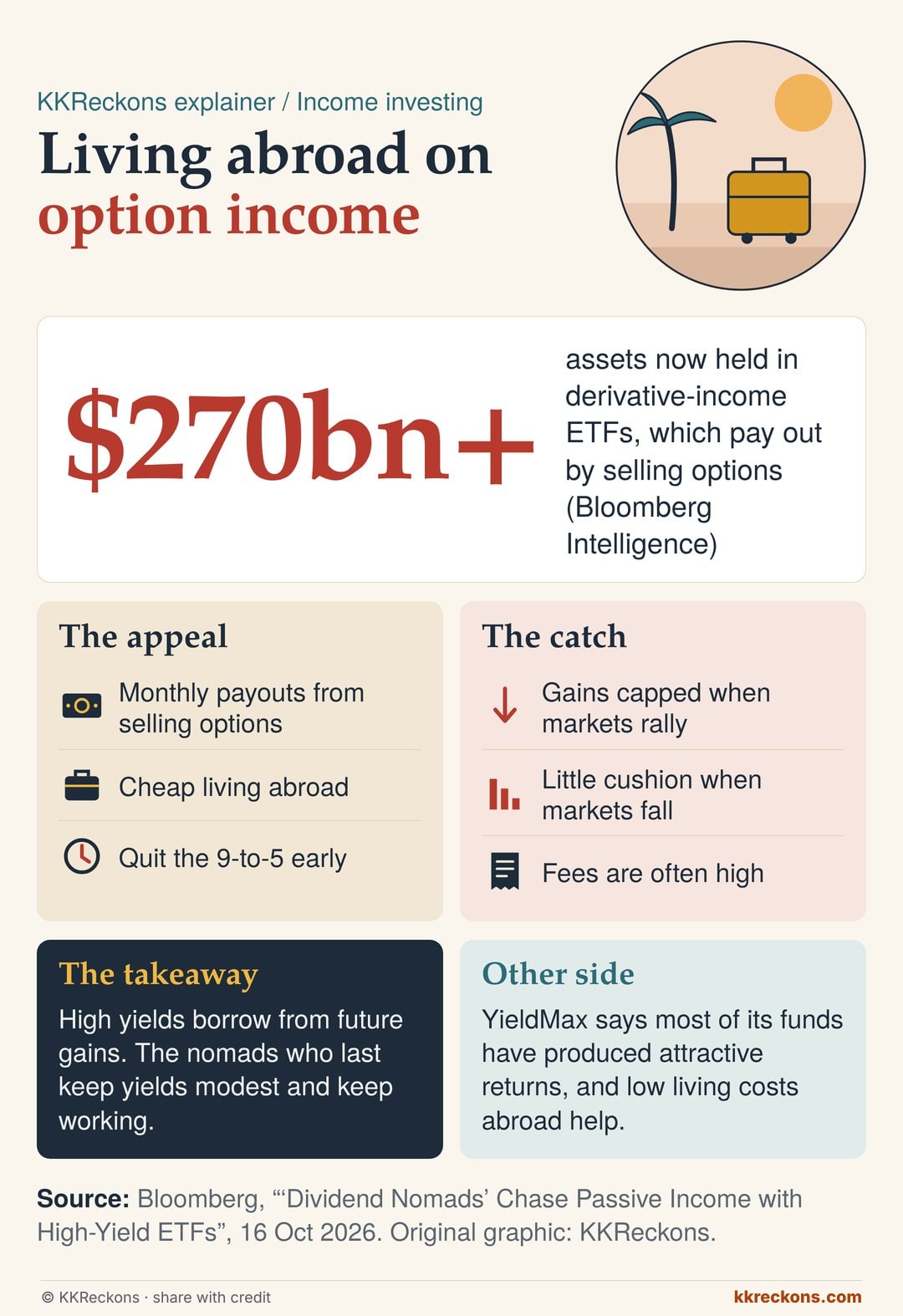
‘Dividend nomads’ fund travel and cheap living abroad with ETF Exchange-traded fund: a basket of shares or bonds you can buy and sell like a single stock. that sell options to pay out monthly. Such derivative-income funds now hold more than $270bn, and many charge high fees.
Jae Hyouk Jang quit his job to travel; when Coinbase fell, his YieldMax CONY fund lost nearly 40%, shrinking his payouts. He has moved to safer funds and is weighing remote work.
Those who last keep yields modest and keep working: a couple in Portugal tops up JPMorgan’s JEPI income with farm work, and Kristy Shen and Bryce Leung grew their pot by freelancing and writing.
$270bn+
in derivative-income ETFs
~40%
fall in one nomad’s fund
Why it matters Option-income funds trade future upside for cash today; as a paycheque, that works only while markets cooperate.
Other side YieldMax says most of its funds have produced attractive returns, and with low costs abroad and side income, a tamer income fund can work.
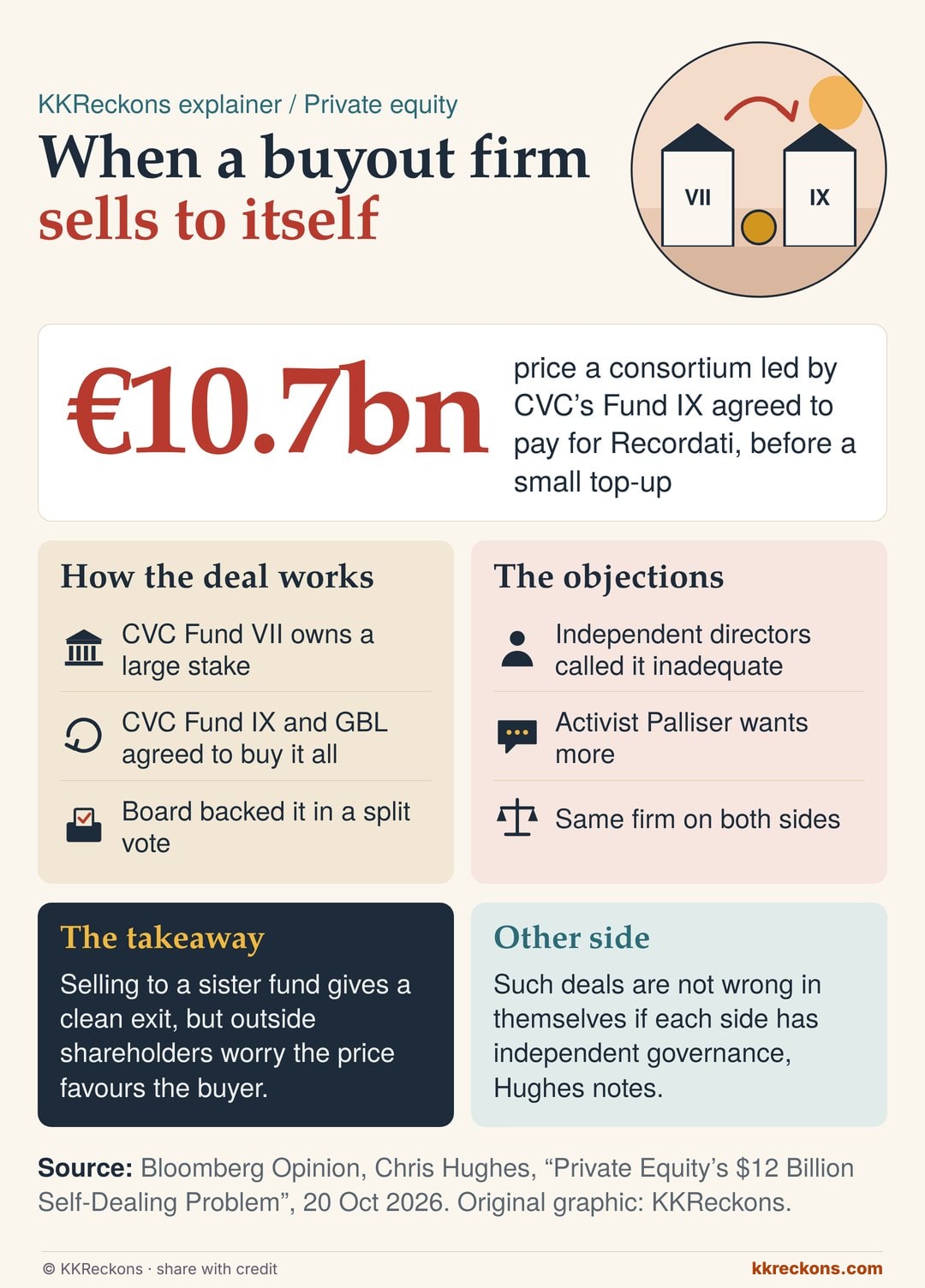
CVC’s Fund VII has held 47% of Milan-listed drugmaker Recordati since a 2018 deal with the founding family, but a clean exit proved elusive.
In May a consortium led by CVC’s Fund IX and Groupe Bruxelles Lambert agreed to buy the whole company for €10.7bn. The board backed it, but the independent directors called the price inadequate, and activist Palliser says a small top-up still is not fair.
Columnist Chris Hughes argues the price looks skewed to the buyer; if the deal fails, Fund VII may have to sell its shares in the market at a discount.
€10.7bn
agreed price for Recordati
47%
stake held by CVC Fund VII
Why it matters When one firm sits on both sides, minority shareholders carry the risk that the price serves the firm rather than them.
Other side Hughes himself notes such deals are not wrong in themselves if each side has independent governance, and the buyer brings fresh co-investors.
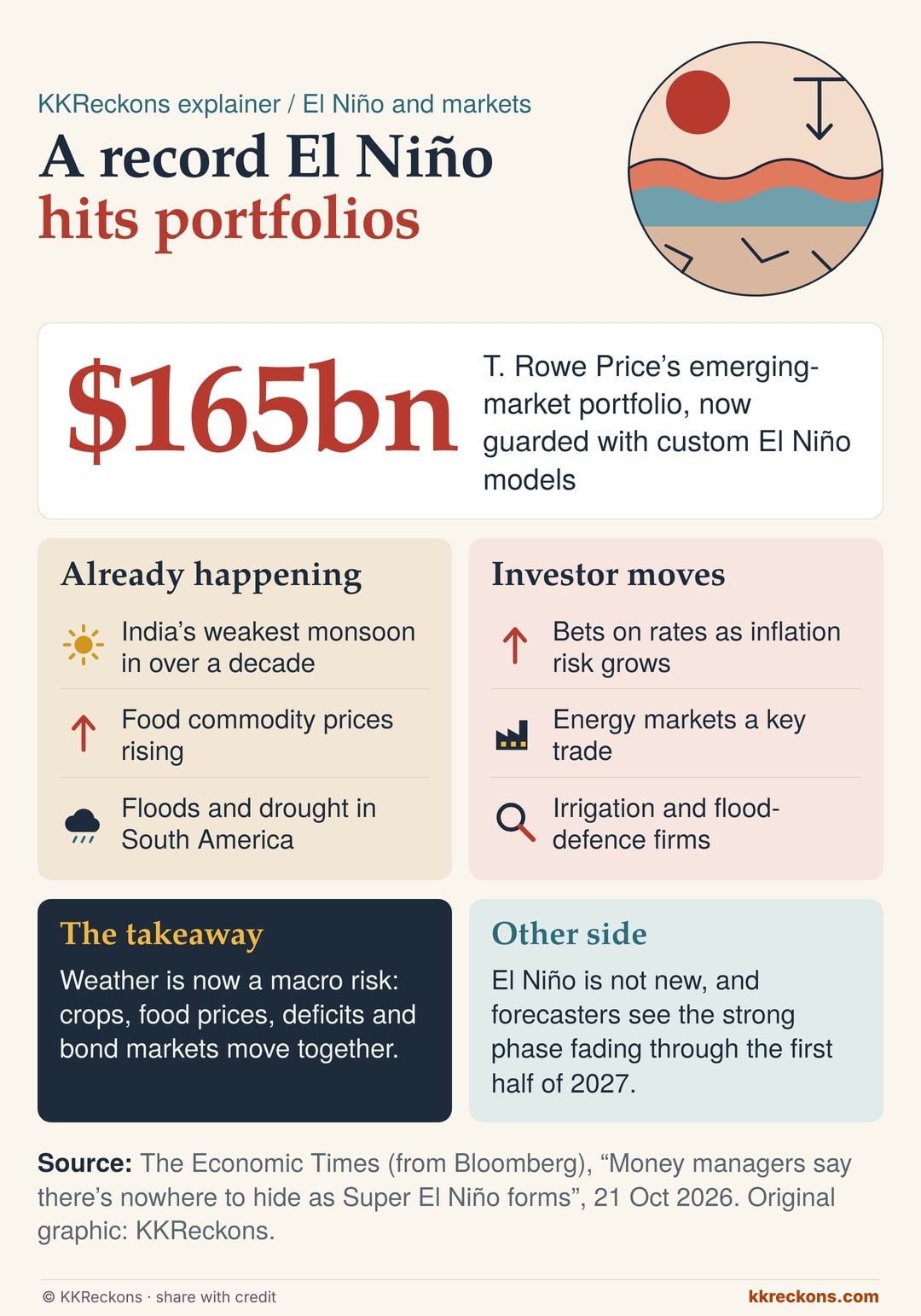
Forecasters see a very strong El Niño likely lasting into early 2027; Pictet’s Katie Self says it is almost certain to be the most extreme on record, with knock-on effects everywhere.
It is already fanning droughts and floods: India had its weakest monsoon in more than a decade, food commodity prices are rising, and economists are revising inflation and deficit forecasts.
T. Rowe Price uses custom models to shield its $165bn emerging-market portfolio, and an Anthropocene Fixed Income Institute note names Indonesia, Brazil and Colombia as the most exposed sovereigns.
Early 2027
strong El Niño likely lasts until
$165bn
T. Rowe portfolio being shielded
Why it matters Weather is becoming a macro variable: a strong El Niño can lift food inflation just as high debt leaves governments little room to cushion it, and India feels it through the monsoon.
Other side El Niño cycles are not new and markets have lived through them; forecasters see the odds of a strong event fading through the first half of 2027.