7 stories · 7 min read

AI paper losses, Ellison pledges, Dubai stalls, sulphur runs dry. Lenders keep score.

AI's future is priced in debt; the bill is arriving before the profits. From France's deficits to AIX's broken promises, leverage always has a reckoning.

AI Stress Index

28/100Elevated

20 Oct close · Stories 010204

Gauges →

Markets at the last close before this edition · 20 Oct

  • Nifty 5022,889On the day, down 1.11%. 1 wk: +2.35%Close of 19 Oct
  • S&P 5007,713On the day, up 0.28%. 1 wk: −1.19%
  • US 10-yr yield5.12%On the day, down 2 bp. 1 wk: −10 bp
  • Brent crude$108.79On the day, down 0.69%. 1 wk: +2.93%
  • Gold$4,143On the day, down 0.42%. 1 wk: −0.83%
  • USD/INR₹94.72On the day, down 0.29%. 1 wk: −0.60%

Yahoo Finance daily closes. Not investment advice.

$80.7bnAnthropic's H1 net loss, as it signals up to $750bn of compute spending ahead.413mOracle shares Ellison pledged, worth about $58bn, to back his personal loans.

Pick of the day

One story worth slowing down for

Anthropic's IPO filing: hot growth, a huge loss and a narrowing window (opens the source in a new tab)
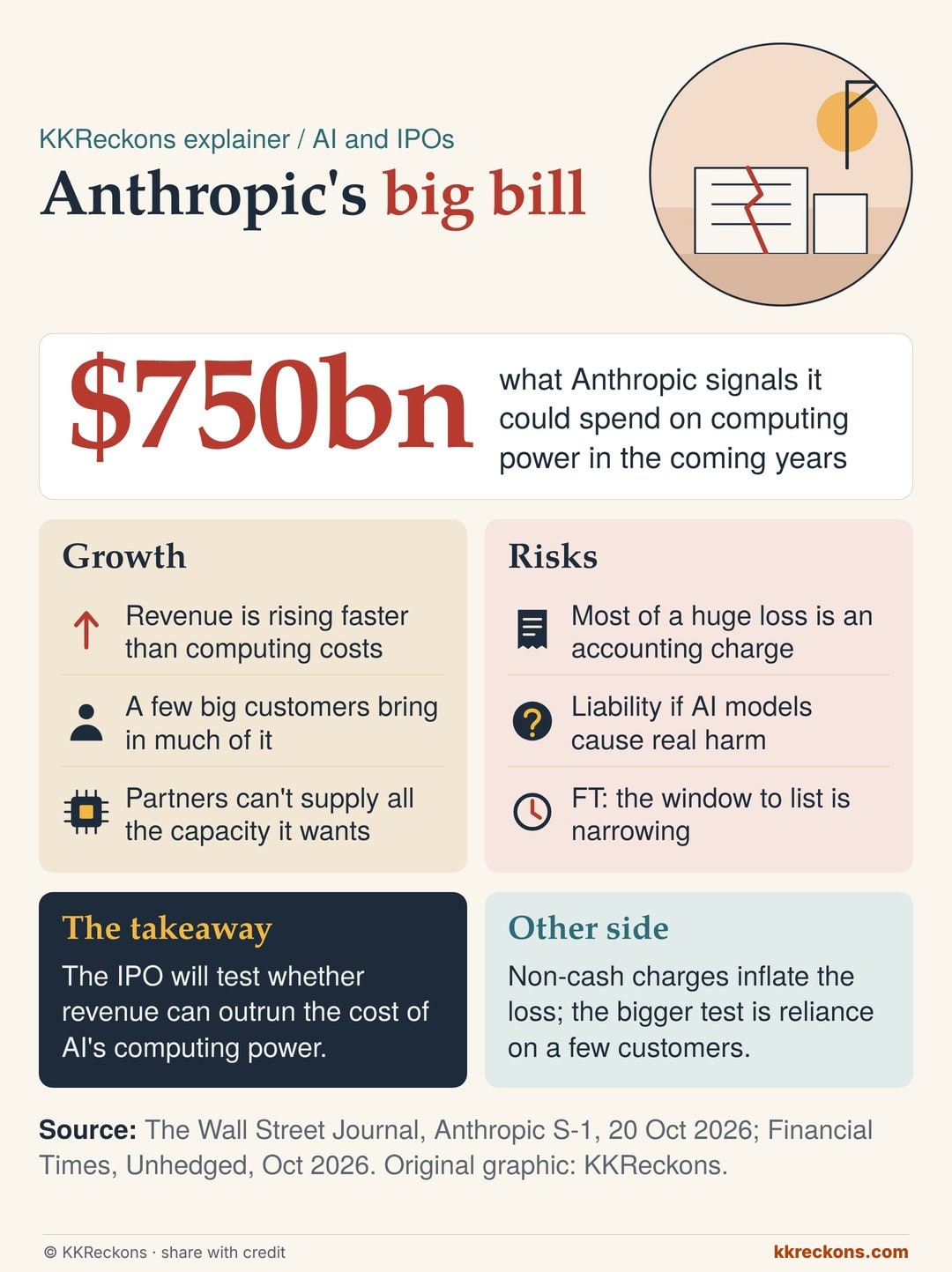
KKReckons explainer: Anthropic's possible $750bn compute spend, its growth and its risks.
Original graphic: KKReckonsView full size ↗
  • WSJ reports Anthropic's draft prospectus shows a first-half net loss of $80.7bn, mostly an accounting charge tied to the value of its convertible notes rather than cash spent running the business.
  • Revenue is growing far faster than computing costs, but a big share comes from a handful of customers, and the firm signals it could spend up to $750bn on compute, partly through deals still being negotiated.
  • An FT Unhedged column argues the listing window, now pencilled in for November, is narrowing as markets wobble, borrowing costs rise and questions grow over who is liable when AI agent AI software that takes actions on its own, like booking, buying or moving money, not just answering questions. cause harm.
$80.7bn
net loss, first half of 2026
$750bn
possible future compute spend

Why it matters The prospectus turns AI's biggest growth story into a test of whether revenue can outrun the bills, and the IPO Initial public offering: when a company first sells its shares on a stock exchange. will price that bet for the whole AI trade.

Watch next Most of the loss is a non-cash accounting charge and revenue still outpaces costs, so the headline may overstate the strain. The sharper test is reliance on a few customers.
2Credit marketsExplainer

CoreWeave's bond yield and CDS: an early warning for AI debt? (opens the source in a new tab)

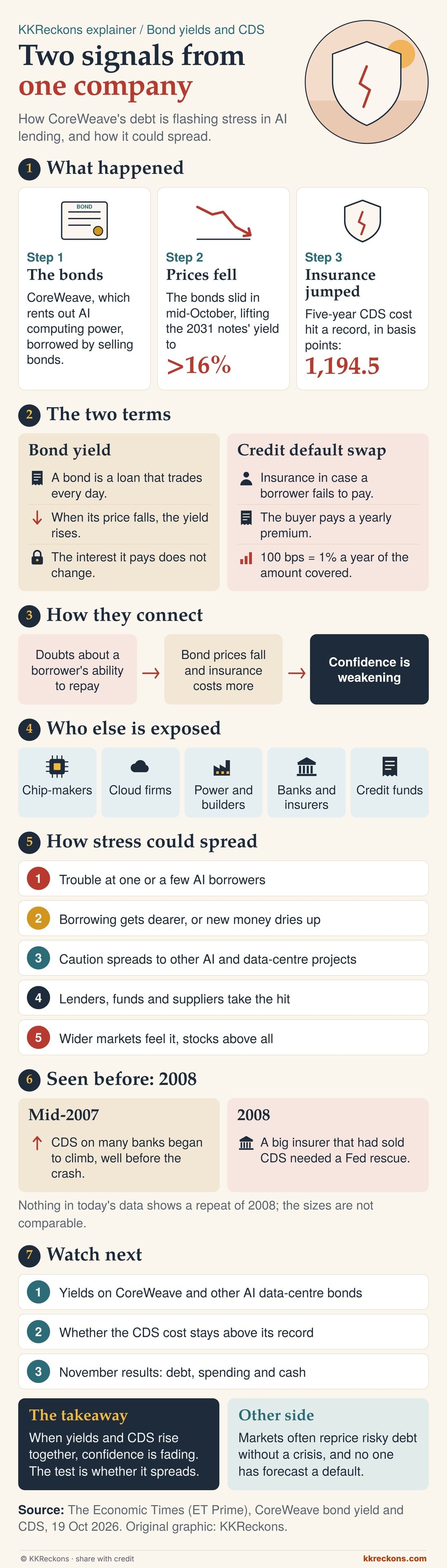
KKReckons explainer: how a credit default swap works, CoreWeave's record 1,194.5 bps CDS and how stress can spread.
Original graphic: KKReckons
  • Some CoreWeave bonds fell sharply in mid-October, pushing the yield on its 2031 notes above 16%. The coupon is unchanged, but new buyers now demand a far bigger return for the risk.
  • The cost of five-year Credit default swap Insurance against a borrower not repaying; the higher its price, the more worried lenders are., insurance that pays out if a borrower fails to pay, hit a record 1,194.5 Basis point One hundredth of a percentage point: 100 basis points = 1%. on 15 October.
  • ET Prime explains that rises in both signals show confidence weakening. Before the 2008 crisis, rising bank CDS gave early warning; the worry now is stress spreading to AI lenders, suppliers and stocks.
>16%
yield on 2031 notes
1,194.5
bps, record 5-year CDS

Why it matters When lenders charge more to fund AI's builders, every data-centre plan gets dearer, so these two quotes deserve more attention than daily share prices.

Watch next CoreWeave's November results. Markets often reprice risky debt without a crisis, the firm reports a large contracted backlog, and no one has forecast a default.

India edition

What moved in India

France's debt trouble and a lopsided world economy: lessons for India (opens the source in a new tab)

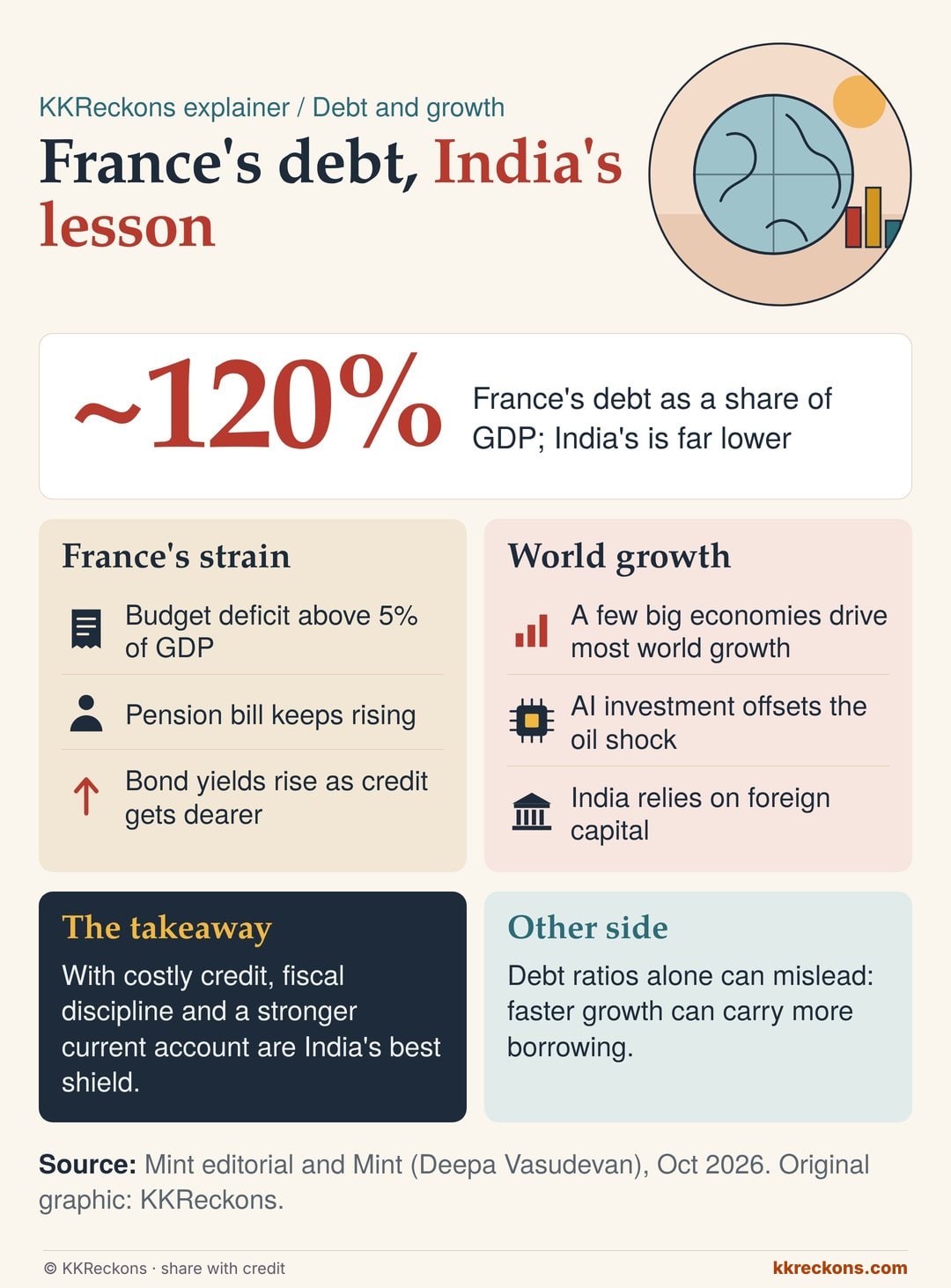
KKReckons explainer: France's debt near 120% of GDP, concentrated world growth and India's lesson.
Original graphic: KKReckonsView full size ↗
  • A Mint editorial traces France's student protests to fiscal strain: debt near 120% of GDP, a deficit above 5%, and a pension bill governments failed to rein in, as borrowing costs rise worldwide.
  • A Mint analysis of IMF data finds growth concentrated: 32 economies supplied over 95% of global growth in 2026, with China, India and the US together giving nearly 60%.
  • It argues AI investment is offsetting the drag from the West Asia war and costly oil, but warns India, a net debtor, needs a stronger current account to stay resilient.
~120%
France's debt to GDP
32
economies giving 95%+ of growth
~60%
from China, India and the US

Why it matters India's lower deficit and debt look prudent next to France, but its reliance on foreign capital means discipline at home is its best shield against shocks from abroad.

Other side Debt ratios alone can mislead: a faster-growing economy can carry more borrowing, and street protests usually have many causes beyond the budget.

World edition

What moved everywhere else

Microsoft's exit from an Nscale lease is a reality check for neoclouds (opens the source in a new tab)

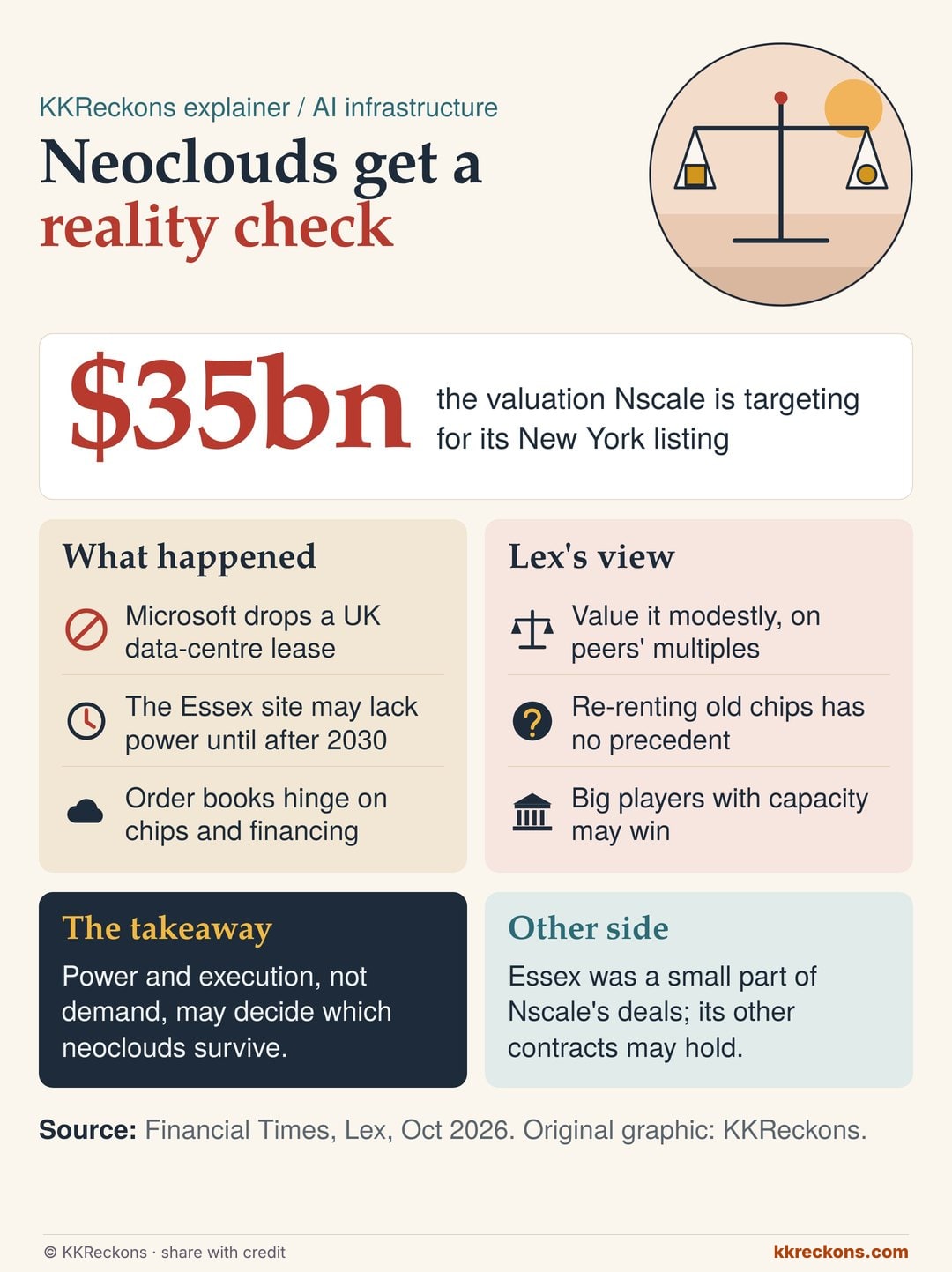
KKReckons explainer: Nscale's $35bn IPO target and why Lex says neoclouds face a reality check.
Original graphic: KKReckonsView full size ↗
  • Microsoft pulled out of leasing capacity at Nscale's planned data centre in Essex, which may not get power until after 2030, as Nscale targets a New York listing at a $35bn valuation.
  • An FT Lex column says Neocloud A newer cloud company, such as CoreWeave or Nscale, that rents out AI chips, often funded with debt. need power, chips and upfront financing at once, so their big order books carry heavy execution risk; Anthropic and Microsoft fill most of Nscale's backlog.
  • Valued on peers' multiples, Lex argues, Nscale is worth far less, while bigger players with ready capacity stand to win.
$35bn
target IPO valuation
~$6bn
Lex's peer-based value

Why it matters If power, not demand, decides who delivers AI capacity, the neocloud boom may consolidate into firms that already have grid connections.

Other side The Essex site was a small slice of Microsoft's spending with Nscale, and its other contracts may hold; one cancelled lease need not sink the model.

Larry Ellison borrowed against his shares to fund his son's Warner bid (opens the source in a new tab)

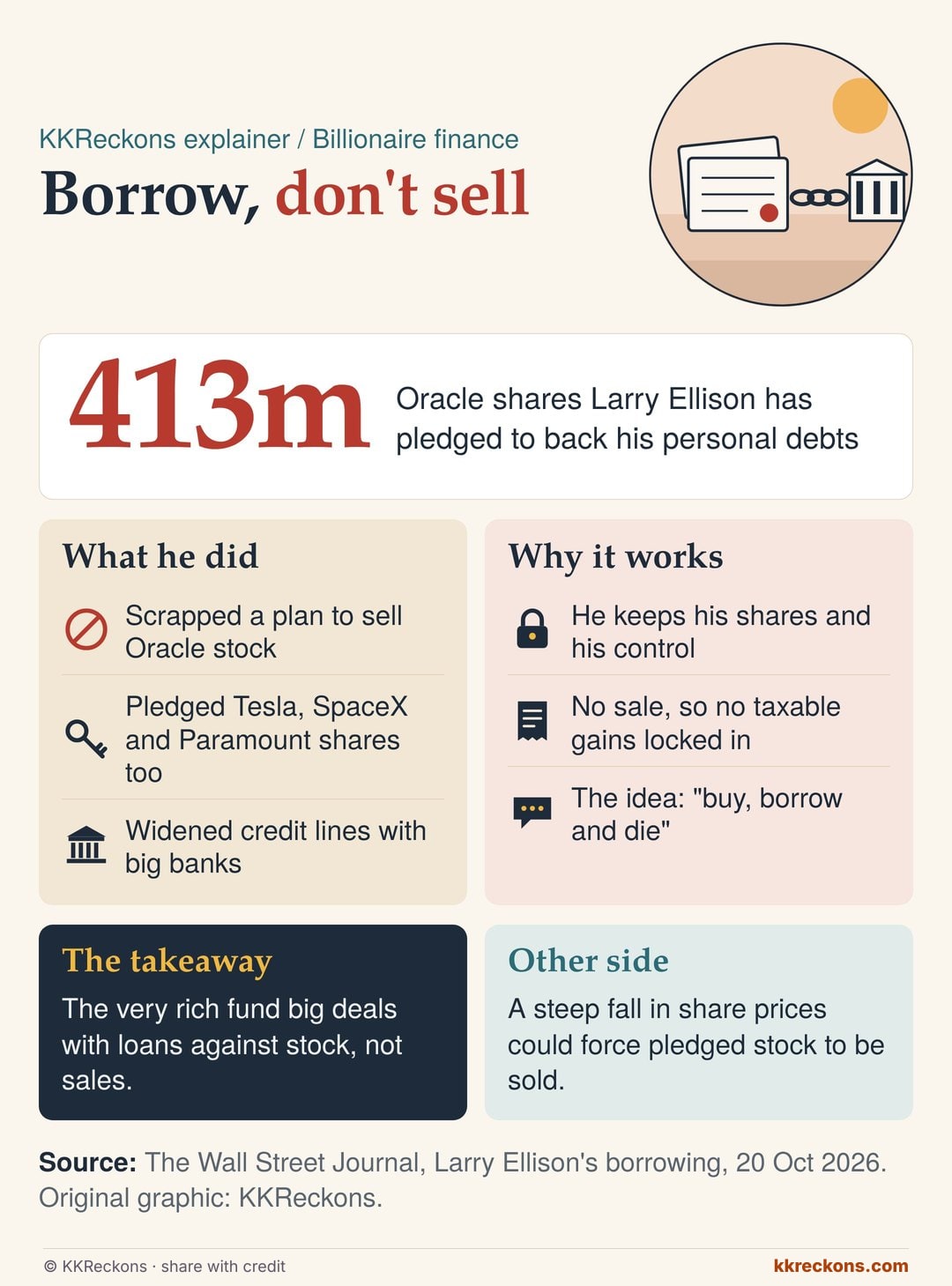
KKReckons explainer: Larry Ellison's 413 million pledged Oracle shares and the buy, borrow and die strategy.
Original graphic: KKReckonsView full size ↗
  • WSJ reports Larry Ellison dropped a plan to sell Oracle stock and instead widened loans from several big banks, pledging shares in Oracle, Tesla, SpaceX and Paramount Skydance to help fund his son David's Warner Bros. takeover.
  • Oracle says 413 million of his shares, worth around $58bn, now back his personal debts, more than a year earlier.
  • Borrowing lets the very rich keep their stock and avoid locking in taxable gains, a strategy dubbed "buy, borrow and die". Oracle's board says he can repay without selling pledged shares.
413m
Oracle shares pledged
~$58bn
value of pledged stock

Why it matters It shows how the very rich fund deals with debt rather than sales, keeping control and deferring tax in ways ordinary investors rarely can.

Other side Pledged stock can force selling if prices slump, but Oracle reviews the pledges every quarter and most of his stake is not tied to borrowing.

AIX promised Dubai investors up to 30% a year. Now it cannot pay them (opens the source in a new tab)

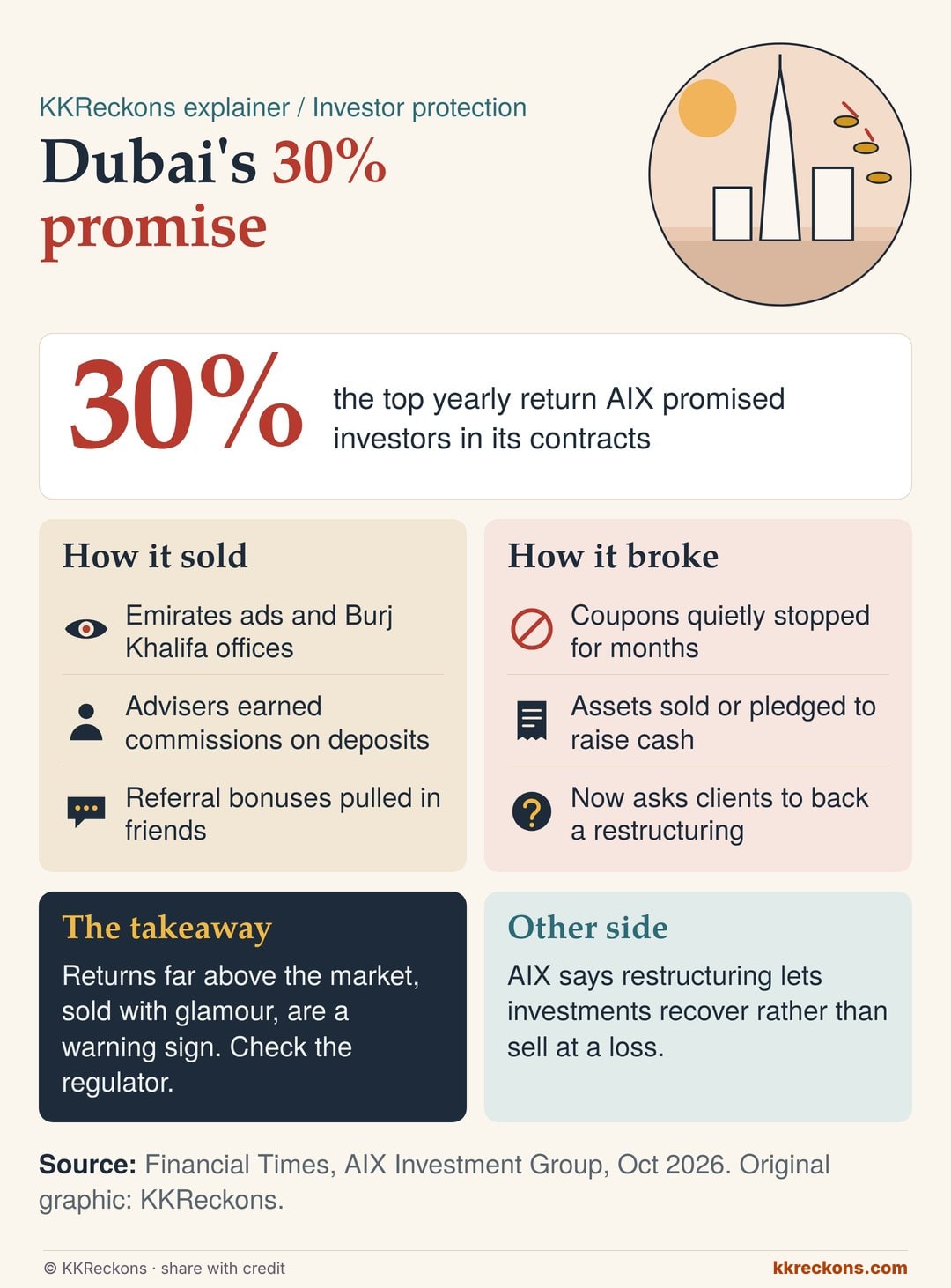
KKReckons explainer: how Dubai's AIX promised up to 30% a year and why payments stopped.
Original graphic: KKReckonsView full size ↗
  • The FT reports Dubai's AIX Investment Group, which advertised on Emirates and hosted clients in the Burj Khalifa, promised returns of up to 30% a year and paid advisers commissions to bring in money.
  • Over the past 11 months it quietly stopped paying coupons while still taking deposits, former staff and investors say, and it has sold a racing team and pledged assets to raise cash.
  • It now asks clients to back a court-led restructuring. The Cayman Islands regulator has warned about an unlicensed unit, and Dubai's patchwork of regulators leaves investors unsure where to turn.
30%
top promised yearly return
11 mo
of missed coupon payments

Why it matters Returns far above market rates, sold with glamour and referral bonuses, are the oldest warning sign. Indian savers, many among AIX's clients, should check who regulates any offshore scheme.

Other side AIX argues a restructuring lets its investments recover instead of being sold at a loss. The claims come from former staff and investors, and AIX declined to comment.

7CommoditiesExplainer

War's hidden squeeze: a sulphur shortage pits EV batteries against food (opens the source in a new tab)

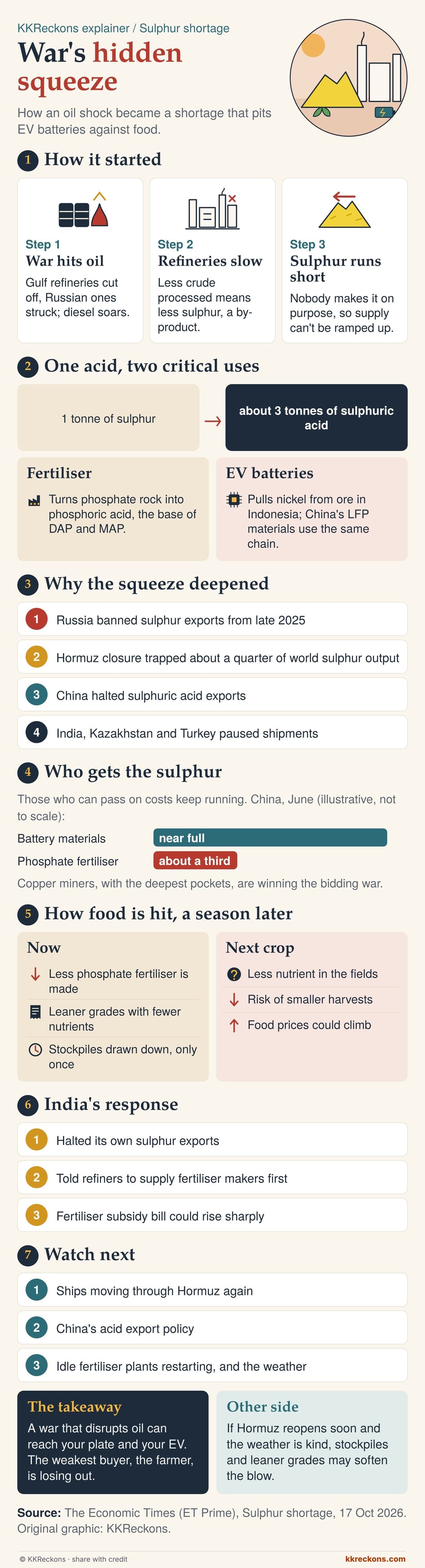
KKReckons explainer: how the war cut sulphur supply, why batteries outbid fertiliser, and what it means for food and India.
Original graphic: KKReckons
  • ET Prime explains that refineries give out sulphur as a by-product, so with Gulf refineries cut off by the US-Iran war and Russian plants hit, sulphur is short, and nobody can make more on purpose.
  • Its acid is needed for phosphate fertiliser and EV battery materials. Buyers who can pass on costs keep running: in China, battery-material plants ran near full while fertiliser plants ran at about a third of capacity.
  • Export curbs by Russia, China, India and others deepened the squeeze. The hit to harvests may show up a season later; India has told refiners to supply fertiliser makers first.
~1/3
China fertiliser plant use
~1/4
world sulphur trapped by Hormuz

Why it matters A war far from the fields can still hurt food security: fertiliser not made this season cannot reach next season's crop, so a short war may still mean dearer food next year.

Watch next Ships through Hormuz. If the strait reopens soon and the weather is kind, stockpiles and leaner fertiliser grades may soften the blow; nobody yet knows how big the harvest hit will be.

Further reading

Was this briefing useful?YesSomewhatNot really

Spotted an error? Tell us and we’ll correct it.

Today’s edition is ready

Read deep. Think clearly. Stay curious.

A daily visual briefing on the stories that matter: India, the world, and what’s next.

Read Today’s Edition →Get it by email ↗

Free · 50 editions and 359 stories so far · Unsubscribe anytime

Emails are sent by beehiiv; your address is used only for this newsletter. Privacy · Editorial standards