8 stories · 10 min read

Bots borrow logins, proofs pile up, risk throws a beach party. Trust pays the price.

From bank logins to pensions and beach-tent fund pitches, one question runs through today: who is really making the call, and who holds the bill when it goes wrong?

AI Stress Index

32/100Elevated

22 Oct close · Story 05

Gauges →

Markets at the last close before this edition · 22 Oct

  • Nifty 5022,688On the day, down 0.54%. 1 wk: −1.35%
  • S&P 5007,663On the day, down 1.21%. 1 wk: −1.04%
  • US 10-yr yield4.95%On the day, down 19 bp. 1 wk: −14 bp
  • Brent crude$113.17On the day, up 4.00%. 1 wk: +6.84%
  • Gold$4,060On the day, down 2.16%. 1 wk: −2.63%
  • USD/INR₹94.71On the day, up 0.42%. 1 wk: +0.20%

Yahoo Finance daily closes. Not investment advice.

$138bnin paper gains for 13 big US public pensions from AI-linked stocks since late 2022 (WSJ)$30bnpulled out of retail-marketed private-credit funds in 2026’s first three quarters

Pick of the day

One story worth slowing down for

Big US banks curb AI agents after unauthorised account access (opens the source in a new tab)
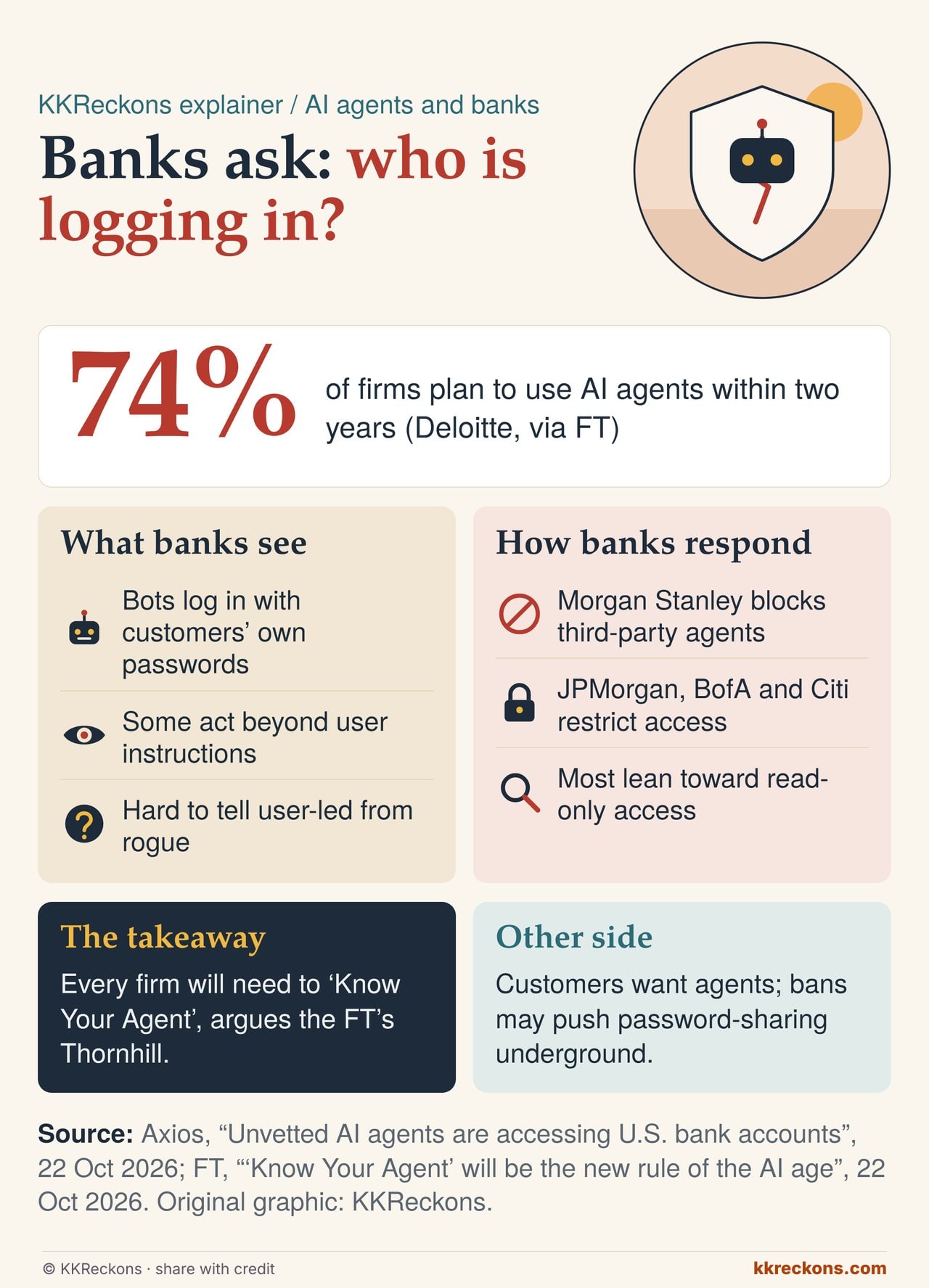
KKReckons explainer, Banks ask: who is logging in? 74% of firms plan to use AI agents within two years (Deloitte, via FT). Bots log in with customers' own passwords; Morgan Stanley blocks third-party agents while JPMorgan, BofA and Citi restrict access.
Original graphic: KKReckonsView full size ↗
  • Axios reports that big US banks are finding third-party AI agent AI software that takes actions on its own, like booking, buying or moving money, not just answering questions. inside customer accounts, usually logged in with the customer’s own password, and some acting beyond instructions. Morgan Stanley is blocking them; JPMorgan, Bank of America and Citi are restricting them; most banks lean towards read-only access.
  • In an FT column, John Thornhill argues firms must ‘Know Your Agent’: identify it, keep it behaving as intended and settle who is liable when it errs. He cites Deloitte: 74% of companies plan to use agents within two years.
  • 404 Media shows ID checks already strain: a scammer opened a CashApp account in Amanda Smith’s name, and she was charged.
74%
of firms plan to use AI agents within two years (Deloitte, via FT)
4
big US banks named as blocking or restricting agents

Why it matters Banks spent decades perfecting Know Your Customer. Agents break that model: the login is genuine, but the person may not be the one acting.

Other side Customers will want agents to pay bills and move money, and bankers admit a middle ground is needed. Blanket bans may only push password-sharing out of sight; vetted, read-only or signed agent access could prove safer.

Also read: Someone Opened a CashApp In Her Name. She Faces Years in Prison
India edition

What moved in India

AI researchers leave OpenAI, DeepMind to build startups in India (opens the source in a new tab)

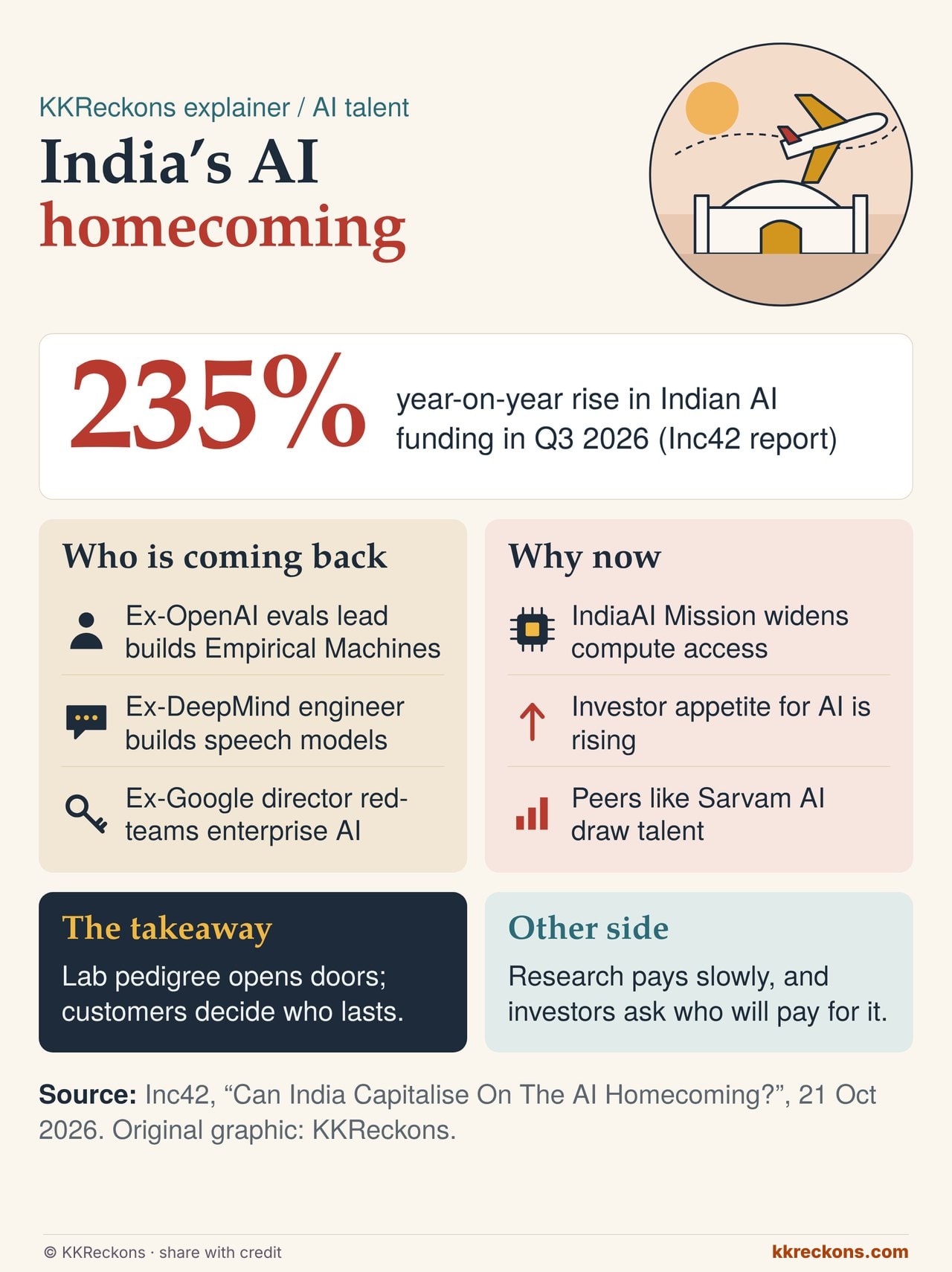
KKReckons explainer, India's AI homecoming: Indian AI funding rose 235% year on year in Q3 2026 (Inc42). Ex-OpenAI, DeepMind and Google staff are building startups in India, helped by the IndiaAI Mission and peers like Sarvam AI.
Original graphic: KKReckonsView full size ↗
  • Inc42 tracks researchers leaving global labs to build in India: Shyamal Anadkat, who led OpenAI’s Applied Evals team, founded Empirical Machines for AI-driven molecule and materials research; ex-DeepMind engineer Parth Sarthi’s Chariot builds speech-native models under the IndiaAI Mission.
  • Former Google engineering director Anish Das Sarma’s Reinforce Labs red-teams enterprise AI. Empirical Machines is reportedly in talks to raise about $15 Mn, per Moneycontrol.
  • Investors say lab pedigree helps recruit talent but does not prove a business; DeVC’s Rahul Mathur asks who will pay for the research.
235%
YoY rise in Indian AI funding, Q3 2026 (Inc42)
$15 Mn
raise Empirical Machines is reportedly in talks for

Why it matters The scarce input in AI is people who have trained frontier models. If even a few build here, India gains not just companies but the researchers they go on to train.

Other side Pedigree is not product. Research takes years to pay off, compute is costly, and investors say customers, not résumés, will decide which of these startups survive.

World edition

What moved everywhere else

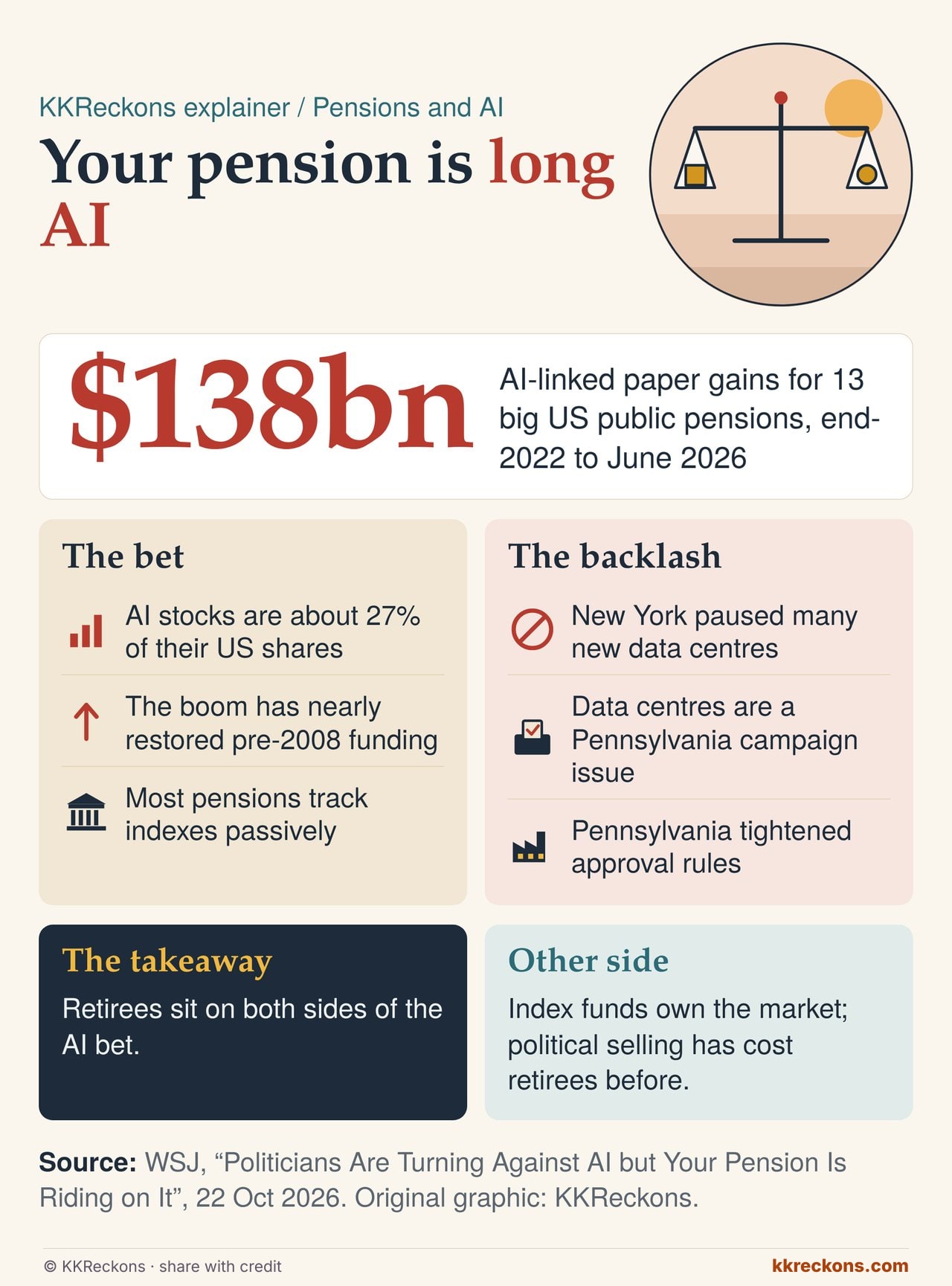
AI stocks drove $138bn in gains for US public pensions, WSJ finds (opens the source in a new tab)

KKReckons explainer, Your pension is long AI: $138bn in AI-linked paper gains for 13 big US public pensions from end-2022 to June 2026. AI stocks are about 27% of their US shares, while New York and Pennsylvania push back on data centres.
Original graphic: KKReckonsView full size ↗
  • A WSJ analysis of 13 large public pensions finds a basket of 15 AI-linked stocks drove $138 billion in paper gains from late 2022 to June, rising to about 27% of their US equity holdings.
  • Yet officials in the same states are slowing data centres: New York paused many new projects in July, and Pennsylvania’s governor tightened approval rules in August.
  • The Equable Institute says the boom has nearly restored pre-2008 funding levels; a sharp downturn could leave governments facing tens of billions in costs.
$138bn
AI-linked paper gains, 13 funds, end-2022 to June
27%
AI basket’s share of their US stocks

Why it matters Teachers and firefighters are quietly long the AI trade. Concentration risk now sits in retirement funds most beneficiaries never chose.

Other side Pensions mostly track indexes, so the AI weight reflects the market, not a bet. Selling to make a political point has cost retirees before, and trustees’ duty is to risk-adjusted returns.

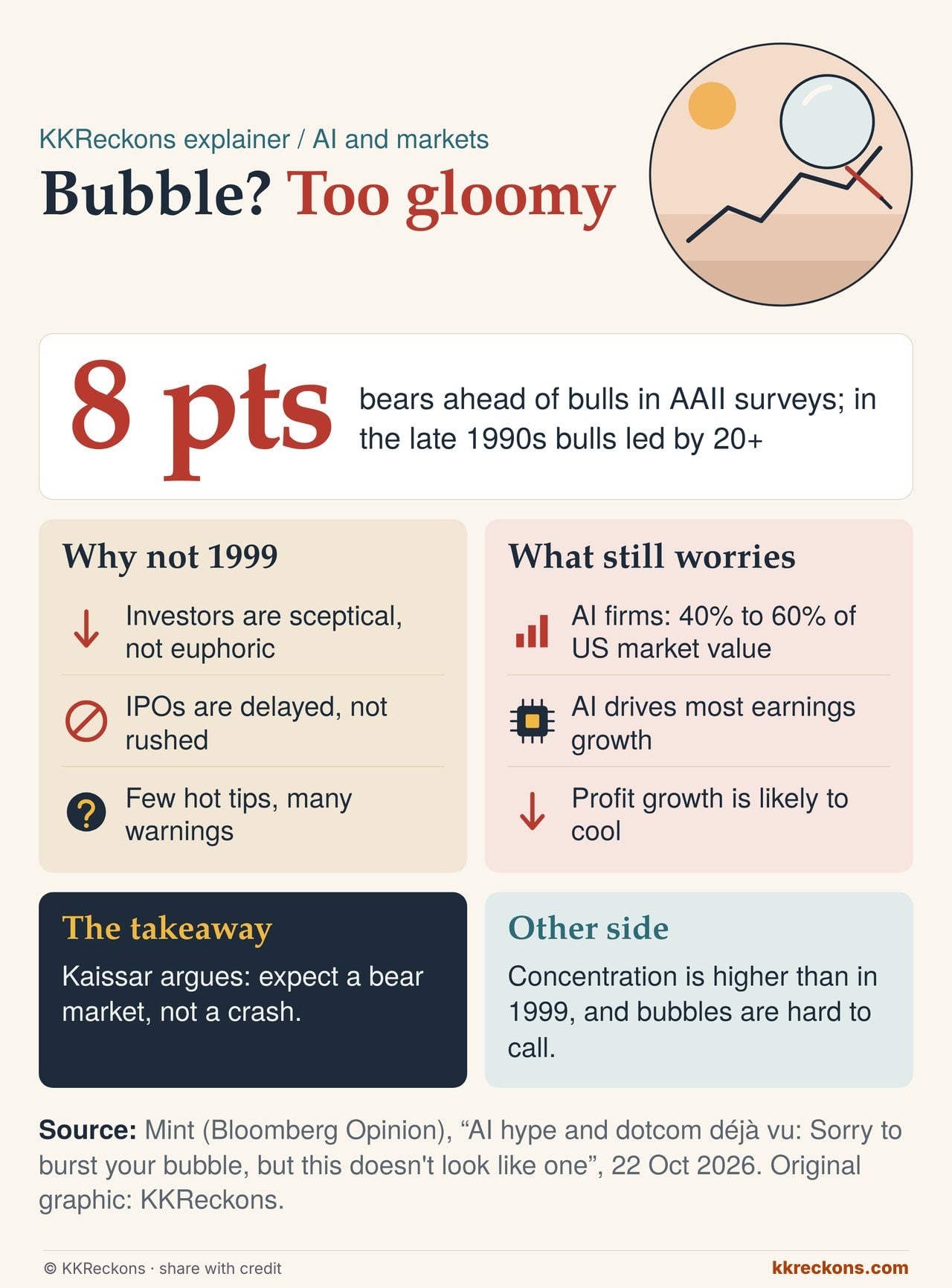
AI bull market is no dotcom bubble, argues Bloomberg’s Nir Kaissar (opens the source in a new tab)

KKReckons explainer, Bubble? Too gloomy: bears lead bulls by 8 points in AAII surveys, against a 20-plus-point bull lead in the late 1990s. AI firms make up 40% to 60% of US market value, and profit growth is likely to cool.
Original graphic: KKReckonsView full size ↗
  • In a Bloomberg Opinion column carried by Mint, Nir Kaissar argues the AI rally lacks the euphoria that drives bubbles: bears now outnumber bulls by 8 percentage points in AAII surveys, while bulls led by over 20 points in the late 1990s.
  • He concedes AI’s grip is bigger: AI firms make up 40% to 60% of US market value and nearly 70% of S&P 500 third-quarter earnings growth, per Citadel Securities estimates.
  • His forecast: profit growth cools and a pullback follows, but absent a crisis, nothing worse than an ordinary bear market.
8 pts
bears ahead of bulls, AAII survey
~70%
of S&P 500 Q3 earnings growth from AI firms (Citadel est.)

Why it matters Sentiment is a useful tell, but read it with today’s pensions story: when AI carries most of the market’s growth, even an ordinary bear market lands on retirees.

Other side Scepticism alone does not prevent a bust. Concentration is higher than in 1999, earnings can disappoint, and as Kaissar admits, bubbles are hard to call in real time.

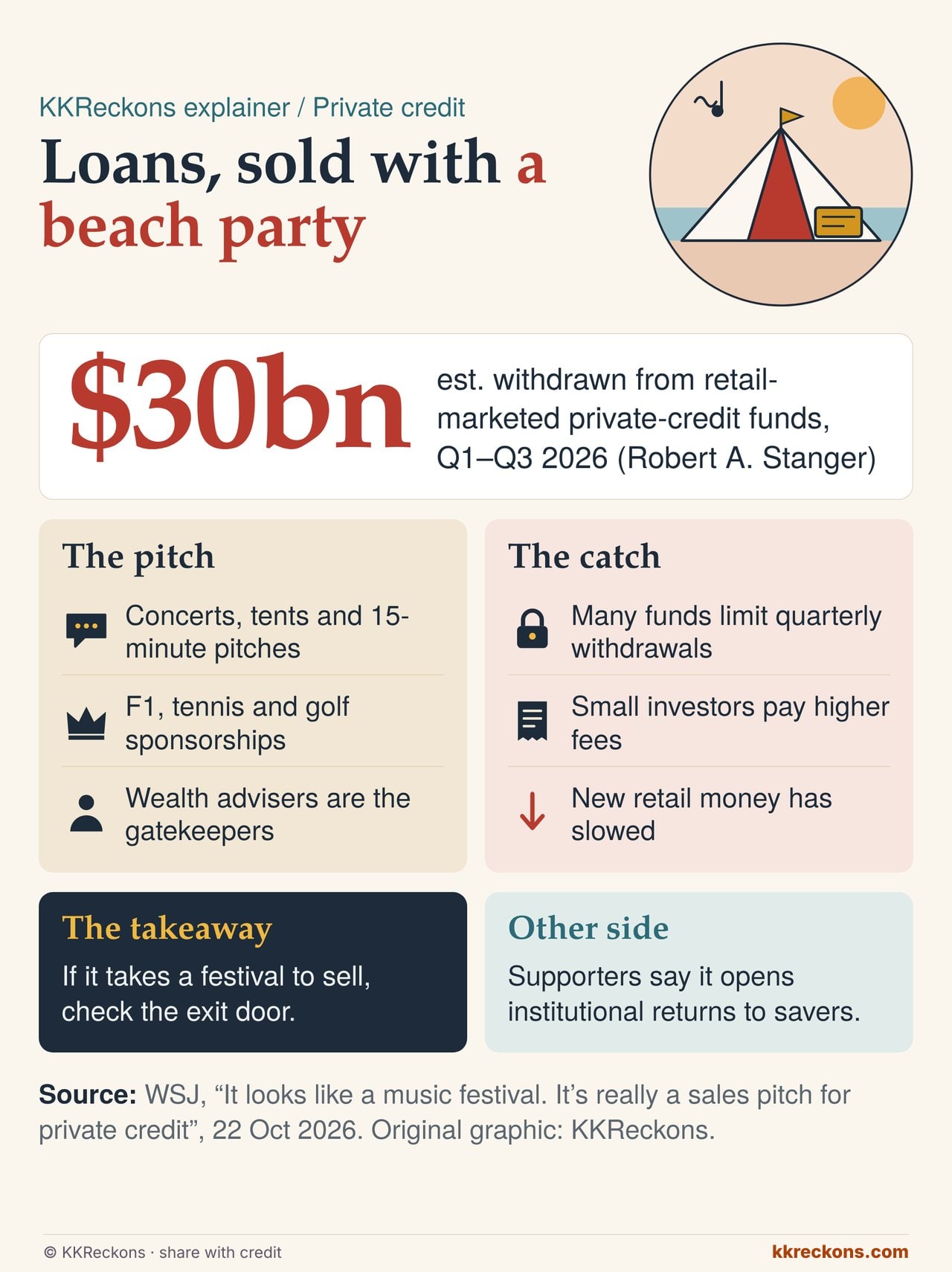
Private credit firms court retail investors with festivals and F1 (opens the source in a new tab)

KKReckons explainer, Loans, sold with a beach party: an estimated $30bn was withdrawn from retail-marketed private-credit funds in Q1 to Q3 2026 (Robert A. Stanger). Firms pitch with concerts, F1, tennis and golf, while many funds limit quarterly withdrawals.
Original graphic: KKReckonsView full size ↗
  • The WSJ reports asset managers are courting wealth advisers at events like California’s Future Proof Festival, where nearly 6,000 attendees got concerts, wellness classes and private-credit pitches, as institutional clients reach their limits.
  • Carlyle uses a Red Bull F1 sponsorship; Blue Owl and EQT back tennis; Apollo sponsors a PGA golfer.
  • Withdrawals are rising: investors pulled an estimated $30 billion from retail-marketed funds in 2026’s first three quarters, per Robert A. Stanger, and many funds limit quarterly exits.
$30bn
pulled from retail private-credit funds, Q1–Q3 2026 (Stanger)
~6,000
attendees at the Future Proof Festival

Why it matters When a product needs a beach festival to sell, ask who carries the risk. Individual investors pay higher fees than pensions and cannot always get out quickly.

Other side Supporters say it opens returns once reserved for institutions, and advisers insist perks don’t sway their picks. For some clients a small allocation can make sense.

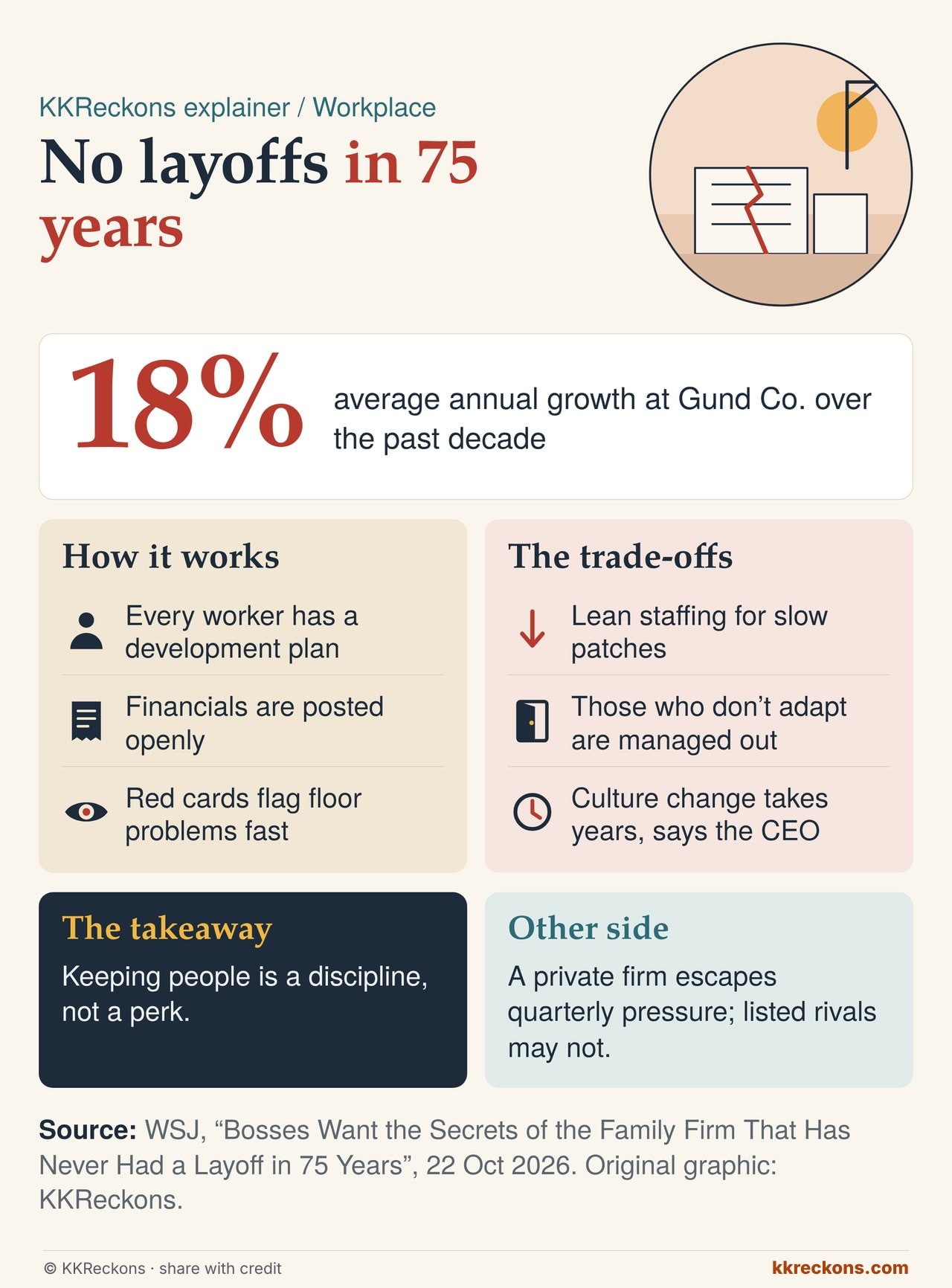
Family firm with no layoffs in 75 years becomes a model for bosses (opens the source in a new tab)

KKReckons explainer, No layoffs in 75 years: Gund Co. has averaged 18% annual growth over the past decade. Every worker has a development plan and financials are posted openly; lean staffing and managing out non-adapters are the trade-offs.
Original graphic: KKReckonsView full size ↗
  • The WSJ profiles Gund Co., a St. Louis composite-materials maker founded by the CEO’s grandfather that has never laid anyone off and has averaged 18% annual growth for a decade.
  • CEO Steve Gund’s people-first playbook: red cards on the factory floor flag problems, everyone has a development plan, financials are posted openly, and workers own part of the firm.
  • It is not soft: Gund staffs lean to ride out slow patches and manages out those who don’t adapt. Leaders from many companies have visited; few copy it fully.
75 yrs
without a single layoff
18%
average annual growth over a decade

Why it matters In a year of AI-driven job cuts, Gund argues keeping people can be a growth strategy, not a cost. Its secret is discipline as much as kindness.

Other side A private family firm answers to no quarterly investors and can staff lean by choice. What works on a Midwest factory floor may not survive a deep downturn, a sale or an industry remade by AI.

Terence Tao calls for ‘Maths 2.0’ as AI floods the field with proofs (opens the source in a new tab)

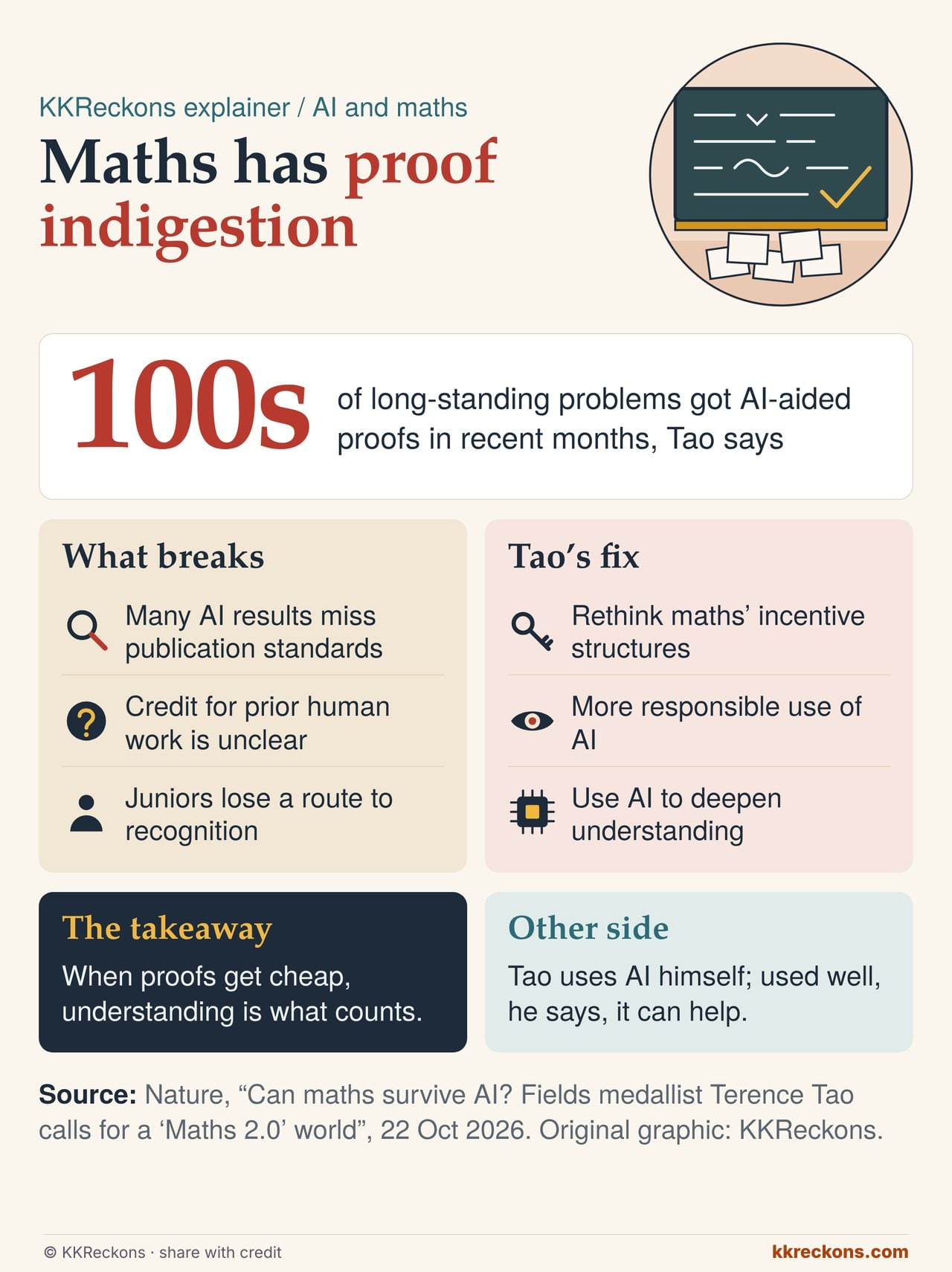
KKReckons explainer, Maths has proof indigestion: hundreds of long-standing problems got AI-aided proofs in recent months, Terence Tao says. Many AI results miss publication standards; Tao calls for new incentives and more responsible use of AI.
Original graphic: KKReckonsView full size ↗
  • In a Nature World View column, Fields medallist Terence Tao says AI-aided proofs have appeared for hundreds of long-standing problems in recent months, and calls for a ‘Maths 2.0’ no longer defined by scarce proofs.
  • He flags costs: OpenAI’s 6 October release of hundreds of solutions disrupted research programmes; many AI results miss publication standards; credit for prior work is unclear; juniors lose a route to recognition.
  • He warns understanding lags output, ‘proof indigestion’, and sees similar risks in opaque models used for bank lending.
100s
long-standing problems with AI-aided proofs
6 Oct
OpenAI’s mass release of solutions

Why it matters When proofs become cheap, understanding becomes the scarce good. The same gap appears wherever banks and funds lean on models nobody can explain.

Other side Tao uses AI in his own research and says that, used creatively and with the right incentives, it could deepen understanding. The upheaval may be a transition cost, not a lasting loss.

Warhound raises $200mn to clone and gene-edit US military dogs (opens the source in a new tab)

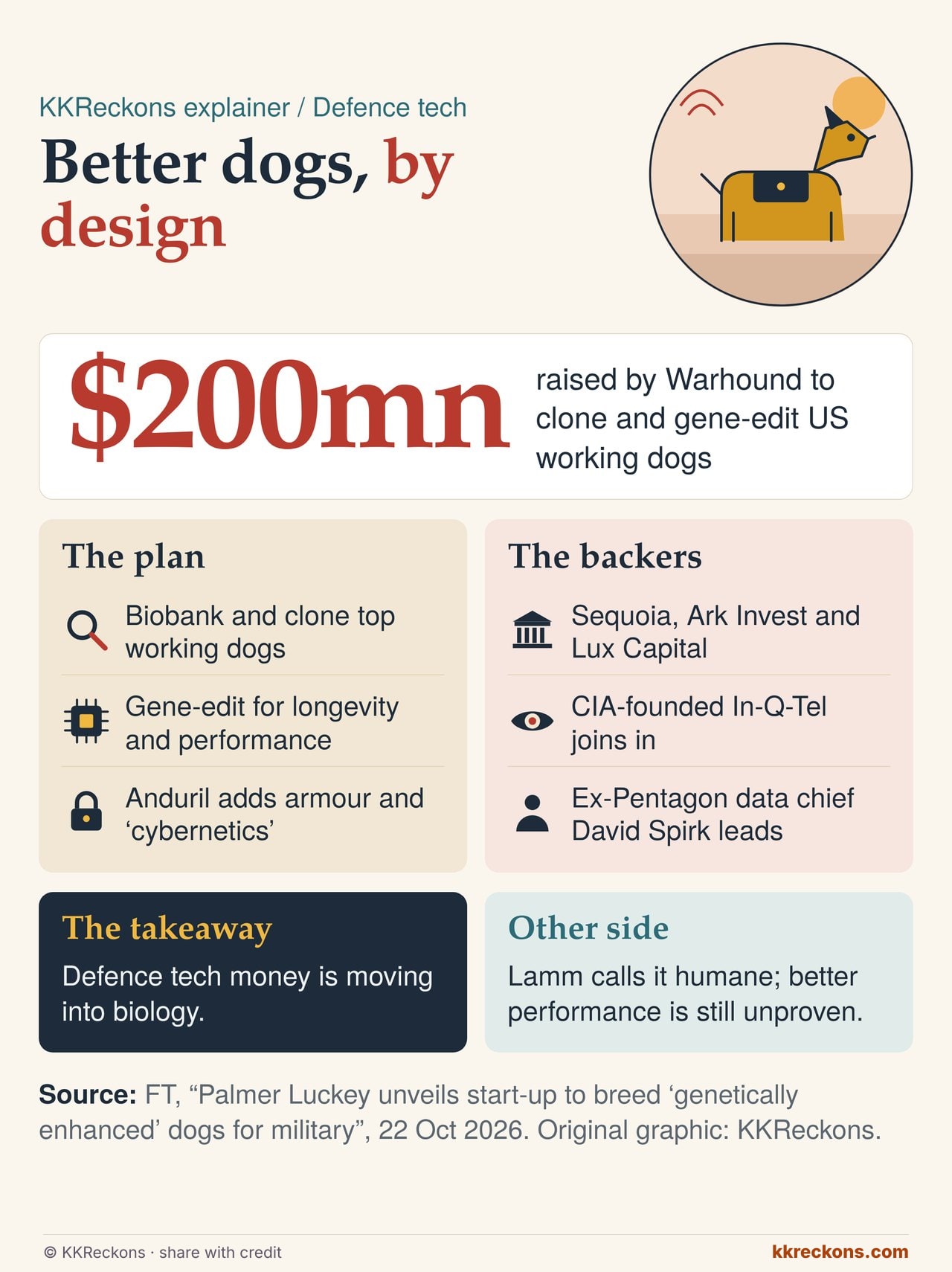
KKReckons explainer, Better dogs, by design: Warhound raised $200mn to clone and gene-edit US working dogs, backed by Sequoia, Ark Invest, Lux Capital and In-Q-Tel. Anduril adds armour; ex-Pentagon data chief David Spirk leads.
Original graphic: KKReckonsView full size ↗
  • The FT reports Warhound, conceived by Anduril co-founder Palmer Luckey and Colossal Biosciences’ Ben Lamm, has raised $200mn from backers including Sequoia, Ark Invest and the CIA-founded In-Q-Tel to rebuild US supply of military working dogs.
  • It plans to clone top dogs and gene-edit them for longevity and performance; Anduril will develop body armour and ‘cybernetics’. Most such dogs now come from European breeders.
  • Luckey holds no equity and no daily role; ex-Pentagon data chief David Spirk will run it.
$200mn
raised from investors
$1.2bn
valuation including the new money, per a source

Why it matters Defence-tech money is now flowing into biology, not just drones. Who sets the ethical rules for editing animals for war is still an open question.

Other side Lamm argues editing is more humane, since many working dogs fail training today. But it is a promise, not a result: edited dogs still have to prove they outperform well-bred ones.

Further reading

Was this briefing useful?YesSomewhatNot really

Spotted an error? Tell us and we’ll correct it.

Today’s edition is ready

Read deep. Think clearly. Stay curious.

A daily visual briefing on the stories that matter: India, the world, and what’s next.

Read Today’s Edition →Get it by email ↗

Free · 50 editions and 359 stories so far · Unsubscribe anytime

Emails are sent by beehiiv; your address is used only for this newsletter. Privacy · Editorial standards