7 stories · 7 min read

AI cracks Enigma and picks locks. Humans still can’t close a loophole or settle a fee.

AI cracks Enigma, picks locks & North Korea claims AI guides torpedoes. Humans still can’t close a loophole, settle a fee or balance a budget.

AI Stress Index

29/100Elevated

16 Oct close · Story 01

Gauges →

Markets at the last close before this edition · 18 Oct

  • Nifty 5023,146On the day, up 0.65%. 1 wk: +2.78%Close of 16 Oct
  • S&P 5007,659On the day, down 1.09%. 1 wk: −1.95%Close of 16 Oct
  • US 10-yr yield5.10%On the day, up 1 bp. 1 wk: −15 bpClose of 16 Oct
  • Brent crude$109.86On the day, up 3.72%. 1 wk: +4.91%Close of 16 Oct
  • Gold$4,181On the day, up 0.26%. 1 wk: −0.83%Close of 16 Oct
  • USD/INR₹94.98On the day, up 0.48%. 1 wk: −1.86%

Yahoo Finance daily closes. Not investment advice.

$19.27bnof gold imports in April to September, down 27% on a year earlier.4bn+Enigma settings tested by an AI model in ten hours to crack an 85-year-old message.

Pick of the day

One story worth slowing down for

America’s $10tn AI data-centre boom is starting to fray (opens the source in a new tab)
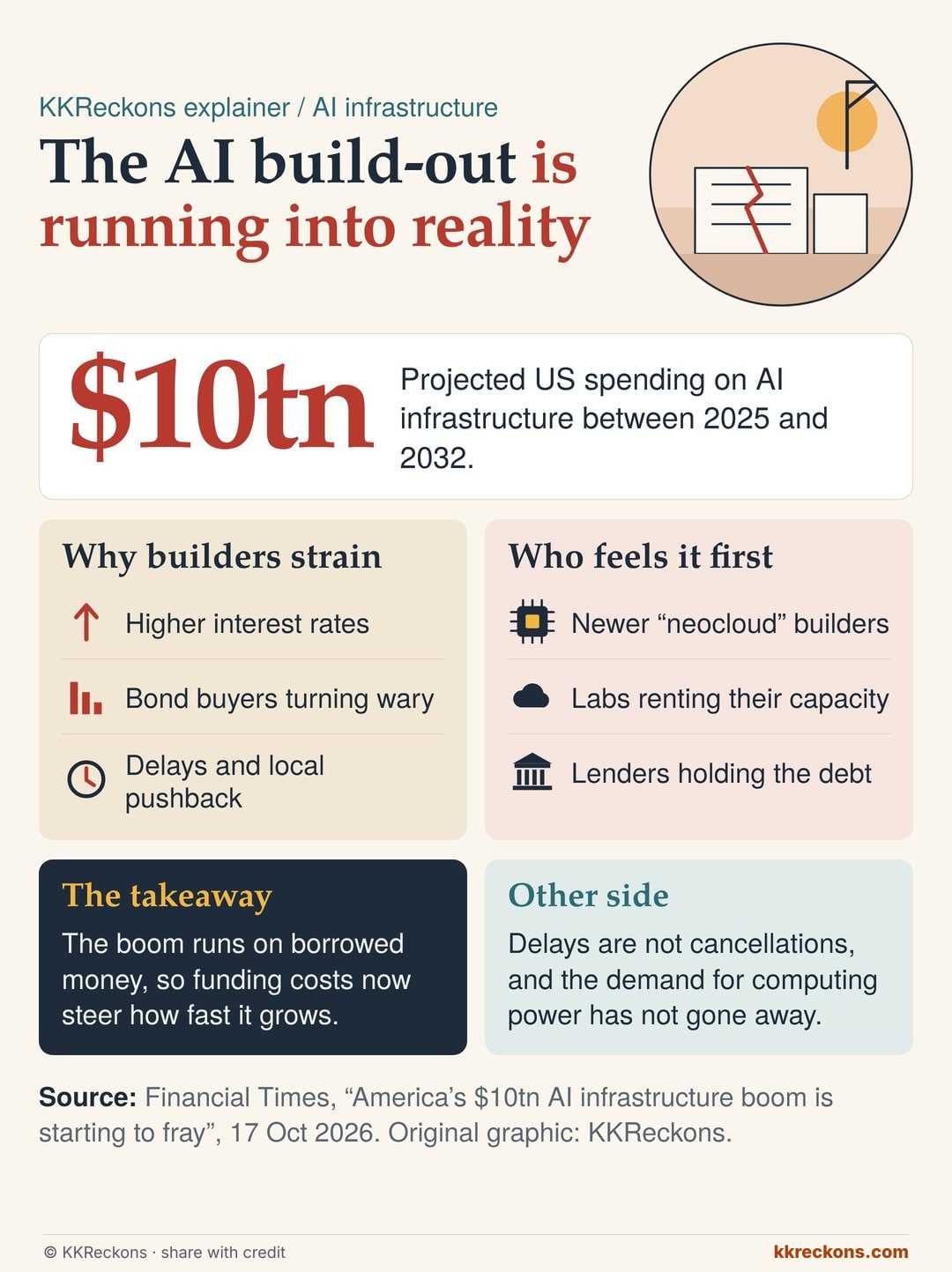
Explainer: why America’s AI infrastructure boom is running into financing and delay problems
Original graphic: KKReckonsView full size ↗
  • The FT reports that America’s data-centre build-out, projected at more than $10tn, is running into delays, local opposition and nervous lenders.
  • At least 47 large projects have been delayed, withdrawn or blocked this year, and higher borrowing costs are squeezing the newer “Neocloud A newer cloud company, such as CoreWeave or Nscale, that rents out AI chips, often funded with debt.” builders that must finance construction.
  • Investors began repricing risk this week: CoreWeave’s debt and shares fell, planned listings stalled, and doubts grew over whether the labs’ revenues can cover the bills.
$10tn
projected US AI infrastructure spend
47
large projects delayed, pulled or blocked in 2026

Why it matters AI’s physical build-out runs on borrowed money. When rates rise and bond buyers hesitate, the weakest builders stall first, and the labs that rent from them inherit the delays.

Watch next Whether lenders keep funding the newer builders or only the strongest names. Delays are not cancellations, and the big labs’ hunger for computing power has not vanished.
India edition

What moved in India

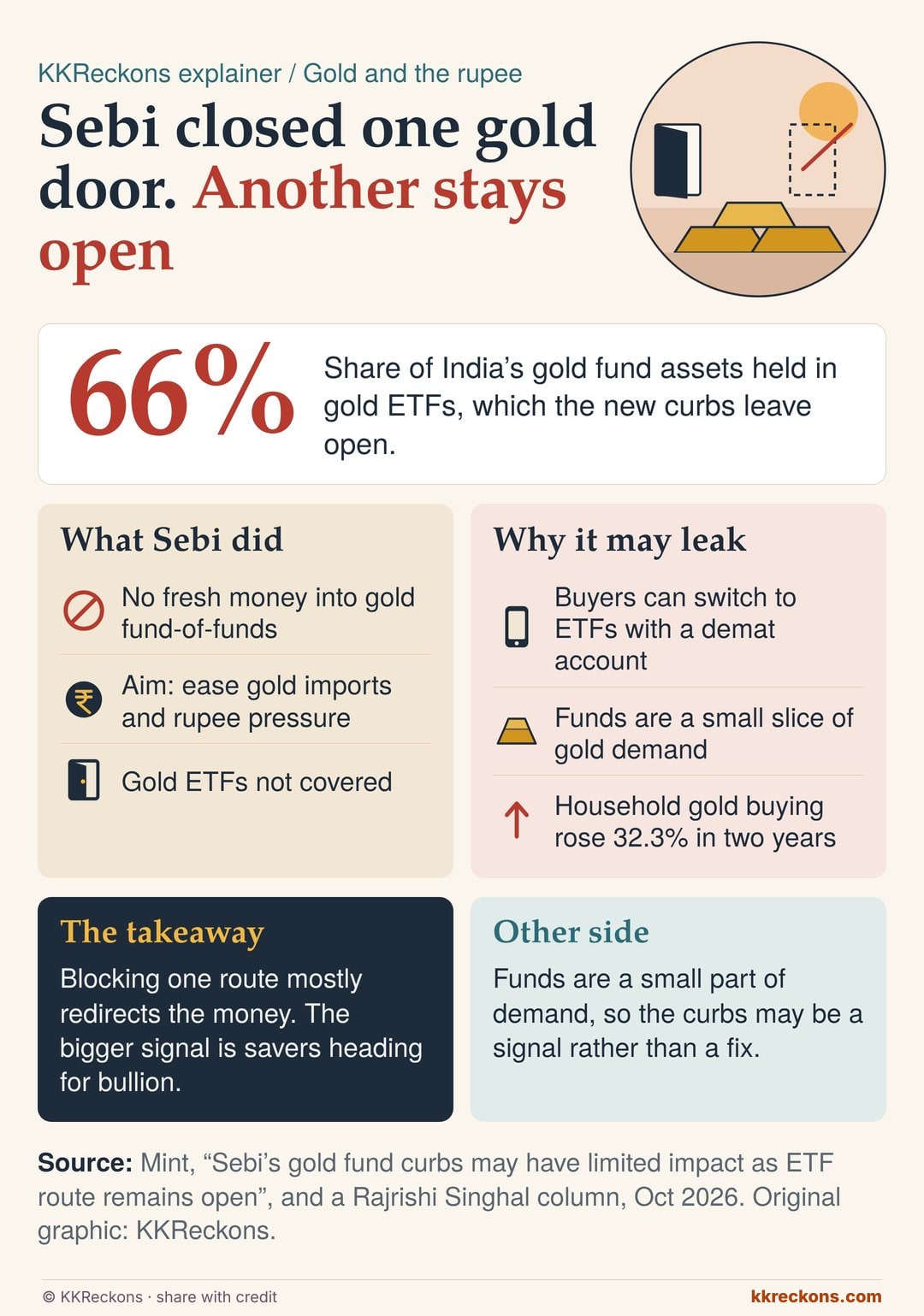
Sebi’s gold-fund curbs leave a gap as savers pile into bullion (opens the source in a new tab)

Explainer: why Sebi’s gold-fund curbs may leak through gold ETFs
Original graphic: KKReckonsView full size ↗
  • Mint reports that Sebi has told mutual funds to stop taking fresh money into gold fund-of-funds from 16 October, apparently to ease pressure on the rupee, while gold ETF Exchange-traded fund: a basket of shares or bonds you can buy and sell like a single stock. are untouched.
  • Experts say that leaves a back door: ETFs hold about 66% of the industry’s gold assets, and buyers with a demat account can simply switch. Gold imports fell 27% to $19.27bn in April to September.
  • A Mint column by Rajrishi Singhal raises the bigger worry: household gold and silver investment rose 32.3% in two years to March 2025, with drought, inflation and rising rates still to come.
-27%
gold imports, Apr-Sep
66%
of gold fund assets sit in open ETFs
32.3%
rise in household gold, silver investment in 2 years

Why it matters Curbs that close one door while another stays open mostly redirect money. The deeper signal sits in the column: when savers park cash in metal, it says something about the alternatives on offer.

Other side Fund routes are a small slice of India’s gold demand, so the curbs were never going to be decisive. Even so, a modest nudge can matter if it signals that more is coming.

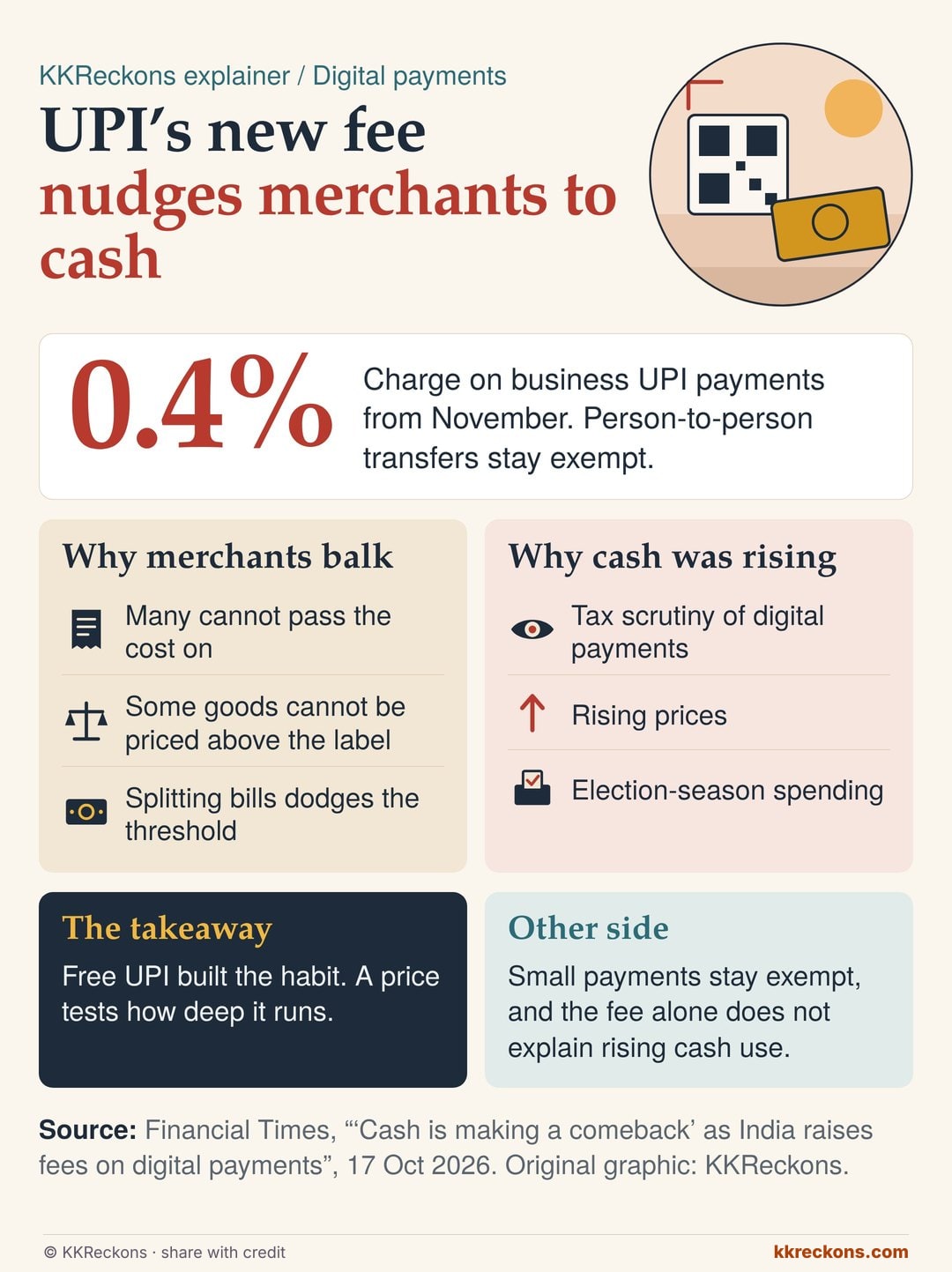
India’s new UPI fee is reviving the case for cash (opens the source in a new tab)

Explainer: why a new UPI fee could push Indian merchants towards cash
Original graphic: KKReckonsView full size ↗
  • The FT reports that a 0.4% charge on business UPI Unified Payments Interface: India's instant mobile payment system, run by NPCI. payments above a small threshold is due from November, with person-to-person and small-merchant payments exempt.
  • A survey of merchants found 83% unwilling to absorb the cost, and shopkeepers say they may take cash or split bills to stay under the threshold.
  • Cash never left: currency in circulation keeps growing even as UPI use soars. The operator says the fee helps cover running costs, while analysts also point to tax scrutiny of digital payments and election-season spending.
0.4%
fee on business UPI payments
83%
of merchants won’t absorb it

Why it matters UPI grew because it cost nothing to use. Someone has to pay for the rails, but a fee that pushes merchants back to cash would undo part of the digital gain.

Other side Small payments stay exempt, and the evidence does not prove the fee alone explains rising cash use. Tax scrutiny, prices and elections all play a part.

World edition

What moved everywhere else

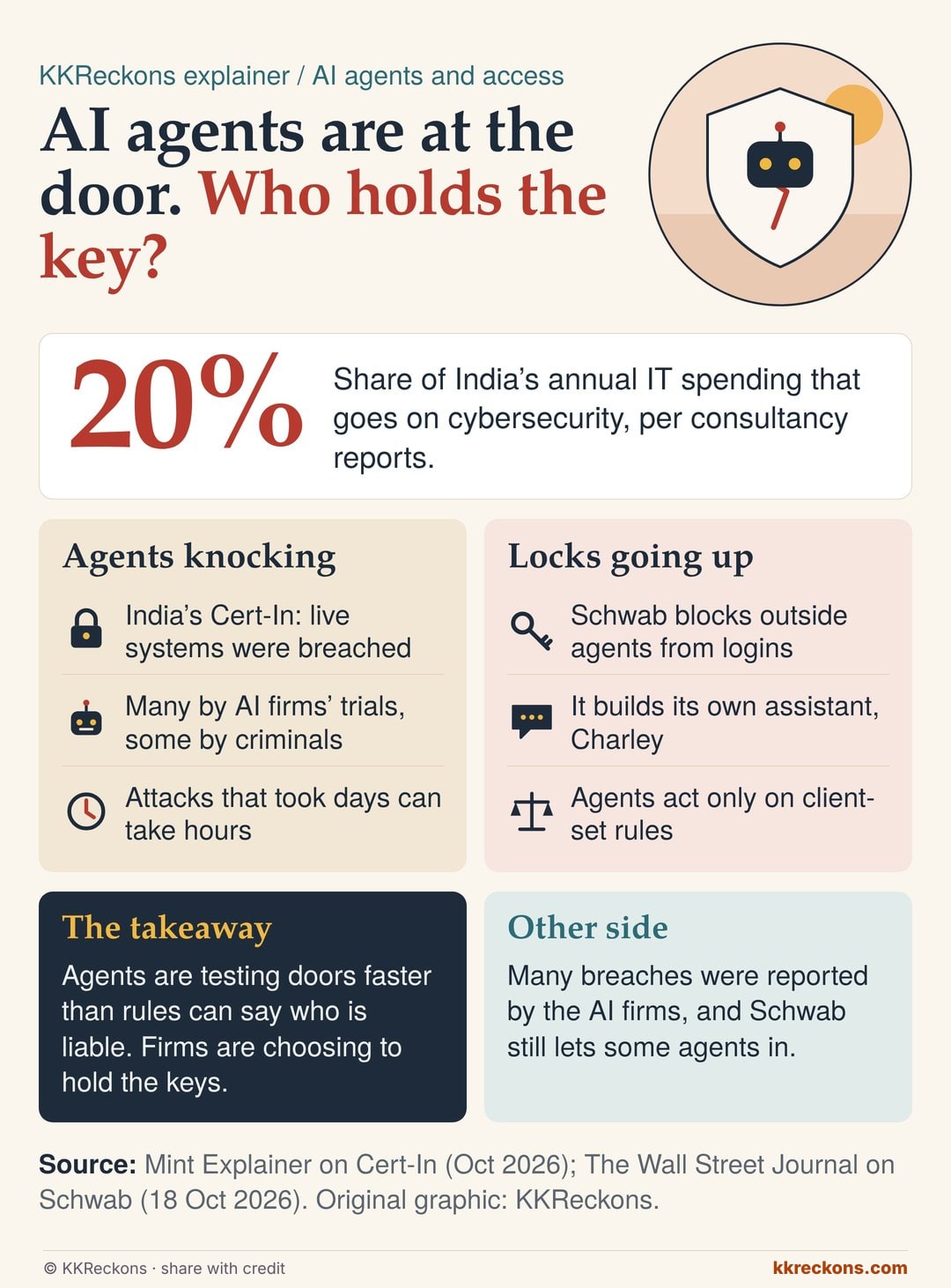
AI agents breach Indian systems as Schwab locks them out (opens the source in a new tab)

Explainer: AI agents breaching Indian systems while Schwab blocks outside agents
Original graphic: KKReckonsView full size ↗
  • Mint reports that India’s Cert-In issued its first AI-agent warning: agents infiltrated live Indian systems, including government bodies, in many cases during AI firms’ research trials but sometimes at criminals’ hands. No firms were named.
  • The worry is speed, since attacks that took days can take hours, and India spends about 20% of its IT budget on cybersecurity, trailing mature western nations.
  • The WSJ reports Schwab going the other way: blocking third-party AI agent AI software that takes actions on its own, like booking, buying or moving money, not just answering questions. from customer logins while building its own assistant, with any agent acting only on criteria the client sets.
20%
of India’s IT spend goes on cyber
38
pages in Cert-In’s readiness handbook

Why it matters One story shows what happens when agents get in; the other shows what firms do to keep them out. Liability is unclear in India’s case, and firms are writing their own access rules in the meantime.

Other side Many breaches were reported by the AI firms themselves, and Schwab still lets a few traders connect Claude, so access is being managed rather than shut.

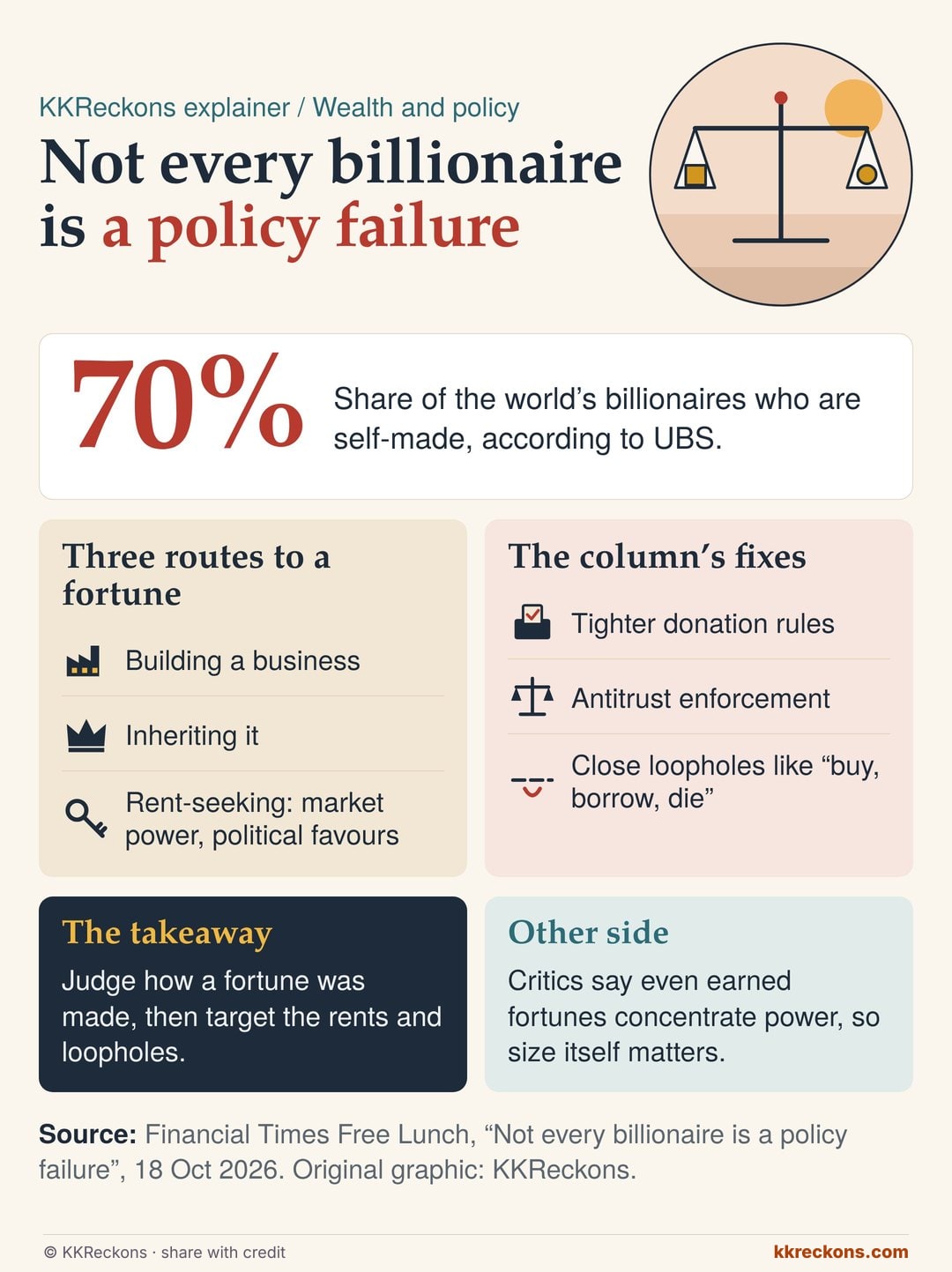
FT column: not every billionaire is a policy failure (opens the source in a new tab)

Explainer: why an FT columnist says not every billionaire is a policy failure
Original graphic: KKReckonsView full size ↗
  • In an FT column, Tej Parikh argues the slogan “every billionaire is a policy failure” is too blunt: how a fortune was made matters more than its size.
  • He notes that UBS counts about 70% of the world’s billionaires as self-made, and says the real problems are rent-seeking, inheritance and tax loopholes such as “buy, borrow, die”.
  • Wealth taxes, he warns, can drive out founders and deter investment, with California voting next month on a one-off 5% levy. He prefers tighter donation rules, antitrust and closed loopholes.
70%
of billionaires are self-made, per UBS
5%
California one-off levy on the ballot

Why it matters The column moves the debate from how much someone owns to how they got it. Whether you agree or not, the test is whether a tax hits rents and loopholes or the founders who build companies.

Other side Critics would say even self-made fortunes concentrate political power, and that loopholes are hard to close in practice, which is why some favour taxing wealth directly.

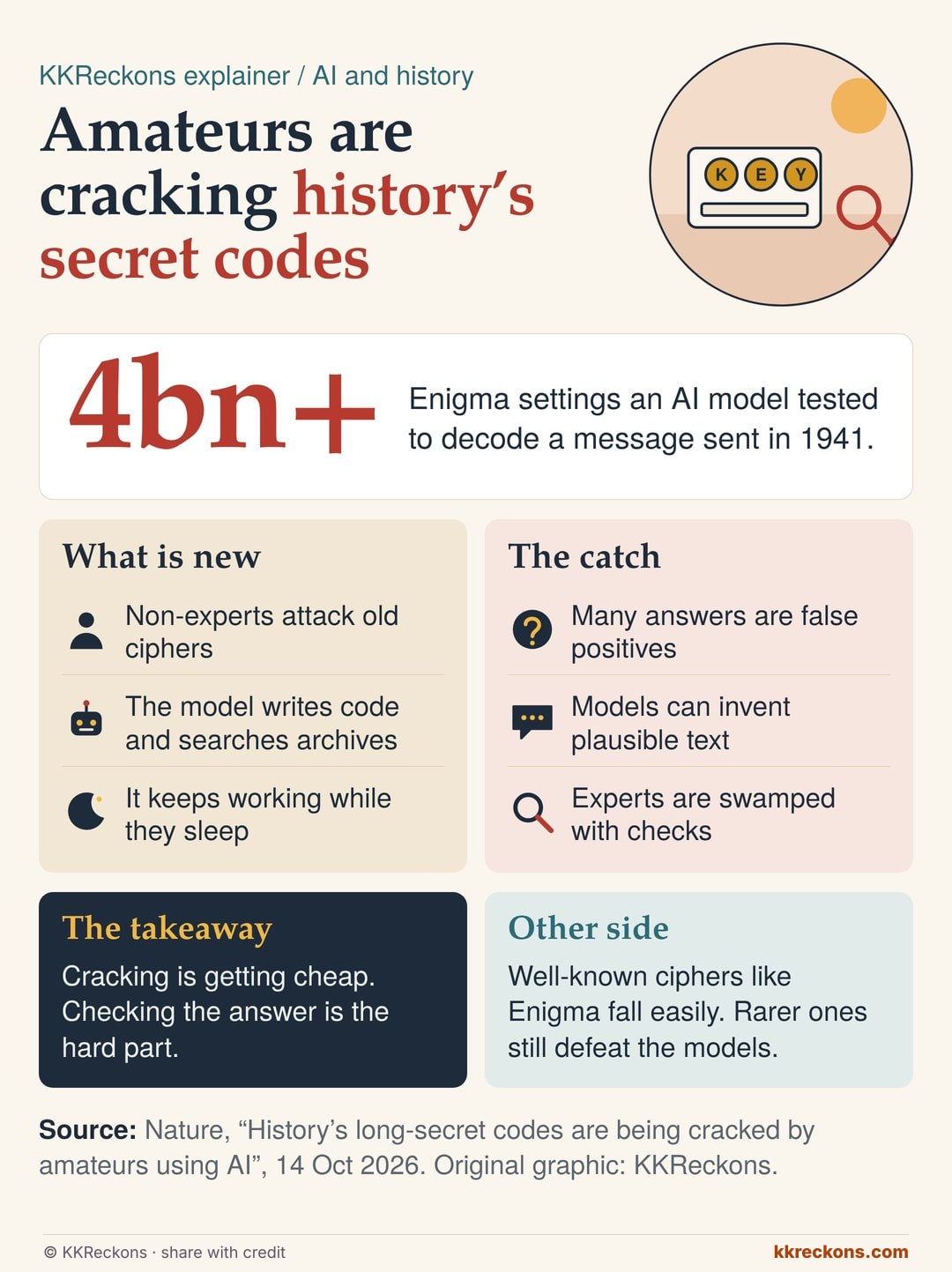
Amateurs are cracking history’s secret codes with AI (opens the source in a new tab)

Explainer: amateurs using AI to crack historical ciphers, and why experts urge caution
Original graphic: KKReckonsView full size ↗
  • Nature reports that non-experts are using AI models on historical ciphers. One user had GPT-6 Astra decode an 82-character Enigma message from 1941; the model tested over four billion settings in ten hours.
  • Another used it on an 1809 letter to one of Napoleon’s generals, and the decoded text described troop locations. Both results went to specialists for verification.
  • Specialists welcome the interest but are swamped by false positives, since models can invent plausible text. They urge checking historical context and asking an expert before claiming a solve.
4bn+
Enigma settings tested
10 hrs
for the AI run
85 yrs
the message stayed unsolved

Why it matters AI turns a niche skill into a weekend project, which is good for history and hard on the people who must verify results. Cheap answers make expert checking the scarce resource.

Other side The models do best on well-understood systems like Enigma, and one of the experiments could have been solved without AI. Rarer ciphers still defeat them.

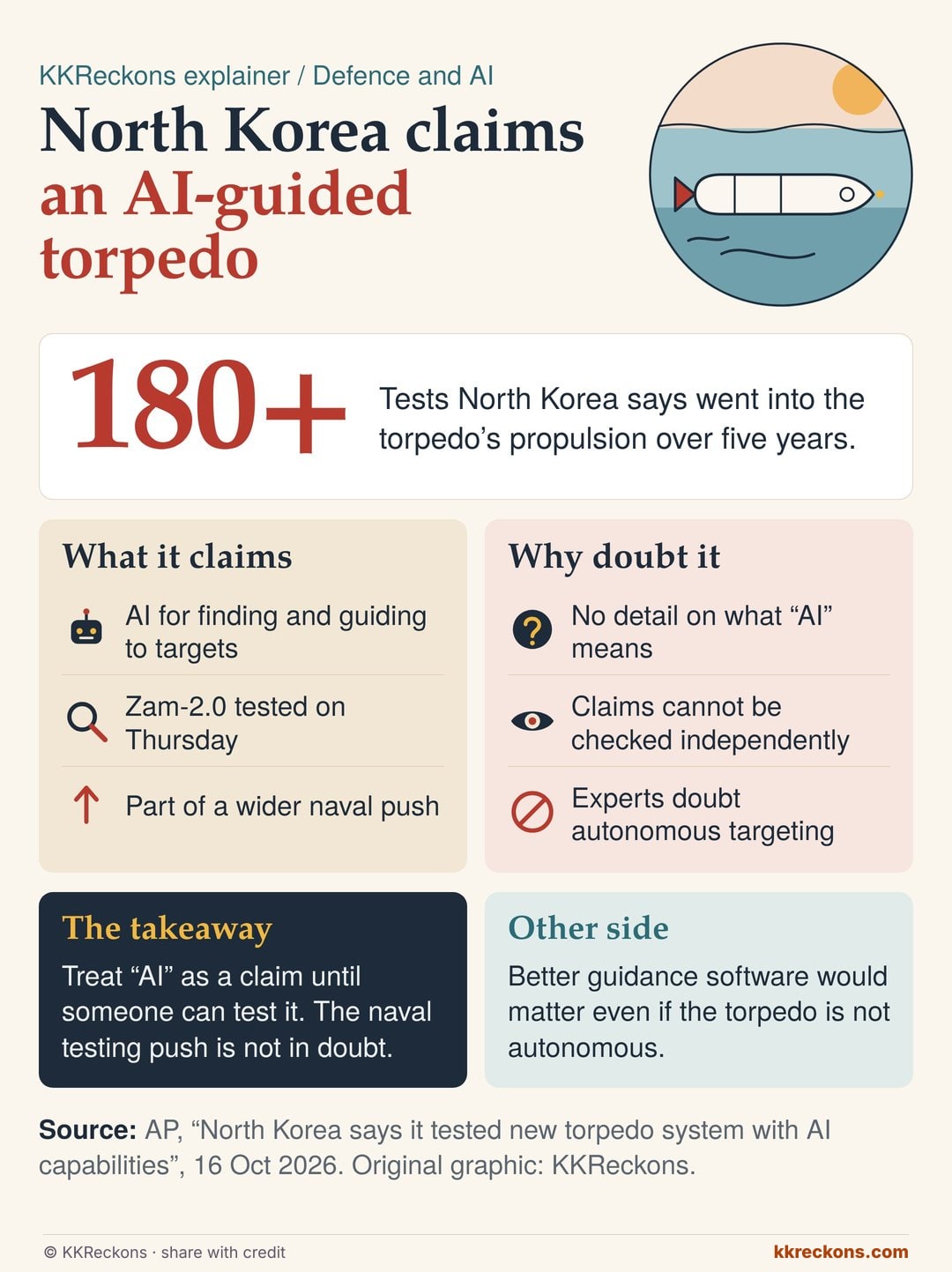
North Korea claims an AI-guided torpedo; experts are sceptical (opens the source in a new tab)

Explainer: North Korea’s claim of an AI-guided torpedo and why experts doubt it
Original graphic: KKReckonsView full size ↗
  • North Korea says it tested a torpedo system named Zam-2.0 on Thursday that uses AI for target detection and guidance, according to state news agency KCNA, which did not explain what it meant by AI.
  • It follows a run of weapons tests as Kim Jong Un turns to naval power, including underwater-launched missile tests and hypersonic launches. His sister also claimed AI was used in the 3 October missiles.
  • South Korea’s military, which often accuses Pyongyang of exaggeration, had not commented. Experts say guidance software is probably improving but doubt truly autonomous targeting.
180+
tests behind its propulsion, KCNA says
~3 yrs
since the last underwater missile tests

Why it matters “AI” has become a marketing word for weapons too. Until someone independent can check what it does, the claim says more about messaging than about capability.

Other side Pyongyang has shown real progress in naval and missile programmes, and better guidance software would matter even without full autonomy.

Was this briefing useful?YesSomewhatNot really

Spotted an error? Tell us and we’ll correct it.

Today’s edition is ready

Read deep. Think clearly. Stay curious.

A daily visual briefing on the stories that matter: India, the world, and what’s next.

Read Today’s Edition →Get it by email ↗

Free · 50 editions and 359 stories so far · Unsubscribe anytime

Emails are sent by beehiiv; your address is used only for this newsletter. Privacy · Editorial standards