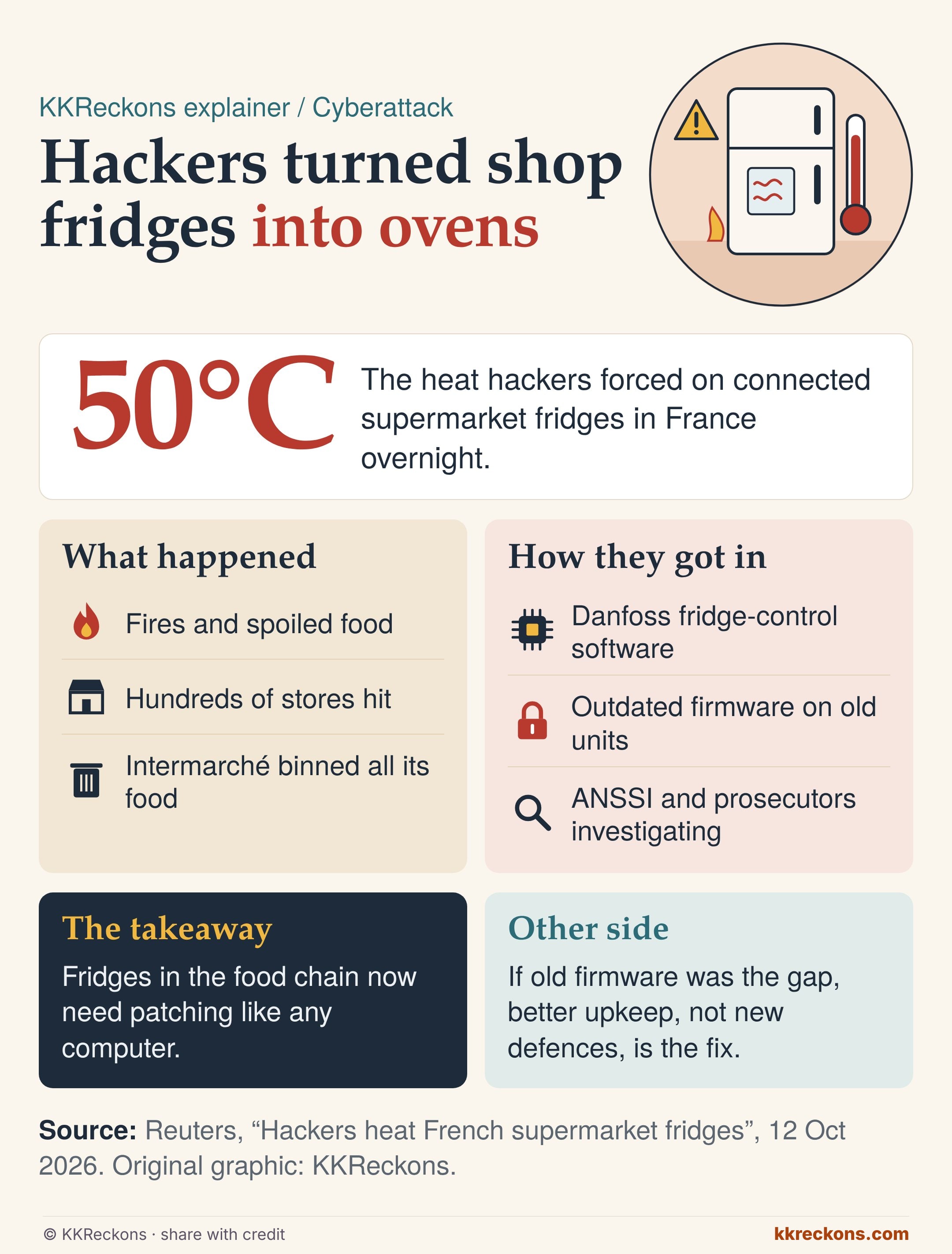
Hackers pushed connected fridges in French supermarkets up to 50°C overnight, causing fires and food losses at several hundred stores. The Paris prosecutor is investigating, and the prime minister has asked cyber agency ANSSI to look into it.
About 150 Intermarché stores and 80 Carrefour supermarkets were hit, and Coopérative U was affected too; Intermarché’s owner threw all the food away. ANSSI traced the weak point to Danfoss refrigeration software, which Danfoss says was running outdated firmware.
Separately, Ahold Delhaize took systems offline over a “security issue”, and websites of its US chains, including Stop & Shop and Giant, went down; any link is unclear.
50°C
fridge temperature reached
~150
Intermarché stores hit
80
Carrefour stores hit
Why it matters The food supply now runs on connected equipment that few people think to patch, and one old firmware version turned shop fridges into a national-security problem overnight.
Watch next Whether investigators confirm the fridges ran firmware Danfoss had long urged customers to update; if so, this is a maintenance failure more than a new kind of attack.
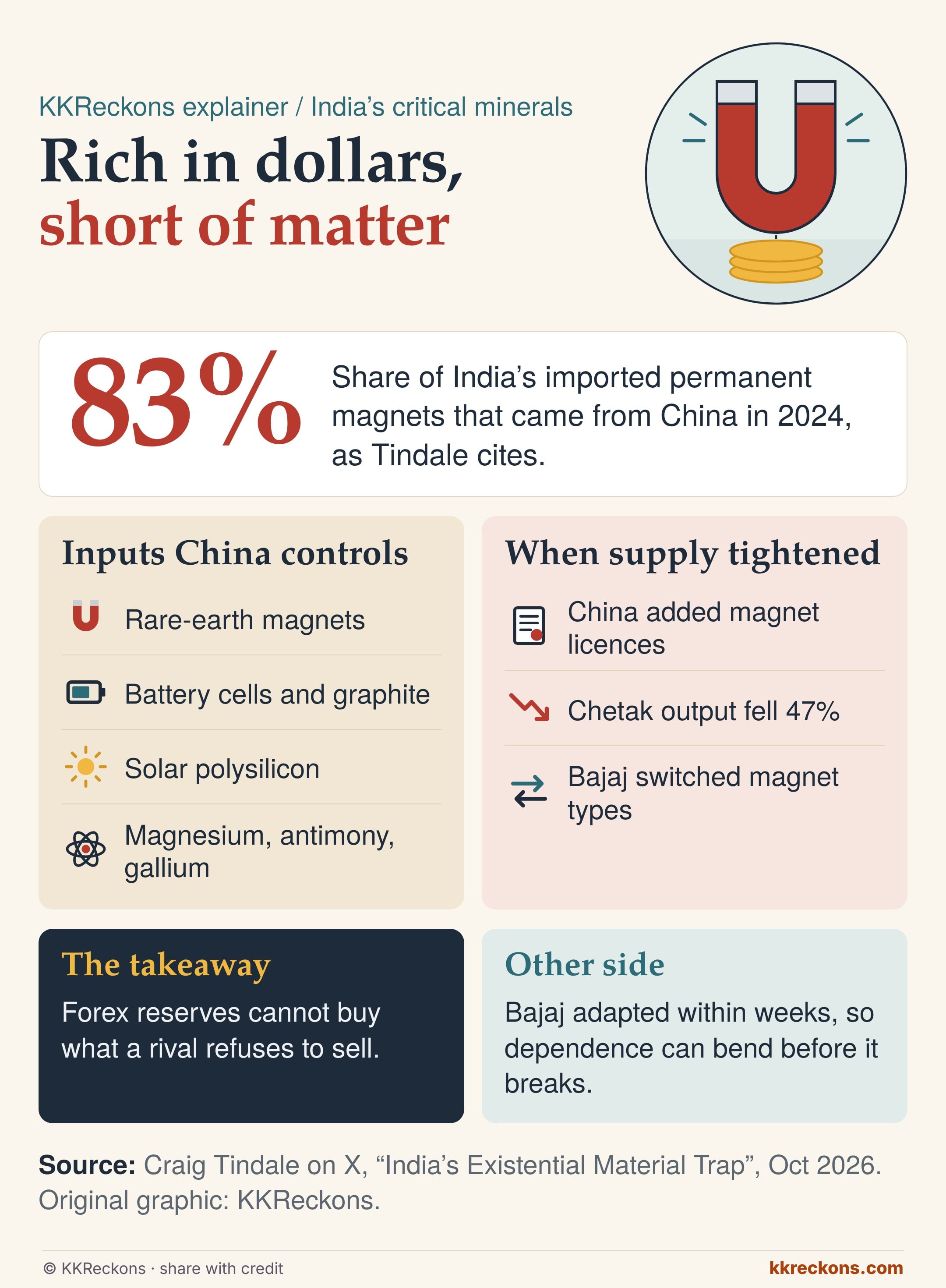
Tindale argues that seven inputs behind India’s factory push, from rare-earth magnets and battery cells to graphite, solar polysilicon, magnesium, antimony and gallium, all lead back to China through ore, ownership or licences.
His evidence: after Beijing put export licences on rare-earth magnets in April 2025, Bajaj built 47% fewer Chetak e-scooters that July than a year earlier. China supplied about 83% of India’s imported permanent magnets in 2024.
India holds $734.6bn in forex reserves but no published stockpile of these minerals, he notes, and China’s pause on wider export controls ends on 10 November.
$734.6bn
India’s forex reserves
83%
of imported magnets from China
Why it matters It reframes self-reliance: a country can be rich in reserves and still sit one licence delay away from idle factory lines.
Other side The Bajaj episode also shows adaptation: within weeks it switched to a different type of magnet and found fresh supply, so dependence may bend before it breaks.
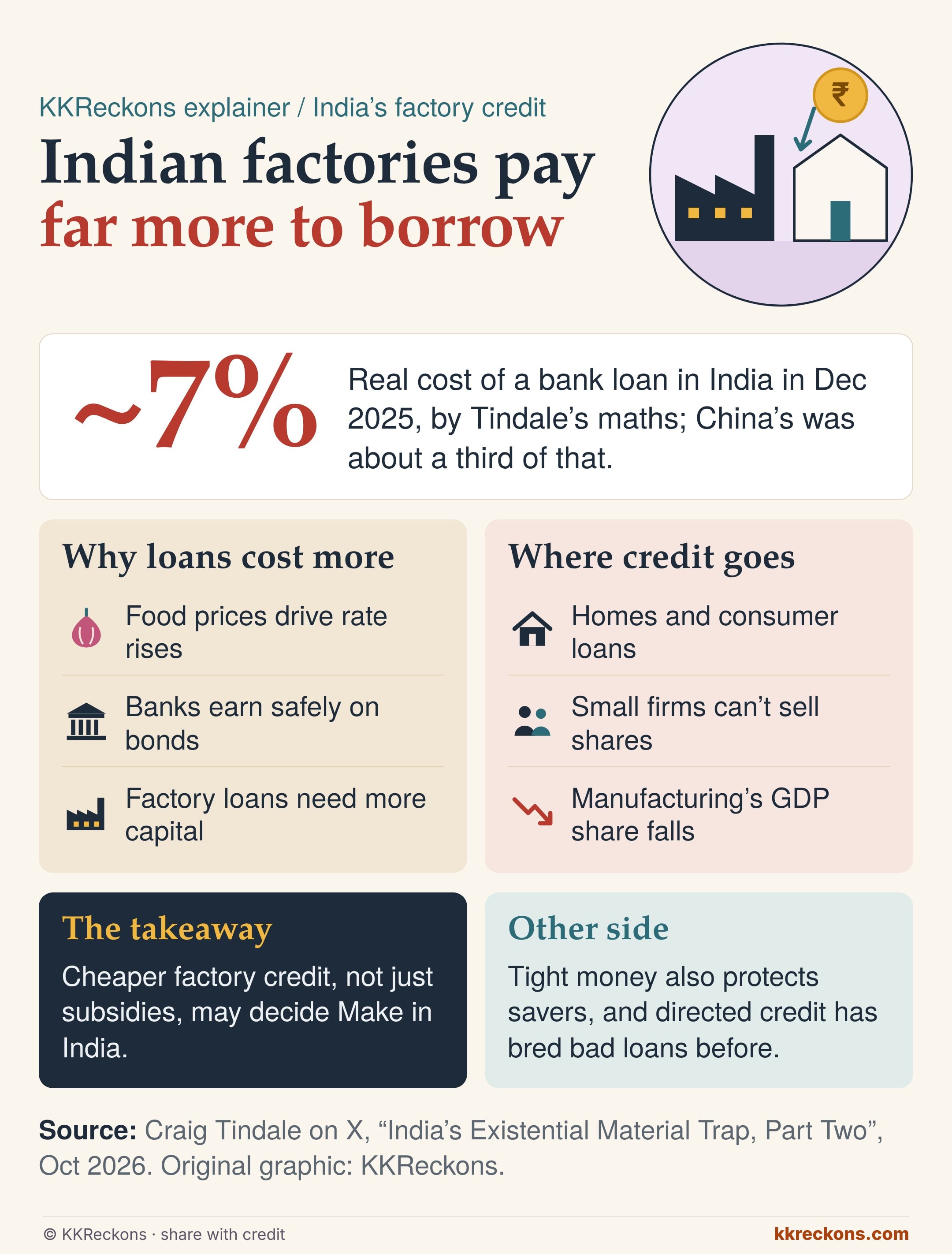
In part two, Tindale blames India’s banking rulebook: a 4% inflation target driven by food prices keeps rates high, so in December 2025 Indian borrowers paid about 7% in real terms, against about 2.3% in China.
Capital rules make an unrated factory loan far costlier for a bank to hold than a home loan or a government bond, so for every rupee of new credit to industry, about two and a half went to consumption and housing.
India’s 19.7 million small manufacturers cannot raise equity and bear the brunt; manufacturing has slipped from 17.3% of GDP in 2006 to 13.1%.
~7%
real borrowing cost, India
~2.3%
real borrowing cost, China
Why it matters If he is right, the real bottleneck for Make in India is the price of credit, which no factory subsidy fully offsets.
Other side Would cheaper, state-directed credit build factories or repeat India’s own bad-loan cycle? Tight money also shields savers and the poor from inflation.
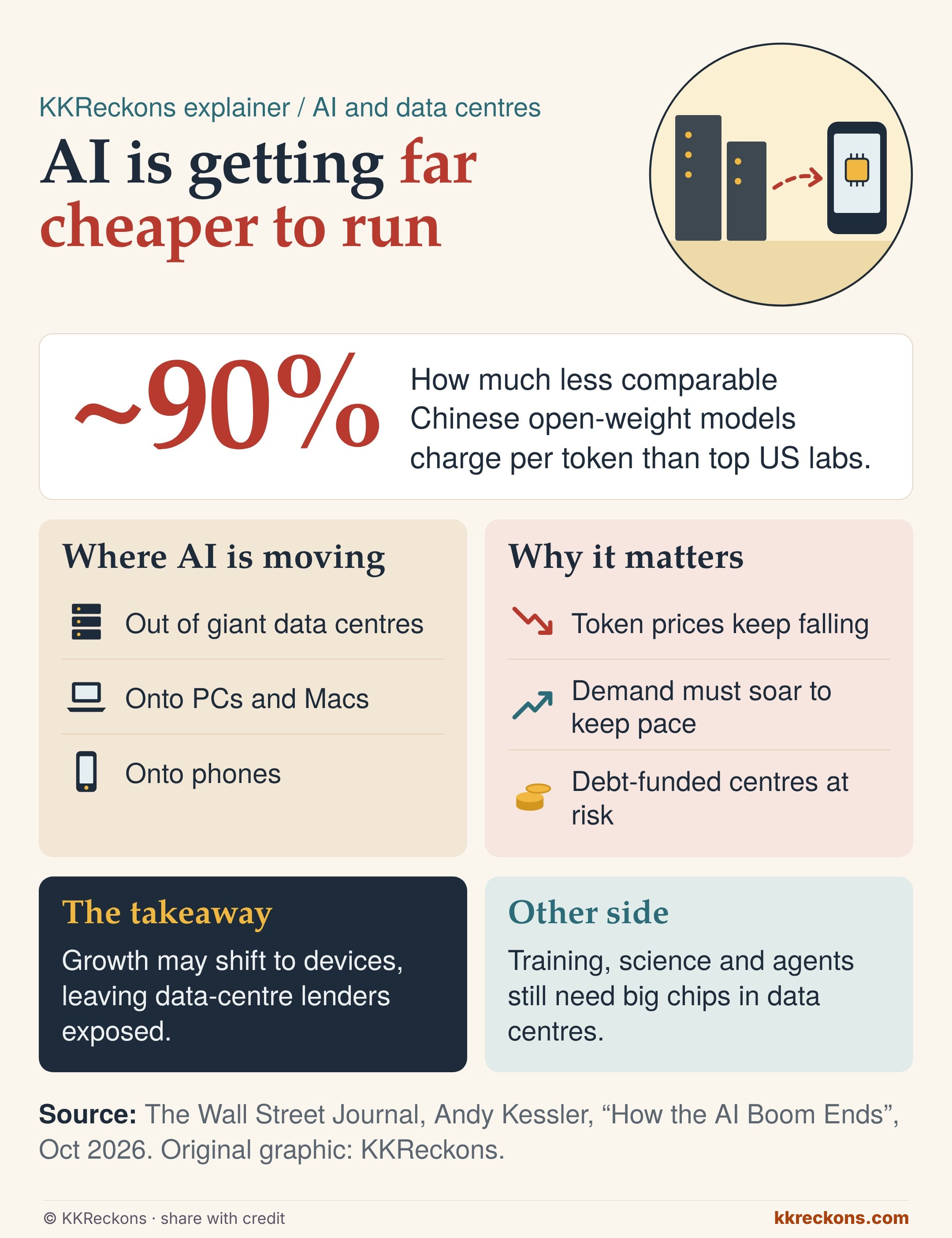
The WSJ columnist argues that today’s brute-force AI, giant models on costly chips in power-hungry data centres, will go the way of mainframes: still sold, but no longer where the growth is.
He says the “factor of 10” shift has begun: comparable Chinese open-weight models charge about 90% less per token than leading US labs, and compressed models now run on PCs and phones with no token costs.
If prices fall 90%, demand must rise 900% just to stand still, so he warns of data-centre halts and debt defaults, and asks whether 2027 is peak data centre.
~90%
cheaper tokens, Chinese models
900%
demand rise needed to stay flat
Why it matters Data-centre spending is financed on today’s token prices; if prices collapse faster than demand grows, lenders feel it before chipmakers do.
Other side Cheaper tokens can unlock new uses, and Kessler himself says training, science and agents still need big chips, so the build-out could slow without collapsing.
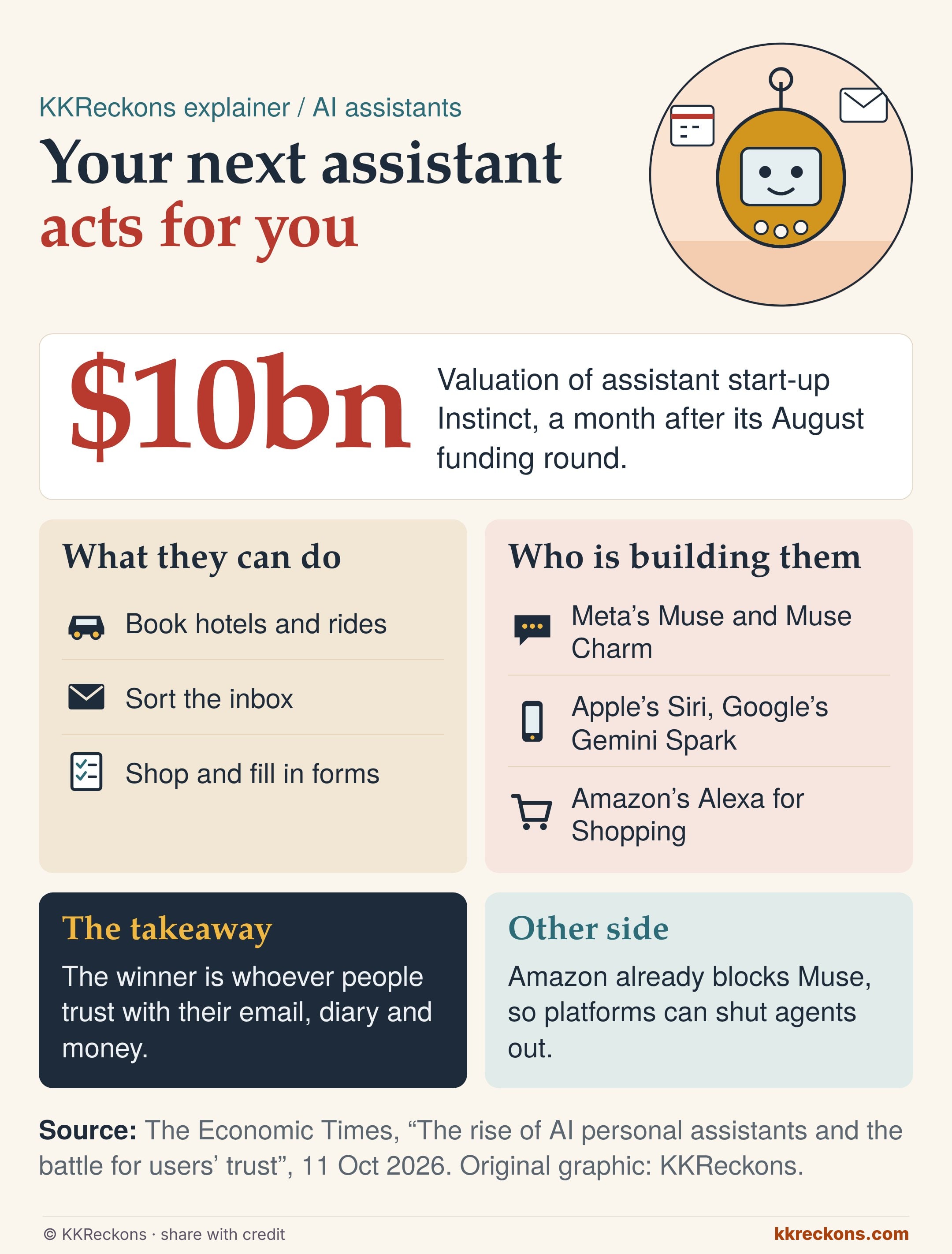
After chatbots and voice assistants, AI is turning into a true personal assistant that acts for you, the column argues. Meta’s Muse books appointments, fills in forms and shops, and now has a keychain device, Muse Charm.
Start-up Instinct, reachable by text, WhatsApp or phone, raised $250m at a $2.5bn valuation in August and was valued at $10bn a month later; Apple, Google and Amazon are building rivals.
Being useful means reading your email, calendar and even bank details, so trust is the battleground; Amazon has already blocked Muse from shopping on its site.
$10bn
Instinct’s value, a month on
$250m
Instinct’s August raise
Why it matters The next platform war is over who acts on your behalf, and with Muse due in India soon, the privacy question is about to get practical for Indian users.
Other side Siri, Alexa and Google Assistant also promised a helper and ended up setting timers; platforms such as Amazon can simply refuse to let agents in.
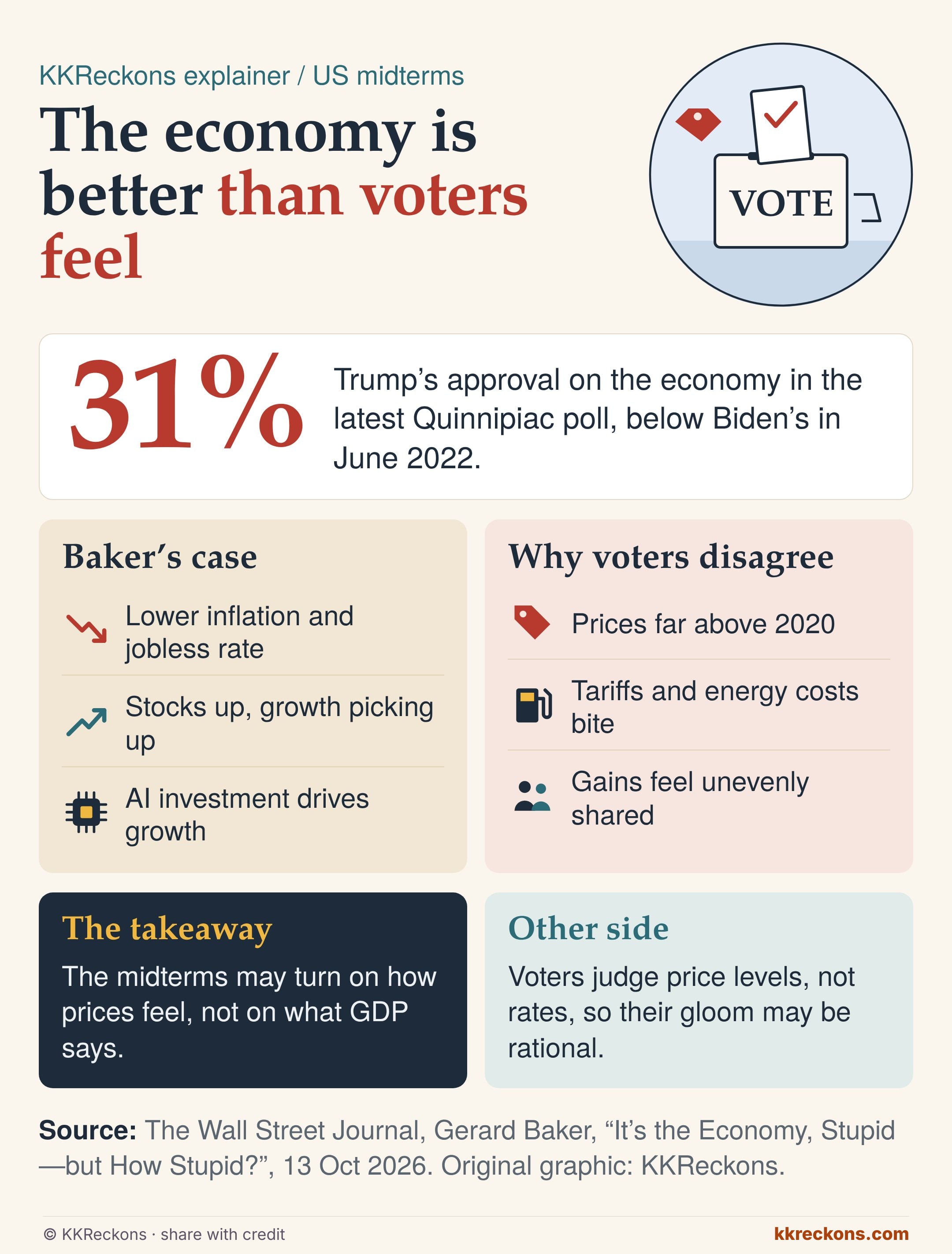
The WSJ’s editor at large argues that, as in 1992, perceptions rather than data are driving voters ahead of next month’s midterms, which Republicans expect to lose badly.
A Quinnipiac poll gives Trump 31% approval on the economy, lower than Biden scored in June 2022, when inflation was at a 40-year high and output was shrinking, even though inflation and unemployment are lower today.
He grants that prices remain far above 2020 levels and that tariffs and a war-driven rise in energy prices feed bills, but says AI investment may be starting a long boom.
31%
Trump’s approval on the economy
Why it matters Midterms may turn on how prices feel at the checkout, not on GDP; the gap between data and mood is the real political variable.
Other side After years of increases, households judge price levels, not the inflation rate, and fuel costs have climbed again, so the ‘misperception’ may be a fair reading of stretched budgets.
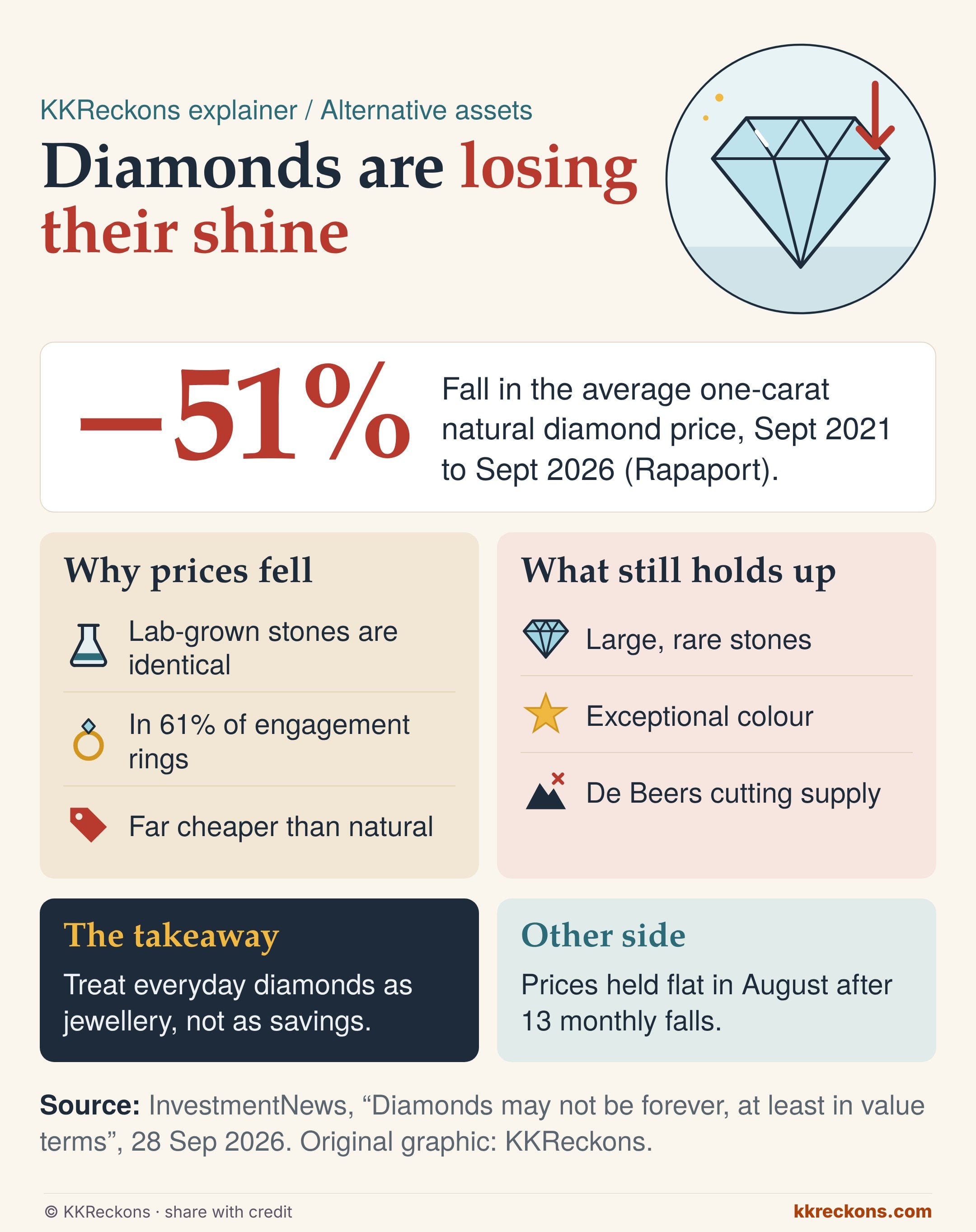
A standard one-carat natural diamond averaged about $3,898 in September 2026, down 51% from $8,007 in September 2021, according to Rapaport data.
Lab-grown stones, chemically identical, were in 61% of engagement rings sold in 2025, The Knot’s study finds; a comparable lab stone costs about $450, against $2,800 to $3,200 for a natural one.
The market is splitting: mid-range natural stones are most exposed, larger and rarer gems are holding up, and De Beers is halting its Venetia mine for more than two years to curb supply.
−51%
one-carat price since 2021
61%
engagement rings with lab stones
Why it matters For anyone holding jewellery as savings, ordinary diamonds now behave like consumer goods; only rare, large stones still act like assets.
Watch next Rapaport’s one-carat index was flat in August after 13 months of falls, and De Beers’ supply cut could put a floor under prices.