7 stories · 6 min read

Fake hires, hot freezers, dear bonds, shaky G7, proud China. Kids get stock. Grads don't.

Today's risks slip in through side doors: a job test, a freezer dial, a bond coupon, an unfilled first job. Watch the quiet entrances, not just the front gate.

AI Stress Index

36/100Elevated

3 Nov close · Story 02

Gauges →

Markets at the last close before this edition · 3 Nov

  • Nifty 5023,811On the day, up 1.58%. 1 wk: +4.66%
  • S&P 5007,569On the day, up 0.36%. 1 wk: −1.99%
  • US 10-yr yield4.95%On the day, up 6 bp. 1 wk: −4 bp
  • Brent crude$103.60On the day, down 1.12%. 1 wk: −9.03%
  • Gold$3,940On the day, down 0.74%. 1 wk: −3.29%
  • USD/INR₹94.73On the day, down 0.19%. 1 wk: −0.48%

Yahoo Finance daily closes. Not investment advice.

$6.3bnstolen from Binance after a fake job interview let hackers in1.2%a year to insure Meta's debt, on par with junk-rated South Africa

Pick of the day

One story worth slowing down for

Binance says fake job interviews opened the door to its $6.3bn heist (opens the source in a new tab)
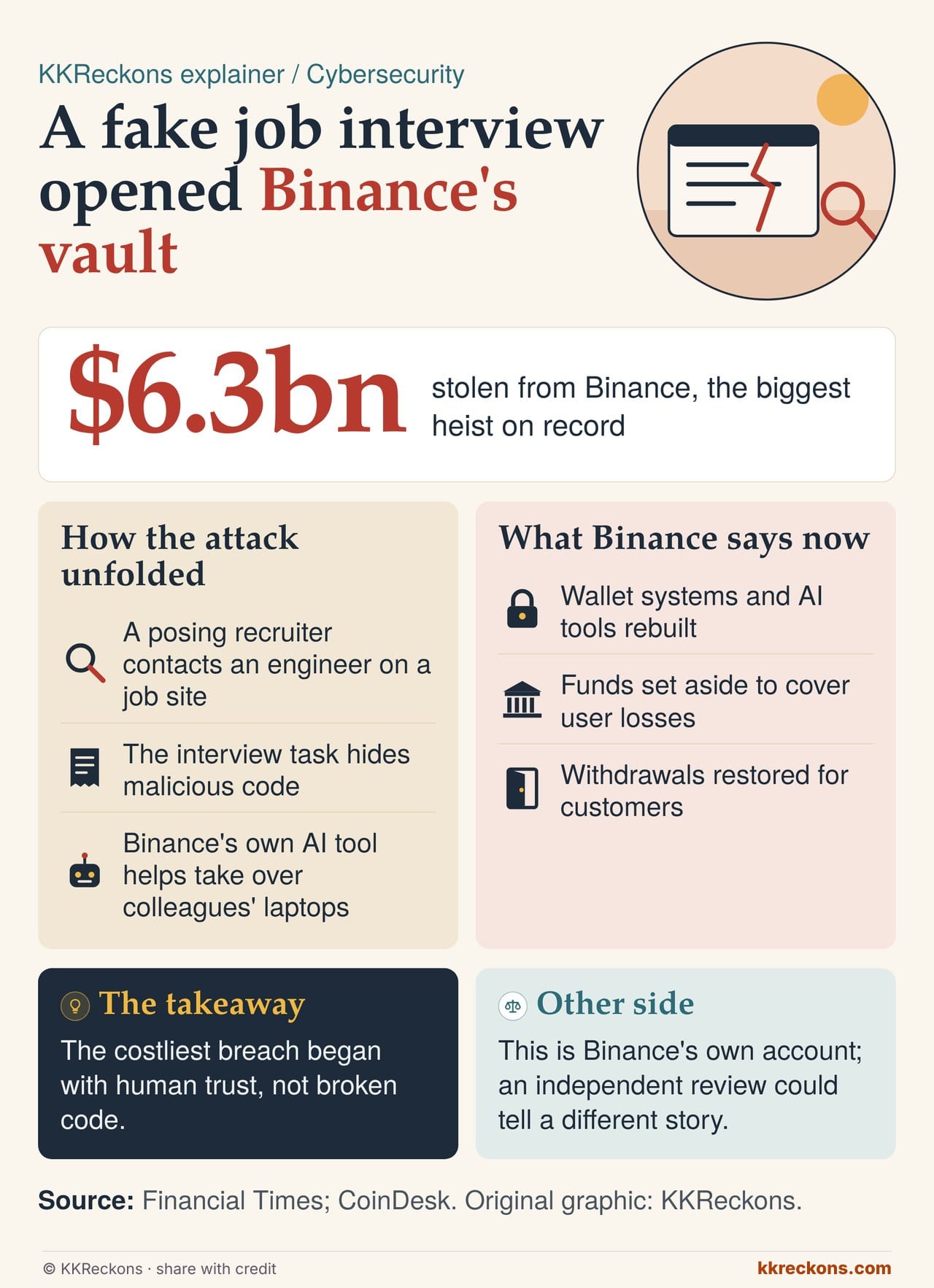
Explainer: how fake job interviews led to the $6.3bn Binance heist
Original graphic: KKReckonsView full size ↗
  • Binance's own investigation says the thieves behind last week's theft, which the FBI blames on the North Korea-linked group TraderTraitor, posed as recruiters and gave an engineer an interview task laced with malware.
  • That foothold, plus an earlier tampered download on another engineer's laptop, let them use Binance's in-house AI tool to take over colleagues' machines and trigger the attack on 29 October.
  • The exchange says it has rebuilt its wallet systems and AI tools, set aside money to cover users' losses and reopened withdrawals.
$6.3bn
stolen in the biggest heist on record

Why it matters The weakest point in a crypto vault was a job seeker's trust. As companies wire AI agent AI software that takes actions on its own, like booking, buying or moving money, not just answering questions. into their systems, one infected laptop can now reach much further than it used to.

Other side This is Binance describing its own breach, and it is keeping some security details private. Its account may stress the attackers' cunning over its own control gaps; an independent review would tell more.
World edition

What moved everywhere else

2AI financeOpinion

AI's borrowing bill is rising as bond buyers demand more (opens the source in a new tab)

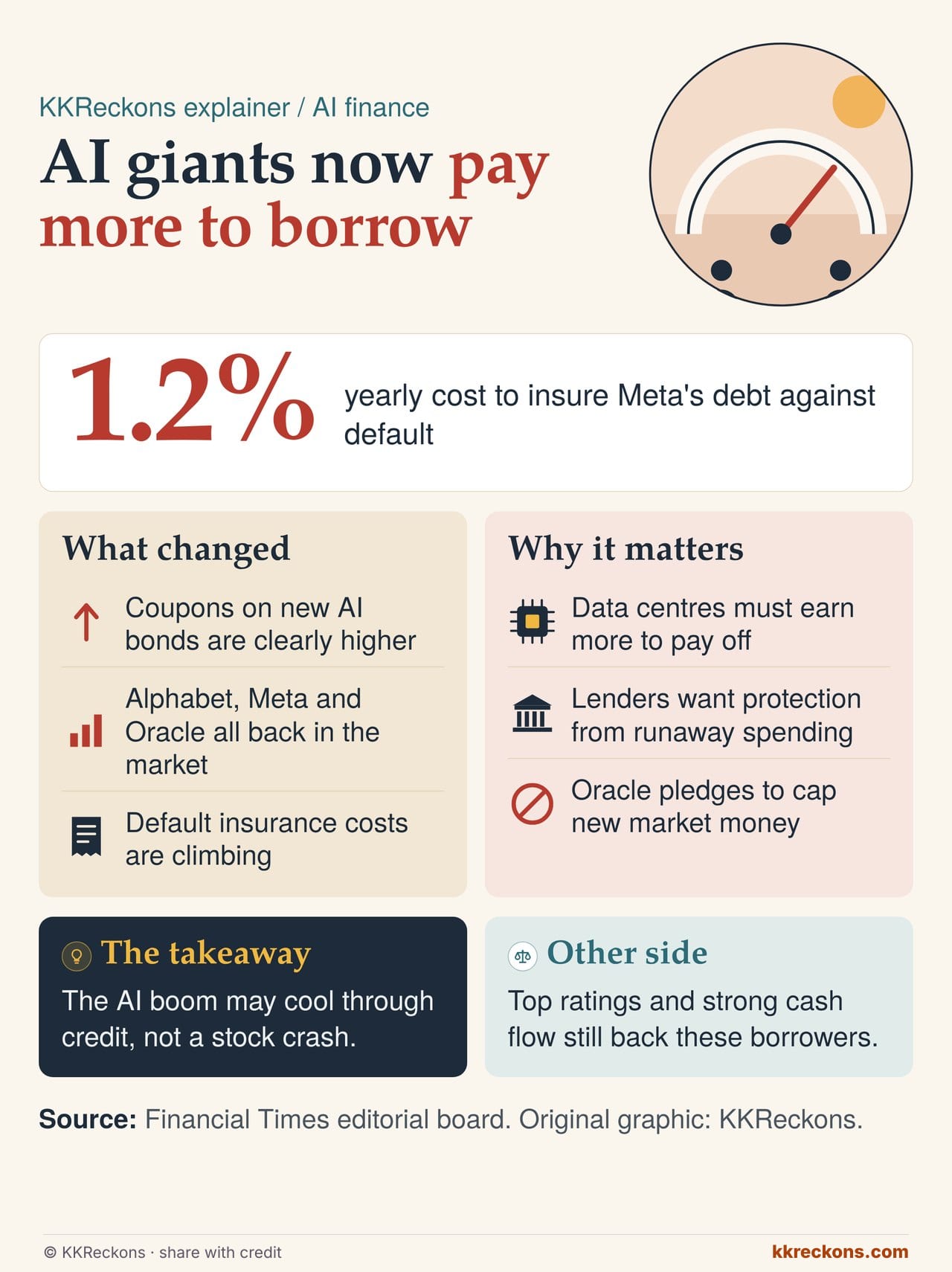
Explainer: rising borrowing costs for AI giants
Original graphic: KKReckonsView full size ↗
  • The FT's editorial board notes that Alphabet, Meta and Oracle went back to bond markets this week but had to pay clearly more than a few months ago; Oracle's new bonds carry coupons above 8.5%.
  • Insuring against default is dearer too: protection on Meta's debt now costs about 1.2% a year, which the board likens to junk-rated South Africa.
  • Its view: the AI boom may not end with a stock crash but with a slow squeeze in credit. Oracle has even pledged to cap the new money it raises from markets until 2030.
1.2%
yearly cost to insure Meta's debt

Why it matters Dearer money raises the return every data centre has to earn. If cash-rich, top-rated giants pay more, smaller AI borrowers and the lenders behind them face a much harder test.

Other side These firms still hold strong ratings and cash-rich core businesses, and they are still raising huge sums. Repricing risk is credit markets working, not breaking.

3Cyber warfareExplainer

Europe's supermarket freezer hacks: what we know so far (opens the source in a new tab)

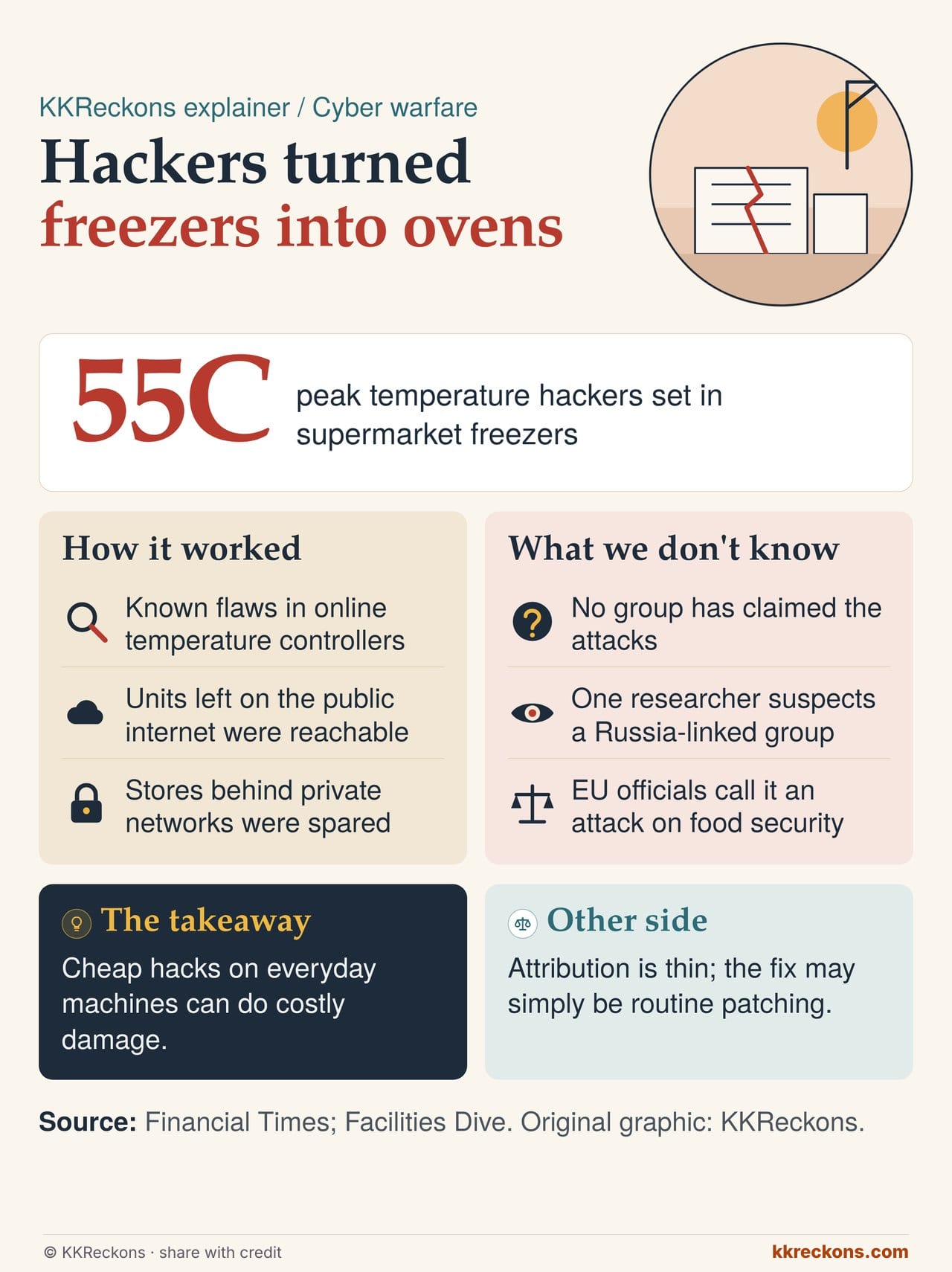
Explainer: how hackers turned up supermarket freezers
Original graphic: KKReckonsView full size ↗
  • On Monday hackers remotely pushed freezer temperatures as high as 55C in almost 100 stores across Sweden, Finland, Ireland, Belgium, Luxembourg and Estonia, weeks after a similar overnight wave hit French supermarkets.
  • The trick was simple: known flaws in internet-linked temperature controllers. Danfoss and Copeland confirmed affected systems; shops kept off the public internet or behind private networks were spared.
  • No one has claimed it. A Sentinel researcher suspects a Russia-linked group seeking deniable disruption, and EU officials call it an attack on food security.
55C
peak freezer temperature set by hackers

Why it matters Cheap hacks with costly results are the new frontier. Freezers, pumps and boilers now sit online, and many owners lack the budget or skills to lock them down.

Other side Blame rests on one researcher's reading of thin traces, and the fix is routine patching. Calling it state warfare could overstate what copycats might also pull off.

4JobsOpinion

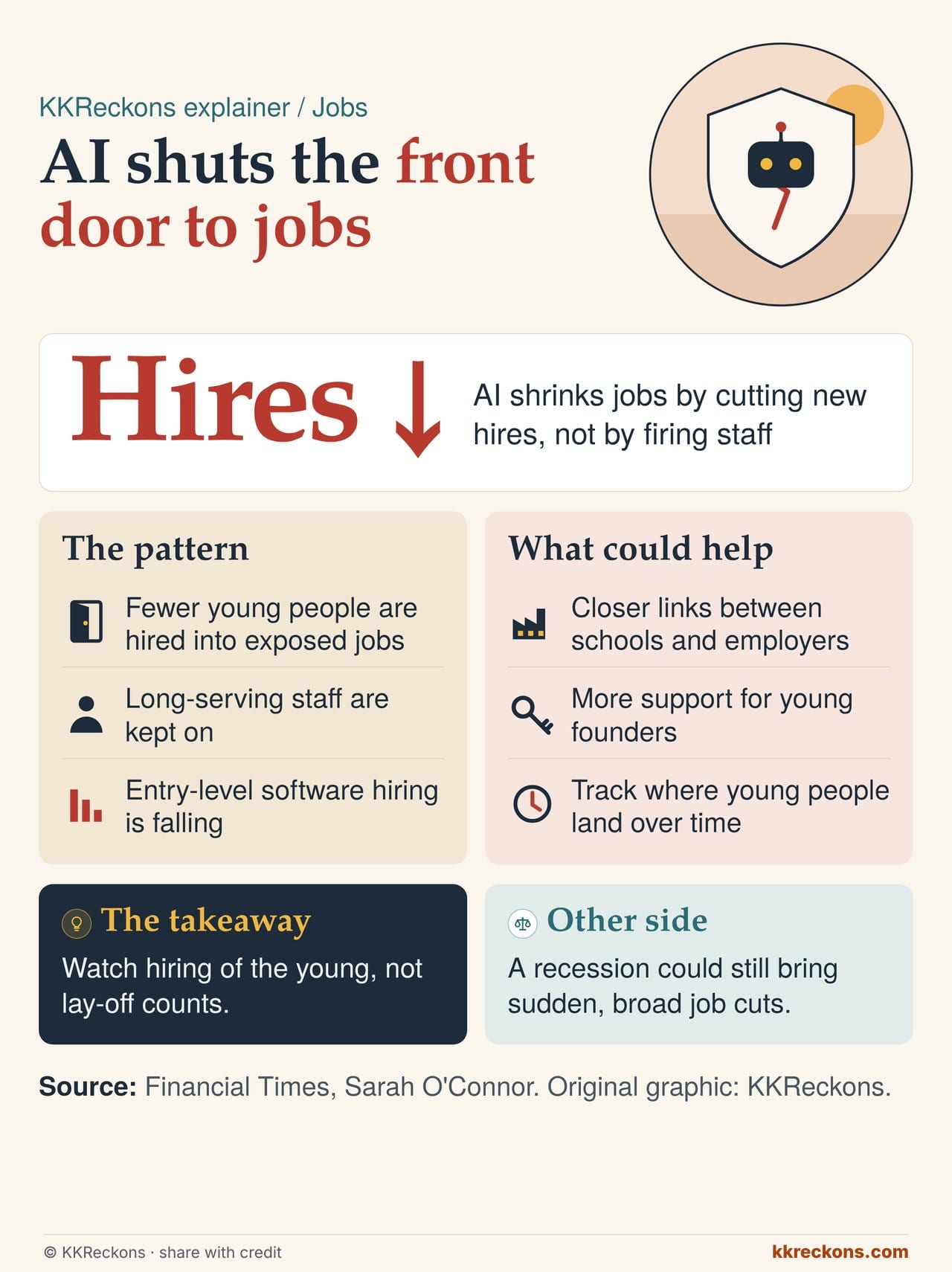
AI is shutting the door on new hires, not pushing workers out (opens the source in a new tab)

Explainer: AI shrinks hiring rather than causing lay-offs
Original graphic: KKReckonsView full size ↗
  • Sarah O'Connor argues the real AI jobs shock is fewer hires, not mass lay-offs. History fits: boot-sewing machines in Victorian England choked off new artisans rather than sacking existing ones.
  • Today's signs match. Lay-offs stay low, entry-level software hiring is falling while demand for seniors holds, Danish firms using AI simply hire more slowly, and call centres shrink because hiring slowed.
  • She wants policy aimed at the young: closer ties between schools and employers and more support for start-ups, since retraining schemes such as Sweden's often leave them out.

Why it matters Lay-off numbers can look calm while a generation struggles to land its first job. For countries with big young workforces, India among them, slower entry hiring matters more than headline cuts.

Other side It is early and the data are thin. A recession could still bring abrupt cuts, and young people have often adapted fastest to new technology.

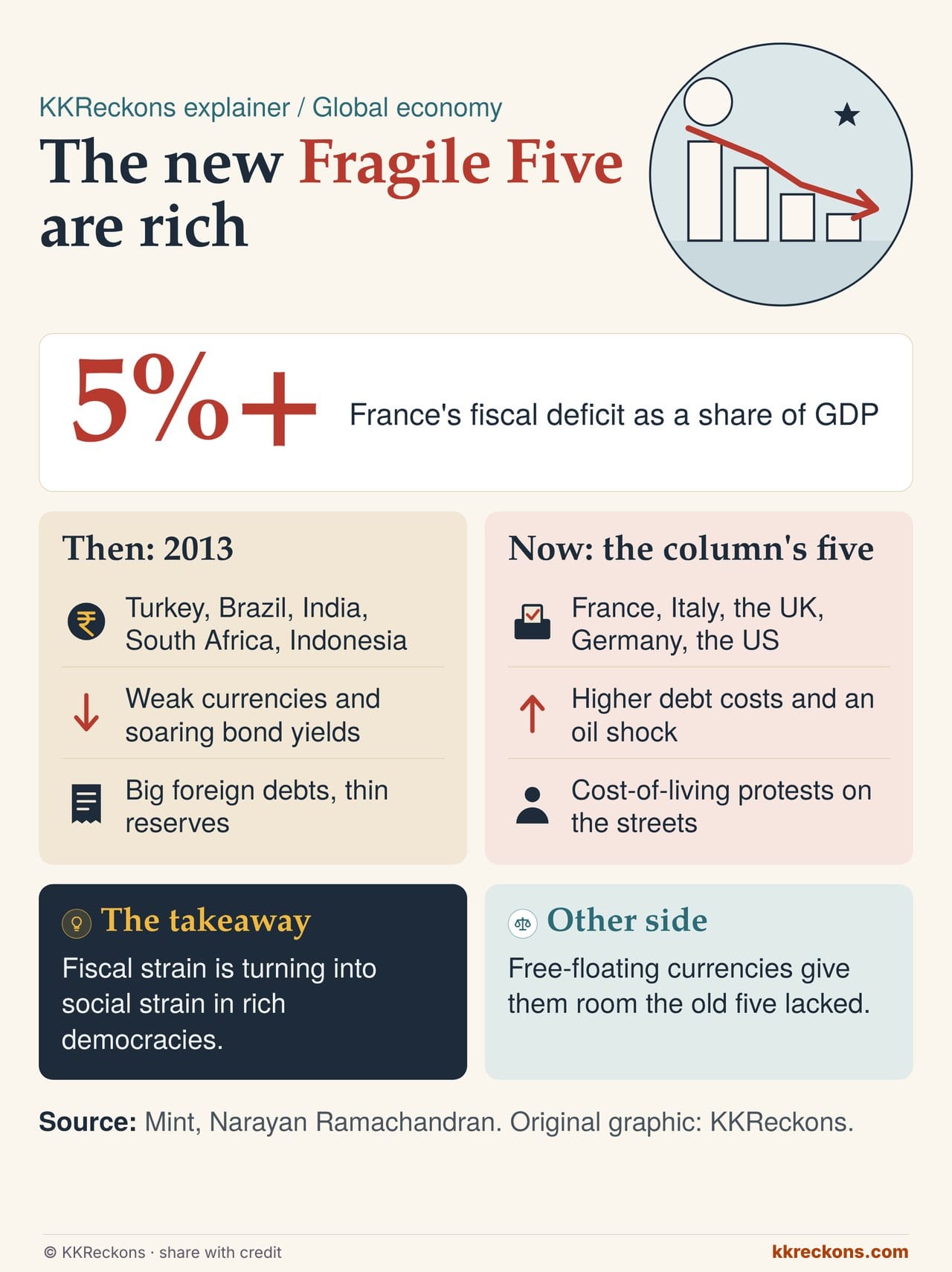
The new Fragile Five are rich nations, a Mint column argues (opens the source in a new tab)

Explainer: why rich G7 nations look fragile
Original graphic: KKReckonsView full size ↗
  • Narayan Ramachandran takes the 2013 label once pinned on Turkey, Brazil, India, South Africa and Indonesia and hands it to France, Italy, the UK, Germany and the US: fragile now in social, not currency, terms.
  • Higher rates swell debt costs while inflation and an oil shock squeeze budgets. France's student protests have grown into a cost-of-living revolt against a fiscal deficit above 5% of GDP, and Italy has seen looting and fuel blockades.
  • He rates Germany the least at risk of the five.
5%+
France's fiscal deficit, share of GDP

Why it matters India was on the old list and now watches the roles reverse. Unrest in big rich economies can dent demand for Indian exports and keep oil and interest rates jumpy.

Other side Floating reserve currencies and deep bond markets give these nations room the old Fragile Five never had. Street protests are not defaults, and the label may stretch the comparison.

6BrandsOpinion

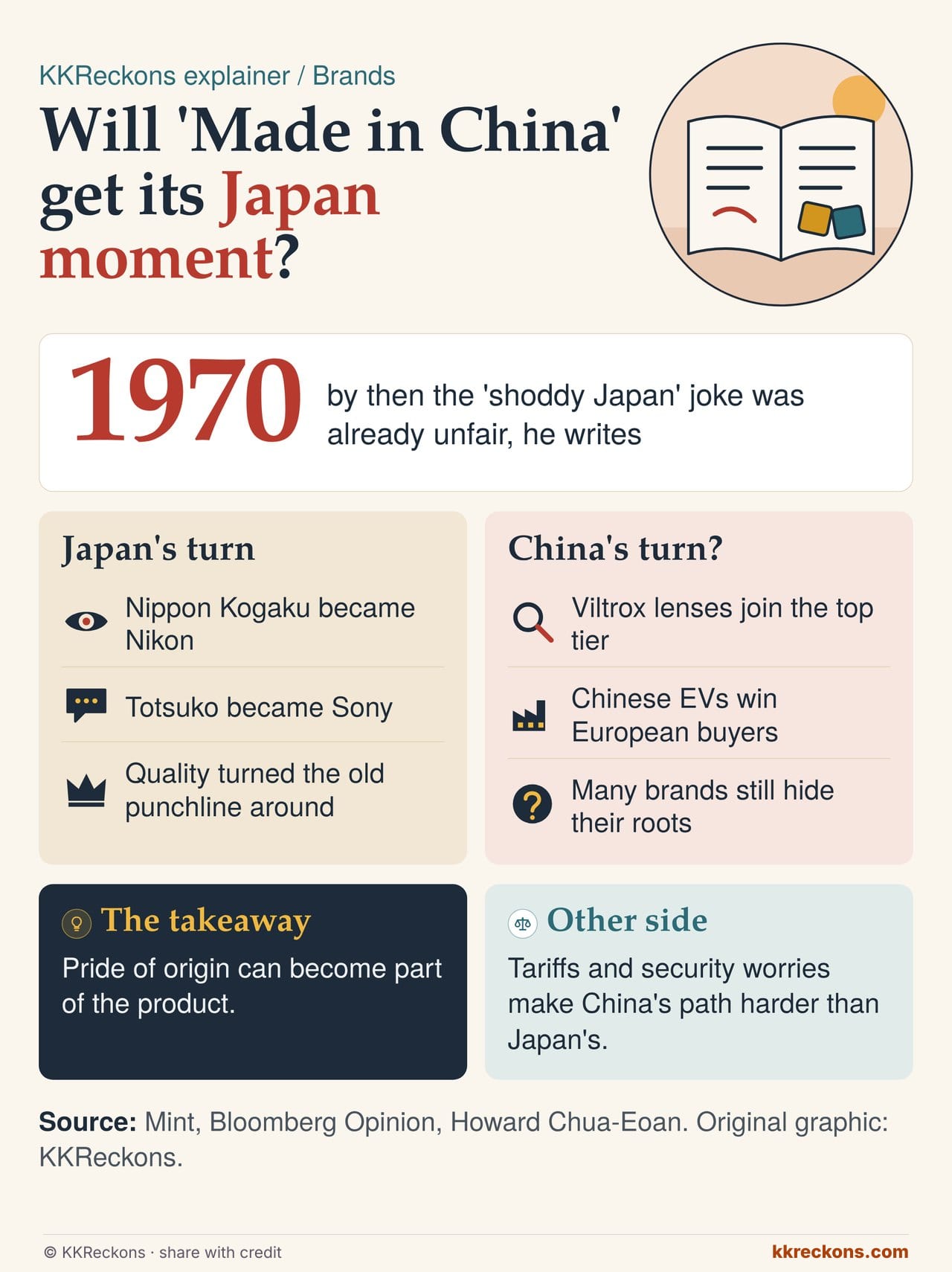
Is 'Made in China' heading for its 'Made in Japan' moment? (opens the source in a new tab)

Explainer: from Made in Japan to Made in China
Original graphic: KKReckonsView full size ↗
  • Bloomberg Opinion's Howard Chua-Eoan, in Mint, recalls when 'Made in Japan' was a joke for flimsy toys, until firms like Nippon Kogaku (now Nikon) and Totsuko (now Sony) made it a badge of quality.
  • He sees China at a similar turn: Shenzhen lens maker Viltrox is joining the elite, and Europeans buy Chinese EVs that an HSBC report judged simply better.
  • Yet many Chinese brands play down their roots, from Miniso's Uniqlo-like logo to Temu's offshore legal home. He expects that to fade as confidence grows.

Why it matters If Chinese brands start selling their origin as a plus, rivals from Europe to India lose the easy line that cheaper means worse.

Other side Japan rose in an era of open markets; China faces tariffs, quotas and security worries. Keeping a low profile may be smart strategy, not shyness.

7InvestingOpinion

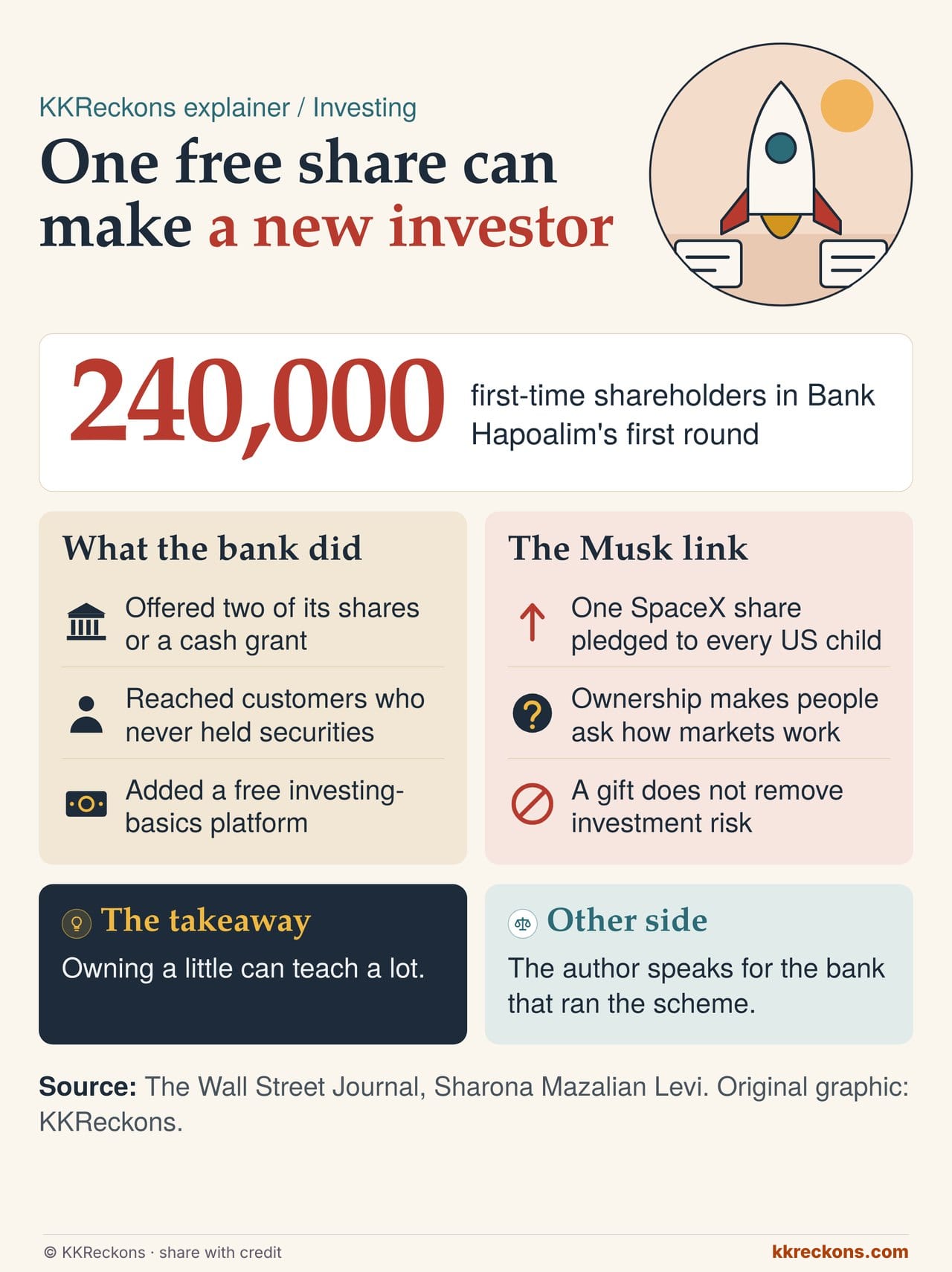
Bank Hapoalim says free shares made new investors, backing Musk (opens the source in a new tab)

Explainer: what gifting single shares does for new investors
Original graphic: KKReckonsView full size ↗
  • In the WSJ, Bank Hapoalim's spokesperson praises Elon Musk's plan to give one SpaceX share to every American child next year.
  • Israel's largest retail bank offered customers two of its shares or a cash grant in 2025. In the first round, about 240,000 people who had never held securities with it became shareholders, and it added a free investing-basics platform.
  • Her case: owning even one share makes people curious about prices, dividends and earnings, and the first step is the hardest.
240,000
first-time shareholders in round one

Why it matters Gifting shares is a cheap way to widen market participation, a live question wherever household savings sit mostly in cash, gold or deposits.

Other side The author speaks for the bank that ran the scheme, and a gift share doubles as marketing. Musk's plan is still a promise, and real financial literacy takes more than one stock.

Was this briefing useful?YesSomewhatNot really

Spotted an error? Tell us and we’ll correct it.

Today’s edition is ready

Read deep. Think clearly. Stay curious.

A daily visual briefing on the stories that matter: India, the world, and what’s next.

Read Today’s Edition →Get it by email ↗

Free · 50 editions and 359 stories so far · Unsubscribe anytime

Emails are sent by beehiiv; your address is used only for this newsletter. Privacy · Editorial standards