7 stories · 6 min read

AI props growth. Stories prop stocks. Cheese props diplomacy. None is a guarantee.

Markets at the last close before this edition · 8 Oct

  • Nifty 5022,232On the day, down 1.64%. 1 wk: −0.85%
  • S&P 5007,765On the day, down 0.47%. 1 wk: +1.29%
  • US 10-yr yield5.23%On the day, down 5 bp. 1 wk: −1 bp
  • Brent crude$104.28On the day, up 4.07%. 1 wk: +1.93%
  • Gold$4,157On the day, up 0.39%. 1 wk: −1.08%
  • USD/INR₹96.82On the day, up 0.07%. 1 wk: +0.62%

Yahoo Finance daily closes. Not investment advice.

20,000+staff moved from captive tech centres to IT services firms in the past 12 months.0.4%of 4,000+ Indian stocks grew profit every single year for a decade: just 17 companies.

Pick of the day

One story worth slowing down for

1Global economyOpinion

Nouriel Roubini: the world is in turmoil, so why is the global economy still chugging along? (opens the source in a new tab)

  • After the 2025 ‘Liberation Day’ tariffs and this year’s Iran War, the biggest energy shock since the 1970s, IMF data still show global growth at 3.5% in 2025, the same as 2024, with lower inflation.
  • Four props, he argues: markets forced a tariff retreat (from 21.5% in April 2025 to 9.6% now) and a fragile Iran ceasefire; new energy sources and China’s oil reserves cushioned the shock; policy easing, then tightening; and, above all, the AI investment boom.
  • Risks: oil back above $100, a constrained Strait of Hormuz, Taiwan and Russia–Ukraine, populist elections, heavy debt and a frothy AI boom. He still sees the positive scenario as more likely.
3.5%
global growth, 2025
9.6%
avg US tariff now
$100+
oil a barrel, again

Why it matters Jobs, savings and loan rates on both sides of the world ride on whether this resilience holds, and much of it now hinges on AI.

Other side If AI spending is the main prop, is the resilience real or borrowed from a boom that could deflate? Growth forecasts made in wartime can also age fast.

India edition

What moved in India

Mint Explainer: Why is Elon Musk’s Starlink at war with Indian telecom giants? (opens the source in a new tab)

  • On Wednesday Musk posted that unnamed Indian ‘oligarchs’ were blocking Starlink’s launch to keep a ‘monopolistic chokehold’; on Thursday the government called any suggestion of bias ‘baseless and misconceived’, citing security assessments under way.
  • Starlink won its licence in June 2025, after OneWeb and Jio Satellite in 2022; more than four years after the first licence, commercial launches for all players remain stalled over security and data-sovereignty concerns.
  • Jio wanted satellite spectrum auctioned; in September 2026 the telecom department chose administrative allocation with a 5% charge on adjusted gross revenue, still awaiting cabinet approval. Ironically, Airtel and Jio have both signed pacts with SpaceX to offer Starlink.
165+
countries licensed, per Musk
5%
spectrum charge on AGR
4+ yrs
since India’s first licence

Why it matters Satellite internet can reach places towers and fibre don’t; who gets to sell it, and on what terms, shapes India’s connectivity.

Other side Is this protectionism, or a fair wait for security checks on foreign-run satellites carrying Indian data? Musk named no one, and his rivals are also his Indian partners.

20,000-plus people shift as IT firms buy GCCs and captive tech carve-outs (opens the source in a new tab)

  • More than 20,000 employees moved from GCCs, enterprise IT units and product operations to IT services firms in the past 12 months; analyst Pareekh Jain expects similar numbers in the next 12.
  • TCS took over Best Buy’s India GCC; HCLTech bought Guardian Life’s India operations for $10.5 million (nearly 2,000 staff); Wipro paid $386 million for Olam’s Mindsprint (3,200+ staff), tied to an eight-year deal expected to bring over $1 billion.
  • HFS’s Achyuta Ghosh says about 10% of mature GCCs could be fully or partly transferred in two to three years, mostly operations-heavy, labour-intensive centres; deals usually involve 500–3,000 staff.
20,000+
staff moved, 12 mo
~3,000
pure GCC moves
~10%
GCCs may transfer

Why it matters In a low-growth market, IT firms are buying growth with long contracts attached, and thousands of staff are changing employers.

Other side Is this a vote of confidence in IT firms, or a sign that many GCCs never reached scale? And how do transferred staff fare once AI-led productivity is priced into the contract?

4India consumerInterview

India’s aspirational middle class gives it a demographic edge, says Verlinvest CEO Roberto Italia (opens the source in a new tab)

  • Verlinvest plans to invest €1 billion in India over the next five years, with opportunities in health, fitness and digital content.
  • CEO Roberto Italia, 60, manages €2 billion for Belgian families who are long-standing AB InBev shareholders; their 31-year-old evergreen capital has backed Vita Coco, Oatly, Chewy, Epigamia, Juicy Chemistry and Wakefit.
  • He says a large share of Indians are becoming, or aim to become, middle class and are willing to spend; even amid AI job fears, India’s young population stays a strategic asset. He likens Mumbai to 1990s New York.
€1bn
India, next 5 yrs
€2bn
assets managed
31 yrs
evergreen capital

Why it matters Patient global capital is betting on India’s spending power, which feeds the brands, startups and jobs behind it.

Other side A ‘demographic edge’ is a compelling story, and investors pitch their own bets. Will jobs and incomes keep pace with the aspirations?

What do you gift the Swiss President? PM Modi chose three Indian cheeses (opens the source in a new tab)

  • On Monday, 5 October, in New Delhi, PM Narendra Modi gave Swiss President Guy Parmelin three award-winning Indian cheeses: Gulmarg, Konark and Yeoor.
  • Parmelin is in India on a three-day state visit; the gift was presented as a showcase of India’s growing cheesemaking tradition, with a nod to Switzerland’s own fame for cheese.
3
award winners
3 days
state visit
5 Oct
gift day, Delhi

Why it matters Soft power on a plate: India offering its own craft to the home of cheese.

Other side A gift is a gesture, not a market. Will Indian artisan cheese find buyers abroad beyond the diplomatic table?

World edition

What moved everywhere else

‘Switzerland has spoken’: will UBS leave? (opens the source in a new tab)

  • Three and a half years after its state-orchestrated rescue of Credit Suisse, UBS faces a Swiss proposal, backed last month by parliament’s upper house, to hold an extra $16bn of capital; the lower house still has to vote.
  • Its options: stay and pay (analysts put the real shortfall at $6bn–8bn), split off the international arm, sell or shrink the US business, merge with a foreign bank, or leave Switzerland, which Morgan Stanley says could bring an exit tax of up to $10bn.
  • Top-10 shareholder Artisan Partners has urged a move; finance minister Karin Keller-Sutter says leaving would be ‘much more expensive and legally very complex’. A senior UBS employee says staying and adapting is most likely.
$16bn
extra capital
90%
foreign units, from ~60%
$10bn
possible exit tax

Why it matters After Credit Suisse, Switzerland is choosing safety over its biggest bank’s growth, and banks and investors everywhere are watching.

Other side Is this overcaution that could push a national champion abroad, or a fair price for a bank whose balance sheet is bigger than the Swiss economy? Rivals, for their part, welcome a competitor forced to hold more capital.

7InvestingOpinion

Devina Mehra: the art of storytelling can turn into an investment pitfall, even for veterans (opens the source in a new tab)

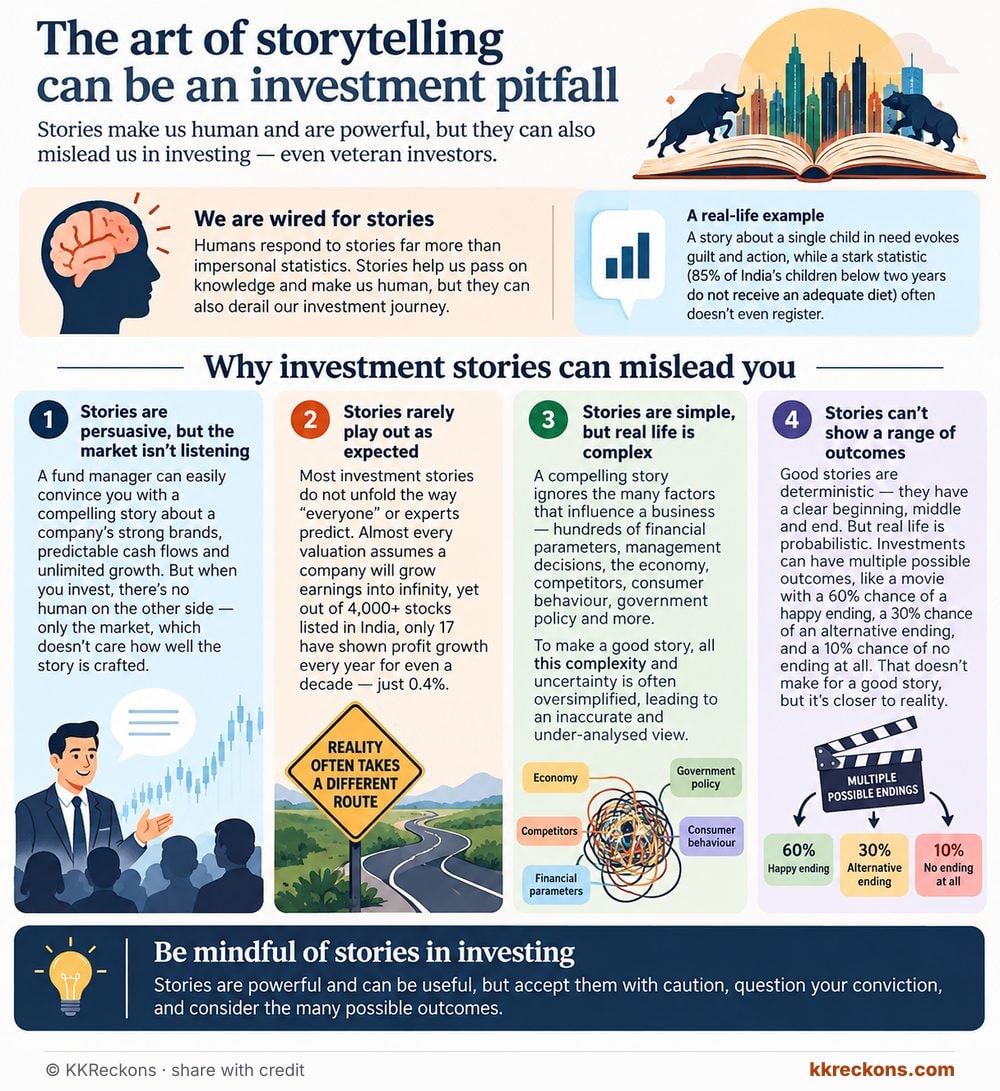
KKReckons explainer: why investment stories can mislead, even veteran investors. Four reasons: stories persuade but the market isn't listening; stories rarely play out as expected (of 4,000-plus Indian stocks, only 17 grew profit every year for a decade, just 0.4%); real life is more complex than a story; and stories can't show a range of outcomes. Takeaway: use stories with caution and consider the possible outcomes.
Original graphic: KKReckonsView full size ↗
  • We respond to stories, not statistics. A fund manager’s tale of great brands and endless growth persuades people, but the market doesn’t care how well a story is told.
  • Valuations assume earnings grow forever, yet of 4,000-plus stocks listed in India only 17 have grown profit every year for even a decade: just 0.4%.
  • Warren Buffett held his Coca-Cola story too long: from its 1998 high Coke has returned about 4x with dividends, against 6x for Pepsi and 11x for the S&P 500.
0.4%
steady 10-yr growers
4x
Coke since 1998 high
11x
S&P 500, same period

Why it matters Before you buy, test the story behind the stock and imagine other endings.

Other side Conviction also stops investors panic-selling, and long holds of great companies have built fortunes. Where does a sound thesis end and a story begin?

Was this briefing useful?YesSomewhatNot really

Spotted an error? Tell us and we’ll correct it.

Today’s edition is ready

Read deep. Think clearly. Stay curious.

A daily visual briefing on the stories that matter: India, the world, and what’s next.

Read Today’s Edition →Get it by email ↗

Free · 50 editions and 359 stories so far · Unsubscribe anytime

Emails are sent by beehiiv; your address is used only for this newsletter. Privacy · Editorial standards