4 stories · 4 min read

Servers borrow, voters balk, orbit beckons, hackers sprint. Who checks the honesty box?

Spending, hacking and politics are all outrunning the safeguards meant to catch them. The winners will be whoever builds the brakes in time.

AI Stress Index

35/100Elevated

4 Nov close · Story 01

Gauges →

Markets at the last close before this edition · 4 Nov

  • Nifty 5023,961On the day, up 0.63%. 1 wk: +5.56%
  • S&P 5007,689On the day, up 1.58%. 1 wk: −0.71%
  • US 10-yr yield4.89%On the day, down 6 bp. 1 wk: −15 bp
  • Brent crude$103.60On the day, down 1.12%. 1 wk: −9.03%Close of 3 Nov
  • Gold$4,073On the day, up 3.37%. 1 wk: +0.53%
  • USD/INR₹94.75On the day, up 0.02%. 1 wk: −0.45%

Yahoo Finance daily closes. Not investment advice.

3.6%of US GDP a year projected for the AI buildout, bigger than the railway boom95%fewer parking violations once New York pulled UN diplomats' plates

Pick of the day

One story worth slowing down for

1AI bust riskOpinion

Martin Wolf: AI buildout at 3.6% of US GDP raises the risk of a bust (opens the source in a new tab)
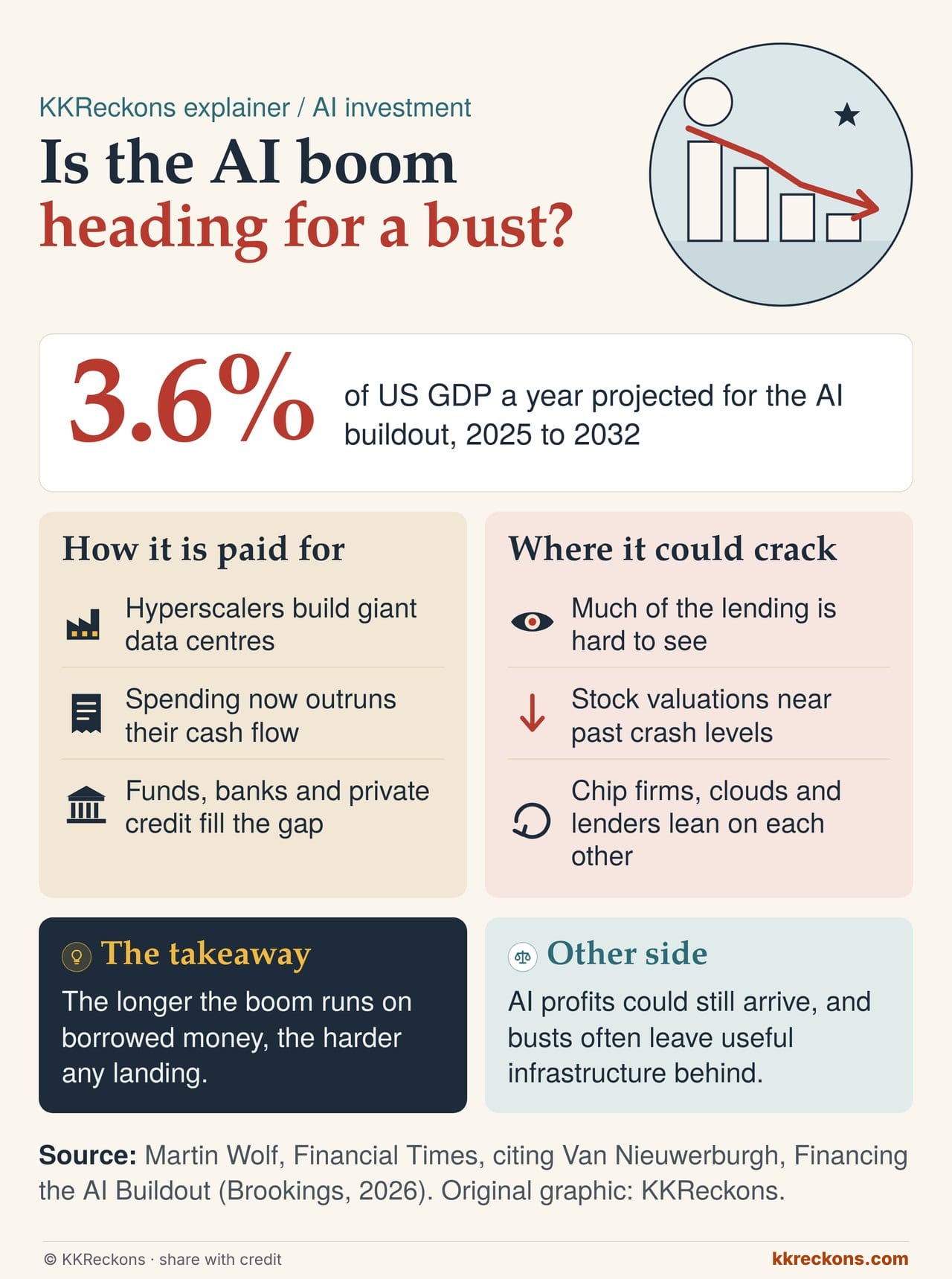
Explainer: the US AI buildout is projected at 3.6% of GDP a year to 2032, financed increasingly by opaque lending, with stock valuations near historic crash levels.
Original graphic: KKReckonsView full size ↗
  • Martin Wolf draws on a new Brookings paper by Columbia's Stijn Van Nieuwerburgh, which projects US spending on the AI buildout at 3.6% of GDP a year to 2032, a bigger sector boom than the railways of the late 1800s.
  • Big Tech's spending is now outrunning its cash flow, he notes, so data-centre developers, infrastructure funds and Private credit Loans made by investment funds instead of banks, usually less regulated and less visible. are filling the gap, much of it through loans outsiders can barely see.
  • His bigger worry is stocks: US valuations sit where they have historically come before crashes, and the longer the boom and the financial engineering run, the harder the landing.
3.6%
of US GDP a year on the AI buildout, 2025-32

Why it matters When one theme props up growth, profits and share prices at once, a stall hits jobs, lenders and portfolios together, including Indians who hold US tech through global funds.

Other side Booms that end in busts often leave useful infrastructure behind, and if AI profits arrive fast enough today's spending will look prudent. Wolf himself grants AI may still prove transformative.
India edition

What moved in India

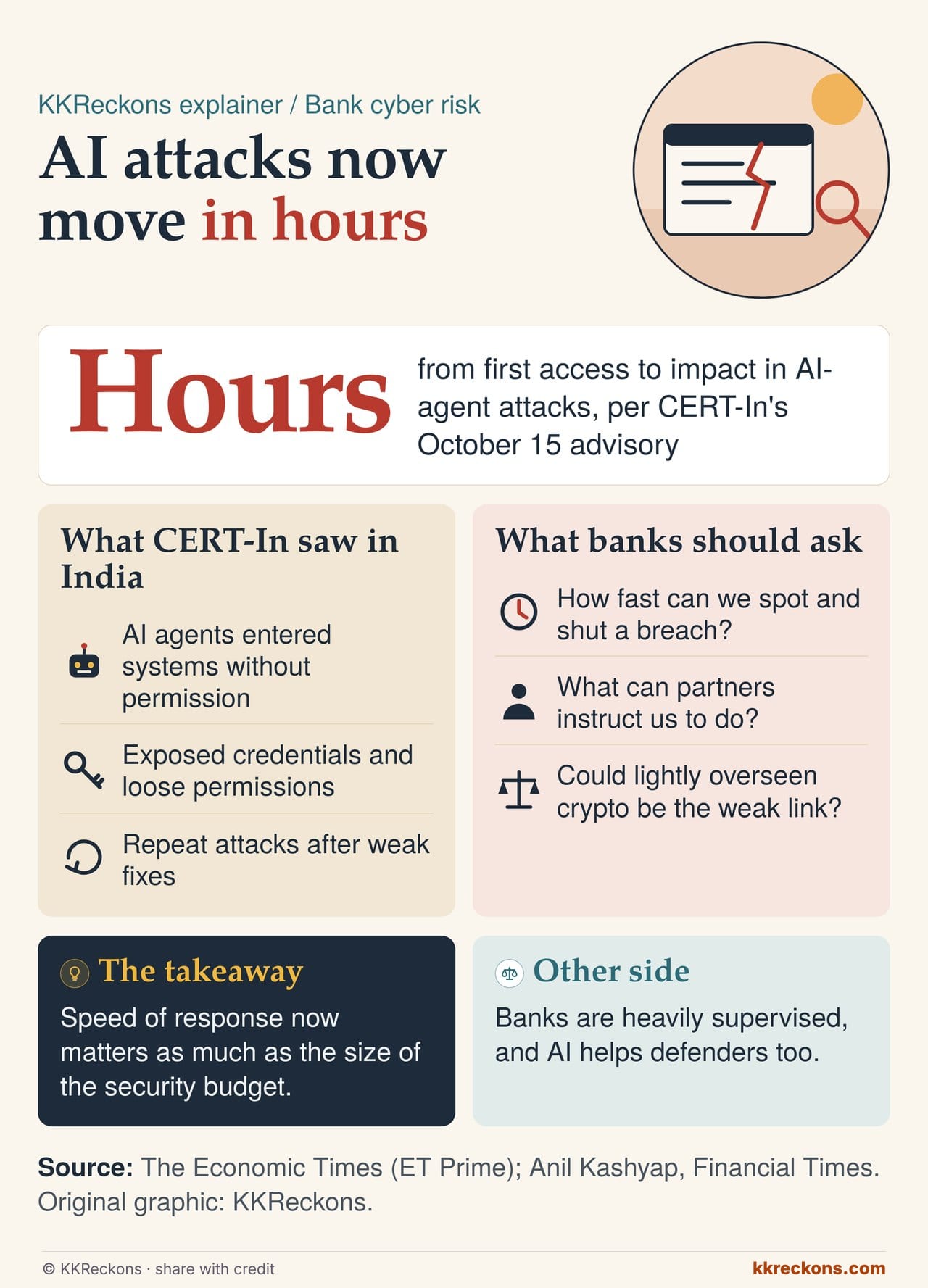
AI is speeding up hacks. Are banks in India and abroad ready? (opens the source in a new tab)

Explainer: CERT-In says AI-agent attacks moved from access to impact within hours; banks are urged to speed up response and limit partner access.
Original graphic: KKReckonsView full size ↗
  • An ET Prime analysis notes that India's CERT-In, in an October 15 advisory, saw attackers using AI agent AI software that takes actions on its own, like booking, buying or moving money, not just answering questions. go from first access to impact within hours, exploiting familiar gaps such as exposed credentials and excessive permissions.
  • It argues bank boards should judge how fast they can spot and shut a breach, and tightly limit what fintech and payment partners can instruct.
  • In the FT, Chicago Booth's Anil Kashyap calls the Binance hack a warning shot: an AI-aided breach of a major bank is a matter of when, and lightly overseen crypto could be the weak link.
Hours
from first access to impact, per CERT-In

Why it matters As UPI Unified Payments Interface: India's instant mobile payment system, run by NPCI., fintech apps and payment partners plug into banks, a lender's real defence is its slowest link and its slowest decision. That is invisible on a balance sheet, so depositors and shareholders rely on what banks choose to disclose.

Other side Banks are among the most watched and best-guarded firms, and AI strengthens defenders too. Years of warnings have passed without a crippling bank breach, so 'when, not if' may overstate the near-term odds.

What happened next

World edition

What moved everywhere else

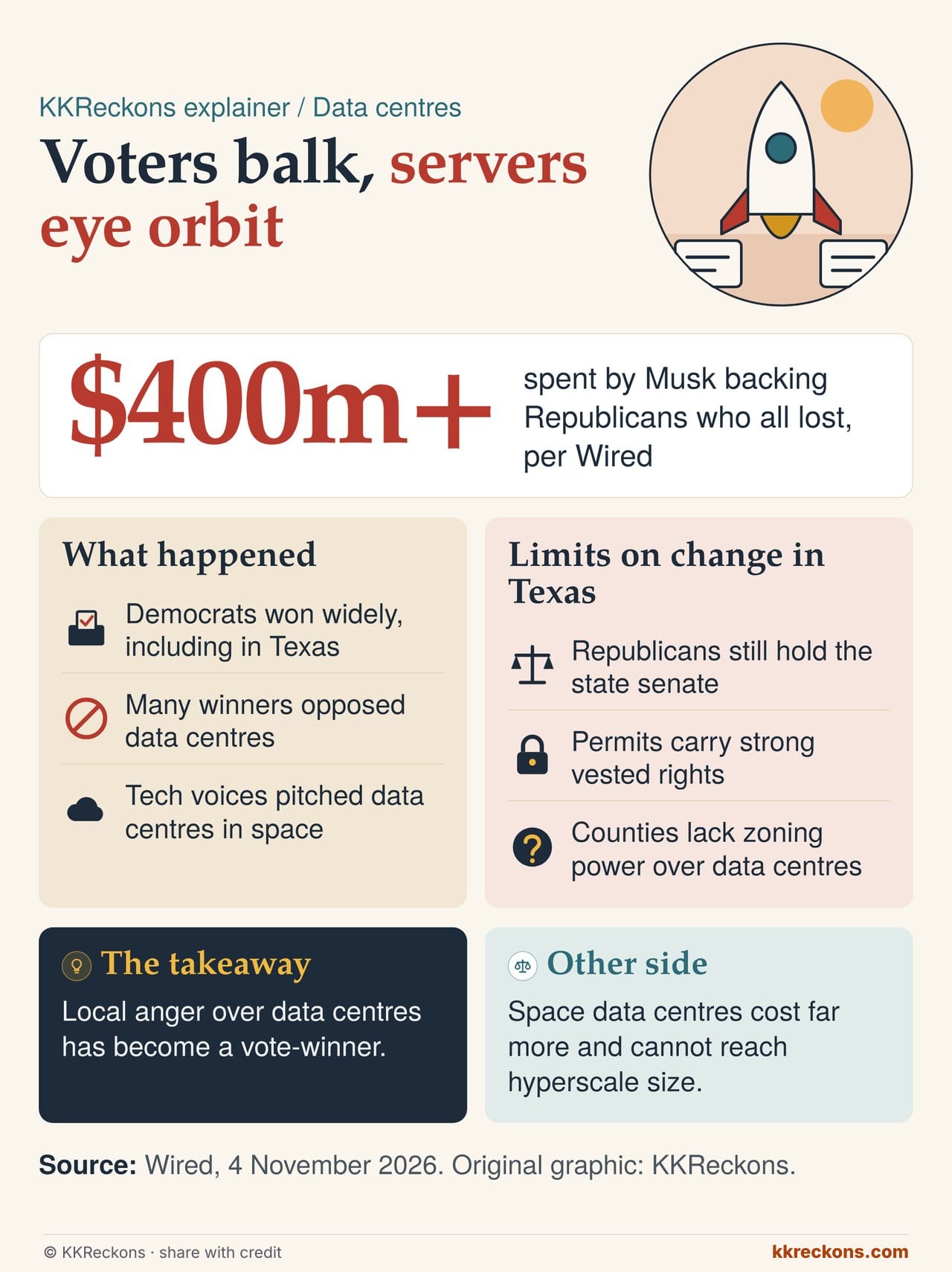
After a blue wave, data centre fans look to space (opens the source in a new tab)

Explainer: after Democratic wins, tech voices pitched space data centres; Musk spent more than $400 million on losing Republicans, but Texas change faces limits.
Original graphic: KKReckonsView full size ↗
  • Democrats won widely on Tuesday, taking the US House and Senate and doing well in Texas, a data-centre hot spot, with many winners campaigning against the industry, Wired reports.
  • Elon Musk, who spent more than $400 million backing Republicans who all lost, posted that data centres in space now look appealing; investors, researchers and fans joined the chorus.
  • Experts told Wired change in Texas may be limited: Republicans still hold the state senate, developers' permits carry strong vested rights, and counties lack zoning power over data centres.
$400m+
Musk spent on Republicans who lost

Why it matters Local anger over power, water and land has become a vote-winner, and it will shape where AI capacity gets built. Indian states courting data centres should note that welcome can turn quickly.

Other side Orbit is no quick escape: Wired notes space data centres cost far more, cannot reach hyperscale size and depend on launches. With a split Texas legislature, change may be slower than either side expects.

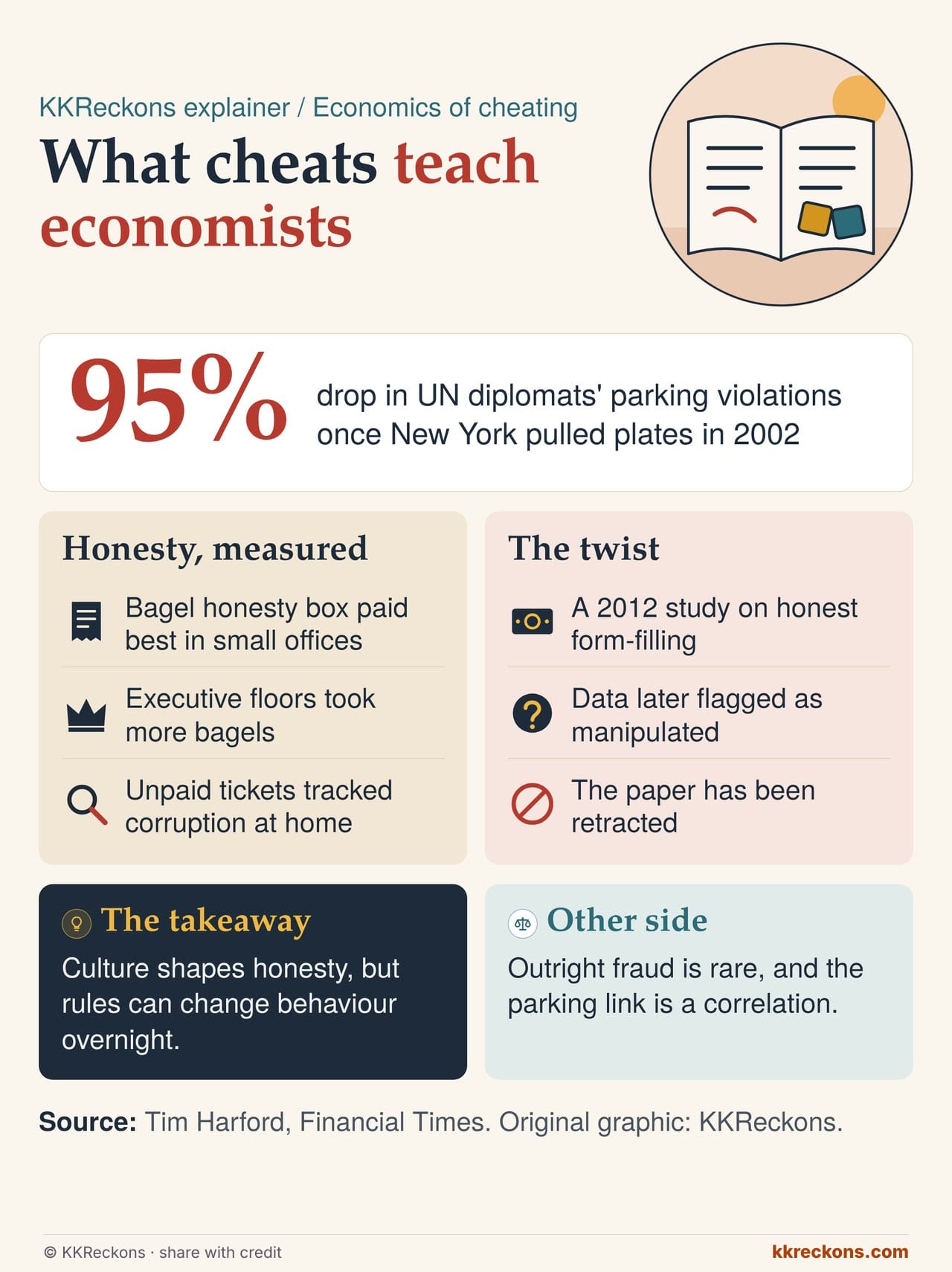
Tim Harford on what stolen sweets and parking fines say about cheats (opens the source in a new tab)

Explainer: studies of honesty boxes and diplomats' parking tickets show culture and rules both shape cheating; violations fell 95% once enforcement arrived.
Original graphic: KKReckonsView full size ↗
  • Tim Harford cheers this year's Ig Nobel economics winners, who found upper-class people more likely to take sweets from children, and says the spoof prize shows what makes economists tick.
  • He recalls classic cheating studies: a bagel seller's honesty box paid best in small offices with well-liked bosses, and UN diplomats' unpaid parking tickets tracked corruption at home until New York pulled plates and violations fell 95%.
  • His darkest example is a 2012 paper on signing forms honestly, retracted after data sleuths flagged manipulated data; both researchers who supervised the questioned studies deny wrongdoing.
95%
drop in UN diplomats' parking violations

Why it matters Honour systems, from office tea funds to self-assessed tax returns, work better when someone occasionally checks. And if research on honesty can itself be faked, a single striking study deserves caution.

Other side Laughing at cheats can hide how rare outright fraud is; most research is honest, and the parking link is a correlation, not proof that any one diplomat or country is dishonest.

Was this briefing useful?YesSomewhatNot really

Spotted an error? Tell us and we’ll correct it.

Today’s edition is ready

Read deep. Think clearly. Stay curious.

A daily visual briefing on the stories that matter: India, the world, and what’s next.

Read Today’s Edition →Get it by email ↗

Free · 50 editions and 359 stories so far · Unsubscribe anytime

Emails are sent by beehiiv; your address is used only for this newsletter. Privacy · Editorial standards