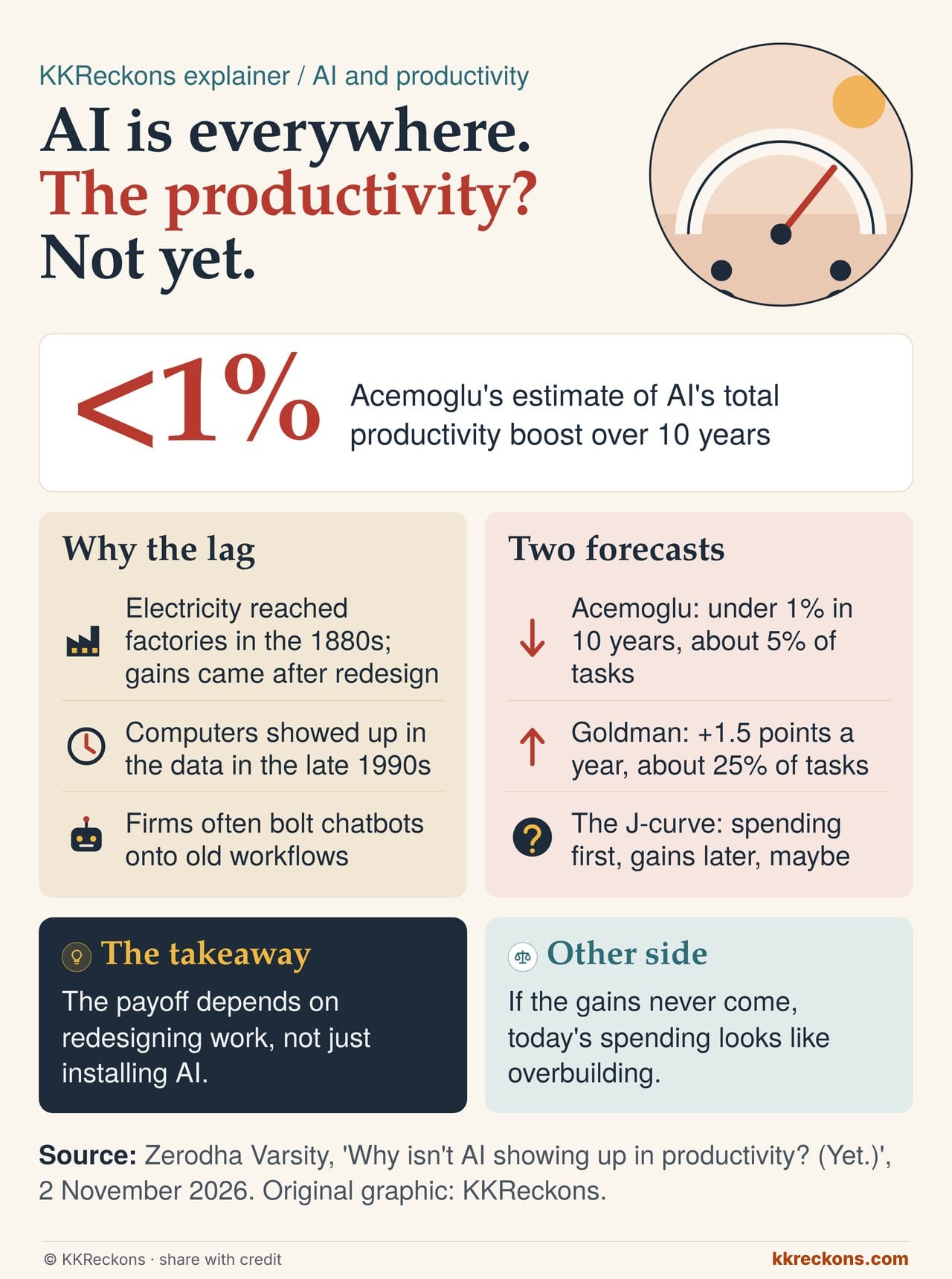
Zerodha Varsity revisits Robert Solow's 1987 quip that computers were visible everywhere except the productivity statistics; US trend labour productivity growth had slid from 3.8% in 1948 to 1.2%.
History shows a lag: factories gained from electricity only after redesigning around individual motors, lifting manufacturing productivity 5.3% a year in the 1920s. Computers paid off in the late 1990s.
AI forecasts diverge: Daron Acemoglu sees under 1% over a decade, assuming about 5% of tasks shift to AI; Goldman Sachs sees about 1.5 points a year, assuming about 25%.
<1%
Acemoglu: boost over 10 years
+1.5 pts
Goldman: a year, once adopted
5.3%
1920s factory productivity
Why it matters Firms bolting chatbots onto old workflows may be repeating factory owners who swapped one steam engine for one big motor; the payoff depends on redesigning the work itself.
Other side The J-curve is a hypothesis, not a promise: if the gains never arrive, today's AI spending looks less like early investment and more like overbuilding.
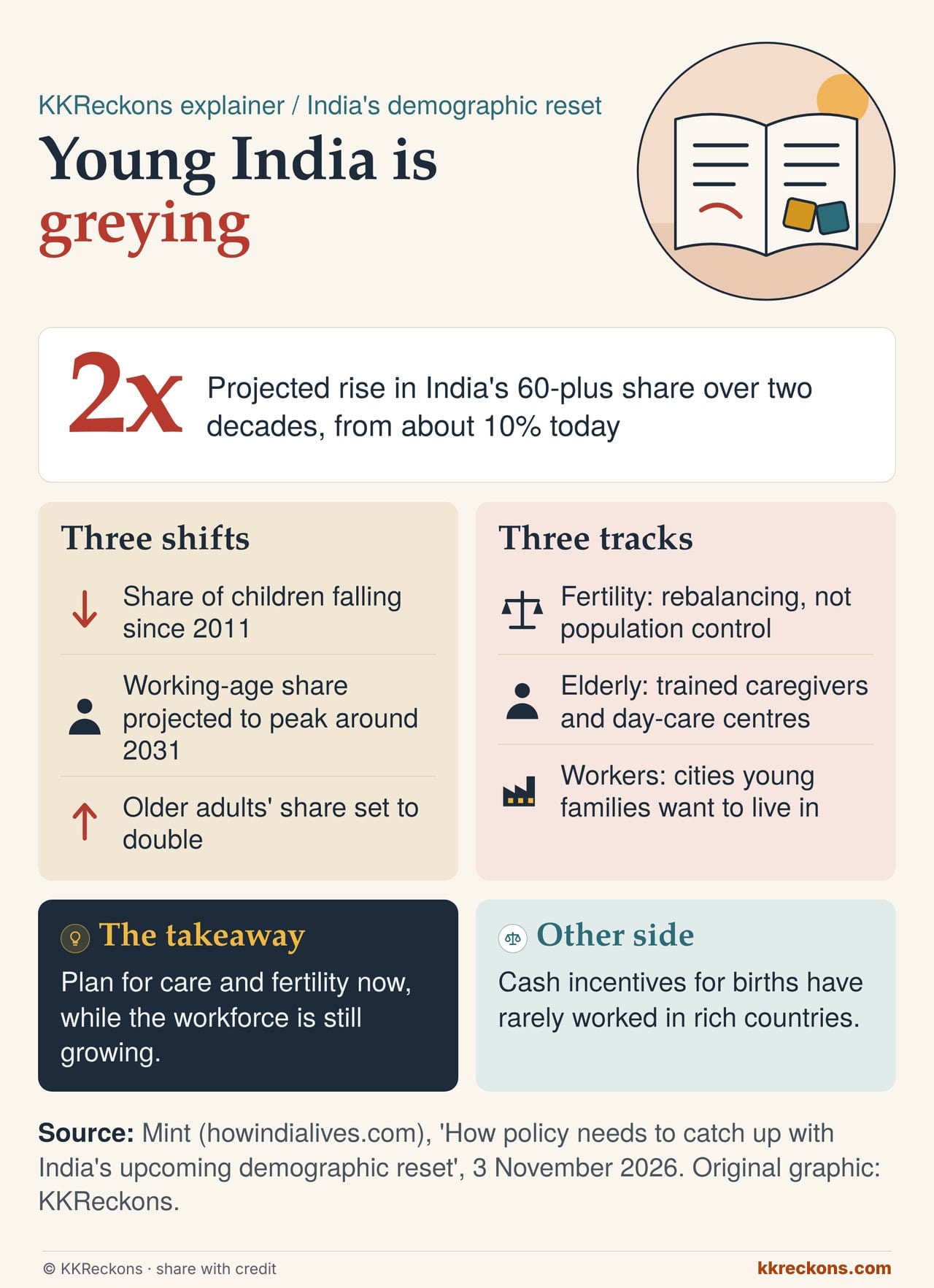
A howindialives.com piece in Mint says India is still young, but the share of people aged 60 and over, about 10% now, is projected to double in two decades, while the working-age share peaks around 2031.
Fertility in eight states has slipped below the level demographers link to a low-fertility trap, yet family planning still rewards sterilisation. It urges rebalancing, not control.
For older adults it proposes trained, better-paid caregivers, Keralam-style day-care centres and ASHA workers retrained for geriatric care; for workers, cities young families want to live in.
Why it matters India's growth story leans on its working-age bulge; building care systems and family-friendly cities now is cheaper than scrambling after that bulge peaks.
Other side Pro-natal incentives have done little in rich countries, and with the workforce still growing, scarce public money may do more for jobs today than for births tomorrow.
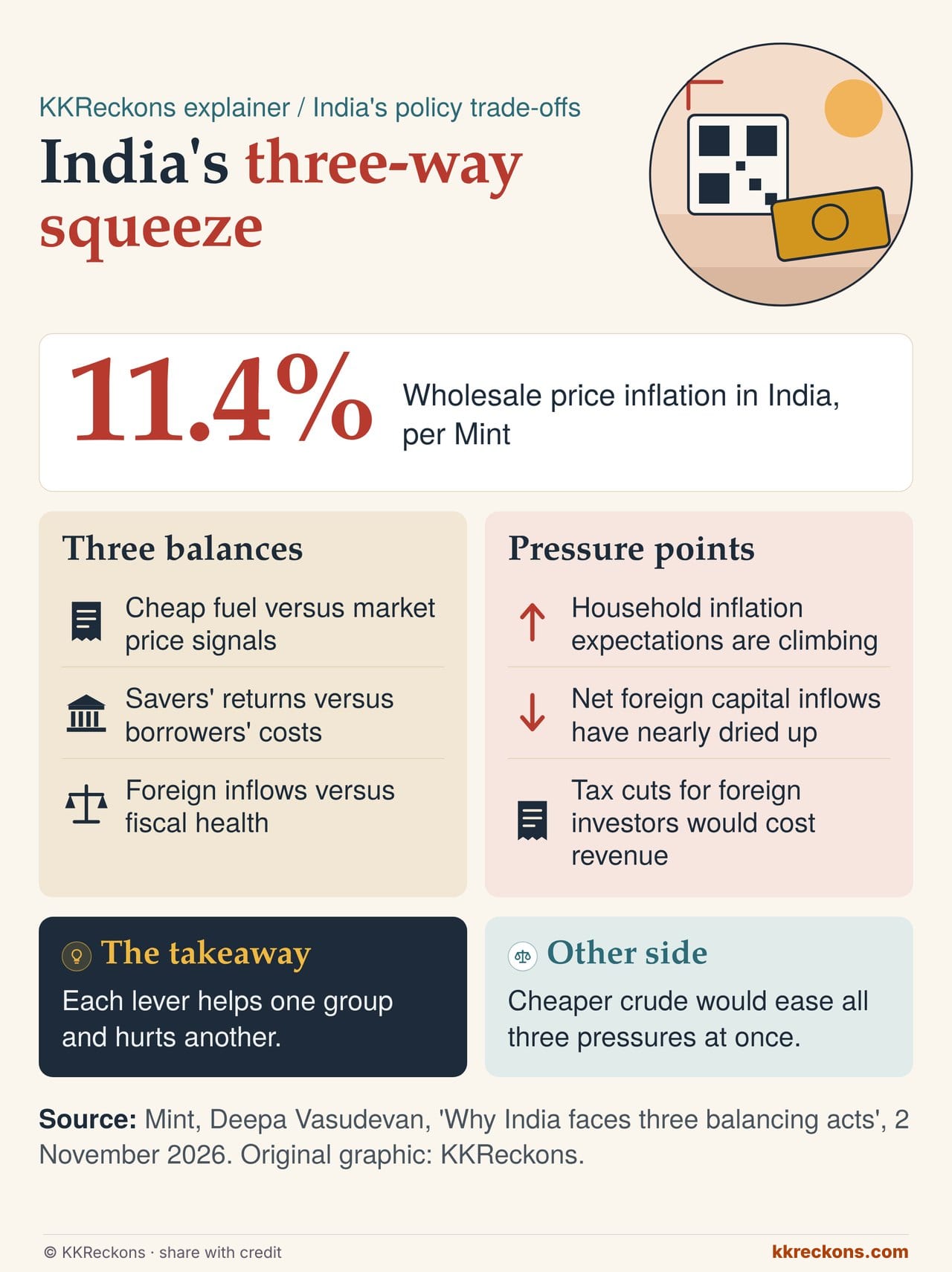
Deepa Vasudevan writes in Mint that the West Asia war has sharpened three balances for India: cheap fuel versus market prices, savers versus borrowers, and foreign money versus fiscal health.
Holding pump prices down only delays inflation. With wholesale inflation at 11.4%, either the RBI keeps raising rates or retail fuel prices rise, possibly after Diwali.
Net capital inflows that averaged $50bn a year until 2023-24 have nearly dried up. Tax breaks for foreign investors might help, but would cost revenue as the deficit risks overshooting.
Why it matters Every lever helps one group and hurts another; the real danger is pulling several at once, such as cutting taxes for foreign investors just as subsidies and borrowing climb.
Other side These trade-offs can ease on their own: if crude prices fall, fuel, inflation and rate pressures soften together and the hardest choices fade.
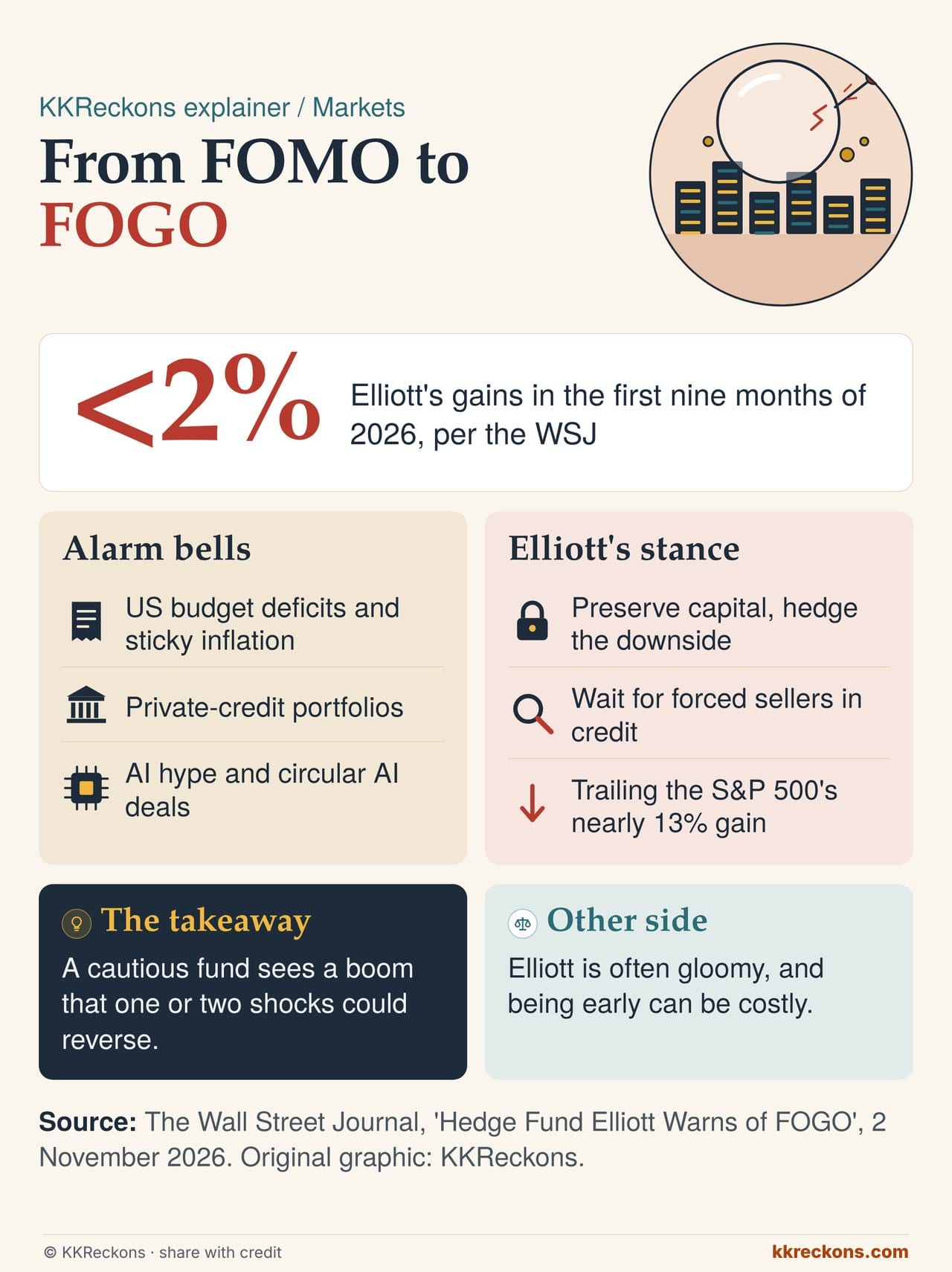
In an October investor letter seen by the WSJ, Paul Singer's Elliott likens today's debt-fuelled, hype-driven market to the Roaring '20s and says almost every bear-market warning is flashing.
It lists US deficits, sticky inflation, Private credit Loans made by investment funds instead of banks, usually less regulated and less visible., AI hype and circular AI deals, plus gambling-like trading, and warns the mood could flip from FOMO to fear of getting obliterated.
Elliott itself has lagged, gaining under 2% in the first nine months of 2026 against nearly 13% for the S&P 500, and is keeping capital ready for forced sellers.
Why it matters When a famously cautious fund trails the market, its warning also defends its own positioning; readers should weigh the list of risks more than the timing.
Other side Elliott's letters are known for gloom, and frothy markets can run for years; being early on a crash can cost nearly as much as missing it.
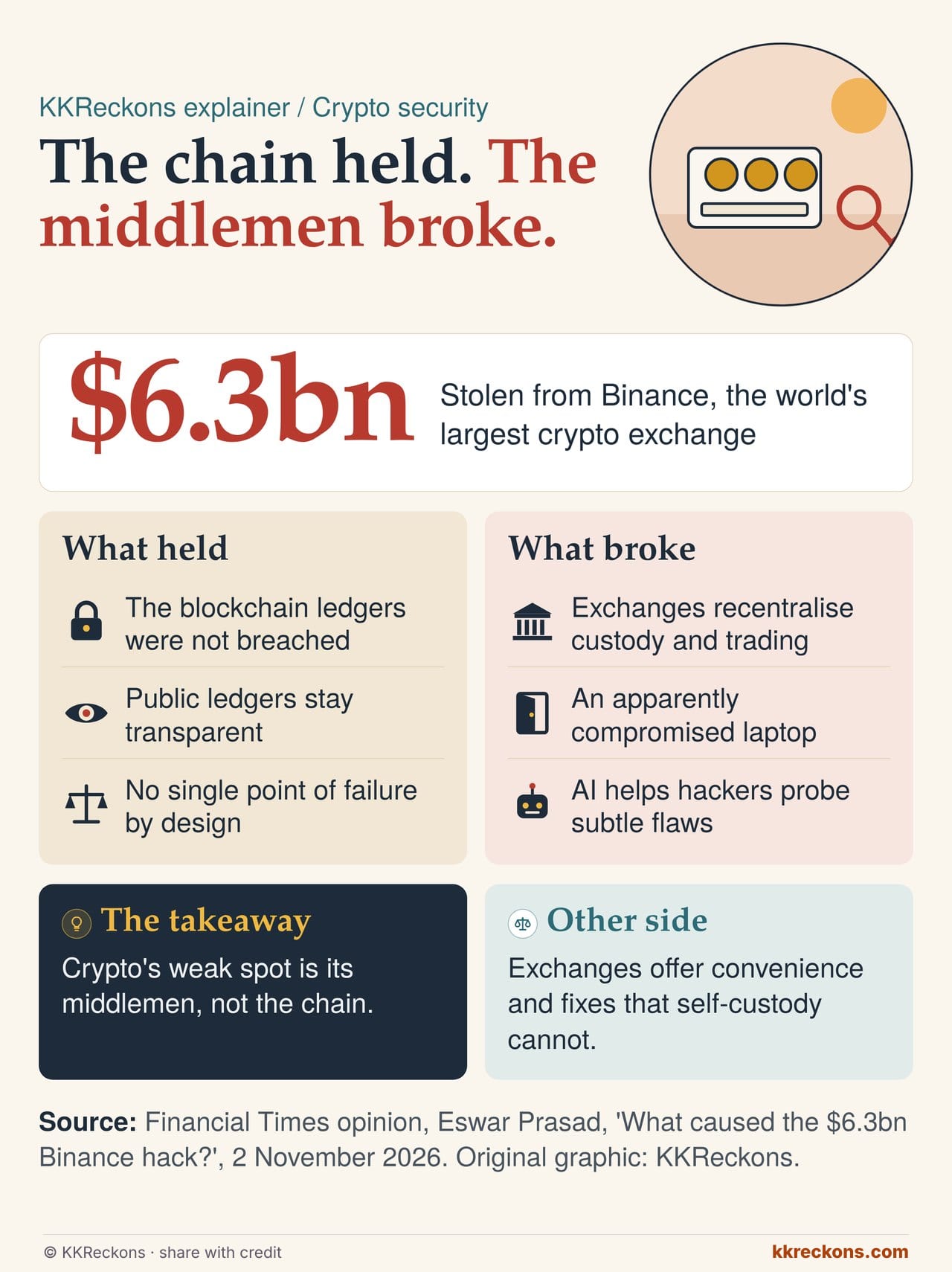
Cornell economist Eswar Prasad argues the $6.3bn hack of Binance shows how crypto's promise of decentralisation has been undercut by big centralised exchanges.
The blockchains were not breached, he says; the weak points lie in the ecosystem around them, from exchanges to oracle software, plus human error such as an apparently compromised laptop.
He warns AI is helping hackers, including from North Korea, find subtle flaws, and urges regulators to stop a loss of trust spilling into mainstream finance.
Why it matters Investors park coins on exchanges for convenience, recreating the single point of failure crypto was built to remove; that trade-off now carries a record price tag.
Other side Banks get hacked too, and exchanges offer customers the reassurance that losses can be fixed, something a pure self-custody world would not.
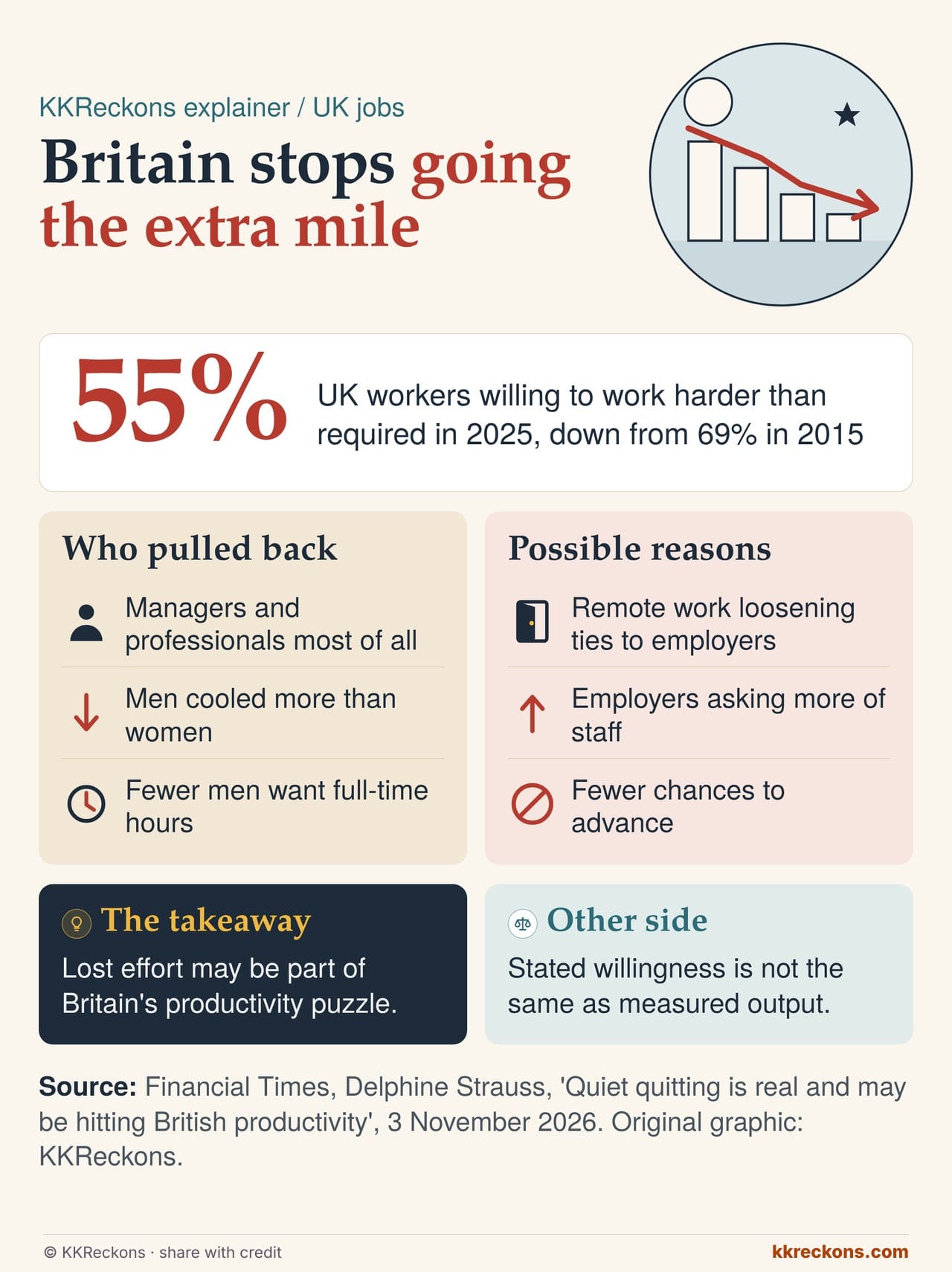
A Resolution Foundation analysis of the British Social Attitudes Survey finds UK workers more disengaged than a decade ago, with job satisfaction the gloomiest in the survey's history.
The share willing to work harder than required fell from 69% in 2015 to 55% in 2025; managers and professionals pulled back most, and men cooled more than women.
The think tank points to post-pandemic priorities, remote work, heavier demands and fewer chances to advance, and says the shift could help explain weak UK productivity.
Why it matters If effort, not just hours or capital, is slipping, part of Britain's productivity problem lies in management and job design, which investment alone won't fix.
Other side The survey measures stated willingness, not output; staff who already feel always on may say they do less extra while working just as hard.