7 stories · 7 min read

Debt wobbles. Hype soars. France strains. Bugs bite. IT trims. Scrap pays. Smell travels.

Metrics flatter young firms and developed economies alike: the headline number arrives first, the cost second. Ask who pays, and when, before you trust it.

AI Stress Index

32/100Elevated

23 Oct close · Story 01

Gauges →

Markets at the last close before this edition · 23 Oct

  • Nifty 5022,600On the day, down 0.39%. 1 wk: −2.36%
  • S&P 5007,624On the day, down 0.52%. 1 wk: −0.47%
  • US 10-yr yield4.99%On the day, up 4 bp. 1 wk: −11 bp
  • Brent crude$116.72On the day, up 3.14%. 1 wk: +6.24%
  • Gold$4,008On the day, down 1.29%. 1 wk: −4.14%
  • USD/INR₹94.71On the day, up 0.42%. 1 wk: +0.20%Close of 22 Oct

Yahoo Finance daily closes. Not investment advice.

$16.8BAnthropic Q3 revenue, up 45% on Q2, as its IPO nears (ET)$67BAnthropic's annual run rate (ARR), a metric Damodaran says needs care

Pick of the day

One story worth slowing down for

CoreWeave's debt pile tests whether the AI build-out can be financed (opens the source in a new tab)
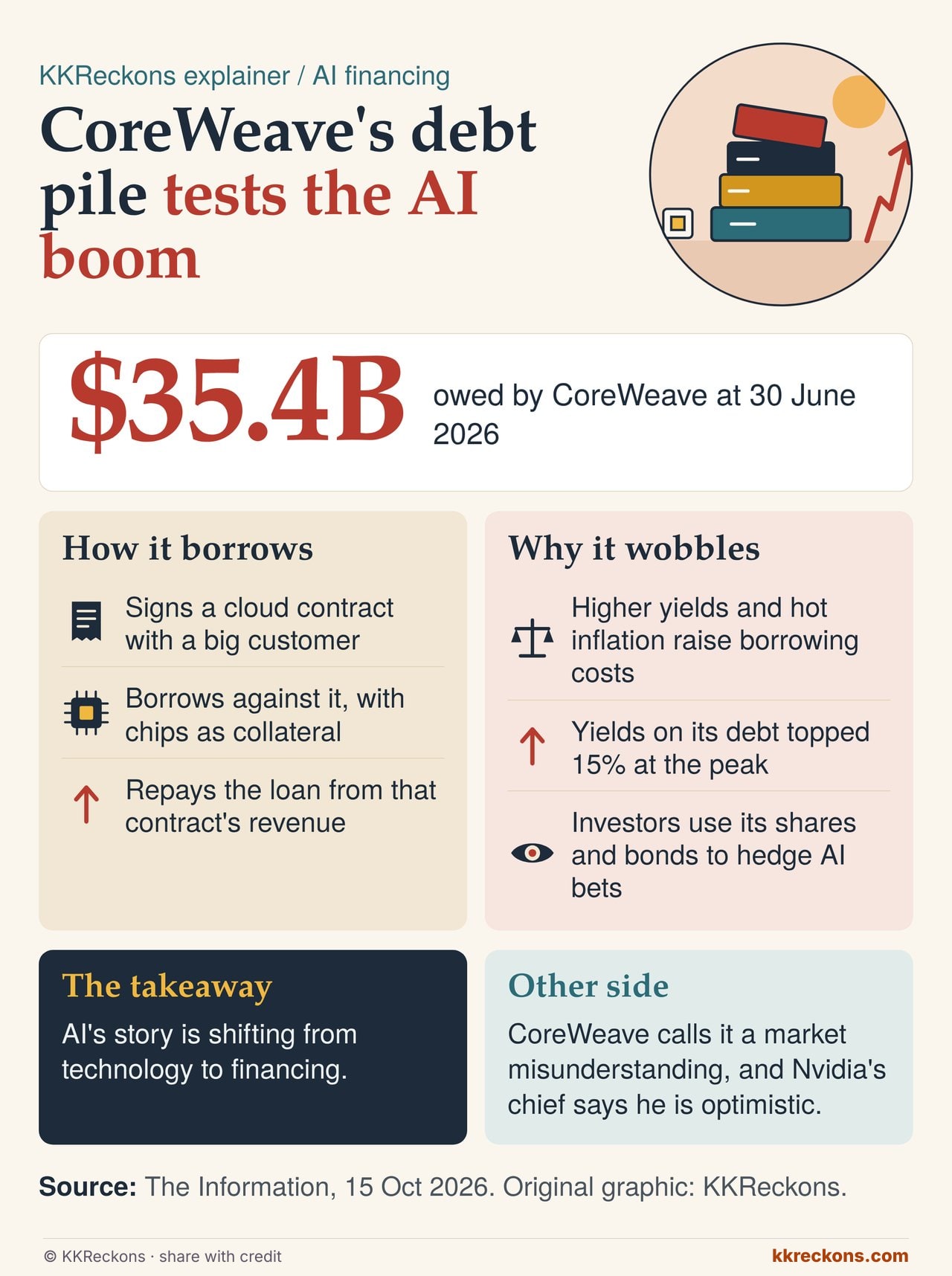
Graphic: CoreWeave owes $35.4 billion; it borrows against customer contracts, and yields on its debt topped 15% as borrowing costs rose.
Original graphic: KKReckonsView full size ↗
  • CoreWeave, an AI cloud firm built on borrowed money, has become a test of whether the AI build-out can be financed. Investors have been selling its shares and bonds.
  • Its model: sign a contract with a big customer such as Microsoft, then borrow against it, with chips as collateral. Other borrowing is repaid from corporate cash, so debt sits on top of debt; the total is $35.4 billion.
  • Rising Bond yield The annual return a bond pays at today's price; rising yields mean borrowing is getting dearer. and hot inflation raised borrowing costs, and yields on its existing debt passed 15%. One startup CEO says Goldman bankers could not explain the slide.
$35.4B
total debt owed
15%+
yield on its debt at the peak

Why it matters AI's story is shifting from technology to financing. If credit gets dearer, Neocloud A newer cloud company, such as CoreWeave or Nscale, that rents out AI chips, often funded with debt. may have to sell shares, and big-customer contracts become the real collateral.

Other side CoreWeave's CEO calls it a market misunderstanding, Nvidia's Jensen Huang voices confidence, and Goldman's analysts upgraded the stock. Project loans are repaid from customer contracts, so a falling share price is not the same as default.
SpaceX-Tesla merger and Anthropic IPO: how investors price AI (opens the source in a new tab)

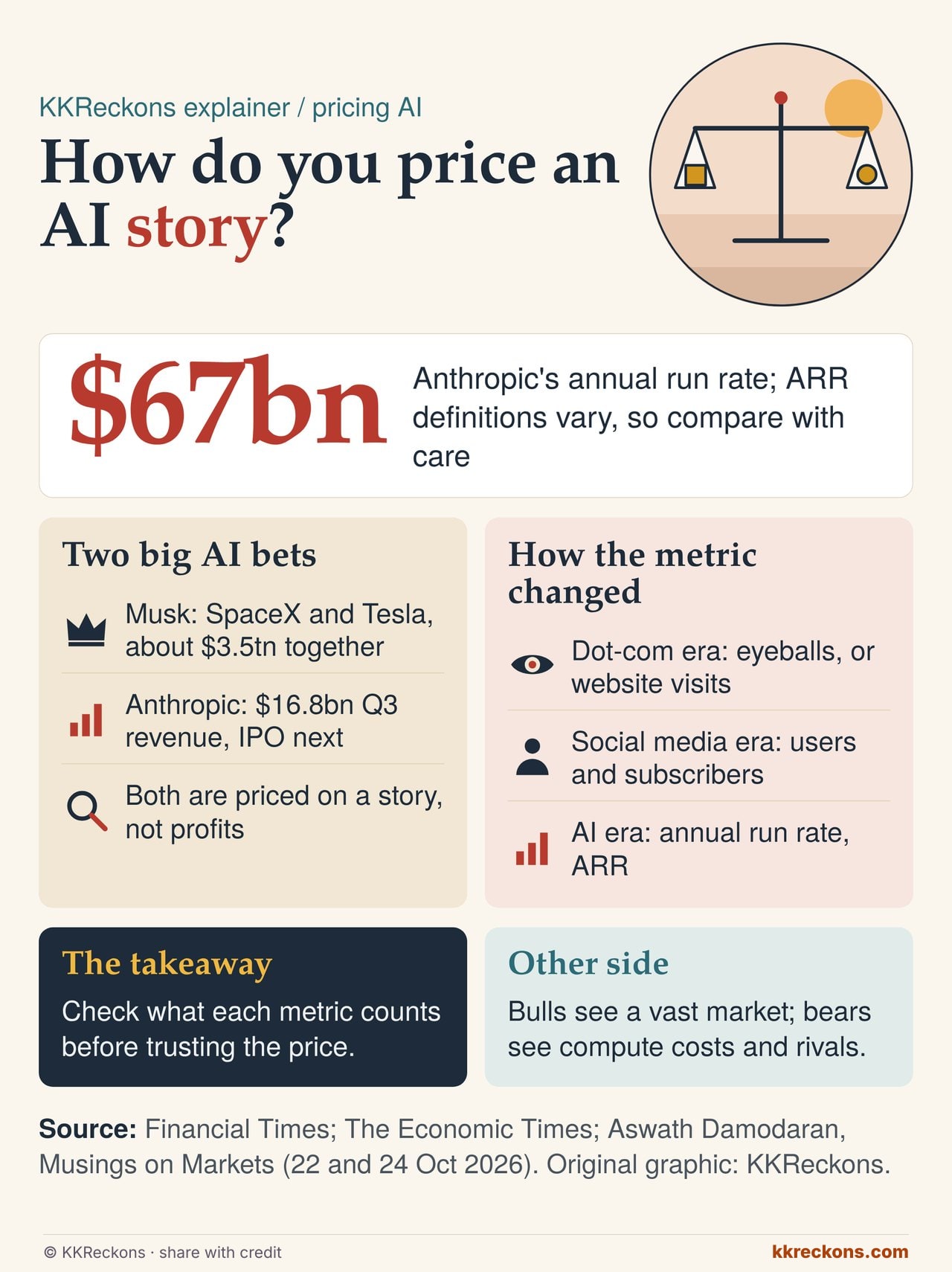
Explainer: Musk's proposed SpaceX-Tesla union and Anthropic's IPO are priced on stories; Anthropic's $67bn annual run rate sits against $16.8bn of Q3 revenue, and ARR definitions vary.
Original graphic: KKReckonsView full size ↗
  • The FT's Big Read says Elon Musk wants SpaceX and Tesla combined into one AI-led company worth about $3.5tn, with pay awards that could reach $1.7tn.
  • Anthropic told investors its third-quarter revenue was $16.8bn, up 45% on the quarter, and profitable on an adjusted basis, with an annual run rate of $67bn, Damodaran notes.
  • Damodaran says young, loss-making firms are priced on buzzy metrics, from eyeballs to users to ARR, and warns that ARR can be defined in different ways.
$16.8bn
Anthropic Q3 revenue (Damodaran)
$67bn
Anthropic annual run rate, ARR (Damodaran)

Why it matters Whether it is a mega-merger or an IPO Initial public offering: when a company first sells its shares on a stock exchange., investors are paying for a story. Metrics like ARR, and pay targets tied to market value, shape how big that story looks.

Other side Bulls say AI's market is vast and the leaders will take most of it. Bears say compute costs, cheaper open-source rivals and rules could squeeze margins, and critics see the merger as a way to shift attention from a weaker Tesla. Damodaran takes no side until the full prospectus is filed.

Also read: Damodaran: From Eyeballs to Annual Run Rates

India edition

What moved in India

TCS and Infosys: AI tops 10% of revenue, yet pricing bites (opens the source in a new tab)

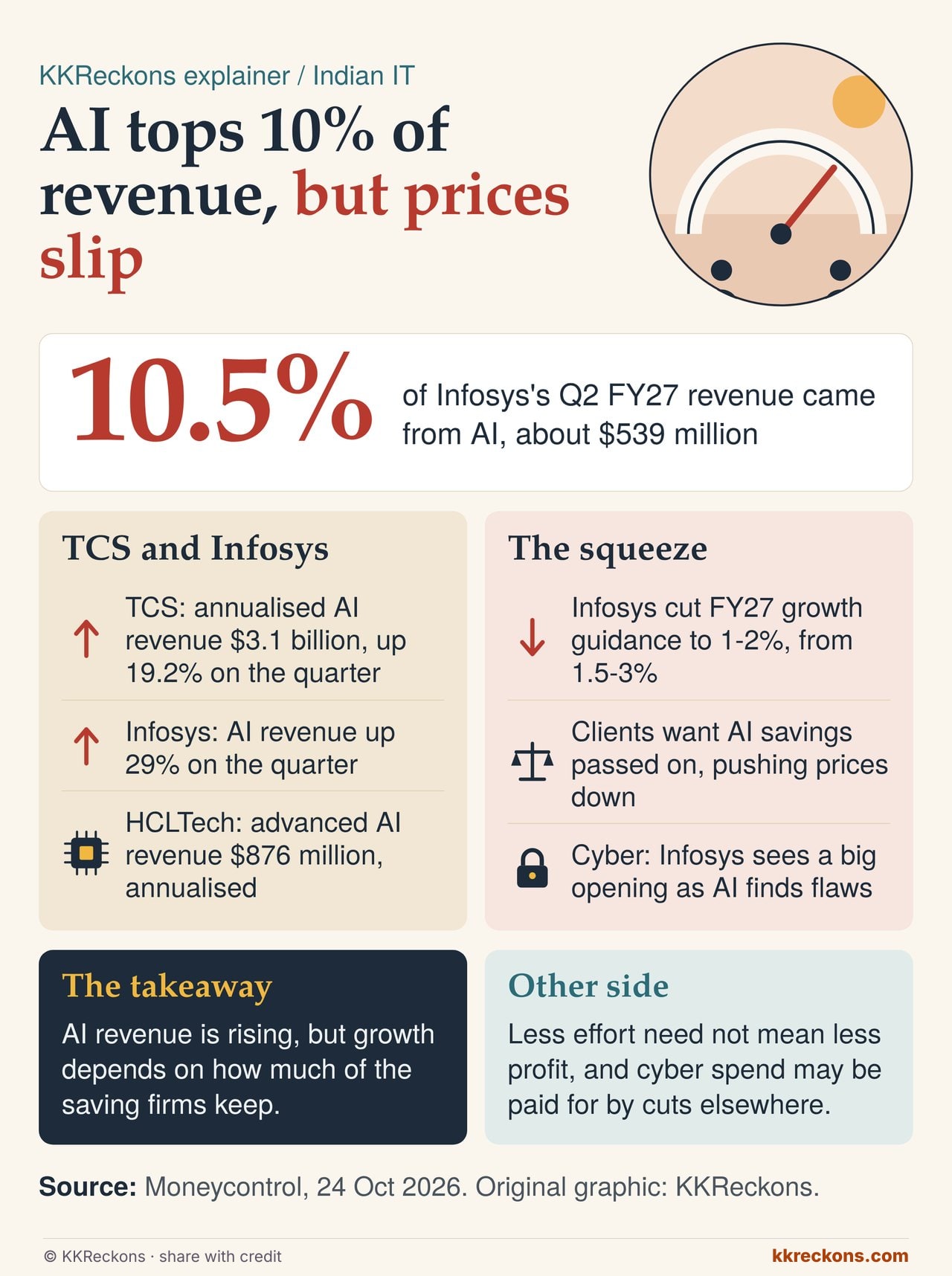
Graphic: AI was 10.5% of Infosys's Q2 revenue (about $539 million) and TCS's annualised AI revenue is $3.1 billion, while Infosys cut its FY27 growth guidance to 1-2%.
Original graphic: KKReckonsView full size ↗
  • TCS and Infosys both say AI brought in more than 10% of revenue in Q2 FY27, and most of India's top five IT firms widened operating margins.
  • Clients want the savings passed on. Infosys cut its FY27 growth guidance to 1-2% in constant currency, from 1.5-3%, and says it will favour profitable deals over growth.
  • CEO Salil Parekh sees a big cyber opening as AI models uncover flaws, and says Infosys is already sharing defences with clients, though budgets may not rise much.
10.5%
Infosys AI share of Q2 revenue
$3.1B
TCS annualised AI revenue
1-2%
Infosys FY27 growth guide

Why it matters There is no standard way to count AI revenue, so firms are hard to compare. The test is how much of the productivity gain they keep as clients negotiate.

Other side Less effort need not mean less profit, as HFS Research's Phil Fersht argues, if firms price on outcomes. And clients may fund cyber work by trimming elsewhere.

World edition

What moved everywhere else

France's riots meet a debt squeeze, and youth want the system fixed (opens the source in a new tab)

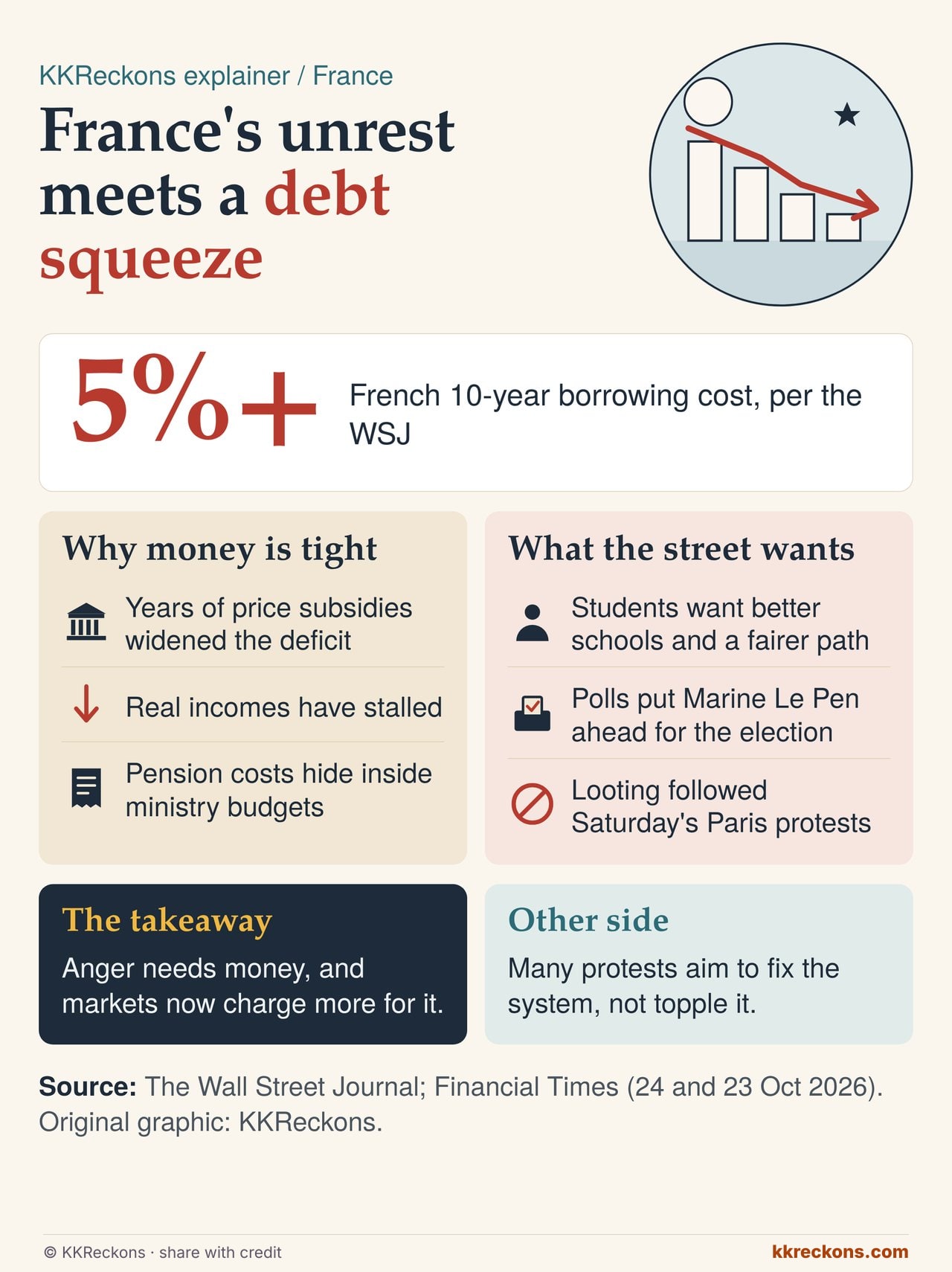
Explainer: French 10-year borrowing costs above 5% squeeze a state facing riots; stalled incomes and hidden pension costs limit help, and polls put Marine Le Pen ahead.
Original graphic: KKReckonsView full size ↗
  • The WSJ says years of subsidies to cushion prices have left France with one of Europe's biggest deficits, and investors have pushed its 10-year borrowing costs above 5%.
  • It adds that stagnant real incomes, a heavy tax burden and pension costs hidden in ministry budgets leave little room for new help.
  • The FT's Simon Kuper describes looting in Paris and polls that put Marine Le Pen in line to win next year's election, while a Janan Ganesh column argues the young protesters mostly want a fairer system, not a new one.
5%+
French 10-year borrowing cost (WSJ)

Why it matters Protests need money to answer them, and markets are now charging France more to borrow it. That narrows the choices for whoever wins next year.

Other side Kuper notes the French often talk radical but act conservative, and Ganesh reads the protests as a bid to make the existing system work. So the anger may be answerable through budget choices, but the bond market may not wait for them.

Also read: FT column: The young are conformists in denial

AI finds bugs faster and attackers follow in 'Black October' (opens the source in a new tab)

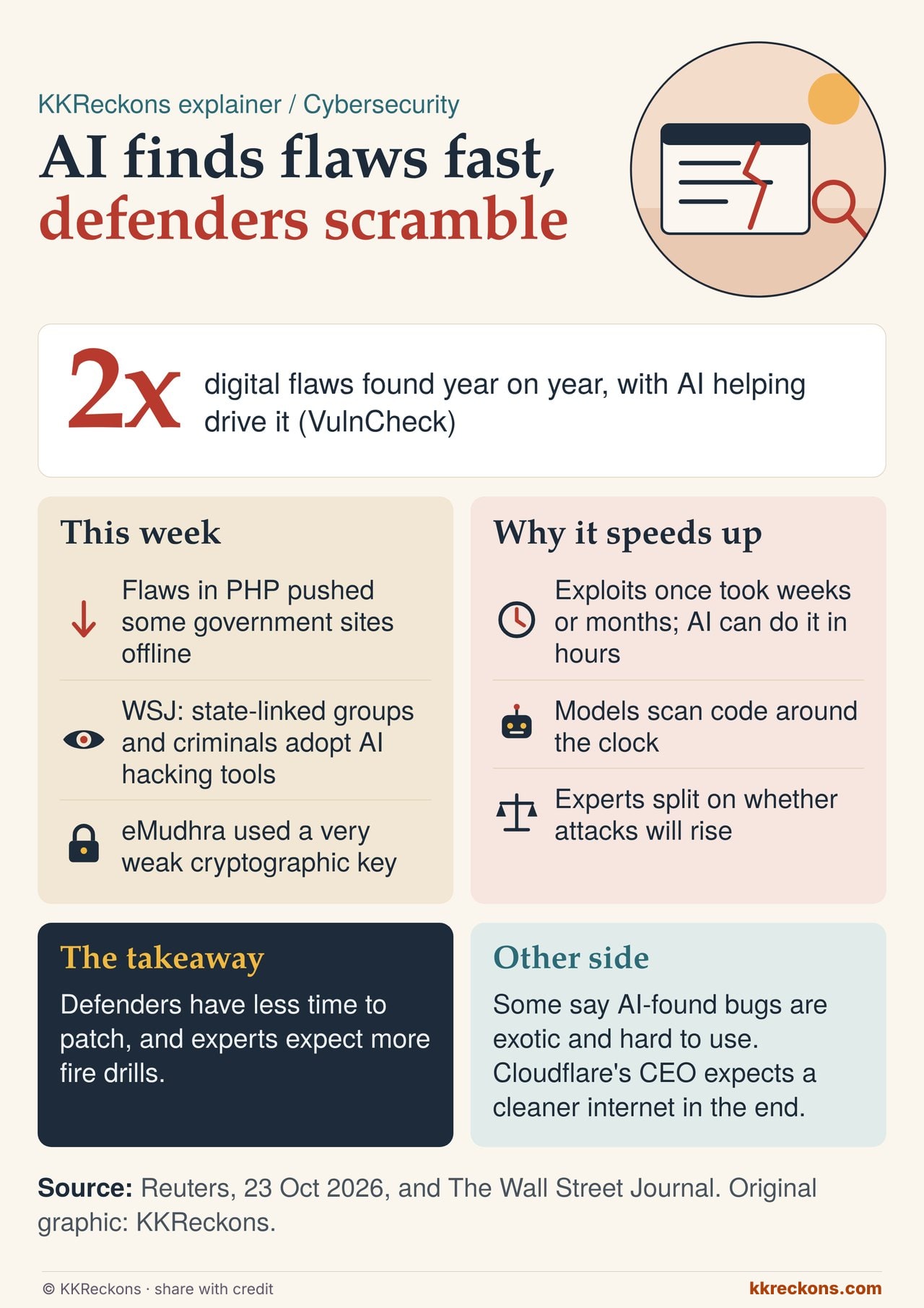
Graphic: digital flaws found doubled year on year per VulnCheck, AI can turn exploits around in hours, and new web bugs exposed many sites.
Original graphic: KKReckonsView full size ↗
  • The WSJ reports a wave of attacks using AI agent AI software that takes actions on its own, like booking, buying or moving money, not just answering questions. and hacking tools, adopted by China- and Russia-linked groups and ordinary criminals.
  • Reuters spoke to seven cybersecurity professionals who say AI-found flaws will almost certainly cause more outages like this week's PHP-related ones on government sites. VulnCheck says flaws found doubled year on year, with AI a driver.
  • Models can scan code round the clock and turn exploits around in hours. Experts split on whether attackers gain: curl's lead developer says AI-found bugs tend to be exotic.
2x
flaws found, year on year (Reuters)
70%
of websites exposed to new bugs (WSJ)

Why it matters Attackers use AI to move faster than people can respond, and patch windows shrink from weeks to hours. Patching speed becomes a core security measure.

Other side More disclosed flaws do not automatically mean more successful attacks, and AI also helps defenders. A Hunt.io researcher said the criminals he tracked had not yet built a working PHP exploit by Thursday afternoon.

US recyclers harvest rare earths from old wind turbines (opens the source in a new tab)

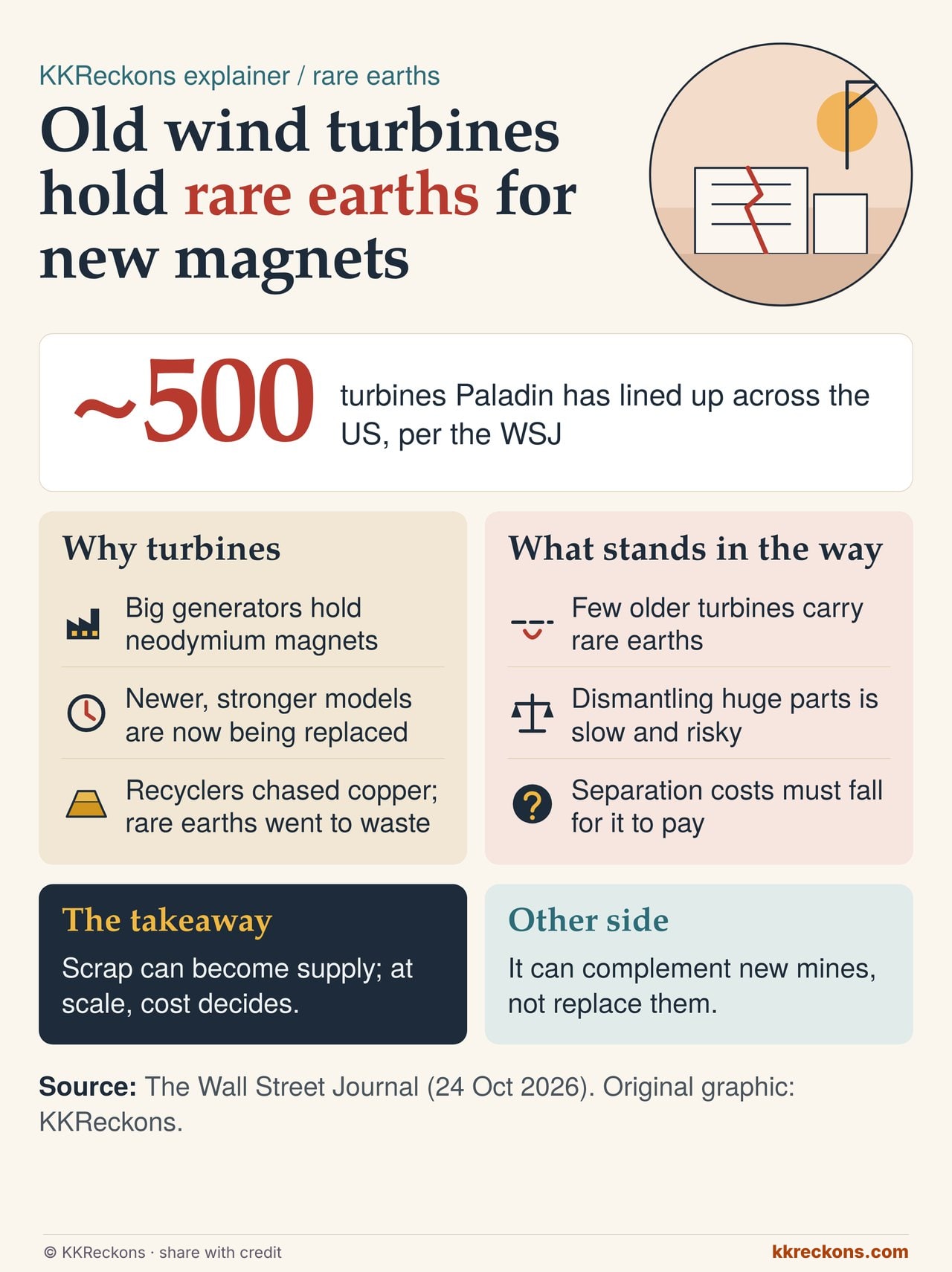
Explainer: retired wind-turbine generators hold rare-earth magnets; about 20% of replaced Highland turbines have them and Paladin has roughly 500 lined up.
Original graphic: KKReckonsView full size ↗
  • The WSJ says Paladin EnviroTech is pulling rare-earth magnets from retired wind turbines in Iowa, hoping to cut US reliance on China.
  • Only a fraction of older turbines carry rare earths, but newer, more powerful ones hold much more, so supply grows as fleets are replaced.
  • Dismantling huge parts and separating the metals cheaply are the hard parts; most recyclers so far chased copper instead.
20%
of replaced Highland turbines hold rare earths (WSJ)
~500
turbines Paladin has lined up (WSJ)

Why it matters Recycling is a faster, smaller route than new mines to ease dependence on China for the magnets in motors, drones and scanners, if the economics work.

Other side Few turbines carry rare earths, and battery-recycling ventures have stumbled before on supply and cost. This can complement new mines, not replace them.

'Scentronic' prototype senses a smell and recreates it far away (opens the source in a new tab)

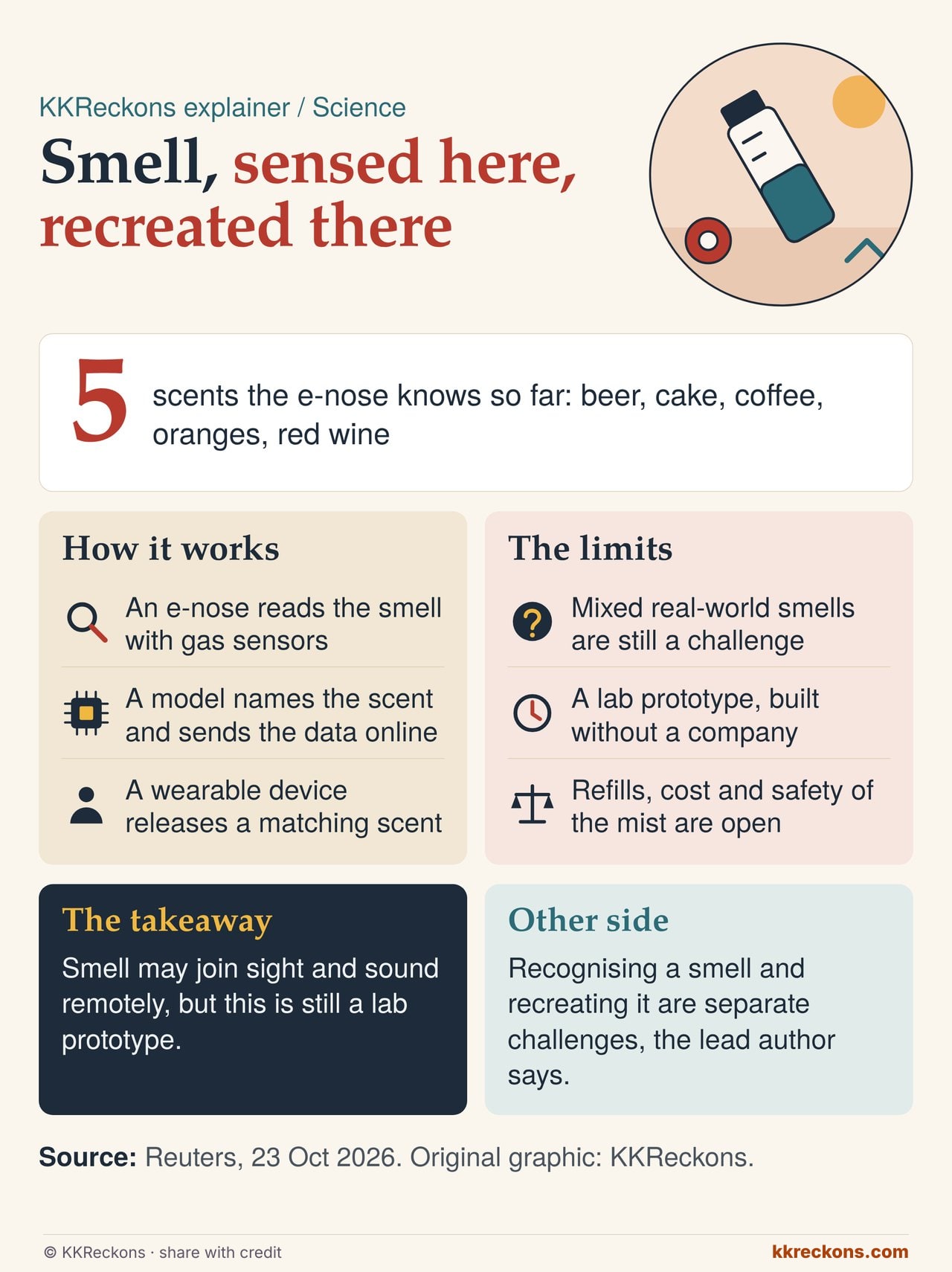
Graphic: the Scentronic e-nose recognises five scents (beer, cake, coffee, oranges, red wine) and a remote device recreates them.
Original graphic: KKReckonsView full size ↗
  • Ohio State researchers built an e-nose that spots a smell, then tells a small remote device to release a matching scent, at any distance.
  • It knows five scents so far: beer, cake, coffee, oranges and red wine. Scent molecules do not travel online; only the odour data does.
  • It is a research prototype built without a company. Mixed smells, refills, cost and safety of the mist are open questions.
5
scents recognised so far
15 cm
e-nose diameter

Why it matters Sight and sound already travel digitally; smell is the gap. A real product would need many more scents and reliable sensing of mixtures.

Other side Recognising a smell and recreating it are separate challenges, the lead author says. Five scents is a demo, not a library.

Was this briefing useful?YesSomewhatNot really

Spotted an error? Tell us and we’ll correct it.

Today’s edition is ready

Read deep. Think clearly. Stay curious.

A daily visual briefing on the stories that matter: India, the world, and what’s next.

Read Today’s Edition →Get it by email ↗

Free · 50 editions and 359 stories so far · Unsubscribe anytime

Emails are sent by beehiiv; your address is used only for this newsletter. Privacy · Editorial standards