6 stories · 5 min read

Burn, ration, return: AI's three moods. India adds a fourth: rules that hold.

Markets at the last close before this edition · 15 Oct

  • Nifty 5022,997On the day, up 1.66%. 1 wk: +3.44%
  • S&P 5007,744On the day, up 0.33%. 1 wk: −0.27%
  • US 10-yr yield5.09%On the day, down 10 bp. 1 wk: −14 bp
  • Brent crude$105.92On the day, down 0.13%. 1 wk: +1.57%
  • Gold$4,170On the day, up 1.51%. 1 wk: +0.32%
  • USD/INR₹94.52On the day, down 0.66%. 1 wk: −2.37%

Yahoo Finance daily closes. Not investment advice.

17.6%foreign ownership of Indian large caps, a decade-plus low; J.P. Morgan sees room to buy.$29a month is all Accenture now funds per person for Claude; some staff spent $1,000.

Pick of the day

One story worth slowing down for

1MarketsOpinion

J.P. Morgan: India is becoming investors’ default non-AI bet (opens the source in a new tab)
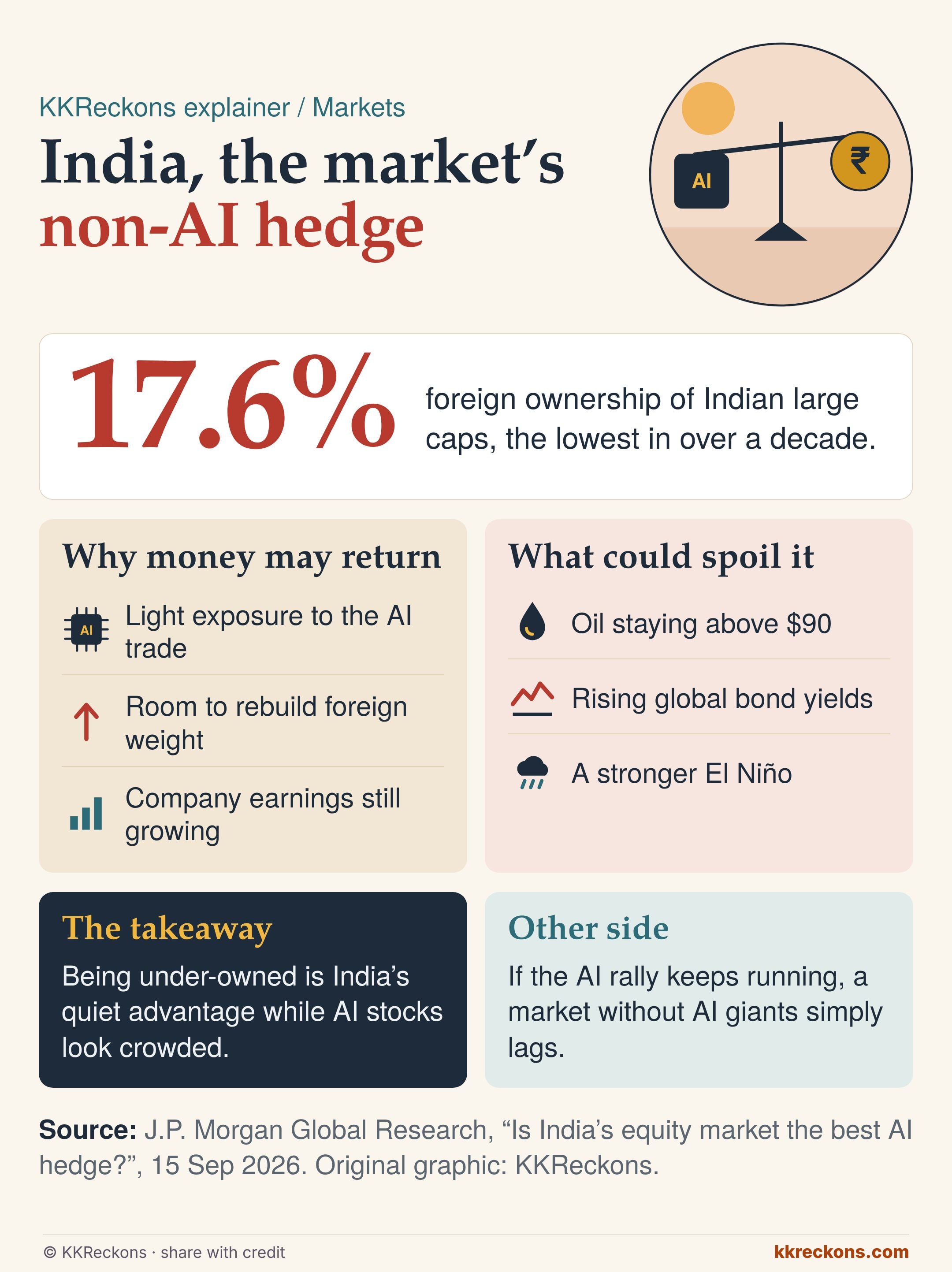
Explainer: why foreign money may return to India and what could spoil it
Original graphic: KKReckonsView full size ↗
  • J.P. Morgan’s Rajiv Batra argues India is increasingly the default pick for investors who want emerging-market exposure without the AI trade. India is about 12% of the MSCI EM index, against about 25% for China.
  • Foreign investors bought about $2.5bn in July and $3bn in August, yet own just 17.6% of large caps, a decade-plus low. Domestic institutions have been net buyers for 37 straight months.
  • The bank expects FY27 earnings growth of about 10.4–11% and GDP growth of 6.5–7%. The risks it flags: oil well above $90, rising global yields and a stronger El Niño. Published 15 September.
17.6%
foreign ownership of large caps
$115bn
possible inflows if underweights close
37
straight months of local buying

Why it matters Crowding in AI stocks is India’s opening: a market without AI giants becomes a diversifier. Foreign owners are light, so there is room to buy, and today’s Yes Bank ruling and Fairfax’s IDBI bet add to the case for confidence.

Other side Being the non-AI market cuts both ways. If AI stocks keep running, India lags, and a sustained oil spike would test the story fast.

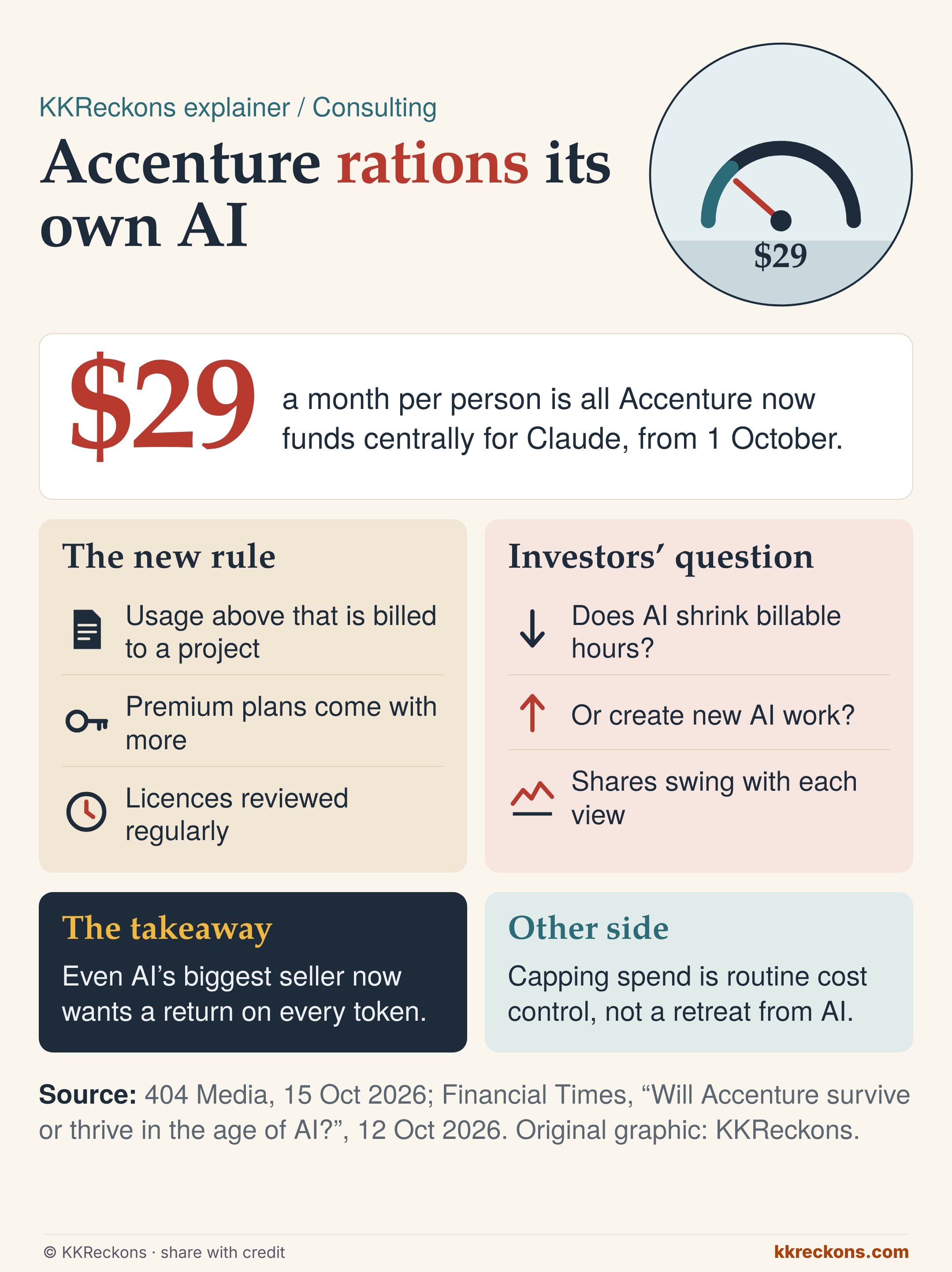
Accenture sells AI to clients, rations Claude for its own staff (opens the source in a new tab)

Explainer: Accenture's new Claude budget and investors' AI question
Original graphic: KKReckonsView full size ↗
  • From 1 October, Accenture centrally funds just $29 a month per person for Claude Enterprise, 404 Media reports. Heavier users, some spending up to $1,000 a month, must charge the excess to a project; Premium plans include $250 of usage a week.
  • The Financial Times says investors cannot decide whether AI threatens the consultancy or boosts it, and its shares have swung sharply in recent months.
  • Accenture forecasts organic growth of about 2% this year and is betting clients will pay it to roll out AI, while rivals may reprice labour-heavy work.
$29
monthly Claude budget per person
$1,000
monthly spend of some users
~2%
organic growth Accenture forecasts

Why it matters The irony is the signal: even AI’s biggest salesman is counting tokens. Companies are moving from ‘try everything’ to ‘show the return’, good news for disciplined users and bad news for open-ended AI budgets.

Other side A spending cap is routine cost control, not a verdict on AI; the budget simply moves to the projects that use it most.

India edition

What moved in India

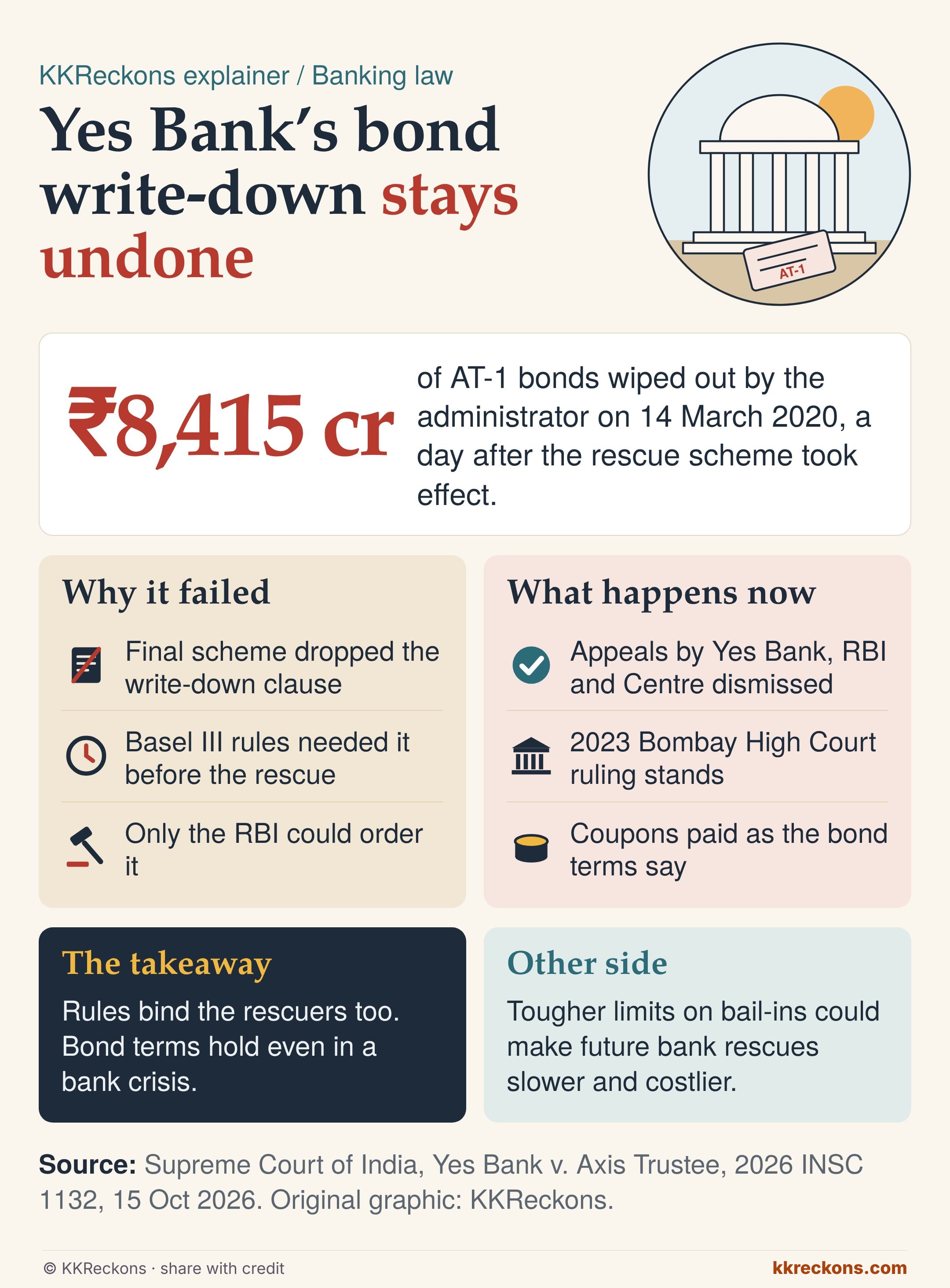
Supreme Court: Yes Bank’s ₹8,415 crore AT-1 write-down stays quashed (opens the source in a new tab)

Explainer: why the Yes Bank AT-1 write-down failed and what happens now
Original graphic: KKReckonsView full size ↗
  • The Supreme Court dismissed appeals by Yes Bank, the RBI and the Centre, upholding the Bombay High Court’s 2023 ruling that the administrator’s 14 March 2020 write-down of ₹8,415 crore of AT-1 bonds was invalid.
  • The final rescue scheme had deliberately dropped the write-down clause, the court held, and the RBI’s Basel III rules required any write-down before the reconstruction took effect, ordered by the RBI, not an administrator.
  • It called the handling by the RBI, the administrator and Yes Bank questionable, noted the bank sold these high-risk bonds to individuals, and said coupons must be paid as the bond terms require.
₹8,415 cr
AT-1 bonds written down in 2020
0.6%
Yes Bank’s CET1 ratio, Dec 2019

Why it matters Rules beat rescue convenience. Foreign money now buying into Indian lenders, such as Fairfax at IDBI and CSB, gets a clear signal: bond terms and the RBI’s own rulebook will be enforced, even against the regulator.

Other side Bail-ins exist so taxpayers don’t pay for bank failures. If write-downs are this easy to overturn, will the next rescue be slower and costlier, and will AT-1 buyers price in that protection as a free option?

4BankingInterview

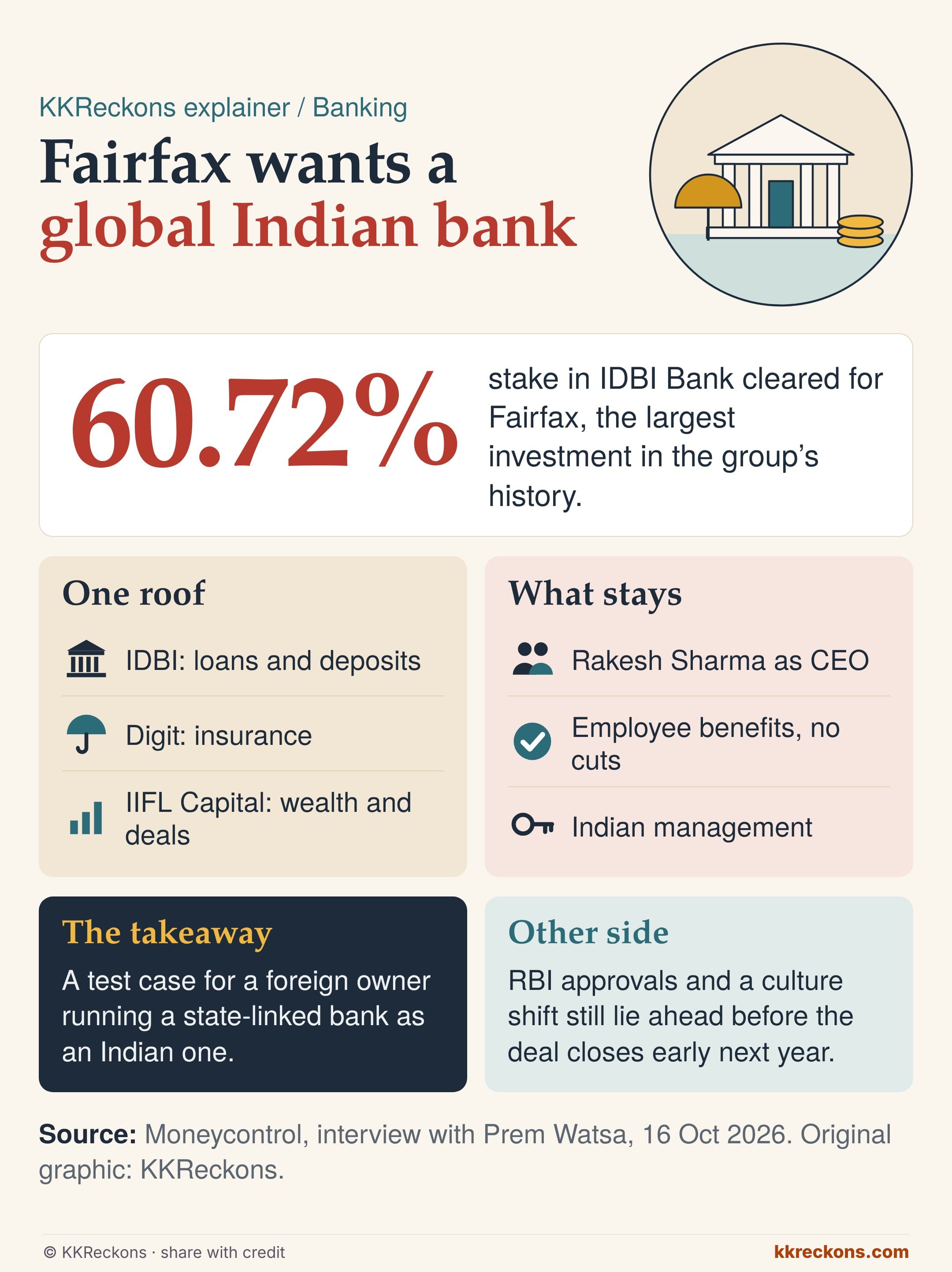
Fairfax plans a ‘global Indian bank’ from IDBI, keeps its CEO (opens the source in a new tab)

Explainer: Fairfax's plan for IDBI Bank and what stays the same
Original graphic: KKReckonsView full size ↗
  • Prem Watsa says Fairfax will build IDBI Bank into a global Indian bank, linking it with Digit Insurance and IIFL Capital Services for insurance, wealth management and investment banking, while those firms’ parents stay unchanged.
  • The ₹52,878 crore purchase of a 60.72% stake, cleared by the government, is Fairfax’s largest ever and should close early next year. Rakesh Sharma stays as CEO; N S Kannan is lined up as chairman, subject to RBI approval.
  • Watsa promised no cut in employee benefits. RBI cross-holding rules give Fairfax two years to decide on its 40% stake in CSB Bank.
₹52,878 cr
for a 60.72% stake
40%
CSB stake to decide on within two years

Why it matters Bank, insurer and wealth arm under one owner is the model India’s big private banks already run. If a foreign owner can run IDBI as an Indian bank, it becomes the template for future sales of state-linked lenders.

Watch next RBI approvals for the new chair and structure, and whether a long-time state-run workforce adapts to a private owner without the promised calm cracking.

World edition

What moved everywhere else

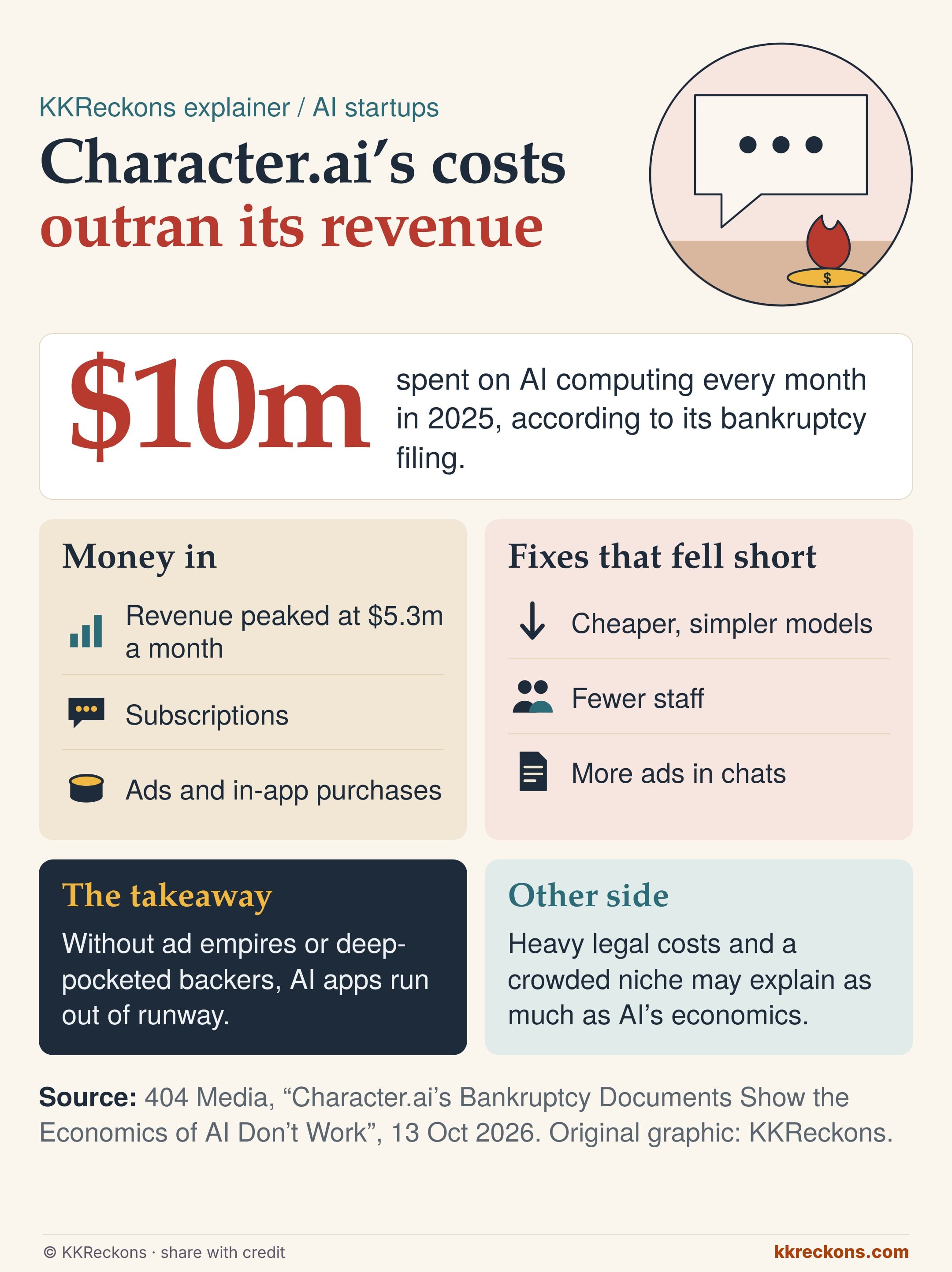
Character.ai’s bankruptcy filing shows AI’s cost problem (opens the source in a new tab)

Explainer: Character.ai's computing costs against its revenue
Original graphic: KKReckonsView full size ↗
  • Character.ai, valued at $1bn in 2023, has filed for Chapter 11. Its CEO’s court declaration says the technology is expensive to run and the company has always struggled to turn a profit.
  • It spent $13.8m a month on computing in 2024 and $10m in 2025, while revenue from all sources, ads included, peaked at $5.3m a month. By August 2026 it was still losing about $8–9m a month.
  • Cheaper models, layoffs, ads and in-app purchases did not close the gap, and lawsuits over harm to users added heavy legal bills. The service stays online during the bankruptcy.
$10m
monthly compute bill, 2025
$5.3m
best month of revenue

Why it matters Scale needs a subsidy. The giants fund AI from ad empires or fresh capital; second-tier players have neither. Expect consolidation, and more cluttered, pricier AI apps as survivors chase break-even.

Other side Is this AI’s economics or one firm’s niche? Heavy lawsuit costs and a crowded companion-app market may explain much of the collapse.

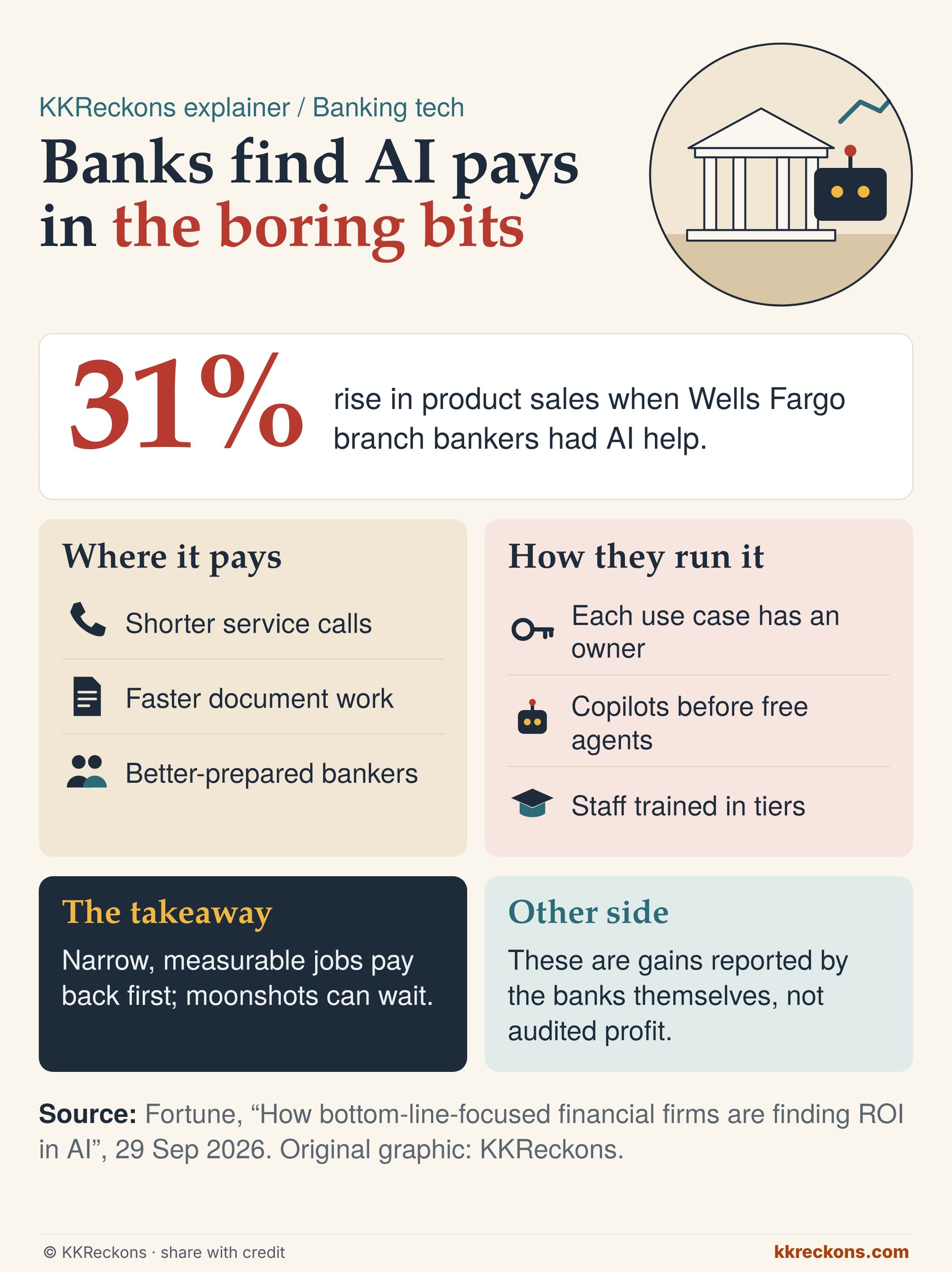
Banks find AI pays in the boring bits (opens the source in a new tab)

Explainer: where banks are finding a return on AI
Original graphic: KKReckonsView full size ↗
  • Finance placed a dozen firms on Fortune’s AIQ 75 list, second only to tech, with JPMorgan Chase first overall. BCG says financial firms were set to invest 2% of revenue in AI this year.
  • Bank of America says its EricaAssist agent cut average call times by nearly a minute; Wells Fargo saw a 31% rise in product sales when branch bankers used AI; 87% of Citi staff use its Stylus tool.
  • BNY now has nearly 400 AI initiatives in production, while Bank of America stays cautious on fully autonomous agents.
31%
Wells Fargo branch sales lift with AI
~400
BNY AI initiatives in production

Why it matters Returns come from narrow, measurable jobs: shorter calls, faster documents, better-prepared bankers. That is the opposite of Character.ai’s story, and it is where IT vendors serving banks should aim.

Other side These figures come from the banks’ own executives. Proof of profit, not just activity, is still thin.

Further reading

Was this briefing useful?YesSomewhatNot really

Spotted an error? Tell us and we’ll correct it.

Today’s edition is ready

Read deep. Think clearly. Stay curious.

A daily visual briefing on the stories that matter: India, the world, and what’s next.

Read Today’s Edition →Get it by email ↗

Free · 50 editions and 359 stories so far · Unsubscribe anytime

Emails are sent by beehiiv; your address is used only for this newsletter. Privacy · Editorial standards