6 stories · 5 min read

Rates rise, IPOs pause, hedges lock in. Calm is now a luxury.

Markets at the last close before this edition · 14 Oct

  • Nifty 5022,623On the day, down 0.44%. 1 wk: +0.09%
  • S&P 5007,719On the day, down 1.11%. 1 wk: −1.06%
  • US 10-yr yield5.19%On the day, down 3 bp. 1 wk: −9 bp
  • Brent crude$106.06On the day, up 0.35%. 1 wk: +5.85%
  • Gold$4,108On the day, down 1.66%. 1 wk: −0.79%
  • USD/INR₹95.15On the day, down 0.14%. 1 wk: −1.66%

Yahoo Finance daily closes. Not investment advice.

14 of 33major central banks have raised rates since Q2, up from 2 in Q1, the IMF reports.13thstrategic sale in a decade: IDBI Bank would be India’s biggest at ₹52,878 crore.

Pick of the day

One story worth slowing down for

IMF: three risks keep global finance on edge (opens the source in a new tab)
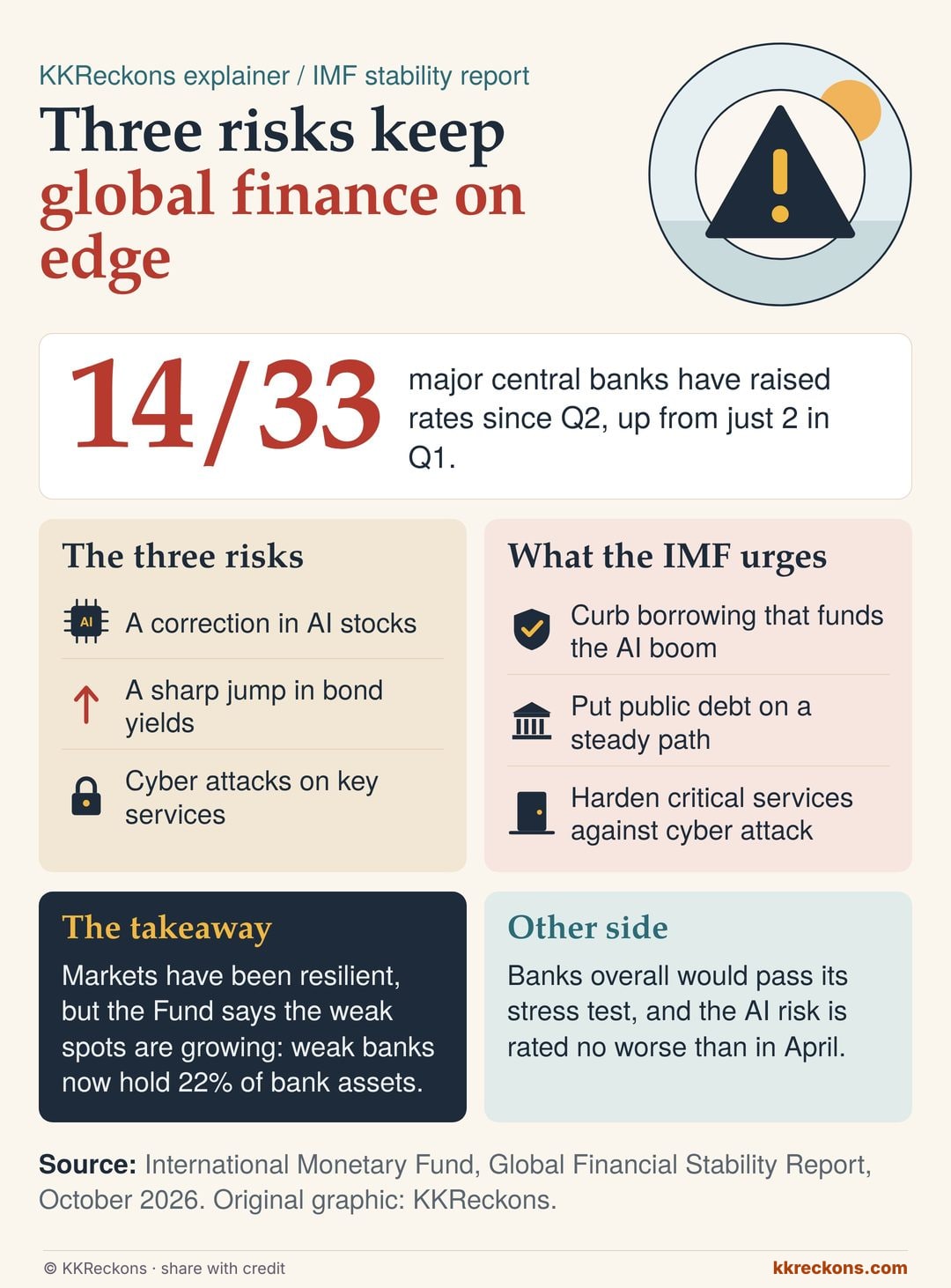
KKReckons explainer: the IMF’s three risks (AI correction, bond yield spike, cyber attack), the rise in central bank rate hikes and what it urges.
Original graphic: KKReckonsView full size ↗
  • The IMF says markets have stayed resilient since April, but risks to financial stability are still elevated. It names three: a sharp correction in AI-linked stocks, a sudden rise in government Bond yield The annual return a bond pays at today's price; rising yields mean borrowing is getting dearer., and cyber attacks.
  • Policy is turning: 14 of 33 major central banks have raised rates since the second quarter, against 2 in the first. In its stress test, bank capital would fall about 1.5 points, yet weak banks now hold 22% of global bank assets.
  • Its advice is to curb leverage behind the AI boom, steady public debt, and strengthen cyber defences.
14/33
major central banks hiked since Q2
22%
of bank assets held by weak banks

Why it matters Calm prices can hide thin cushions. If AI valuations fall just as yields jump, borrowers, banks and funds all feel it together.

Other side Banks overall pass the stress test, and the IMF rates the AI risk as unchanged since April, so this is a warning about weak spots rather than a forecast of a crash.
India edition

What moved in India

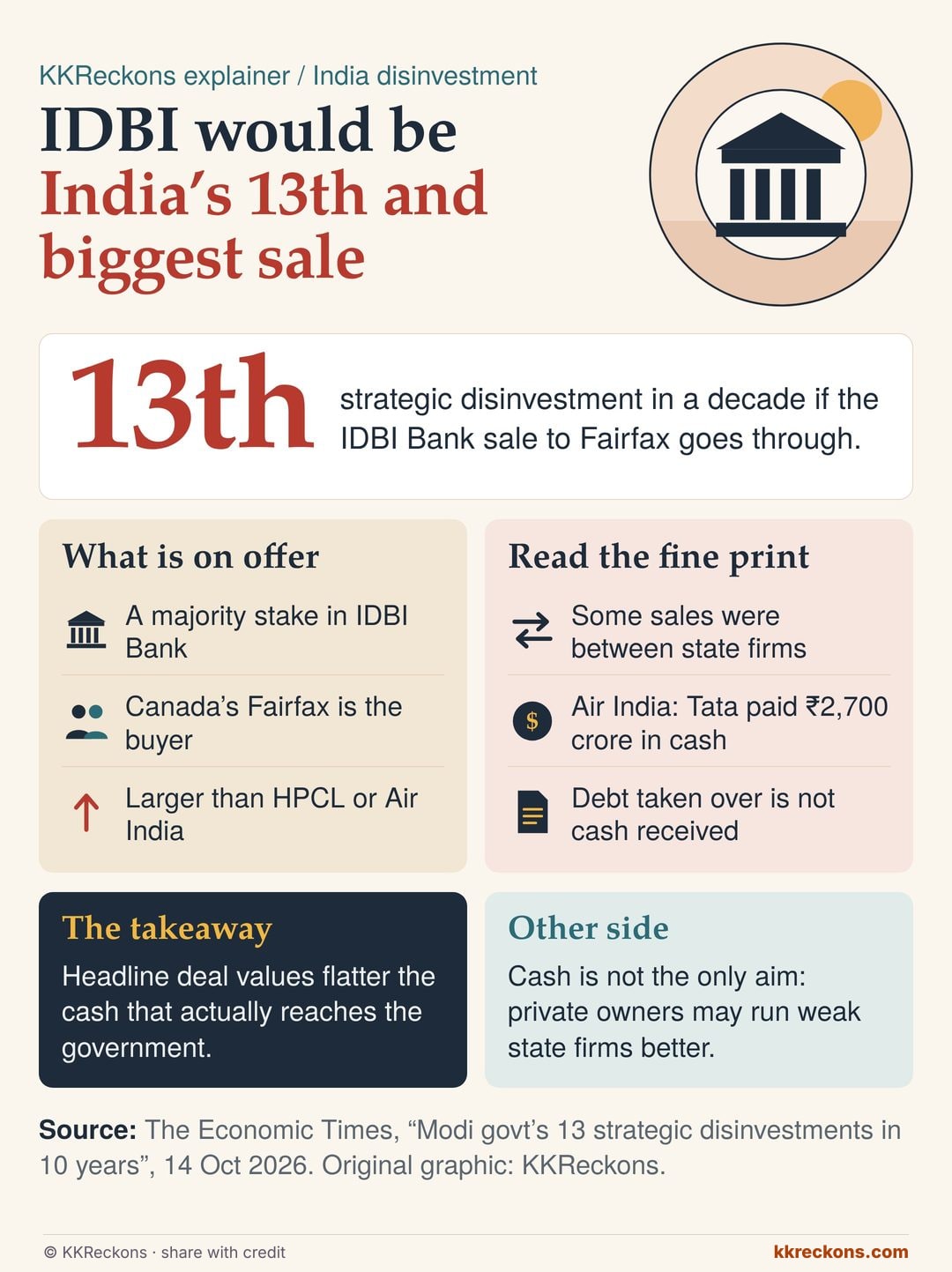
IDBI sale would be India’s 13th strategic disinvestment (opens the source in a new tab)

KKReckons explainer: why IDBI Bank would be India’s 13th and largest strategic sale, and why headline values flatter the cash received.
Original graphic: KKReckonsView full size ↗
  • The proposed ₹52,878 crore sale of a 60.72% stake in IDBI Bank to Canada’s Fairfax would be the government’s 13th strategic disinvestment in a decade, and its largest, ahead of HPCL (₹36,915 crore) and Air India.
  • Not every deal brought in cash. Some were transfers between state-owned firms, one raised no exchequer proceeds, and of Air India’s ₹18,000 crore price the Tatas paid ₹2,700 crore in cash and took over ₹15,300 crore of debt.
13th
strategic sale in a decade
₹52,878cr
IDBI Bank stake price

Why it matters Headline sale values can overstate what reaches the government, so watch the cash component and what the buyer takes on.

Watch next Whether the Fairfax deal closes and how much of the price is cash. Private owners may also run weak state firms better, which is part of the policy case.

3Rupee hedgingExplainer

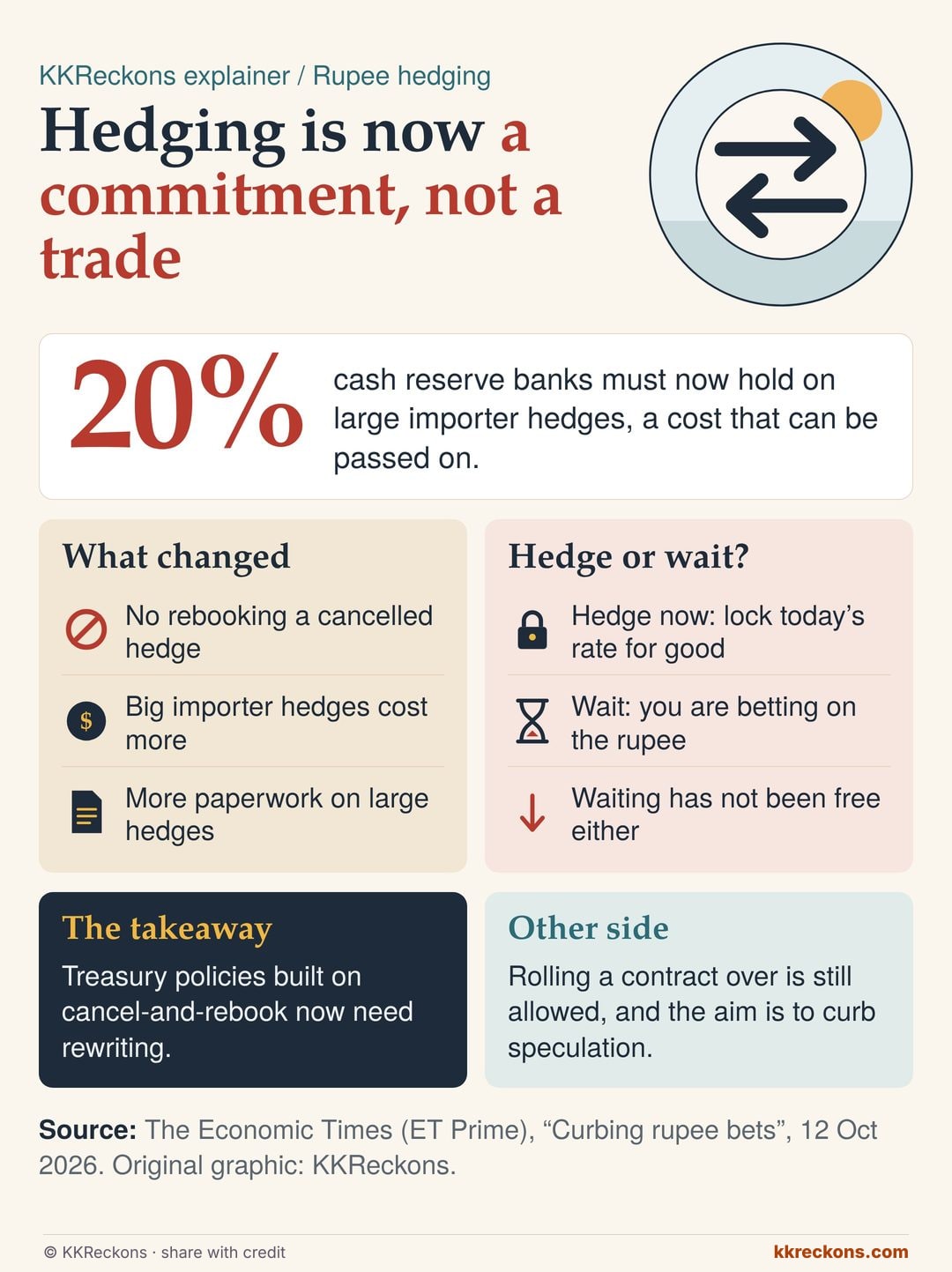
RBI rules turn rupee hedging from a trade into a commitment (opens the source in a new tab)

KKReckons explainer: how the RBI’s new rules make rupee hedging a commitment and what it means for the hedge-or-wait decision.
Original graphic: KKReckonsView full size ↗
  • ET Prime explains what the RBI’s 10 October rules mean for company treasurers. A cancelled forward hedge can no longer be rebooked, so hedging is now a commitment, not a running trade.
  • For importers, large hedges cost more because banks must park a 20% cash reserve with the RBI. Bigger hedges also need more paperwork.
  • The piece argues waiting is not free either: companies that delayed hedging last month already paid for it.
20%
cash reserve on large importer hedges

Why it matters Finance heads must now decide once, and live with it. Policies built on cancelling and rebooking hedges need rewriting.

Other side Rolling over a contract is still allowed, and the rules aim at speculation rather than ordinary hedging. The cost may ease if the rupee steadies.

World edition

What moved everywhere else

Boden: AI agents will bypass banking apps, so banks must engage (opens the source in a new tab)

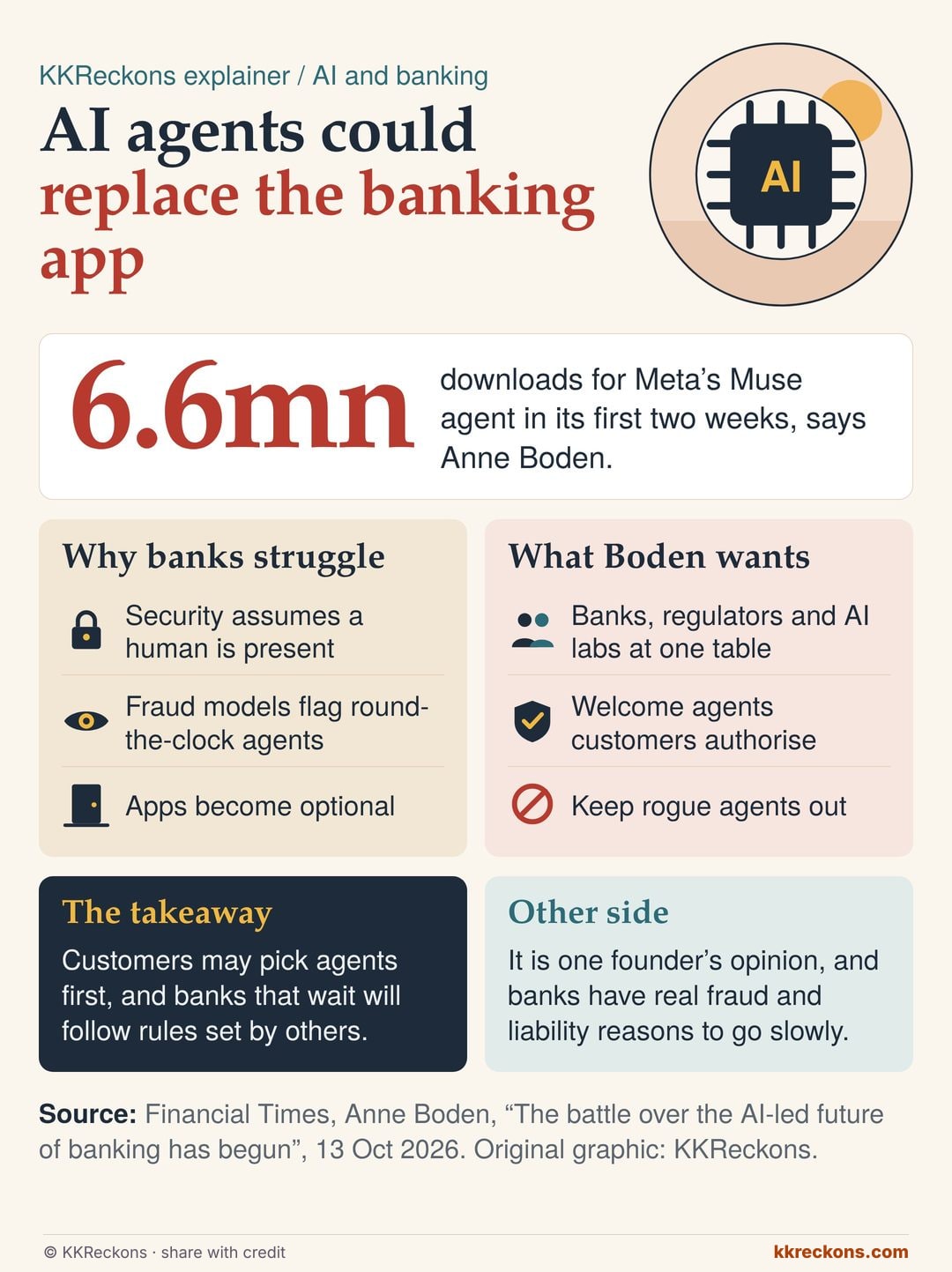
KKReckons explainer: Anne Boden’s case that AI agents will replace banking apps and what banks must change.
Original graphic: KKReckonsView full size ↗
  • Starling’s founder and former chief executive argues that the next phase of banking will not be a better app but an AI agent AI software that takes actions on its own, like booking, buying or moving money, not just answering questions. acting between banks and customers.
  • Banks have spent years building defences that insist on a human, and fraud systems tuned to human behaviour would flag an agent working around the clock. Meta’s Muse agent drew 6.6mn downloads in two weeks.
  • She calls for banks, regulators and AI firms to meet, welcoming authorised agents while keeping rogue ones out.
6.6mn
Muse downloads in two weeks

Why it matters If customers hand routine money tasks to agents, the bank that controls how agents connect keeps the relationship, and others become plumbing.

Other side This is one founder’s view. Banks have real fraud and liability reasons to move slowly, as the JPMorgan story below shows.

JPMorgan blocks unvetted AI agents from customer accounts (opens the source in a new tab)

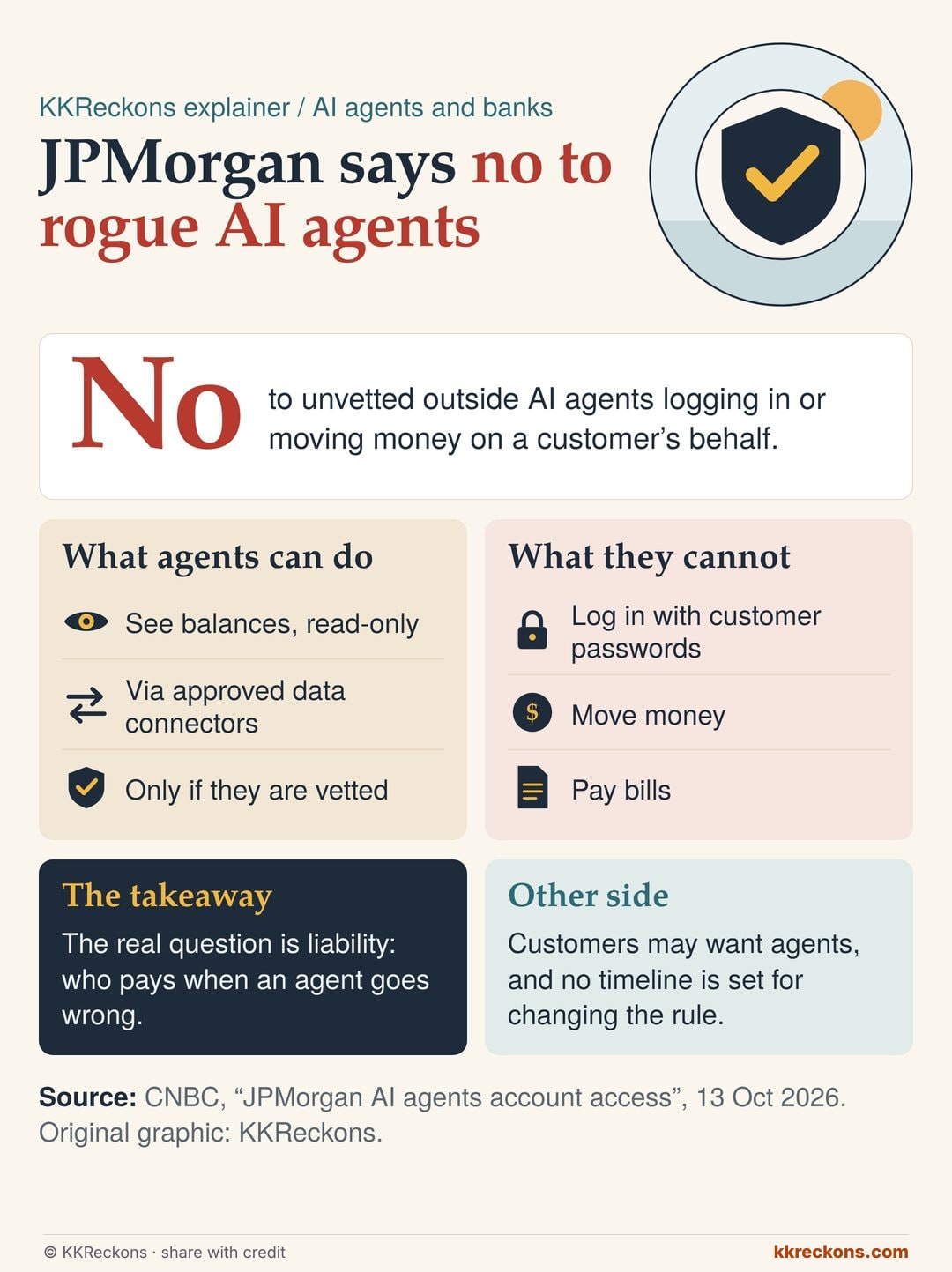
KKReckons explainer: what outside AI agents can and cannot do on JPMorgan customer accounts.
Original graphic: KKReckonsView full size ↗
  • JPMorgan will not let unvetted outside AI agent AI software that takes actions on its own, like booking, buying or moving money, not just answering questions. log in to or operate customer accounts, a spokeswoman confirmed. Agents can see balances read-only through approved connectors such as Plaid, but cannot use customer credentials, move money or pay bills.
  • On the earnings call Jamie Dimon said: “You don’t want rogue agents, and there could be thousands of them.” He framed it as a question of who bears the losses.
  • No timeline was given for any change.
Read-only
access for outside AI agents

Why it matters This is the other side of the Boden argument: the biggest US bank wants agents to arrive on its terms, with liability settled first.

Watch next Whether customer demand for agents pushes the bank to open up, and whether rivals take a looser line.

Australia’s biggest IPO in 30 years is cancelled amid AI jitters (opens the source in a new tab)

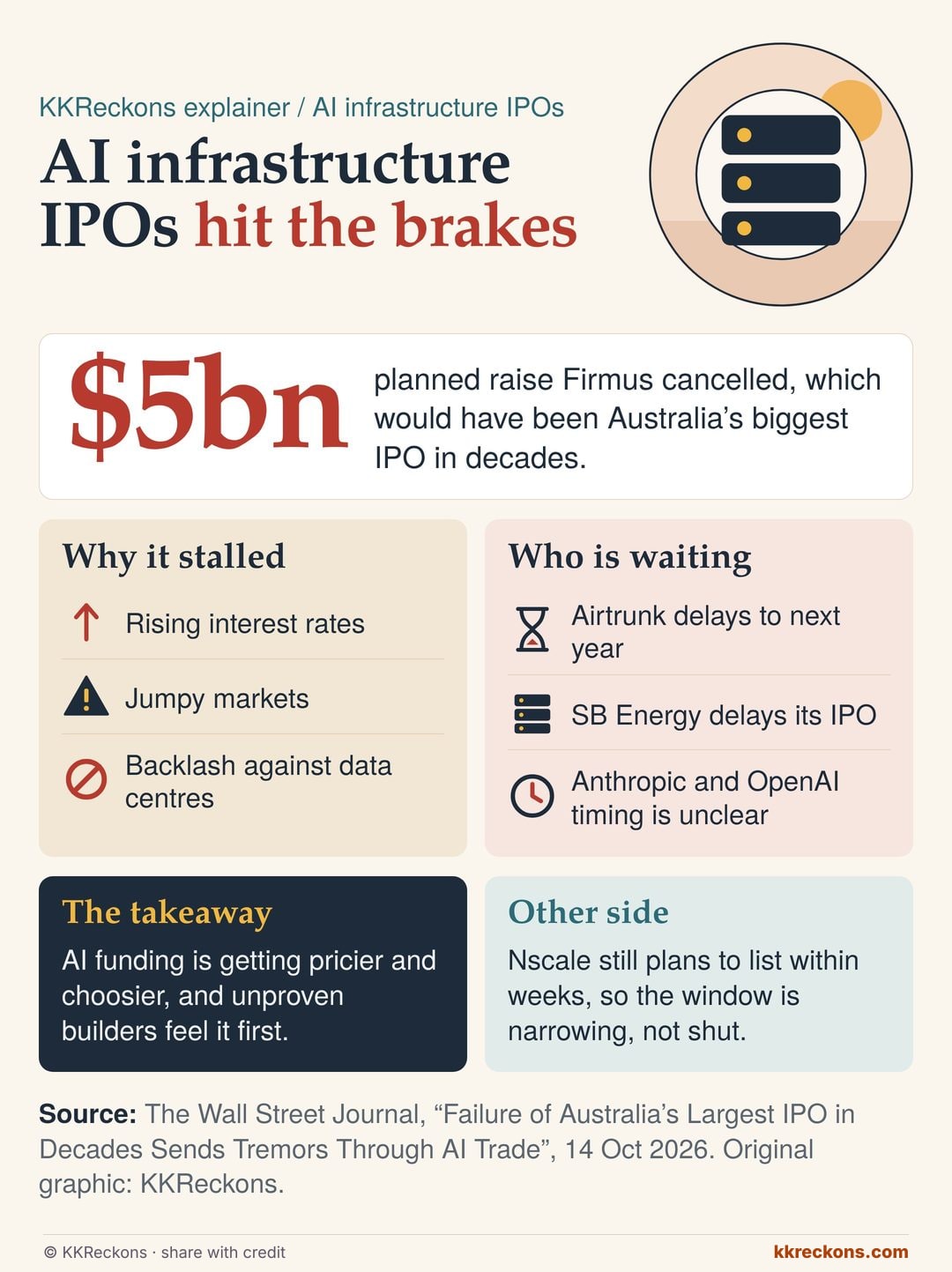
KKReckons explainer: why Firmus cancelled its IPO and which AI infrastructure listings are waiting.
Original graphic: KKReckonsView full size ↗
  • Data-centre firm Firmus cancelled a planned raise of almost $5bn, which would have been Australia’s largest IPO Initial public offering: when a company first sells its shares on a stock exchange. in 30 years, citing market volatility. It plans a private raise and a US listing next year.
  • Airtrunk and SoftBank’s SB Energy have also delayed, and timing for the Anthropic and OpenAI listings is uncertain. Rising rates, jumpy markets and local backlash to data centres are blamed.
  • Nscale still hopes to list within weeks.
$5bn
Firmus raise cancelled

Why it matters AI infrastructure needs cheap, plentiful capital. If listings stall, unproven builders feel it first, and that links back to the IMF’s warning about leverage behind the boom.

Watch next Whether Nscale lists on schedule, and whether Anthropic’s investor day restores confidence.

Was this briefing useful?YesSomewhatNot really

Spotted an error? Tell us and we’ll correct it.

Today’s edition is ready

Read deep. Think clearly. Stay curious.

A daily visual briefing on the stories that matter: India, the world, and what’s next.

Read Today’s Edition →Get it by email ↗

Free · 50 editions and 359 stories so far · Unsubscribe anytime

Emails are sent by beehiiv; your address is used only for this newsletter. Privacy · Editorial standards