John Thornhill: will AI's 'cognitive capitalism' spread wealth or concentrate it? (opens the source in a new tab)
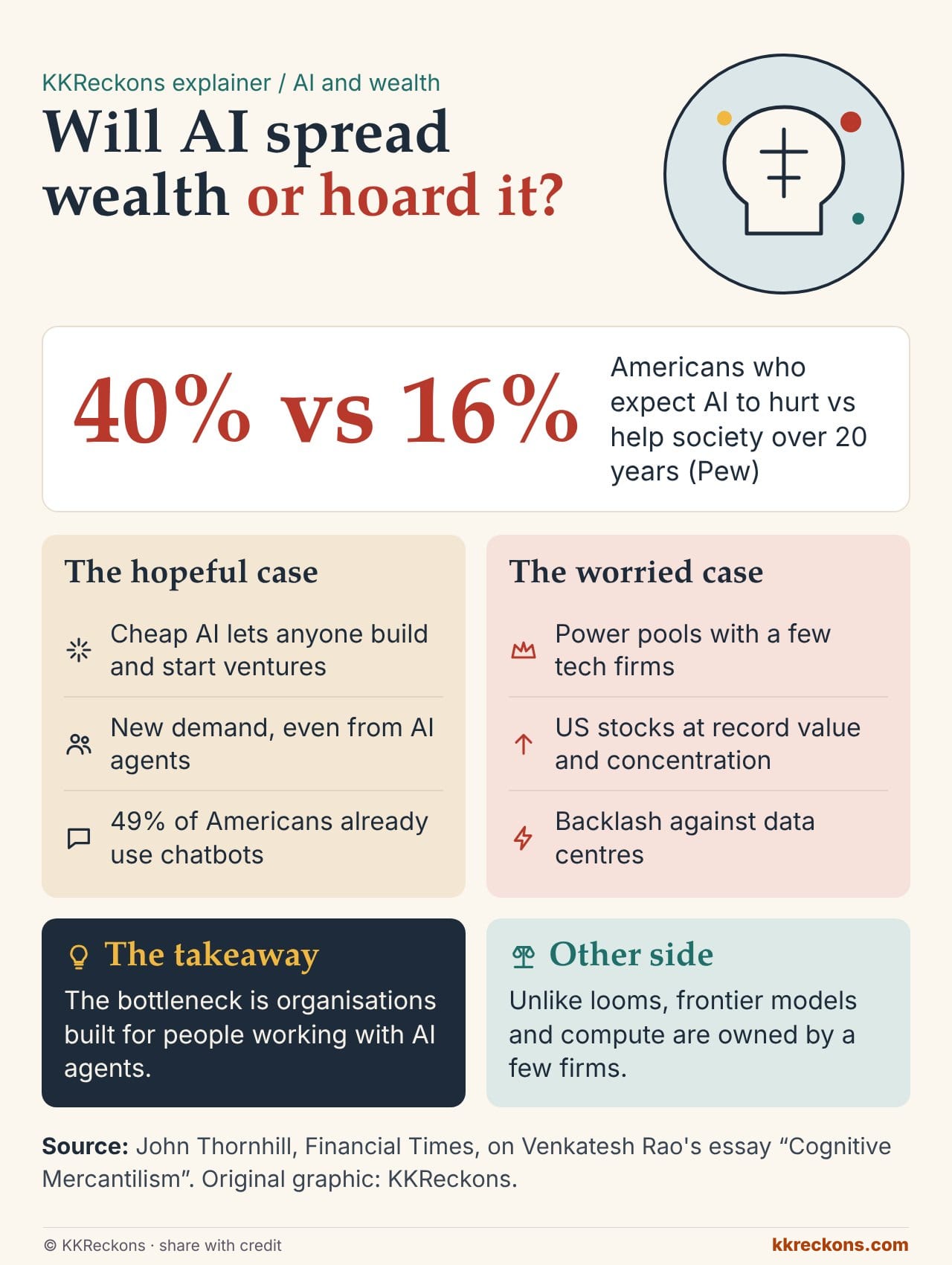
- Thornhill weighs Venkatesh Rao's argument that AI worriers are "cognitive mercantilists", treating intelligence as scarce and to be hoarded, as pre-industrial elites treated wealth.
- Rao's hope: cheap AI lets billions build and start microbusinesses, a new "industrious" revolution, with AI agent AI software that takes actions on its own, like booking, buying or moving money, not just answering questions. adding demand.
- The counter: AI is concentrating power, US stocks are at record value and concentration, and Pew finds 40% of Americans expect harm versus 16% benefit, though 49% use chatbots. DeepMind's Alex Imas says the missing piece is organisations built for humans and AI agents.
- 40% vs 16%
- Americans expecting AI harm vs benefit
- 49%
- Americans who use AI chatbots
Why it matters It lands on the same point as the HBR piece: the bottleneck is how people organise around AI, not the models. For individuals, the gains will go to those who use the tools to build things, not only to consume answers.
Other side The analogy may flatter AI. Unlike looms, frontier models and compute are owned by a handful of firms, so abundance for users can sit alongside tighter concentration for owners.