Why AI is not yet showing up in productivity data (opens the source in a new tab)
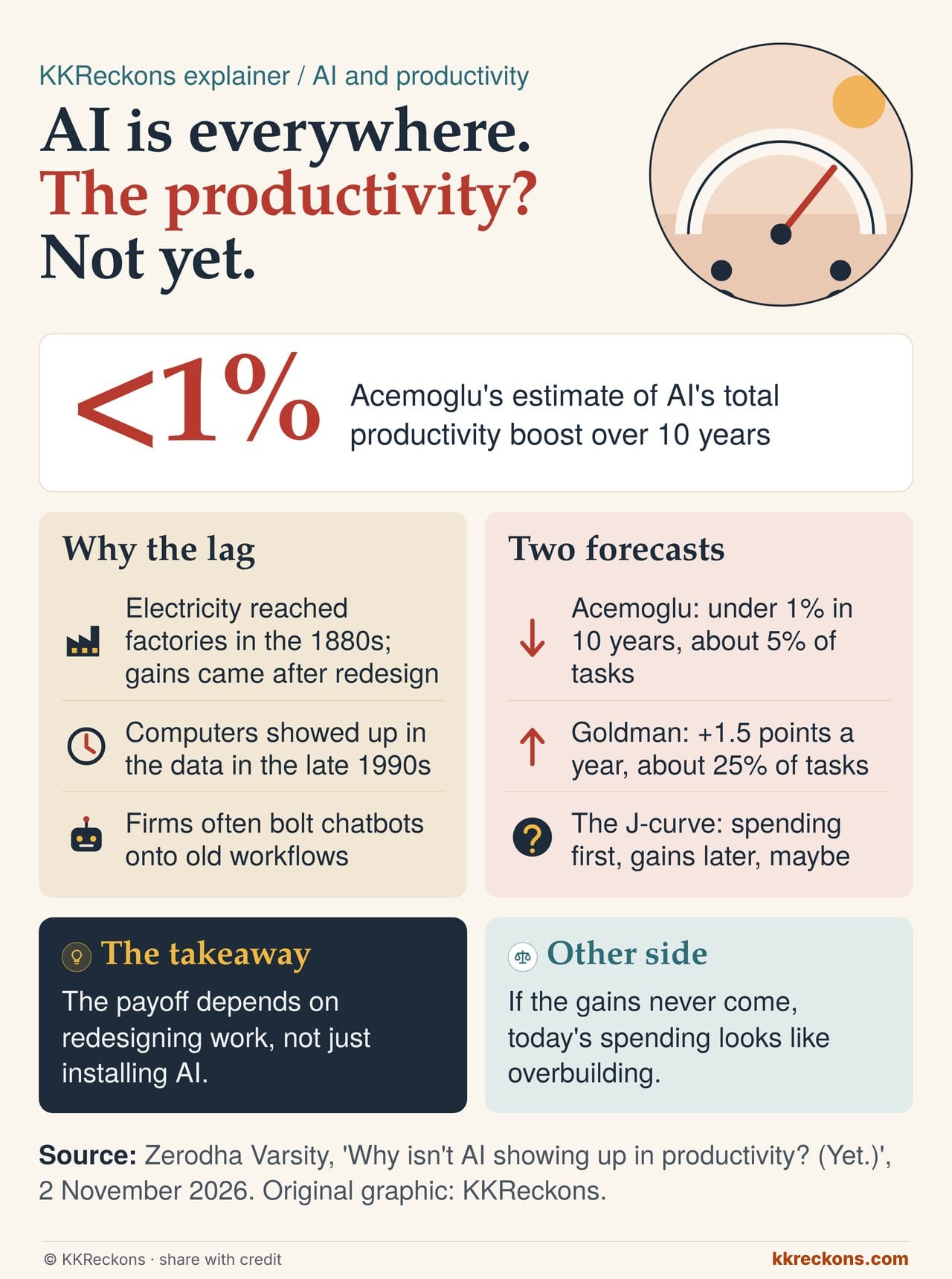
- Zerodha Varsity revisits Robert Solow's 1987 quip that computers were visible everywhere except the productivity statistics; US trend labour productivity growth had slid from 3.8% in 1948 to 1.2%.
- History shows a lag: factories gained from electricity only after redesigning around individual motors, lifting manufacturing productivity 5.3% a year in the 1920s. Computers paid off in the late 1990s.
- AI forecasts diverge: Daron Acemoglu sees under 1% over a decade, assuming about 5% of tasks shift to AI; Goldman Sachs sees about 1.5 points a year, assuming about 25%.
- <1%
- Acemoglu: boost over 10 years
- +1.5 pts
- Goldman: a year, once adopted
- 5.3%
- 1920s factory productivity
Why it matters Firms bolting chatbots onto old workflows may be repeating factory owners who swapped one steam engine for one big motor; the payoff depends on redesigning the work itself.
Other side The J-curve is a hypothesis, not a promise: if the gains never arrive, today's AI spending looks less like early investment and more like overbuilding.