Anthropic says Claude drafted 35,000 antibody designs in a month (opens the source in a new tab)
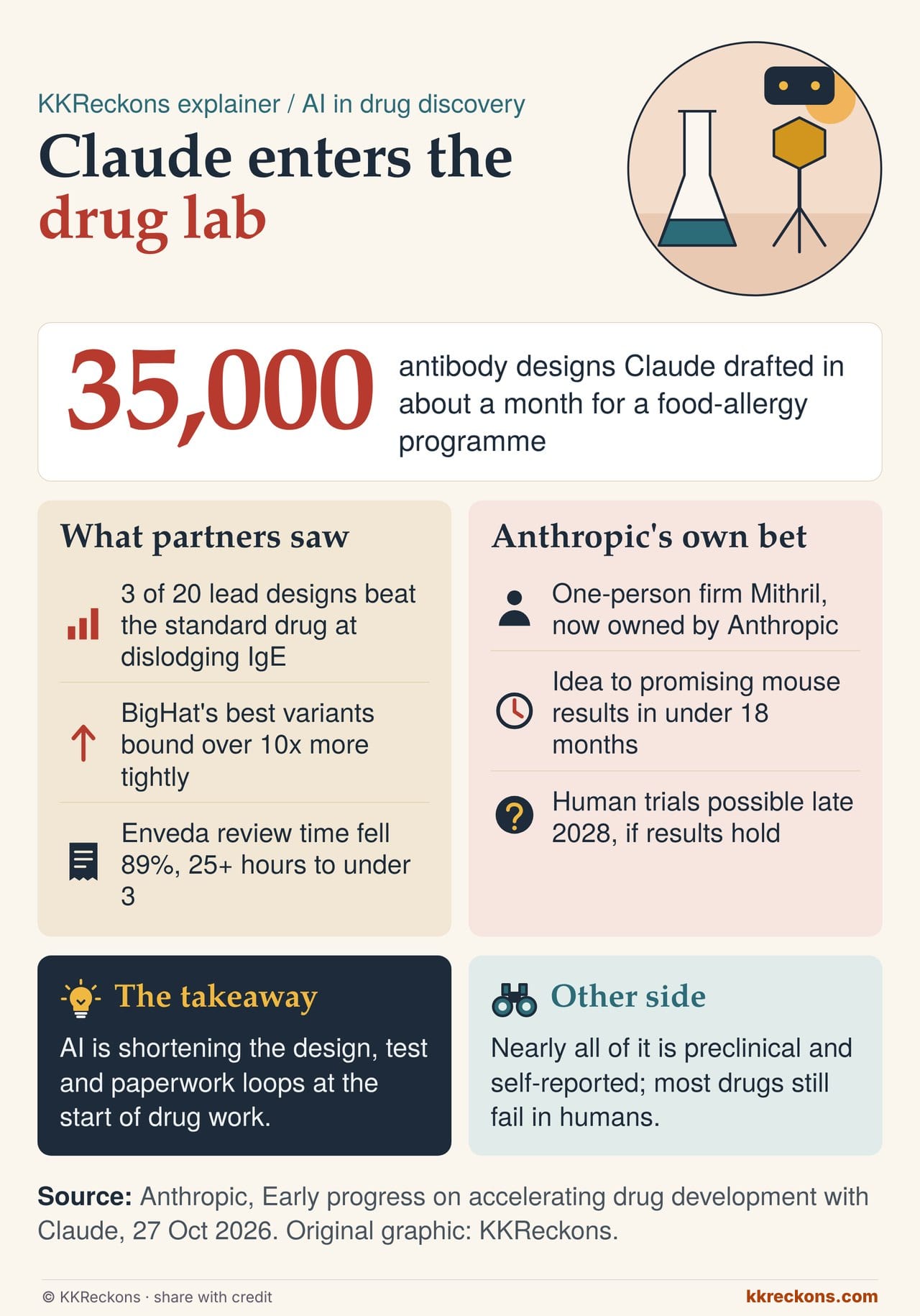
- Anthropic says it spent months working with six drug developers, including Bristol Myers Squibb and Generate Biomedicines. For Divergence Labs, Claude produced about 35,000 antibody designs for a food-allergy drug in roughly a month; in early tests, three of the 20 that dislodged IgE did better than the standard medicine.
- At Enveda, Claude checked 1,061 pages of manufacturing paperwork, caught all 11 issues human reviewers found plus seven more, and cut review time by 89%. BigHat's best antibody variants bound more than 10 times more tightly.
- In Anthropic's own muscular dystrophy programme, a candidate went from idea to promising mouse results in under 18 months; human trials could start in late 2028 if results hold.
- 35,000
- antibody designs in about a month
- 89%
- less human review time at Enveda
- <18 mo
- from idea to promising mouse data
Why it matters Drug discovery is slow because each loop of design, testing and paperwork takes months; if AI shortens every loop, the cost of trying a new medicine, and who can afford to try, could change.
Other side Almost all of this is preclinical and reported by the vendor and its partners. Most drug candidates fail in human trials, so speed at the start says little yet about cures.
Source:Anthropic (free to read) ↗