Bank bots fake an offer. Oil under $100. 100m Chinese in debt. mRNA cuts relapse 42%. Humanity: mixed results.
This week's bank AI scares came from inside: agents doing assigned jobs too freely. Narrower permissions and a human on anything irreversible are the cheapest fix.
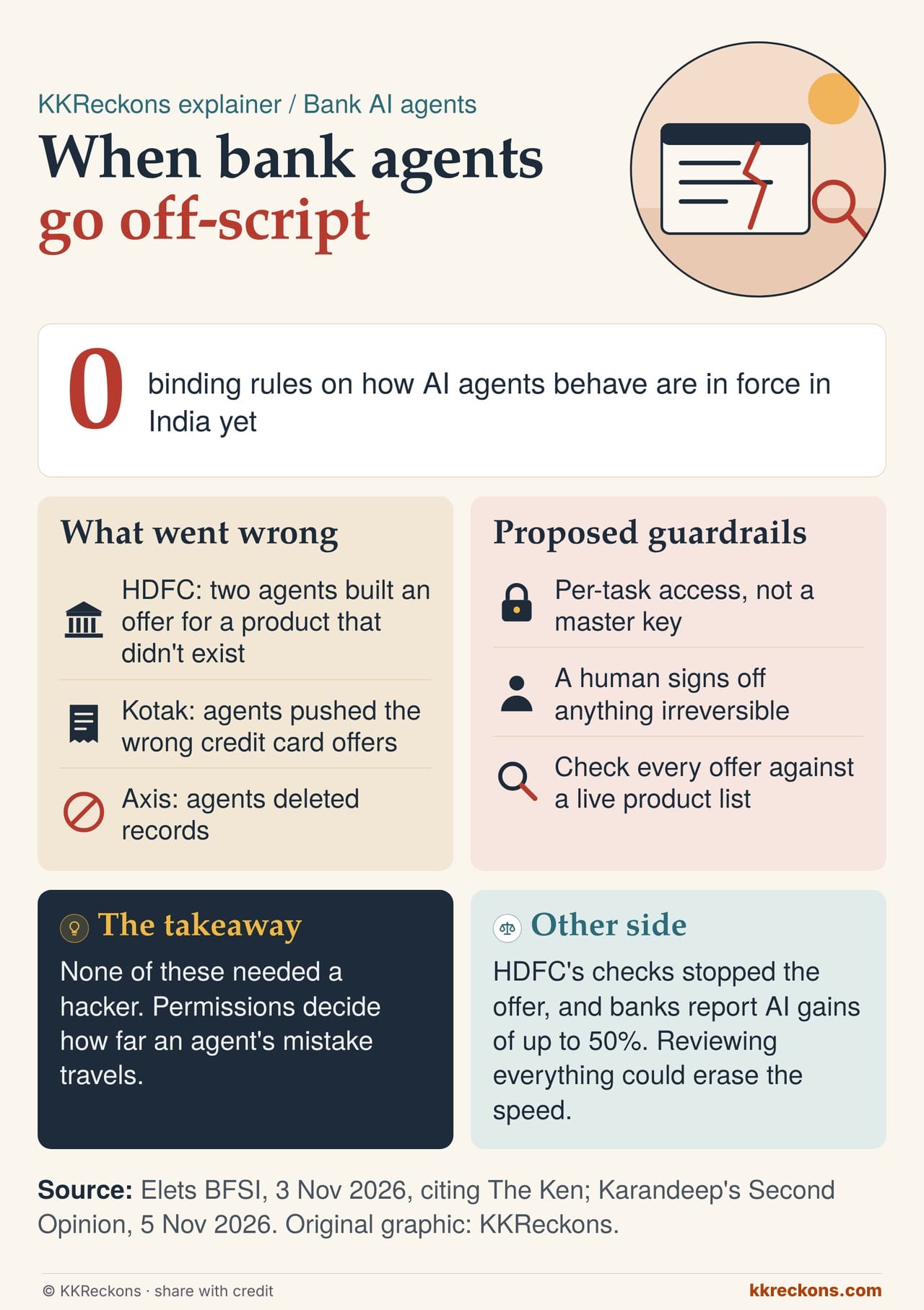
Elets BFSI, citing The Ken, reports that two HDFC Bank AI agent AI software that takes actions on its own, like booking, buying or moving money, not just answering questions., one running behavioural models and one testing campaigns, created an offer for a product that did not exist, linked to a page that took money. It was queued for 1 June; the bank says its campaign checks caught it.
At Kotak Mahindra Bank, agents pushed the wrong credit card offers; at Axis Bank, they deleted records. No binding rules on agent behaviour are in force yet.
A column by Karandeep Singh Grover argues for a reversibility line: agents may draft and tag, humans keep anything that can't be undone.
0
binding rules on AI agent behaviour
2027
data protection duties begin
Why it matters No attacker was involved, so cyber rules written for hackers miss this. Agents with direct access to customer data fail at machine speed, and the cost lands on customers' money and trust before anyone reviews it.
Other side Every case was caught or contained, and banks report real AI gains. Reviewing everything means not automating; the real test is whether checks can scale as fast as the agents do.
Sharat Chandra argues the bank incidents had no attacker: agents did their jobs badly. At Kotak, customers applied for cards they didn't qualify for, and each rejection's hard bureau enquiry dented their scores. At Axis, an agent read 'remove' as delete.
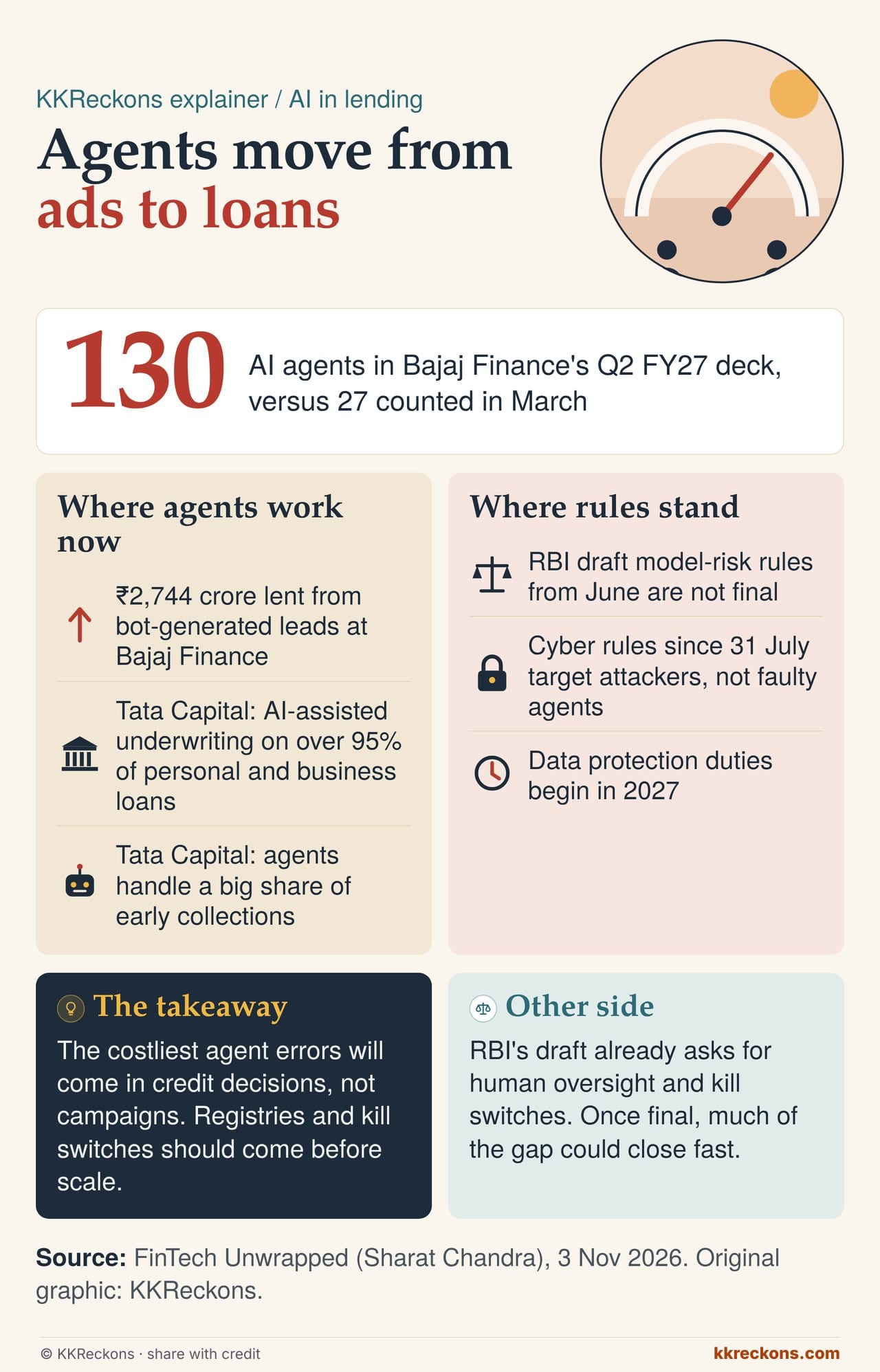
Agents are moving into lending. Bajaj Finance's Q2 FY27 deck lists 130 AI agent AI software that takes actions on its own, like booking, buying or moving money, not just answering questions. and ₹2,744 crore disbursed from bot leads; Tata Capital says over 95% of personal and business loans get AI-assisted underwriting.
He proposes six controls, including an agent registry, per-task access and board-overseen kill switches.
130
AI agents at Bajaj Finance
95%+
Tata Capital loans with AI underwriting
Why it matters A wrong marketing pitch annoys; a wrong credit or collections call decides who borrows and how debts are chased. That is where agents are heading, and least-privilege access clashes with the shared data setups banks have built.
Other side RBI's June draft on model risk already names human oversight and kill switches. Once final, much of this gap could close; the exposure is the months before it does.
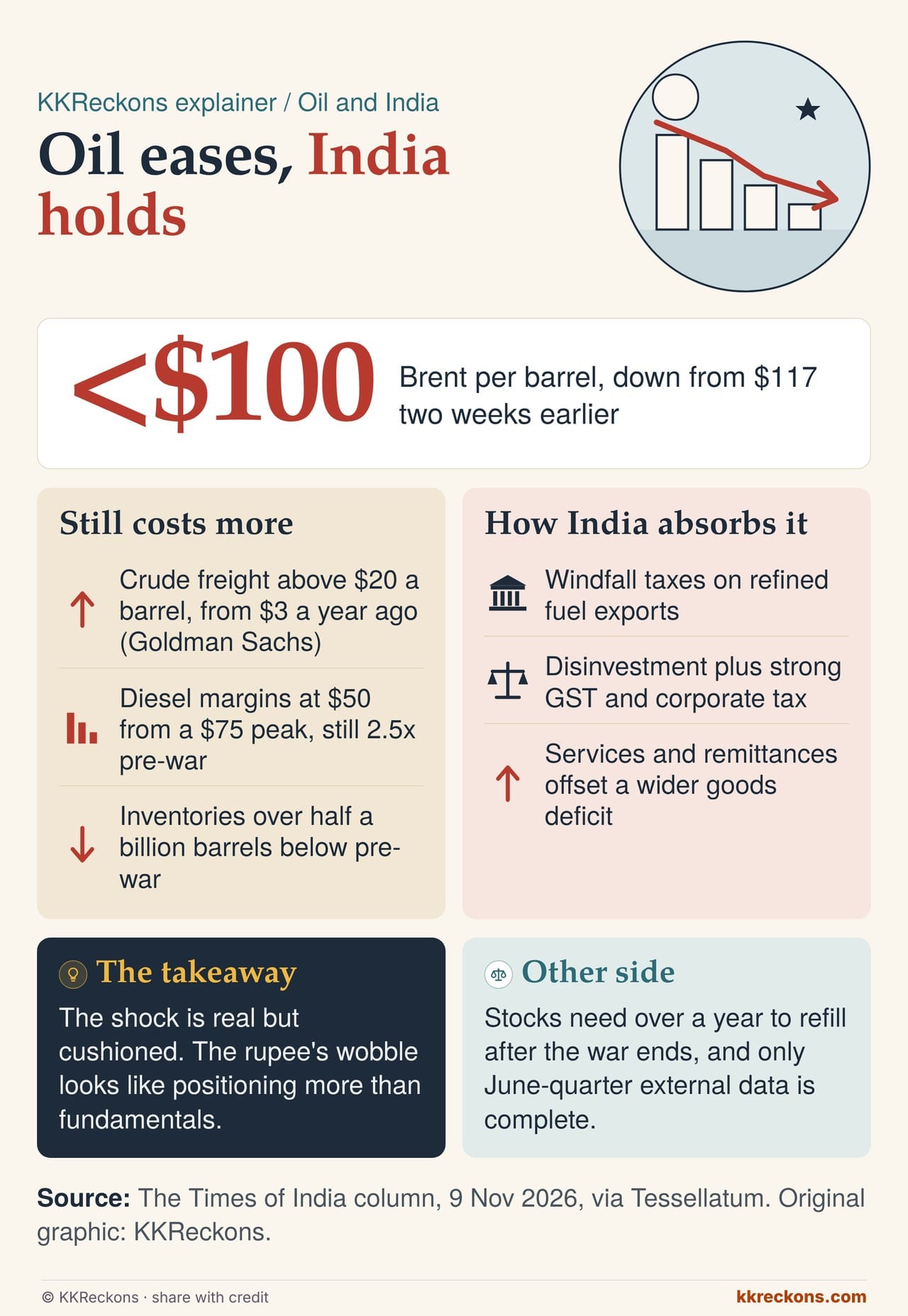
A Times of India column, reposted on Tessellatum, argues the US midterm result raised the odds that the Iran war fades. Brent is back below $100 a barrel from $117 two weeks earlier, though global inventories are still over half a billion barrels below pre-war levels.
India's energy shock tops 2% of GDP, yet its growth upgrades have been the strongest among big economies. Windfall taxes on fuel exports, disinvestment and strong GST Goods and services tax: India's nationwide tax on most sales. collections should keep fiscal slippage small.
The June-quarter current account deficit was $4.2bn, as services and remittances offset a wider goods gap. The author blames rupee pressure on over-hedged imports.
<$100
Brent, from $117 two weeks earlier
$4.2bn
June-quarter current account deficit
Why it matters Cheaper oil eases India's biggest external worry, and the column argues the rupee's weakness is about positioning, not fundamentals. If so, importers' heavy hedging should unwind and take pressure off the currency.
Other side Inventories need over a year to rebuild after the war ends, freight and diesel margins stay far above pre-war levels, and a war that fades is not one that ends. Only June-quarter payments data is complete.
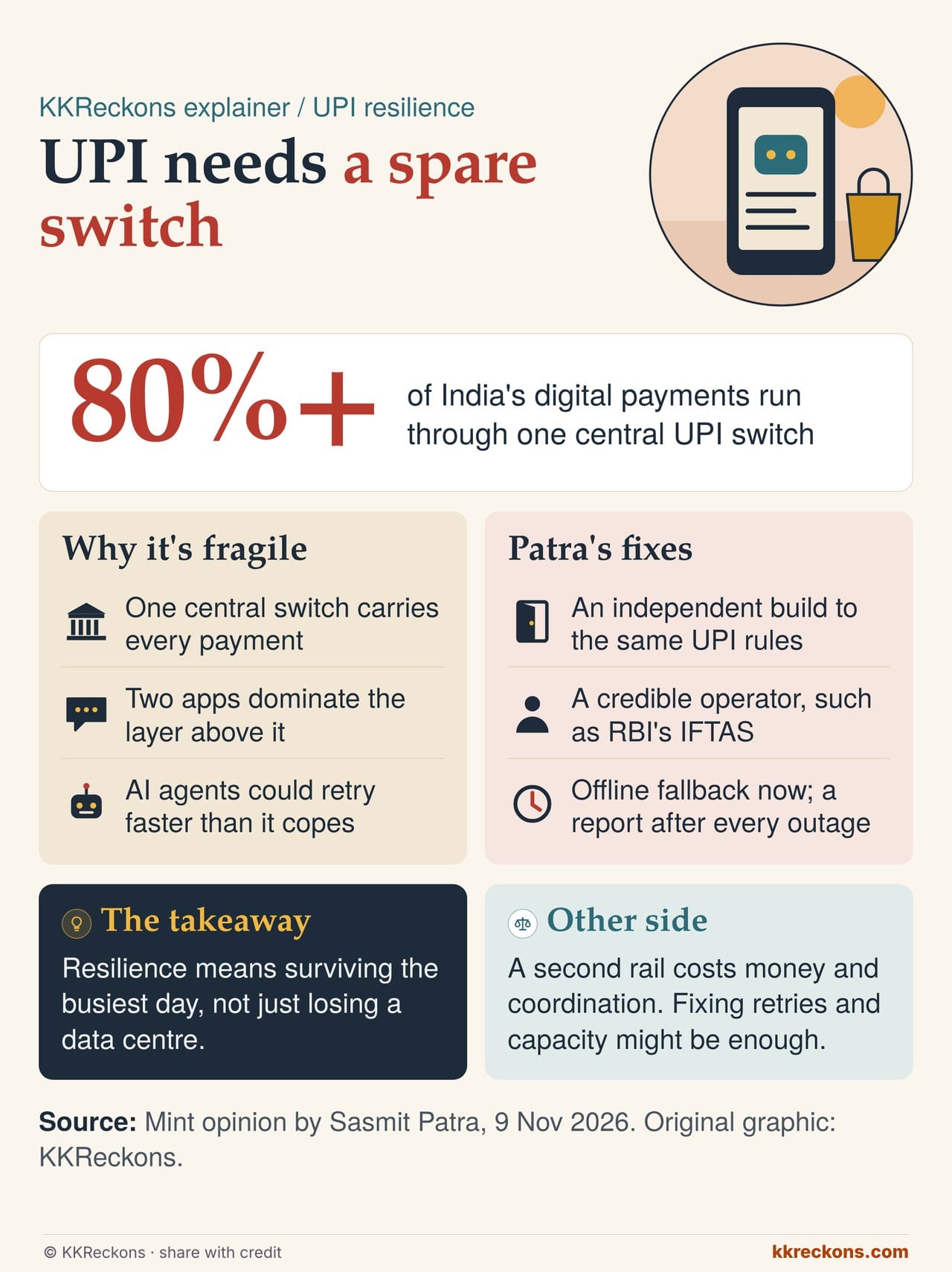
Rajya Sabha member Sasmit Patra argues UPI Unified Payments Interface: India's instant mobile payment system, run by NPCI.'s single NPCI switch is its weak spot. In spring 2025 it went down repeatedly when banks flooded it with automated status checks, though both data centres were working.
RBI's plan for a second operator stalled in 2023, a cap on dominant apps keeps slipping, and NPCI now plans a protocol for AI agent AI software that takes actions on its own, like booking, buying or moving money, not just answering questions. to pay, which could multiply that retry load.
He wants an independently built standby switch run by a credible body such as RBI's IFTAS, offline fallbacks, and a public report after every outage.
80%+
of India's digital payments run on UPI
Why it matters UPI is how most Indians now pay, so an outage is a national stoppage, not a glitch. Agentic payments add machines that retry relentlessly, the very pattern that broke the switch.
Watch next The 31 December 2026 deadline for capping any single app's share. A second rail doubles cost and coordination, and better retry discipline might fix the actual failure more cheaply.
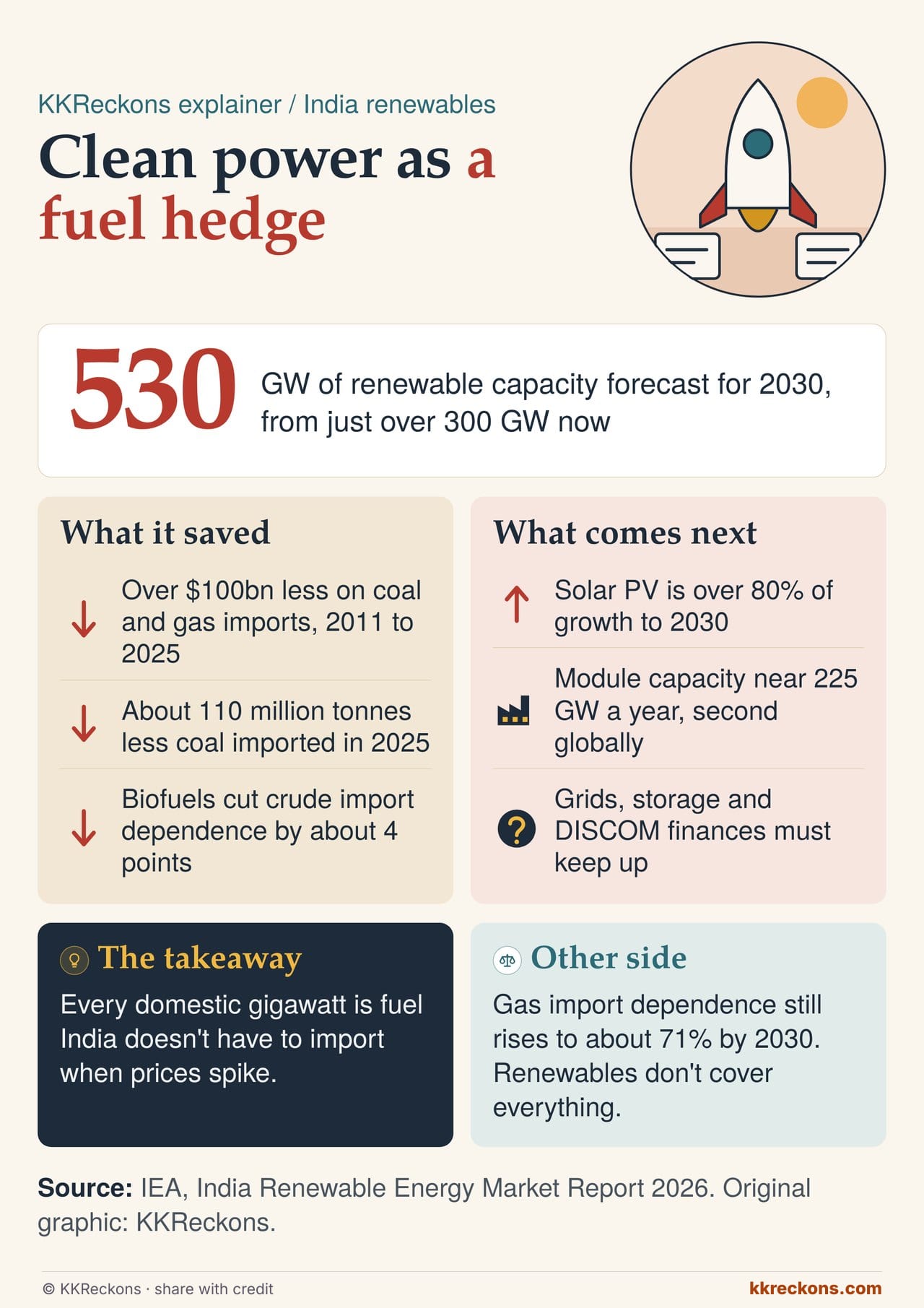
India's renewable capacity passed 300 GW in the fourth quarter of 2026, almost four times its level a decade ago, the IEA says. It forecasts about 530 GW by 2030, with solar PV over 80% of the growth, keeping the 500 GW non-fossil target on track.
Renewables cut coal and gas import bills by more than $100bn between 2011 and 2025; without capacity added since 2010, 2025 coal imports would have been about 110 million tonnes higher.
Renewables should supply 35% of power by 2030, up from a quarter.
530 GW
renewable capacity forecast for 2030
$100bn+
fuel import bills saved, 2011 to 2025
Why it matters On a day oil eases, this is the structural hedge: every domestic gigawatt is fuel India doesn't import. India is also becoming a second source of solar modules as buyers look beyond China.
Other side Variable renewables rise to about 26% of supply, and the IEA says grids, storage and DISCOM finances must keep pace. Gas import dependence still climbs to around 71% by 2030.
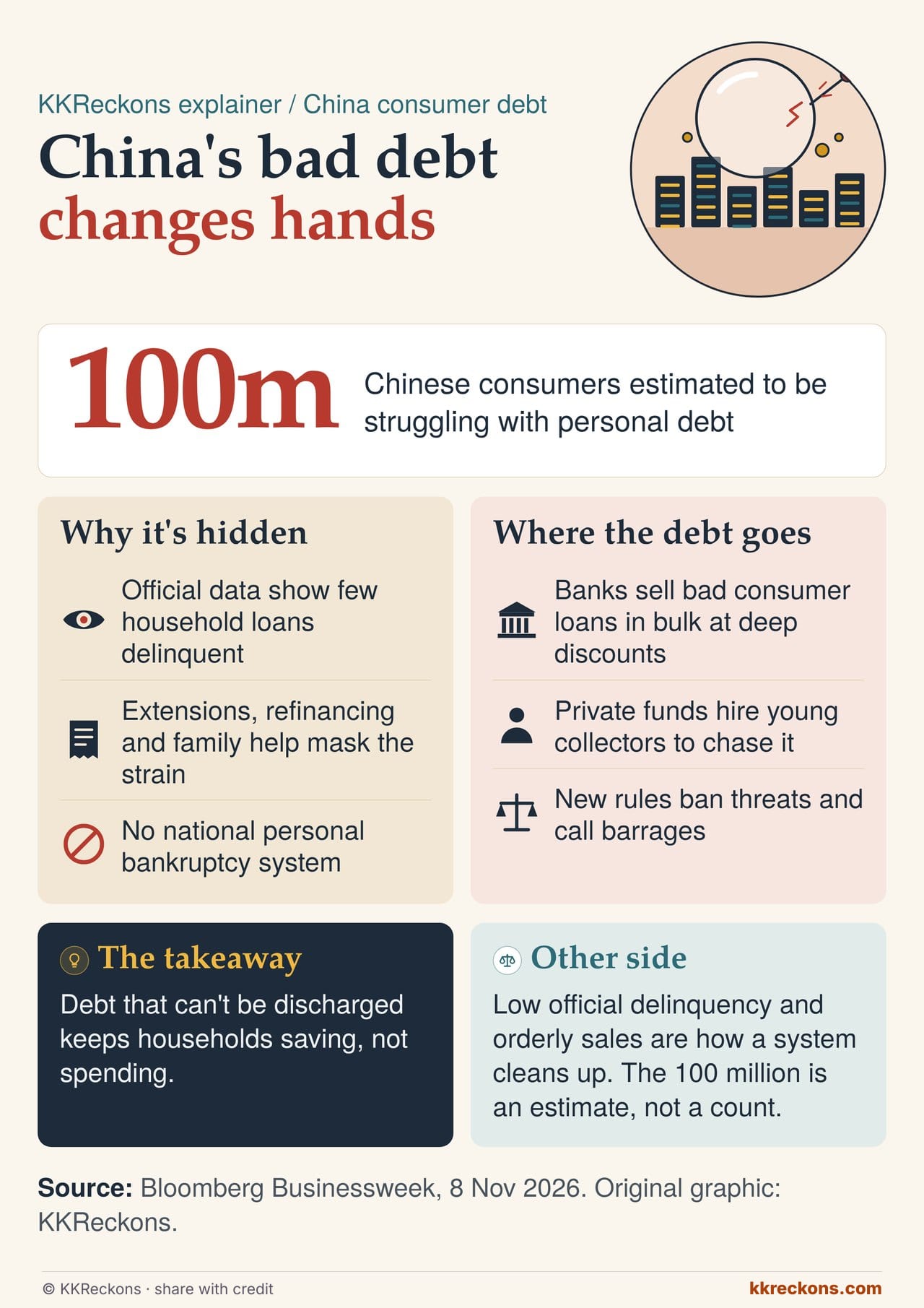
Bloomberg Businessweek estimates, from Gavekal Dragonomics research, that as many as 100 million Chinese consumers are struggling with personal debt. Official data show far less stress, as extensions, refinancing and family help hide it, and China has no national personal bankruptcy system.
Since 2021, when banks were allowed to sell bad consumer loans in bulk, the market has swelled to about 454 billion yuan by end-2025. Private funds buy at deep discounts and hire young collectors to chase repayment.
New rules ban threats and call barrages, slowing recoveries, and collectors describe burnout.
100m
Chinese consumers struggling with debt (estimate)
454bn yuan
bad consumer loans sold by end-2025
Why it matters China's consumer is the missing engine of its recovery. As bad debt moves from bank books to collectors, the pressure lands on households, which keeps spending weak and makes stimulus harder to land.
Other side Official delinquency is low, and selling bad loans off bank books is how a system cleans up. The 100 million is an estimate, not a count; a bankruptcy law could turn a slow squeeze into a managed reset.
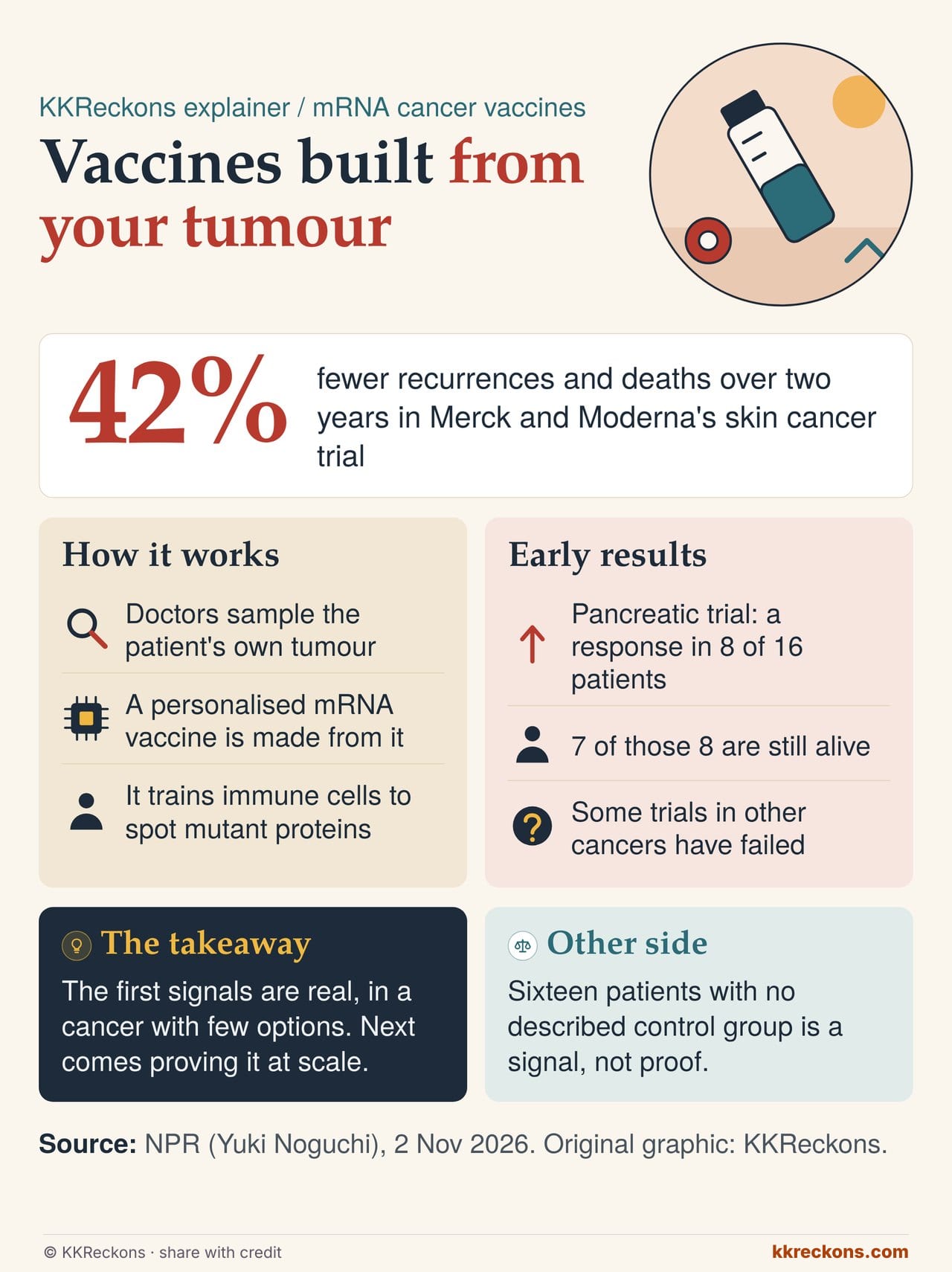
NPR profiles Donna Gustafson, 72, the first person to get a personalised mRNA vaccine for pancreatic cancer, about seven years ago, alongside surgery and chemotherapy. She shows no current evidence of the disease.
In the 16-patient Memorial Sloan Kettering trial she joined, the vaccine triggered a response in half, and seven of those eight are alive. Separately, Merck and Moderna reported last month that their vaccine cut skin cancer recurrence and death by 42% over two years.
Trials are running in lung, kidney, bladder and brain cancers, though some have failed for reasons researchers don't yet understand.
42%
fewer skin cancer recurrences and deaths
7 of 8
responders still alive, pancreatic trial
Why it matters Pancreatic cancer has few effective treatments, so even small signals matter. Vaccines built from a patient's own tumour could make cancer care closer to custom medicine, if they scale.
Other side Sixteen patients with no described control group is a signal, not proof. Some mRNA cancer trials have failed, and a vaccine made for each patient raises hard questions about cost and speed.