Craig Tindale: India is rich in dollars but short of key materials (opens the source in a new tab)
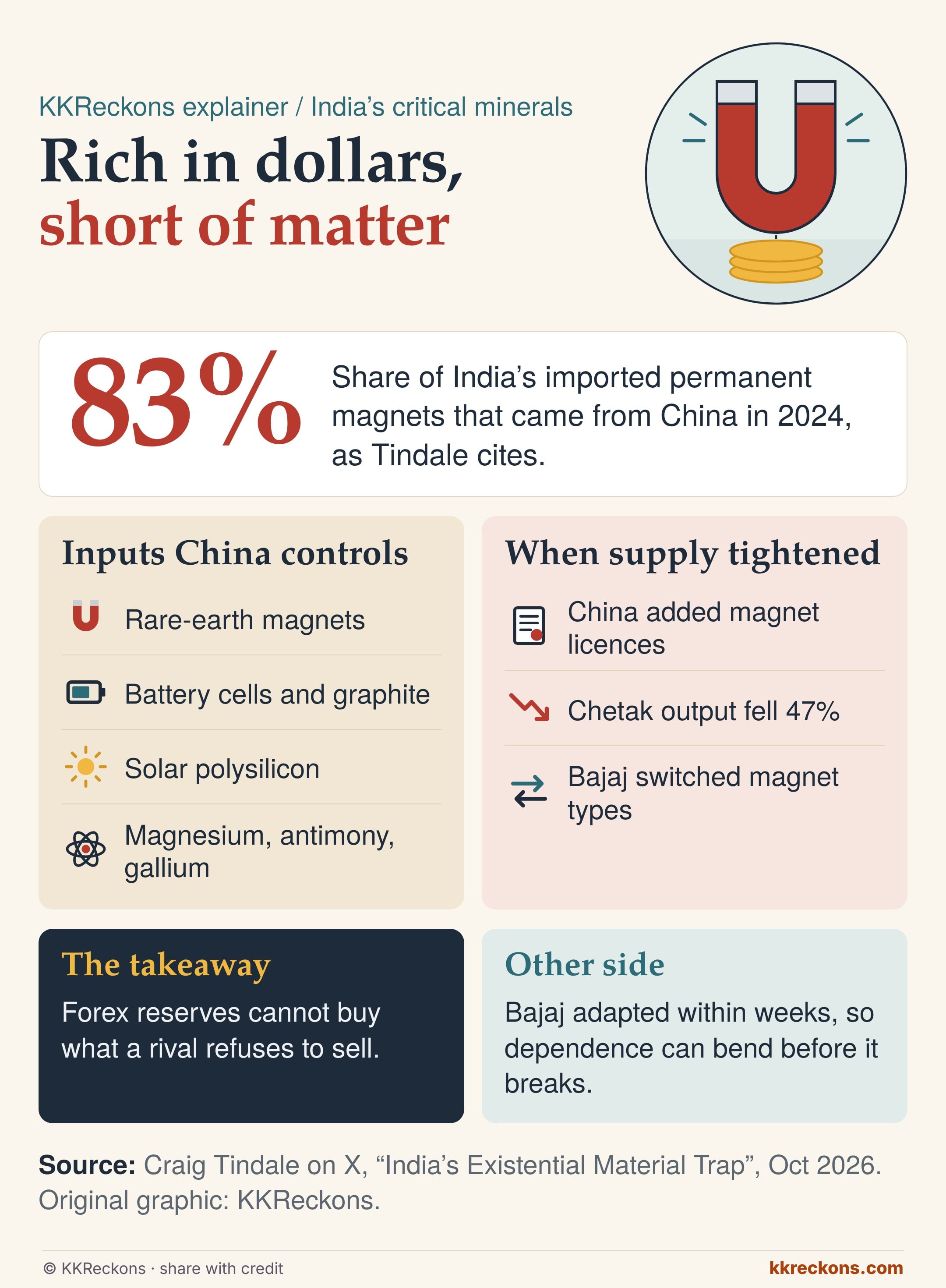
- Tindale argues that seven inputs behind India’s factory push, from rare-earth magnets and battery cells to graphite, solar polysilicon, magnesium, antimony and gallium, all lead back to China through ore, ownership or licences.
- His evidence: after Beijing put export licences on rare-earth magnets in April 2025, Bajaj built 47% fewer Chetak e-scooters that July than a year earlier. China supplied about 83% of India’s imported permanent magnets in 2024.
- India holds $734.6bn in forex reserves but no published stockpile of these minerals, he notes, and China’s pause on wider export controls ends on 10 November.
- $734.6bn
- India’s forex reserves
- 83%
- of imported magnets from China
Why it matters It reframes self-reliance: a country can be rich in reserves and still sit one licence delay away from idle factory lines.
Other side The Bajaj episode also shows adaptation: within weeks it switched to a different type of magnet and found fresh supply, so dependence may bend before it breaks.
Source:X (free to read) ↗