Supreme Court: Yes Bank’s ₹8,415 crore AT-1 write-down stays quashed (opens the source in a new tab)
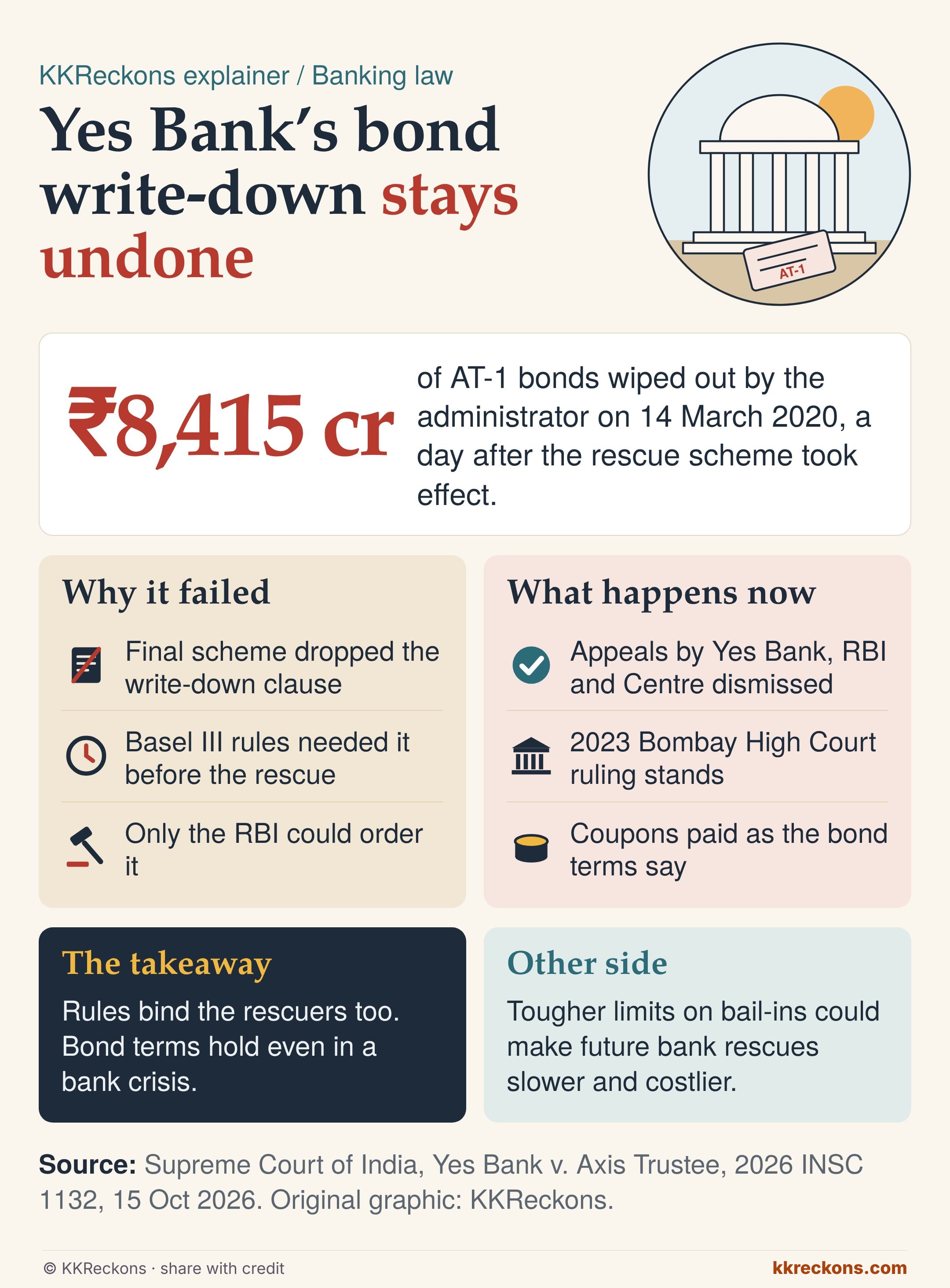
- The Supreme Court dismissed appeals by Yes Bank, the RBI and the Centre, upholding the Bombay High Court’s 2023 ruling that the administrator’s 14 March 2020 write-down of ₹8,415 crore of AT-1 bonds was invalid.
- The final rescue scheme had deliberately dropped the write-down clause, the court held, and the RBI’s Basel III rules required any write-down before the reconstruction took effect, ordered by the RBI, not an administrator.
- It called the handling by the RBI, the administrator and Yes Bank questionable, noted the bank sold these high-risk bonds to individuals, and said coupons must be paid as the bond terms require.
- ₹8,415 cr
- AT-1 bonds written down in 2020
- 0.6%
- Yes Bank’s CET1 ratio, Dec 2019
Why it matters Rules beat rescue convenience. Foreign money now buying into Indian lenders, such as Fairfax at IDBI and CSB, gets a clear signal: bond terms and the RBI’s own rulebook will be enforced, even against the regulator.
Other side Bail-ins exist so taxpayers don’t pay for bank failures. If write-downs are this easy to overturn, will the next rescue be slower and costlier, and will AT-1 buyers price in that protection as a free option?