Would you pay for the best baby? Embryo screening and liberal eugenics (opens the source in a new tab)
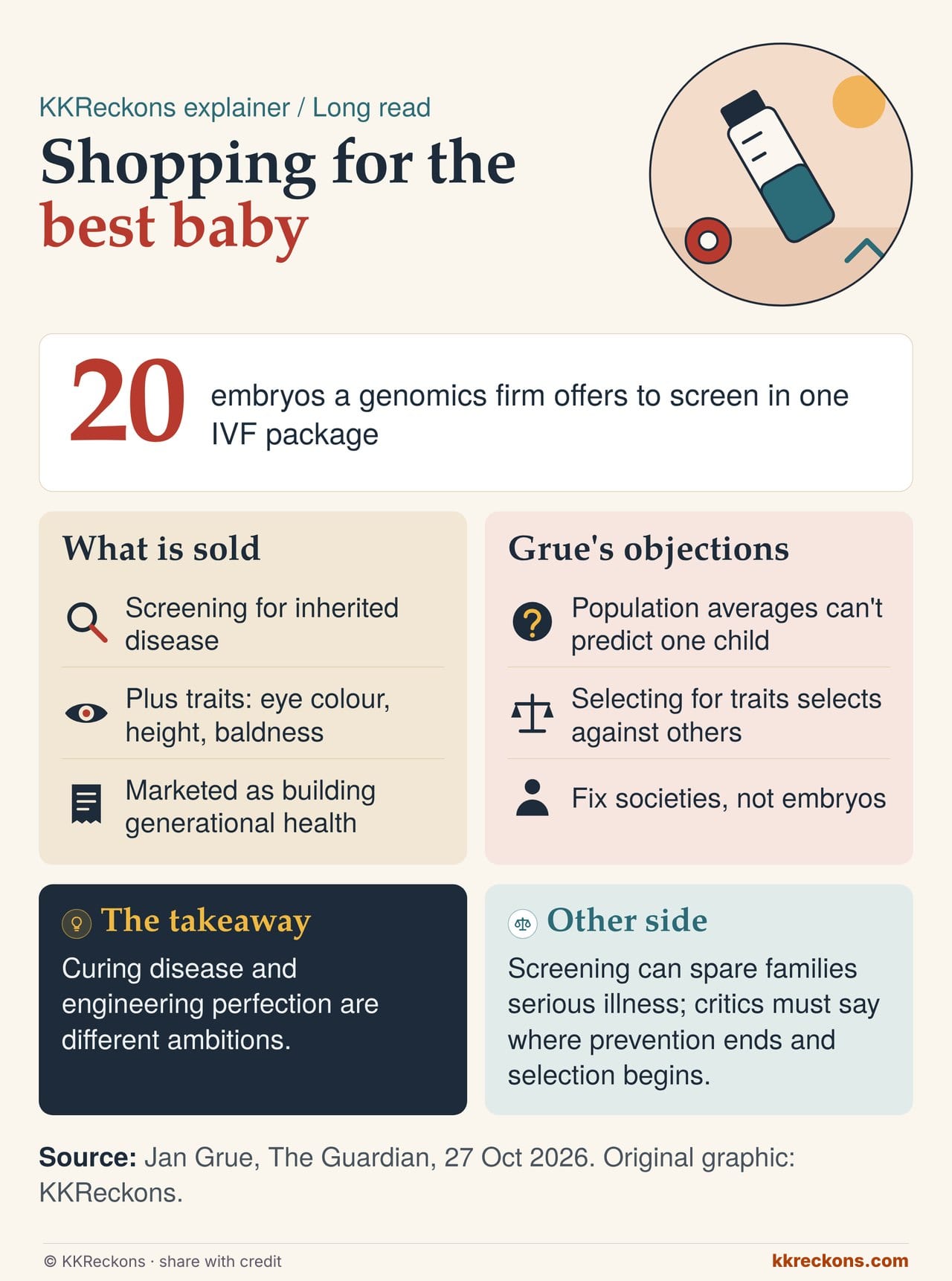
- Jan Grue, a writer misdiagnosed as a child with spinal muscular atrophy, starts from Nucleus Genomics' New York subway ads promising parents their best baby. Its IVF package screens up to 20 embryos for diseases and for traits from eye colour and height to insomnia and baldness.
- He argues that population-level heritability figures, like those on the posters, cannot tell parents how tall or clever one child will be. He calls consumer-led selection liberal eugenics: the old project of improving people, rebranded as individual choice.
- Grue does not oppose cures. His case is for changing societies to fit varied bodies, rather than optimising embryos to fit a narrow ideal of the productive, never-sick worker.
Why it matters We have spent decades optimising businesses, portfolios and productivity; embryo screening extends that logic to children. But a person is not a portfolio, and there is no agreed benchmark for a good life. Curing disease and engineering perfection are different ambitions.
Other side Screening can spare families serious inherited illness, and parents already buy schools, tutors and diets to give children an edge. If the science improves, critics will need to say where preventing suffering ends and unacceptable selection begins, and who should draw that line.