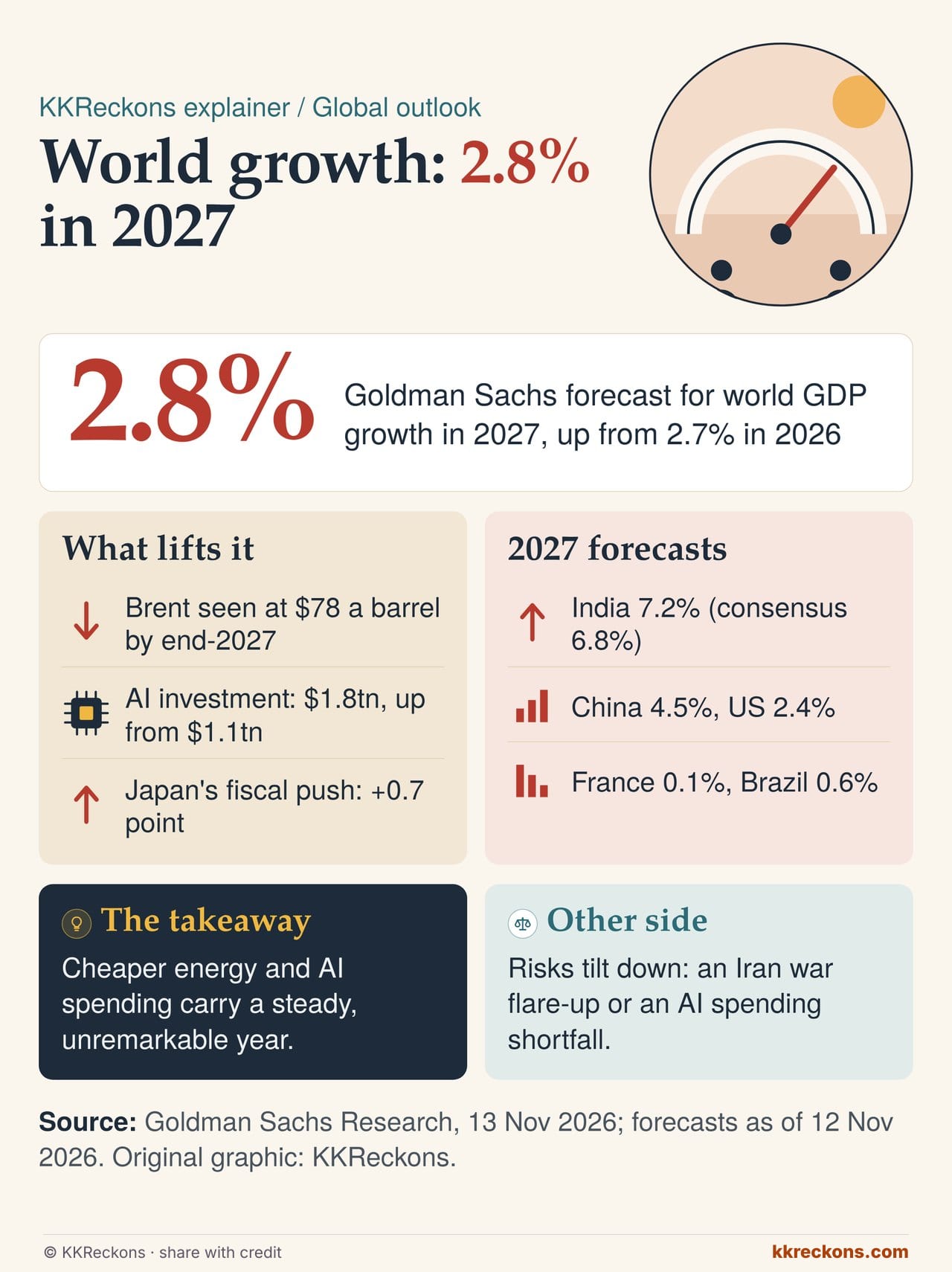
Goldman Sachs Research expects world GDP to grow 2.8% in 2027, a notch above 2.7% this year and in line with consensus. Chief economist Jan Hatzius calls it solid but unremarkable.
Energy flips from drag to mild tailwind, with Brent seen at $78 a barrel by end-2027. AI investment is forecast to reach $1.8 trillion, up from $1.1 trillion, adding about 0.4 point to global growth.
India tops its table at 7.2% for 2027, against a 6.8% consensus. China is seen at 4.5%, the US at 2.4%, while France (0.1%) and Brazil (0.6%) trail.
2.8%
World growth, 2027
$78
Brent, end-2027
7.2%
India growth, 2027
Why it matters If cheap oil and the AI boom both hold, inflation cools: Goldman sees US core PCE easing to 2.4% by end-2027. But it still expects the Fed to hike in December and March before cutting, so relief on borrowing costs comes late. For India, cheaper crude is direct help.
Other side Goldman itself says risks tilt to the downside: a flare-up in the Iran war could push energy prices up again, and AI spending could fall short. A forecast a year out is one bank's view, and the page notes it was prepared by Goldman's executive office rather than its research division.
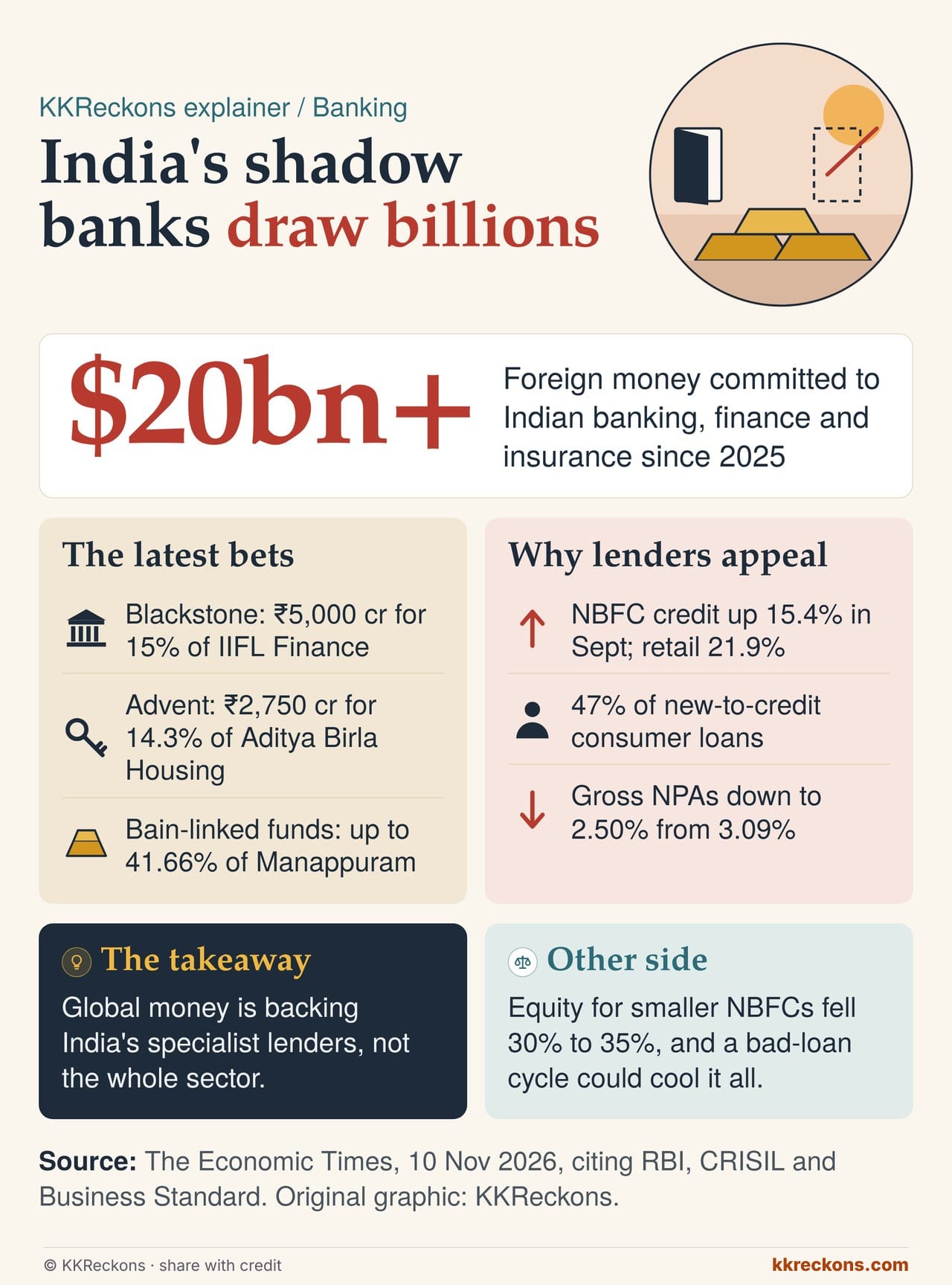
Blackstone is in talks to put about ₹5,000 crore into IIFL Finance for a 15% stake, the latest in a run of global bets on India's non-bank lenders: Carlyle in Nido Home Finance, Advent in Aditya Birla Housing Finance and Bain-linked funds in Manappuram.
Foreign investors have committed over $20 billion to Indian banking, finance and insurance since 2025, ET reports, citing Business Standard. RBI data show NBFC Non-bank finance company: a lender that isn't a bank, such as Bajaj Finance, regulated more lightly by the RBI. credit grew 15.4% in September, retail loans 21.9%.
The money is choosy: CRISIL says equity funding for smaller NBFCs fell 30% to 35% in 2025, as investors back big, secured lenders.
$20bn+
Foreign money into BFSI since 2025
15.4%
NBFC credit growth, Sept
2.50%
NBFC gross NPAs, June
Why it matters Foreign capital lets lenders that reach first-time borrowers, gold-loan customers and small businesses grow faster and borrow more cheaply. NBFCs already make 47% of new-to-credit consumer loans, so this money shapes who gets credit in India.
Other side Plentiful capital can push lenders to chase growth. A fresh bad-loan cycle in unsecured retail, microfinance or small-business lending, rich valuations or slow approvals could cool appetite, and the boom is already bypassing smaller NBFCs.
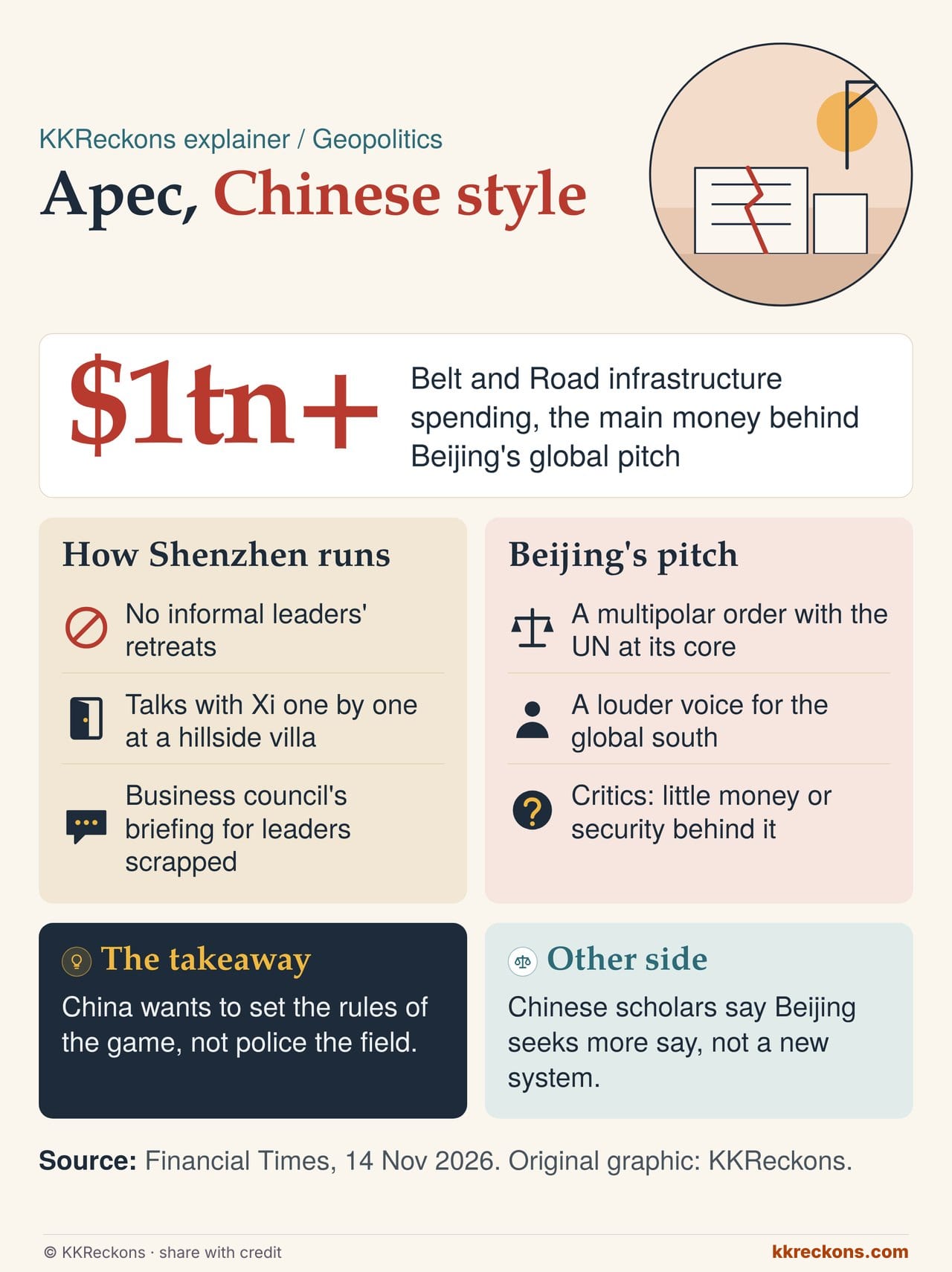
China hosts this week's Apec summit in Shenzhen, its first since 2014, and the FT says the programme has been cut back: no informal retreats, and leaders travel to meet Xi Jinping one by one at a state guesthouse.
Beijing pitches Xi's global governance initiative as a fairer, multipolar order with the UN at its centre and more say for the global south. Western analysts see a bid to hollow out the system's liberal core.
Critics note China puts little money or security behind the vision, beyond Belt and Road infrastructure spending of over $1tn.
2014
China's last Apec
$1tn+
Belt and Road spending
Why it matters How Beijing runs Apec is a preview of how it would run the room. For India, a rival inside Brics and part of the global south China claims to speak for, a China-centred order is a direct concern.
Other side Chinese scholars argue Beijing does not want to overturn a system it has gained from, only to have more say in it. And parts of the global south may prefer a louder voice in a China-led order to the old one, flaws and all.
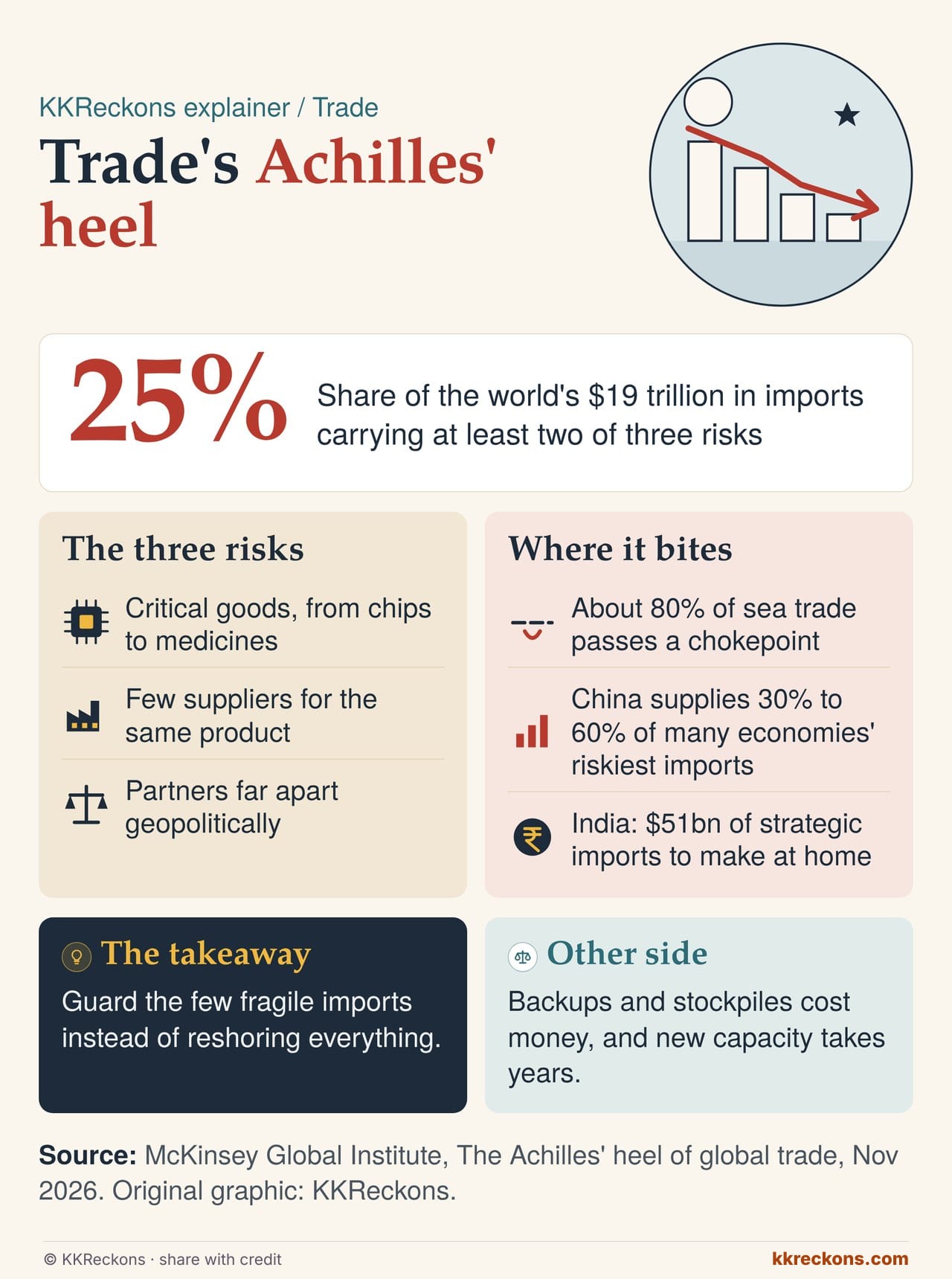
About 25% of the world's $19 trillion in imports is highly exposed, the McKinsey Global Institute finds: these goods carry at least two of three risks, being critical, coming from few suppliers, or from geopolitically distant partners.
Around 80% of seaborne trade passes a chokepoint. China supplies 30% to 60% of many economies' most exposed imports, but dependence runs both ways: Australia sends over half of China's iron ore imports.
India's product exposure is below the global average, yet its energy leans on Gulf routes, and it has flagged about $51 billion of strategic imports to build at home.
25%
Imports at high risk
80%
Sea trade via chokepoints
$51bn
India's make-at-home list
Why it matters Supply shocks now come from both what you buy and the route it takes. Knowing which few imports are truly fragile lets governments and companies protect those, rather than paying to reshore everything. India's $51 billion list is a map of where new factories may follow.
Other side Resilience is not free: backup suppliers, stockpiles and home production raise costs, and the report itself says ramping up output can take years. Push too hard and fragmented trade could cost more than the shocks it guards against.
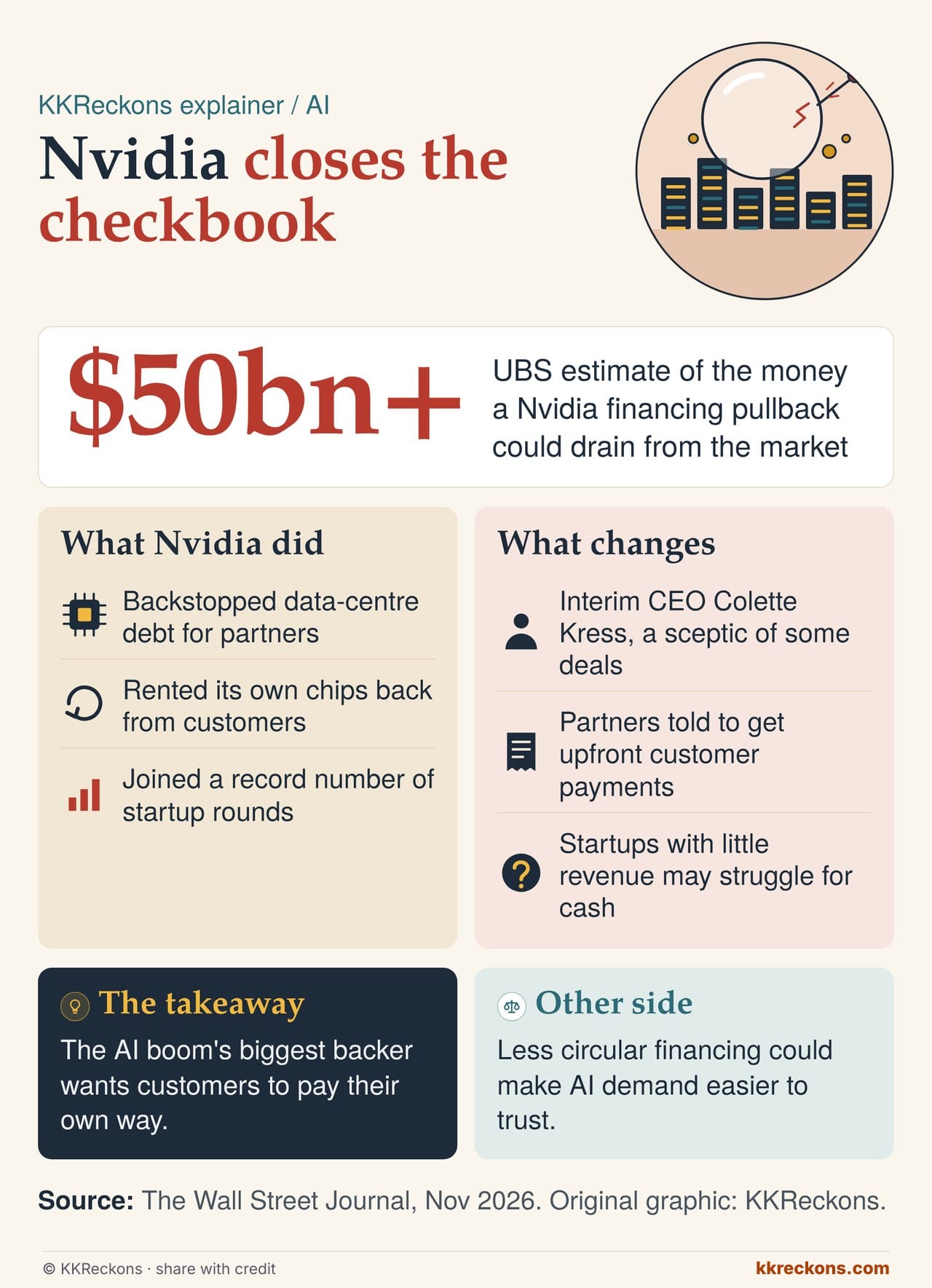
Nvidia's days of bankrolling the AI economy look numbered, the WSJ reports. Interim CEO Colette Kress, the finance chief who had pushed back on some big deals, is expected to pull back further after Jensen Huang resigned over revelations about his personal conduct.
Huang had already told cloud partners last month to secure upfront customer payments if they wanted GPU Graphics processing unit: the chip, mostly from Nvidia, that trains and runs AI models.. Over the past year Nvidia backed data-centre debt, rented its own chips from customers and joined a record 129 venture deals.
A UBS analyst estimates a pullback could drain $50 billion or more from the market, just as interest rates rise.
$50bn+
UBS estimate of possible pullback
129
Nvidia VC deals this year
Why it matters Much of the AI build-out has leaned on Nvidia acting as investor, guarantor and even customer for its own chips. If that support shrinks, cash-hungry startups and cloud firms with little revenue must find money elsewhere, a real test of how much AI demand stands on its own.
Other side A pullback could be healthy: a supplier financing its own customers is circular, and upfront payments tie spending to real demand. Several big deals, such as Perplexity's, have already closed, and rivals like Google and AMD offer similar support.
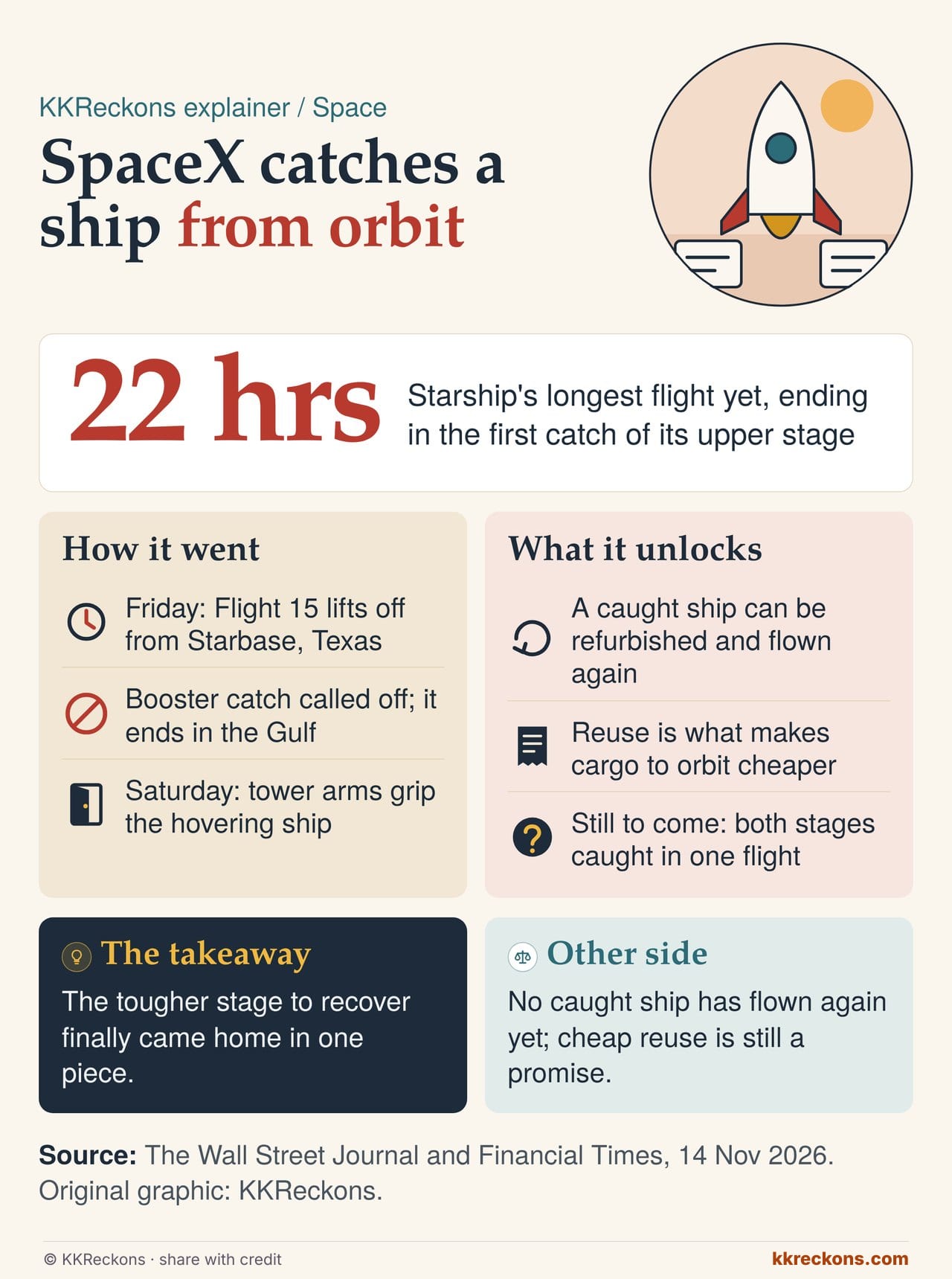
SpaceX caught Starship's upper stage with its launch tower's arms on Saturday, the first time the ship has been recovered after a trip to orbit, the WSJ and FT report.
The flight lasted about 22 hours and released 26 more Starlink satellites. The booster's catch was called off minutes after launch: the WSJ ties it to a fuel alarm, and the FT reports it flipped and exploded in the Gulf of Mexico.
Musk congratulated the team on X. A recovered ship can be refurbished and flown again, which is the point of the programme.
22 hrs
Longest Starship flight
Why it matters Reuse is what turns a rocket into a cargo service. If both stages can be caught and flown again, launching satellites, and Musk's plans for data centres in space, gets much cheaper.
Other side A catch is not yet reuse. No recovered ship has flown again, the booster was lost this time, and the FT notes Starship still needs major changes before it can fly like an aircraft. It has cost billions so far, with a mixed record.